Ministry of Electronics & IT
AI Resources Must Be Directed Towards Clearly Defined Public-Interest Outcomes, Say Experts at India AI Impact Summit 2026
Equity, Inclusion and Public Interest to Define the Future Trajectory of AI Transformation
Scaling AI for Consumers and Creators Identified as Key Policy Challenge
Addressing Asia’s Skill Gap Crucial to Harnessing Full Potential of AI
Posted On:
20 FEB 2026 2:42PM by PIB Delhi
The session “Building Public Interest AI: Catalytic Funding for Equitable Access to Compute Resources” at the India AI Impact Summit 2026 marked the launch of the working report on the subject “Opening Up Computational Resources for New AI Futures” by Dr. Saurabh Garg, Secretary, Ministry of Statistics and Programme Implementation. The discussion brought together senior government leaders, philanthropic institutions and global AI experts to examine how catalytic funding, new institutional models and South–South cooperation can make advanced compute accessible and affordable for the Global South.
The conversation highlighted that the question is no longer limited to build data centre capacity, but to ensure that these resources are used to clearly define public-interest outcomes across sectors such as health, education and agriculture. Speakers stressed that demand aggregation, shared infrastructure, skills development and mission-driven governance frameworks will be critical to translate compute access into real-world deployment for startups, researchers and social-sector organisations.
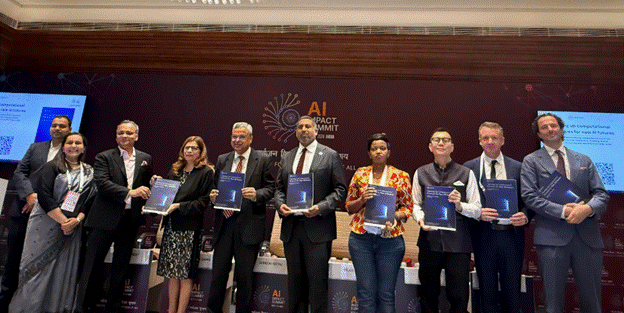
Dr. Saurabh Garg, Secretary, Ministry of Statistics and Programme Implementation, positioned equity at the centre of the global AI transition, stressing that the real measure of progress will be its alignment with public purpose. He said, “We are of the collective opinion that AI will transform the world. The defining question is whether this transformation will be equitable, inclusive, and aligned with the public interest. That is the issue at the heart of the current global conversation.”
Martin Tisné, CEO, AI Collaborative, cautioned against a scenario where capacity creation is not matched by real utilisation, highlighting the risk of a widening gap between infrastructure and impact. He said, “I do have a worry that we could end up in two years’ time in a world where we succeed in having computing capacity in several countries, including in the Global South, but where effectively, the data centres are not used.”
Vilas Dhar, President, Patrick J. McGovern Foundation, underscored the need for new institutional mechanisms to connect policy, capital and deployment at scale, noting that accessibility cannot be left to market forces alone. He said, “Transforming AI into a scalable service for consumers and creators is not just a product challenge; it is a policy challenge. This progress won't happen through the private market alone, nor by asking frontline nonprofits to become developers. Our work over the next 12 months must focus on building the institutions that ‘connect the dots’ and support this transformation at scale.”
Shikoh Gitau, CEO, Qhala, emphasised that compute demand must be anchored in clearly defined development outcomes and supported through cross-country cooperation. She said, “It’s not just about facilitating the GPU. It’s what the GPU is in service of solving for health, education, and agriculture. When you have clear use cases, then the GPU demand becomes an obvious task, and the governance framework to bridge these gaps also becomes clearer.”
Shaun Seow, CEO, Philanthropy Asia Foundation, highlighted demand aggregation, concessional access models and skills development as key levers for expanding access to advanced computing. He said, “When you think about the emergence of new clouds, or GPU as a service, these developments are going to be good for unleashing AI for social impact and economic capture. How do we make it more accessible for startups and impact organisations? You need to think about the ecosystem you're building. The skills gap in Asia is actually huge, and that could be what’s stopping us from really optimising and maximising this power.”
The session outlined a roadmap in which catalytic public and philanthropic capital, shared compute infrastructure and interoperable governance frameworks can together enable AI to function as a global public good.
*****
Mahesh Kumar/ Pawan Faujdar/ Navin Sreejith/ Anil Dutt Sharma
(Release ID: 2230689)
Visitor Counter : 1348