Ministry of Electronics & IT
Breaking Barriers: Multilingual AI as a Bridge to Democratic Access
Personal, Local, Multilingual: A New Vision for Democratic AI Emerges in New Delhi
AI at the Edge: Privacy-Preserving Multilingual Device Showcased at India AI Impact Summit 2026
Global Leaders Call for Culturally Grounded, Citizen-Focused Artificial Intelligence
Multilingual AI Powers Inclusive Digital Futures like BHASHINI
Posted On:
20 FEB 2026 7:57PM by PIB Delhi
At the India AI Impact Summit 2026, the session “Making AI for everyone: The case for personal, local, multilingual AI” showcased how language technologies, open infrastructure, and global partnerships can expand AI access to every citizen, regardless of connectivity, literacy, or linguistic background.
The session opened with a live demonstration by Current AI and Bhashini, presenting a handheld, privacy-preserving multilingual AI device capable of running locally with minimal or zero connectivity. The demonstration illustrated how speech recognition, translation, and vision models can operate together at the edge, enabling users to interact with AI in their native languages while maintaining data privacy. The showcase underscored how interoperable, offline-capable systems can bring AI to the last mile, from rural communities to low-connectivity environments.
In a fireside conversation focused on culturally grounded, citizen-centric AI, featuring Shri Abhishek Singh, Additional Secretary, Ministry of Electronics & Information Technology and Anne Bouverot, Special Envoy for Artificial Intelligence, Government of France.
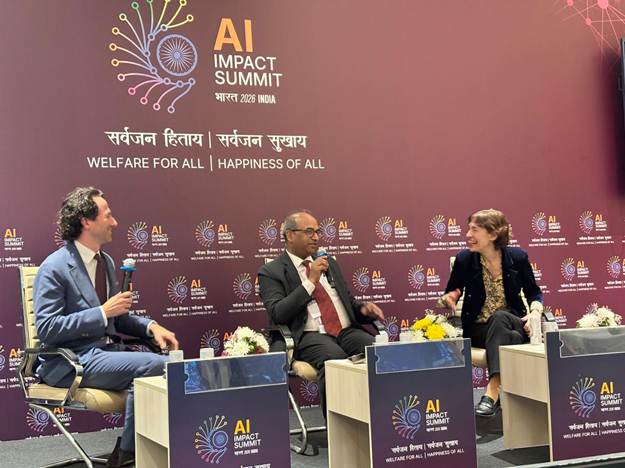
Shri Abhishek Singh emphasized outcome-driven innovation: “When we look at technology… the ultimate objective is not the models, hardware, GPUs, or data platforms; the ultimate objective is what value it creates for citizens and for businesses.” He underscored that AI becomes transformative “when even a person without internet access or digital literacy can simply speak to a device in their own language and receive meaningful responses.” Stressing contextual relevance, he added that traditional and community knowledge must become part of AI training datasets, supported by data-sharing frameworks that balance public interest, privacy, and fairness.
Anne Bouverot reinforced the importance of cultural representation in AI systems. “AI should not reduce the world into a few dominant cultural models,” she said. “When we interact with AI, we should see our own communities and identities reflected.” She called for trusted international frameworks that enable responsible data sharing while protecting creators and preserving public confidence, noting that “no country can build the entire AI stack alone.”
The other fireside chat, moderated by Sushant Kumar of Kalpa Impact, featured Ayah Bdeir, CEO, Current AI and Shri Amitabh Nag, CEO, BHASHINI, who discussed multilingual AI as a foundation for inclusive digital public infrastructure.
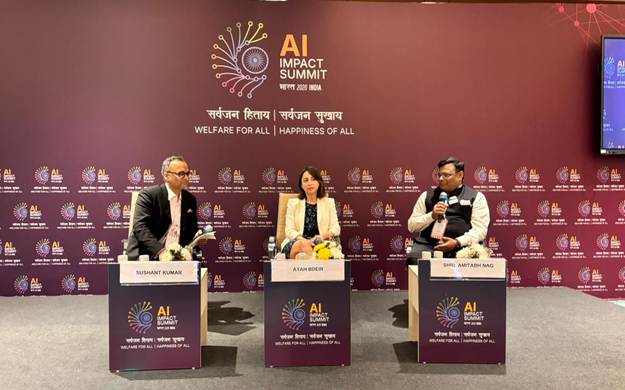
Ayah Bdeir described Current AI as “born out of the AI Summit in Paris as a public-private partnership to create AI for the public interest,” adding that its goal is to “rally a global community to collaboratively build open AI infrastructure that is vertically integrated and released as a public good.” Reflecting on her own experience, she noted, “Technology, if it is not made by us, is not for us,” stressing that linguistic and cultural diversity must be embedded in AI systems from the outset. She also emphasized the importance of transparency and open hardware to prevent lock-in and enable independent community innovation.
Amitabh Nag highlighted how multilingual realities shaped Bhashini’s mission. “All of us grow up with our mother tongue first, and then enter formal systems where multiple languages become necessary,” he said. Addressing the challenge of limited digital data across Indian languages, he noted that extensive dataset collection and domain collaboration were critical to building usable models. “Today, after deployment and continuous learning, we are running nearly 15 million inferences per day,” he shared, adding, “The objective is simple, no language should be left behind, and no citizen should be left behind.”
Together, the session highlighted a shared vision: multilingual, culturally grounded AI, powered by open infrastructure, privacy-preserving design, and international collaboration, can serve as a bridge to democratic access, ensuring that technological progress strengthens diversity rather than erasing it.
*****
Mahesh Kumar/ Pawan Faujdar/ Anil Dutt Sharma
(Release ID: 2230900)
Visitor Counter : 748