Ministry of Fisheries, Animal Husbandry & Dairying
Department of Fisheries, Government of India will organize first‑of‑its‑kind National Conference on Cold water Fisheries in Srinagar
Hon’ble Union Minister FAHD Shri Rajiv Ranjan Singh to release the “Model Guidelines for the Development of Cold-Water Fisheries”
Posted On:
13 MAR 2026 10:40AM by PIB Delhi
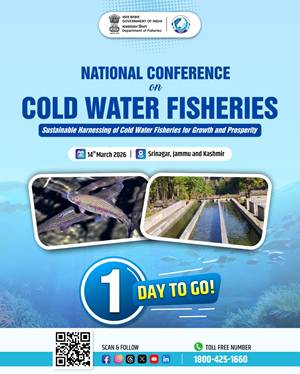
The Department of Fisheries, Government of India, is organizing the National Conference on Cold Water Fisheries at the Sher‑e‑Kashmir International Conference Centre (SKICC), Srinagar, Jammu & Kashmir on 14th March 2026. The event will be held under the guidance of Hon’ble Union Minister Shri Rajiv Ranjan Singh, Ministry of Fisheries, Animal Husbandry & Dairying (MoFAHD) and Panchayati Raj, in the august presence of Shri Manoj Sinha, Hon’ble Lieutenant Governor of Jammu & Kashmir; Shri Omar Abdullah, Hon'ble Chief Minister, Jammu and Kashmir; Prof. S.P. Singh Baghel, Hon’ble MoS, MoFAHD, GoI; Shri George Kurian, Hon’ble MoS, MoFAHD, GoI; and Shri Javid Ahmad Dar, Hon’ble Minister, Agriculture Production Department, Jammu & Kashmir. This will be a first‑of‑its‑kind national dialogue on sustainably harnessing the potential of India’s Cold-Water Fisheries for growth and prosperity.
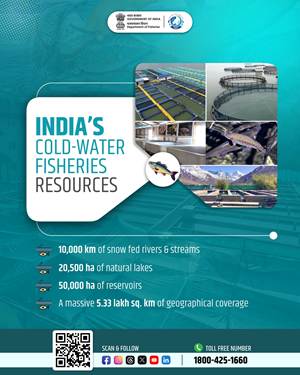
India’s Cold Water fisheries form a unique and valuable segment of the country’s aquaculture landscape, thriving predominantly in the high-altitude regions of the Himalayas, parts of the Northeast, and select zones of the peninsular highlands. It is spread across Jammu & Kashmir, Ladakh, Himachal Pradesh, Uttarakhand, Arunachal Pradesh, Sikkim, and parts of the Western Ghats, North-east and peninsular regions, collectively covering over 5.33 lakh sq. km of mountainous terrain. This vast geography is enriched with pristine rivers, streams, lakes, and reservoirs, offering ideal ecological conditions for the growth and diversification of Cold Water fish species. With more than 278 identified Cold Water fish species, these ecosystems offer immense potential for livelihood generation, nutrition security, scientific aquaculture and biodiversity conservation.
Under the Pradhan Mantri Matsya Sampada Yojana (PMMSY), the Department of Fisheries, Government of India has undertaken major initiatives to strengthen the Cold-Water fisheries segment. A dedicated investment of ₹2,299.56 crore has been sanctioned to Cold Water states to modernize infrastructure, expand hatcheries, enhance seed and feed systems, develop raceway facilities, strengthen transport and cold‑chain networks, and support livelihood‑oriented activities. These interventions are building the foundation for a modern, technology‑driven Cold Water aquaculture ecosystem in India.
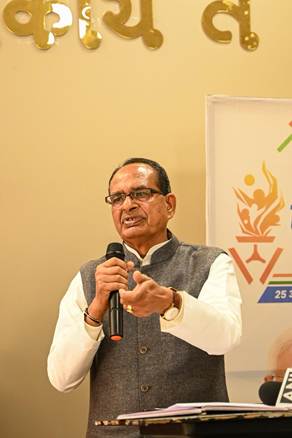
During the Conference, Hon’ble Union Minister FAHD Shri Rajiv Ranjan Singh will release the “Model Guidelines for the Development of Cold Water Fisheries”, distribute scheme benefits to Traditional and Progressive Cold-Water fishers, Fisheries Cooperatives under PM‑MKSSY, and Kisan Credit Card beneficiaries along with awards distribution to the Best FFPOs and Best Fisheries Start‑ups from Jammu & Kashmir. The Technical session will deliberate on key thematic areas including research and innovation, technology adoption, infrastructure expansion, institutional convergence and entrepreneurship development.
The event aims to bring together policymakers, experts, researchers and stakeholders from Jammu & Kashmir, Ladakh, Himachal Pradesh, Uttarakhand, Sikkim, Arunachal Pradesh, Nagaland, Manipur, Meghalaya, Tamil Nadu, Maharashtra, Karnataka and Kerala to explore collaborative pathways for sectoral advancement. By fostering knowledge exchange and aligning national and state priorities, the Conference seeks to accelerate sustainable growth in the Cold Water fisheries sector.
India’s premium Cold Water species such as Rainbow Trout, Brown Trout and Mahseer represent a high-value segment with significant growth potential. Targeted policy interventions have enabled trout production to grow nearly 1.8 times over the past decade. Yet India continues to import Salmon and premium Trout underscoring the need to expand domestic capacity. To address this, the Government of India has laid out the National Vision for Cold Water Fisheries 2030, which aims to double cold water fish production (such as Trout and Mahseer) and generate livelihood opportunities.
In this context, the National Conference serves as a timely and strategic intervention, providing a vital platform for dialogue, partnership and roadmap development to accelerate Cold Water fisheries, enhance sustainable livelihoods and strengthen nutritional security in India’s hilly and remote regions.
Background –
Over the past decade, the Government of India has created a strong investment architecture to support fisheries across the country, including the Cold-Water regions. Beginning with the Blue Revolution scheme and followed by major national programs such as FIDF, PMMSY and PMMKSSY, an investment of over ₹39,272 crore has been envisaged, of which projects worth ₹34,266 crore have already been approved.
Under PMMSY, the Department of Fisheries has approved 5,600 raceways, 54 hatcheries, 5,600 trout rearing units, 293 cold storages, 8,044 transport vehicles and 260 feed mills, these activities are directly benefiting the Cold Water Fish farmers and have significantly improved production and distribution networks across states. Along with these activities, Insurance support to 33.78 lakh fishermen and livelihood and nutritional support to 23.51 lakh families have been provided ensuring social security and resilience among mountain communities
Among the twelve Integrated Aqua Parks (IAP) approved nationally, four IAPs, namely Anantnag in Kashmir, Udham Singh Nagar in Uttarakhand, Ziro in Arunachal Pradesh and Mokokchung in Nagaland, fall under Cold Water fisheries. Notably, the Aqua Parks provide state-of-the-art facilities support fisheries development and ensure end to end connectivity throughout the value chain.
In addition, the Department of Fisheries, Government of India has notified Cold Water fisheries clusters including Jammu and Kashmir with Anantnag as the leading district, Uttarakhand with Pithoragarh as the leading district and Himachal Pradesh with Kullu as the leading district.
In order to strengthen supply chain for inland and high-altitude aquaculture in the future, the Department of Fisheries, GoI is also integrating unmanned aerial vehicles into India’s aquaculture logistics via Drone technology. A pilot has been conducted which demonstrated that drone transport can reduce spoilage, improve access to markets and significantly enhance farmer returns in remote and infrastructure deficient areas where conventional transport is slow or unreliable.
****
JP.
(Release ID: 2239389)
Visitor Counter : 1914