PIB Backgrounder
Infrastructure Financing in India: Trends, Institutions, and Innovations
Posted On:
18 MAR 2026 11:56AM by PIB Delhi
|
Key Takeaways
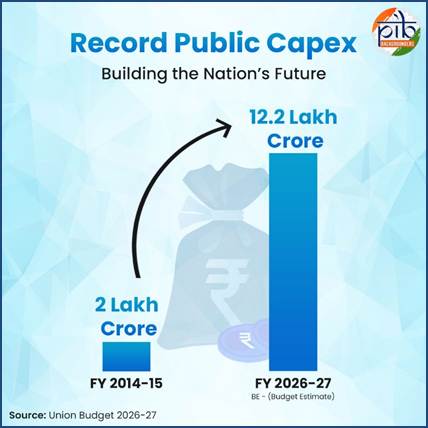
- Public capital expenditure jumped from ₹2 lakh crore in FY 2014–15 to ₹12.2 lakh crore (BE) in FY2026–27.
- The Union Budget 2026–27 has introduced new measures such as the Infrastructure Risk Guarantee Fund and City Economic Regions (CERs), reinforcing infrastructure-led growth and balanced urban development.
- Institutions like NIIF and NaBFID have mobilised billions in global and domestic capital, strengthening governance and long-term financing flows.
- Asset monetisation through InvITs and REITs has unlocked over ₹1.5 lakh crore, recycling funds into new projects and attracting global investors.
|
Introduction
Infrastructure is the backbone of India’s economic growth and social development, shaping opportunities for industry, employment, and improved quality of life. Infrastructure financing is vital because it ensures a steady flow of funds for large projects, reducing dependence on government budgets alone. It helps attract private investment, spread risks, and accelerate project delivery, while aligning infrastructure growth with long-term national goals of sustainability, competitiveness, and inclusive development. Over the past decade, India has consistently prioritized large-scale investment in infrastructure as a driver of inclusive progress and competitiveness, with the World Bank ranking it among the top five countries worldwide for Job creation in infrastructure among low and middle-income economies.
The Union Budget 2026–27 continues this momentum, announcing new measures to strengthen financing instruments, expand public capital expenditure, and support risk mitigation and asset monetisation. These initiatives reflect the vision of Viksit Bharat, where modern infrastructure serves as its foundation.
Rising Public Capex, Stronger Infrastructure Push
Public Capital expenditure refers to government spending on the creation of assets such as roads, buildings, machinery, and equipment, with a high multiplier effect on economic growth.
Over the past decade, public capital expenditure has been the driving force of India’s infrastructure push. The Government has steadily raised allocations, using higher spending as a tool to attract private investment, generate employment, and boost the economy.
- Rising Capex Levels: Public investment has seen a sharp rise, growing from ₹2 lakh crore in FY2014–15 to a Budget Estimate of ₹12.2 lakh crore in 2026–27, continuing its upward trajectory and underscoring the Government’s commitment to infrastructure-led growth.
v Why Higher Capex Matters
- Crowding in private investment: Large-scale government spending builds investor confidence and encourages private participation in infrastructure projects.
- Job creation: Construction of roads, railways, housing, and energy projects generates employment across multiple sectors.
- Boosting demand: Higher capex stimulates demand for steel, cement, machinery, and services, strengthening industrial output and overall economic activity.
- Focus on Tier II and Tier III Cities: The Union Budget 2026-27 places emphasis on developing cities with populations above 5 lakh, positioning them as new growth centres. Investments in housing, transport, and urban infrastructure aim to spread growth beyond metropolitan areas, ensuring balanced regional development.
Further to amplify the potential of urban centres, the Union Budget 2026-27 introduces the concept of City Economic Regions (CERs), mapped according to their specific growth drivers. An allocation of ₹5,000 crore per CER over five years has been proposed, to be implemented through a challenge mode with a reform-and-results-based financing mechanism.
Debt Market Reforms Driving Long-Term Financing
The debt market plays a crucial role in infrastructure financing by enabling governments, companies, and institutions to raise long-term funds through bonds and similar instruments. Investors buy these bonds, providing capital for projects and earning fixed interest in return. Unlike other financing channels that mobilize equity, blended finance, or institutional capital, debt market financing is purely borrowing-based and relies on repayment obligations. The Government has been working to make India’s debt markets stronger and more effective for long-term infrastructure financing through the following measures:
- Inclusive Access: Incentives in public debt issues for women, senior citizens, armed forces personnel, and retail investors.
- Simplified Compliance: Easier rules for issuers, including rationalised norms for large listed entities and digital annual reports.
- Transparency & Efficiency: Refinement of the Electronic Book Provider (EBP) framework for better private placements. An Electronic Book Provider (EBP) is a platform mandated by the Securities and Exchange Board of India (SEBI) for the issuance of debt securities through private placement.
- ESG Financing: Frameworks for Environmental, Social, and Governance (ESG) debt securities such as green, social, sustainability, and sustainability-linked bonds.
- Asset Monetisation: Streamlined norms to strengthen Infrastructure Investment Trusts (InvITs) for recycling capital and financing new projects.
India’s Infrastructure Financing Ecosystem
India’s infrastructure financing has undergone a major transformation over the past decade, shifting from reliance on budgetary support to a blended model of public and private capital. According to the World Bank, India has emerged as the largest recipient of Private Participation in Infrastructure (PPI) investment in South Asia, accounting for over 90% of the region’s total. Institutions like the National Investment and Infrastructure Fund (NIIF) and the National Bank for Financing Infrastructure and Development (NaBFID) have emerged as pivotal anchors, mobilising global and domestic capital and providing long-term development finance to strengthen India’s infrastructure ecosystem. Alongside these institutions, instruments such as Infrastructure Investment Trusts (InvITs) and Real Estate Investment Trusts (REITs) have enabled monetisation of completed assets and recycling of funds into new projects.
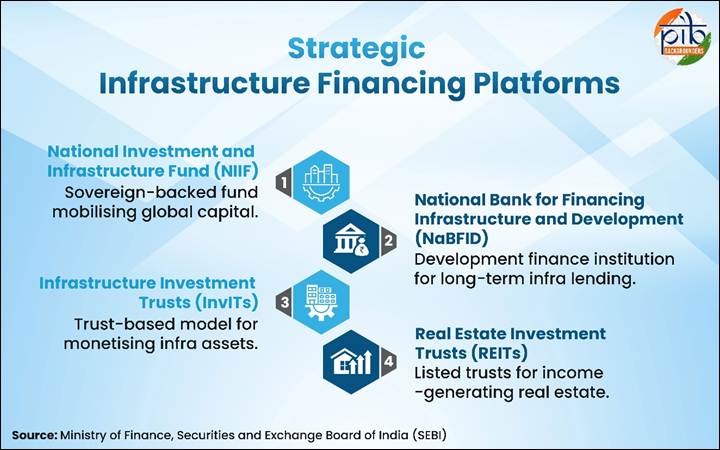
- Institutional Anchors of India's Infrastructure Financing: India’s infrastructure financing landscape is supported by specialized funds and institutions that channel capital, strengthen project pipelines, and enable sustainable growth across key sectors.
- National Investment and Infrastructure Fund (NIIF): The National Investment and Infrastructure Fund (NIIF), founded in 2015 and anchored by the Government of India, raises capital from global and domestic institutional investors. It focuses on building a diversified portfolio with risk-adjusted returns by investing in operational assets and projects under construction. NIIF creates scalable platforms in transportation, energy, and digital infrastructure, either through its own management teams or by partnering with experienced operators. Its strong governance and market expertise make it a trusted partner for institutional investors in India’s infrastructure sector. Today, it manages USD 4.9 billion in Assets Under Management (AUM) across its funds.
- Partnerships and Fund Structure: Over the years, the National Investment and Infrastructure Fund (NIIF) has evolved into a sovereign-linked asset manager, building strong partnerships with leading global investors. These include sovereign wealth funds such as Abu Dhabi Investment Authority (ADIA) and Temasek; pension funds like Australian Super, Ontario Teachers’ Pension Plan, and Canada Pension Plan Investment Board (CPPIB); multilateral development banks such as Asian Infrastructure Investment Bank (AIIB), Asian Development Bank (ADB), and New Development Bank (NDB); along with strategic government counterparts like the Japan Bank for International Cooperation (JBIC).
- Master Fund – Focused on infrastructure investments.
- Private Markets Fund – A fund of funds supporting private equity managers.
- India–Japan Fund – Dedicated to climate, sustainability, and bilateral corridor projects.
- Strategic Opportunities Fund – Concentrated on growth equity investments.
Both the Master Fund and Private Markets Fund are fully committed, with Master Fund investments contributing to greenfield assets in ports, logistics, airports, and data centres.
- National Bank for Financing Infrastructure and Development (NaBFID): The National Bank for Financing Infrastructure and Development (NaBFID), established in 2021, is a specialized Development Finance Institution dedicated to strengthening India’s infrastructure sector. It addresses gaps in long-term non-recourse finance, supports bond and derivatives market development, and fosters sustainable economic growth. NaBFID acts as a provider, enabler, and catalyst by offering lending, investment, equity opportunities, and ESG-focused financing across the life cycle of infrastructure projects.
- Sanctions & Disbursements: As of December 2025, it has approved ~₹3.03 lakh crore and disbursed ~₹1.09 lakh crore across core infrastructure and social/commercial sectors.
- Investor Base Expansion: Introduced the Partial Credit Enhancement (PCE) product to attract wider participation in infrastructure, including insurance funds and pension funds. PCE is a support provided by financial institutions to improve the credit rating of the bonds issued by corporates, including their SPVs, NBFCs, and HFCs. It helps these entities get better terms when raising money through bonds. The Institution sanctioned its first PCE facility in February 2026.
- Transaction Advisory: The Institution provides transaction advisory services to build a pipeline of investment-ready Public-Private Partnership (PPP) projects. These include engagements with the Government of J&K (tourism projects for sustainable development of Dal Lake and surrounding areas in Srinagar) and Andhra Pradesh (Development of port and airport projects). The Institution is under active discussions with multiple state Government bodies, including Uttar Pradesh, Tamil Nadu, Assam, Maharashtra, Telangana, and Gujarat.
- Global Capital Mobilisation: In order to facilitate foreign investment in India’s infrastructure, the Institution is in the process of setting up investment arms at GIFT City through a Finance Company, Fund Management Entity and Alternative Investment Fund. The Institution aims to attract private capital into infrastructure financing through equity investments, thus sharing investment risks and aligning interests with private investors.
- Urban Infrastructure Financing: Expanded support, including ₹520 crore investment in municipal bonds.
- Partnerships & State Engagement: Strengthened Multilateral Development Banks (MDB) collaborations and worked with State Governments on asset monetisation, acting as anchor investor in proposed InvITs.
- Signed MoU with International Finance Corporation (IFC) in June 2023 to jointly offer Transaction Advisory Services focused on Public Private Partnership (PPP) projects.
- Signed Letter of Intent (LoI) with Asian Development Bank (ADB) in December 2024, to promote climate resilience and sustainable urban & rural Infrastructure in India.
- Signed LoI with Foreign Commonwealth & Development Office in February 2025 to explore opportunities for financing of climate positive infrastructure projects, development of financial instruments and capacity building.
- Signed MoU with New Development Bank (NDB) in April 2025 to help bridge the infrastructure financing gap in the country and explore long-term collaboration opportunities, including the exchange of technical expertise, joint participation in infrastructure investments through credit lines, guarantees, co-financing and technical cooperation schemes.
- Signed LoI with Asian Infrastructure Investment Bank (AIIB) in June 2025 to foster joint efforts to develop sustainable infrastructure in India, with a strong emphasis on climate adaptation and mitigation.
- Signed LoI with Climate Bonds Initiative in June 2025 to provide technical advisory for green financing.
- Signed LoI with KfW IPEX Bank in December 2025 for establishing a framework for collaboration in assessing, structuring, and co-financing infrastructure projects across India.
Strengthening Rail Infrastructure through IRFC
Railways form the backbone of India’s infrastructure, driving connectivity, trade, and economic growth. To support this vast network, the Indian Railway Finance Corporation (IRFC) serves as the dedicated financing arm, mobilising resources and strengthening the financial foundation of Indian Railways.
- Established in 1986 as the exclusive financing arm of Indian Railways.
- Raises funds from domestic and international markets to meet Extra Budgetary Resource needs.
- Operates on a leasing model, financing assets that are leased back to Indian Railways.
- Has financed 13,764 locomotives, 76,735 passenger coaches, and 2,65,815 wagons, covering nearly 75% of the rolling stock fleet.
|
- InvITs & REITs: India’s financial ecosystem has introduced innovative market structures that pool investor resources, broaden access to large-scale projects, and create diversified avenues for long-term growth in infrastructure and real estate.
- Infrastructure Investment Trusts (InvITs): Introduced by the Securities and Exchange Board of India (SEBI) in 2014, InvITs are special funds that let investors invest in big infrastructure projects. Earlier, only large institutions could access such opportunities, but InvITs open them up to ordinary investors as well. By pooling money, they create a diversified portfolio of projects that can generate steady income and long-term growth. At the same time, they allow infrastructure developers to tap into household savings, helping finance essential projects.
- The first Public InvIT is planned for launch in 2026, following cumulative monetisation of ₹1.52 lakh crore through Toll-Operate-Transfer (ToT) and private InvITs.
- Financing in Road Infrastructure: These specialised trusts are enabling large-scale monetisation and reliable financing in India’s highways sector.
- The National Highways Infra Trust (NHIT), set up by the National Highways Authority of India (NHAI) in 2020, concluded its fourth fundraising round at an enterprise value of ₹18,380 crore - the largest monetisation transaction in India’s road sector. Across four rounds, NHIT has realised over ₹46,000 crore.
- In January 2026, NHAI-sponsored Raajmarg Infra Investment Trust (RIIT) received a AAA (Stable) rating from CARE Ratings Limited, highlighting the safety and reliability of its debt instruments.
- In September 2020, the Government approved monetisation of POWERGRID’s assets through the InvIT model, the first such initiative in the power sector with proceeds channelled into new and under-construction projects.
InvITs have thus emerged as a trusted instrument for utilising long-term capital, attracting global investors, and strengthening India’s infrastructure financing ecosystem.
2. Real Estate Investment Trusts (REITs): Real Estate Investment Trusts (REITs), regulated by the Securities and Exchange Board of India (SEBI), allow investors to participate in income-generating real estate through small investments. Their units are listed on stock exchanges, offering transparency, liquidity, and diversification. Further, the Union Budget 2026-27 has announced the creation of dedicated REITs for Central Public Sector Enterprises (CPSEs) to accelerate monetisation of government-owned real estate assets.
- Structure: Tripartite model with a sponsor, management company, and trust that owns properties on behalf of investors.
- Income Sources: Rental income from real estate assets and capital gains from property sales.
- Low Entry Cost: Enables investment with small ticket sizes compared to physical real estate.
- Liquidity & Divisibility: Units can be traded on stock exchanges, allowing partial exits unlike whole property sales.
- Diversification: Provides exposure to multiple properties across locations, reducing concentration risk.
ü Transparency: Regular disclosure of Net Asset Value (NAV) ensures clarity on investments.
Infrastructure Risk Guarantee Fund – Securing Finance, Delivering Projects
Infrastructure projects often face challenges such as early-stage project construction & development risks, , delays, and uncertainty in execution. To address these issues, the Government introduced the Infrastructure Risk Guarantee Fund in the Union Budget 2026-27 to strengthen investor confidence and ensure the timely delivery of projects. This fund will provide wide of partial guarantees to lenders, reducing default risks for private developers and making financing more secure.
- Crowd-in private capital: This mechanism will enable the crowding in of private capital and enable higher private sector participation in large-scale infrastructure projects.
- Ensuring Timely Completion: By covering financing gaps, the fund will help prevent delays and ensure projects are completed on schedule.
- Building Confidence: This measure reassures both domestic and global investors, aligning with the broader objectives of the National Infrastructure Pipeline (NIP) and the vision of Viksit Bharat.
Conclusion
India’s infrastructure financing journey reflects a decisive shift towards scale, innovation, and resilience. By blending public investment with institutional strength and modern instruments, the country is building a robust foundation for inclusive growth. The strategy not only secures capital flows but also ensures sustainability, competitiveness, and confidence in India’s long-term development trajectory.
References:
Ministry of Finance:
https://www.indiabudget.gov.in/
https://www.indiabudget.gov.in/economicsurvey/
https://www.pib.gov.in/PressReleseDetailm.aspx?PRID=2135239®=3&lang=2#:~:text=The%20GC%20appreciated%20NIIF's%20evolution,equity%20(Strategic%20Opportunities%20Fund)
https://www.pib.gov.in/PressReleasePage.aspx?PRID=2219991®=3&lang=2
https://sansad.in/getFile/loksabhaquestions/annex/187/AU413_G5UG75.pdf?source=pqals
https://financialservices.gov.in/beta/sites/default/files/2025-02/Budget.pdf
Ministry of Railways:
https://indianrailways.gov.in/railwayboard/uploads/directorate/ele_engg/2025/Status%20of%20Railway%C2%A0Electrification%20as%20on%C2%A030_11_2025.pdf
Ministry of Road, Transport & Highways:
https://www.pib.gov.in/PressReleasePage.aspx?PRID=2115309®=3&lang=2#:~:text=National%20Highways%20Infra%20Trust%20(NHIT,131.94%20per%20unit.
https://www.pib.gov.in/PressReleasePage.aspx?PRID=2210839®=3&lang=1
Cabinet Committee on Economic Affairs (CCEA):
https://www.pib.gov.in/PressReleaseIframePage.aspx?PRID=1652428®=3&lang=2
Indian Railway Finance Corporation:
https://irfc.co.in/
National Investment & Infrastructure Fund (NIIF):
https://niifindia.in/
National Bank for Financing Infrastructure and Development (NaBFID):
https://nabfid.org/
Securities and Exchange Board of India:
https://investor.sebi.gov.in/understanding_reit_invit.html#:~:text=The%20structure%20the%20REITs%20is,management%20company%20and%20the%20trustees
https://www.sebi.gov.in/sebi_data/faqfiles/jan-2023/1674793029919.pdf?utm_source=copilot.com
https://www.sebi.gov.in/sebi_data/meetingfiles/nov-2017/1509521834318_1.pdf
National Institute of Securities Markets (NISM):
https://www.nism.ac.in/understanding-reits/
India Infrastructure Finance Company Limited (IIFCL):
https://iifcl.in/SIFTI
Click here for pdf file.
****
PIB Research
(Release ID: 2241612)
Visitor Counter : 9862