Ministry of Science & Technology
Probes into long-standing solar mystery can help predict weather forecasting
Posted On:
27 MAR 2026 3:07PM by PIB Delhi
Researchers delving into solar coronal shocks triggered by solar flares have cracked a long-standing puzzle about the reason behind the strange variation in the relative strengths of radio waves called fundamental (base note of the wave) and harmonic emissions (overtone) for different bursts.
The study improves scientists’ understanding of how solar shocks generate radio waves and how those waves travel through the corona and can help predict weather forecasting.
Solar coronal shocks triggered by solar flares or coronal mass ejections produce radio emission of a particular kind, known as type II solar radio bursts. These bursts, also called slow-drifting bursts, typically drift at speeds of about 1000 km/s and are detected in the radio waveband.
Type II solar bursts are identified based on characteristics such as drift rate, spectral index and various other plasma parameters and they slowly drift from high to low radio frequencies as the shock moves outward.
Type II bursts usually appear in two parts -- fundamental emission and harmonic emission. Theoretically, the fundamental emission is expected to be stronger than the harmonic. However, observations show that in some cases the harmonic can be stronger than the fundamental.
A team led by astronomers from the Indian Institute of Astrophysics (IIA), an autonomous institution of the Department of Science and Technology (DST), addressed the question that intrigued scientists -- why the relative strengths of the fundamental and harmonic emissions vary for different bursts.
They analyzed data from Compound Astronomical Low Frequency Low Cost Instrument for Spectroscopy and Transportable Observatory (CALLISTO) instruments located around the globe to investigate the puzzle by tracing the origin and characteristics of 58 type II solar radio bursts. This provided new insights into the mystery.
For the process, they utilised the data obtained using Gauribidanur Low Frequency Solar Spectrograph (GLOSS) from Gauribidanur Radio Observatory, operated by IIA.
“Our study finds that events originating from active regions located at heliographic, or solar, longitudes greater than 75° tend to show stronger harmonic emissions. In contrast, events originating closer to the solar disk center (heliographic longitudes less than 75°) exhibit stronger fundamental emissions. Such behaviour is attributed to the refractive effects in the solar corona, directivity and viewing angle of the solar radio emissions. Because of these effects, events associated with active regions greater than 75°, cannot reach the Earth and thus appears either missing or weaker. However, harmonics have broader cone angles and thus stronger emission can reach the Earth”, said. K. Sasikumar Raja, the P.I. of the study.
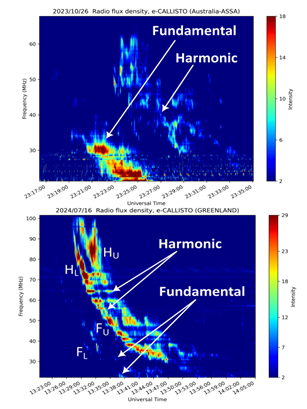
Fig: Top: a Type II burst on 26/10/2023 where the fundamental is stronger than the harmonic, and bottom: a burst on 16/7/2024 where the opposite can be seen.
“CALLISTO and other spectrometers around the globe have collected huge amounts of data. Such data plays a tremendous role in understanding various puzzles like the ones mentioned. We would like to adopt machine learning techniques to probe such data further” said Rishikesh G. Jha, the first author and a student at IIA.
This work was published in the journal Solar Physics, authored by Rishikesh G. Jha, K. Sasikumar Raja, R. Ramesh, and C. Kathiravan from the Indian Institute of Astrophysics, along with Christian Monstein from Istituto ricerche solari Aldo e Cele Daccò (IRSOL), Università della Svizzera italiana, Locarno, Switzerland.
*****
NKR/FT
(Release ID: 2245998)
Visitor Counter : 703