Ministry of Science & Technology
Scientists harness the second life of a spent battery material
Posted On:
30 MAR 2026 3:37PM by PIB Delhi
A new technology for the reuse of spent graphite recovered from end-of-life lithium-ion batteries could convert battery waste into a high-value functional material that improves fuel cell efficiency.
With the rapid growth of lithium-ion batteries and fuel cell technologies, managing battery waste and the need for cost-effective, durable fuel cell catalysts are critical challenges.
Scientists have been exploring whether recycled battery materials could be repurposed to address key performance limitations in fuel cells, and they have zeroed in on graphite, a functional additive in platinum-based oxygen reduction reaction (ORR) electrocatalysts.
Researchers from International Advanced Research Centre for Powder Metallurgy and New Materials (ARCI), an autonomous institute of the Department of Science and Technology (DST), recovered graphite from spent lithium-ion batteries and chemically exfoliated it to increase surface area and the number of edge functional groups. They also carried out extensive physicochemical characterization, electrochemical evaluation for ORR and methanol tolerance, optimization of composition for maximum performance and stability. The research published in the journal ACS Sustainable Resource Management.
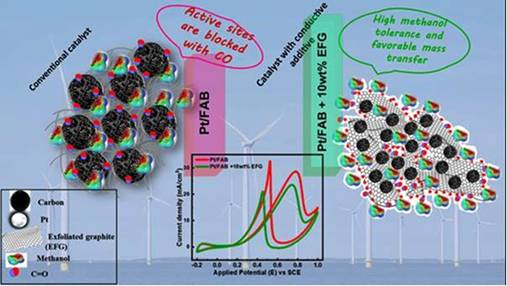
Fig: Graphical illustration of the Pt–exfoliated graphite catalyst, with exfoliated graphite forming a conductive network that suppresses methanol crossover and CO poisoning, leading to improved oxygen reduction performance and durability
Unlike earlier studies focused solely on alkaline media or on battery reuse, this work demonstrates methanol-tolerant ORR in acidic media using recycled graphite.
When integrated with platinum catalysts, the exfoliated graphite formed a conductive network that enhanced both electronic conductivity and oxygen transport while selectively adsorbing methanol molecules. This also acted as a chemical barrier that suppressed methanol oxidation and platinum CO poisoning. An optimum composition of 10 wt % exfoliated graphite was identified, offering superior performance and durability.
This prevents methanol oxidation and CO poisoning of platinum under acidic conditions relevant to Direct Methanol Fuel Cell operation, thereby improving ORR performance and long-term stability. As a result, methanol tolerance improves and electrocatalytic performance enhances while protecting platinum from carbon monoxide (CO) poisoning.
This would help promote sustainable recycling of lithium-ion batteries, reduces reliance on costly catalyst materials, enhances clean energy technologies, supports fuel cell commercialization, and contributes to reduced environmental impact and improved energy security.
*****
NKR/FT
(Release ID: 2246858)
Visitor Counter : 939