Ministry of Science & Technology
Scientists from RRI investigate rare bursts of energy from mysterious space objects
Posted On:
30 MAR 2026 3:38PM by PIB Delhi
Astronomers from the Raman Research Institute (RRI) probed a rare signal from a bright X-ray source, which is repeating — though not at a neat, fixed rate — to reveal that its wobbling accretion disk may be leading to interesting physics.
Ultraluminous X-ray sources (ULXs) feature a compact object — which includes the universe’s most dense and extreme objects, such as black holes and neutron stars — pulling in or accreting material from a companion star. Such systems are called accreting binary systems.
Any celestial object has a cap on how bright it can shine. This limit, called the Eddington limit, depends mainly on the object’s mass. ULXs gobble material so fast that they become more luminous than the critical Eddington limit, sometimes by over 100 times. The exact physical processes that enable ULXs to shine so brightly are a hotly debated topic of research.
Aman Upadhyay, PhD student in the Astronomy and Astrophysics division at RRI, and colleagues, used observations from NASA’s Chandra X-ray Observatory and XMM-Newton— ESA’s X-ray space observatory, taken between 2001 and 2021 to analyze a ULX in the spiral galaxy M74, called ULX M74 X-1, and reported the results in a paper published in The Astrophysical Journal. This ULX was in the news around 2005 when another group reported seeing rare bursts of energy from this object which scientists call flares. When a ULX ‘flares’, its luminosity or brightness varies considerably within a short time span — approximately half an hour for this ULX. The flares exhibited a repeating pattern, although not at a neat, fixed rate. Upadhyay’s work centered around analyzing flaring and non-flaring data from this peculiar source.
The researchers began by studying the source’s flaring spectrum. A spectrum shows the distribution of intensity obtained from the source across energy. They noticed a bump in the graph around one kilo-electronvolt (keV). keV is the unit astronomers use to measure the energy of X-ray sources. Astronomers have observed the one keV feature in other ULXs in the past. It indicates the presence of wind in the system, generated as the pressure from radiation of the extremely bright object peels layers off the inner regions of the accretion disk.
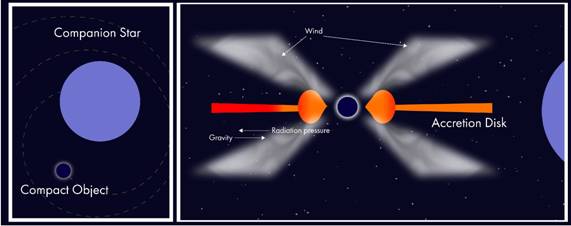
Fig 1. The physical systems around a compact object in an accreting binary system
Barring a funnel-shaped region around the rotation axis of the accretion disk, the wind blown off from the object exists all around it. How big this funnel is, devoid of wind, depends on how fast the object is gorging on the gas and dust around it. When the Chandra telescope views the accretion disk top-down through the funnel, it sees the system at a low inclination angle. In contrast, when Chandra views the system at a high inclination angle, it observes the accretion disk edge-on through the wind, as indicated by the one keV bump in the flaring spectrum.
But the non-flaring spectrum told a different tale. The count of high-energy photons in the non-flaring spectrum was eight times the low-energy count. These high-energy photons could only be emanating from the central, most luminous part of the accretion disk, devoid of the energy-sapping wind. This means Chandra was seeing the system from a low inclination angle.
Playing hide-and-seek with the wind
So, what’s going on? While the flaring spectrum told the researchers that Chandra was seeing the source at a high inclination angle, the non-flaring spectrum told quite an opposite tale. “While there could be several reasons for this happening, one mechanism we’re proposing is the wobbling of the accretion disk,” says Prof. Vikram Rana, co-author of the paper and Upadhyay’s PhD supervisor.
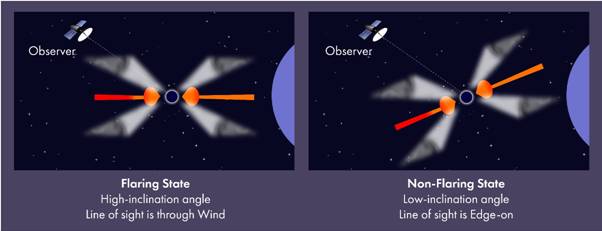
Fig 2. Wobbling of the compact object causes differences in observations from Line of Sight
A spinning top not only spins, but also wobbles around its rotational axis. As the accretion disk wobbles like a spinning top, the wind moves into and out of Chandra’s line of sight, which leads to the source’s brightness decreasing and increasing at not-so-regular intervals. This could explain the not-so-regular flares seen from this source.
It’s a stellar mass black hole!
Earlier studies fitted the models to observations of X-ray sources with normal luminosity and, based on the low accretion disk temperature, concluded that the compact object is an elusive intermediate-mass black hole. However, Upadhyay and colleagues used newer, updated spectral models to fit a double disk blackbody to their observations. “A double disk model doesn’t mean there are two accretion disks,” explains Upadhyay. “It has a single accretion disk with at least two temperature zones.”
The first zone, away from the ultraluminous source, is cooler and accretes within limits. But to explain the physics near the source, Upadhyay assumed super-Eddington accretion, meaning accretion faster than the Eddington limit. The team calculated the accretion disk’s inner radius using this model, from which the object mass came out to be seven times the Sun’s mass. “This place it in the category of stellar mass black holes,” says Upadhyay.
What’s interesting is that their observations match those of neutron star ULXs, suggesting that the compact object could be a neutron star instead of a stellar mass black hole. If validated, the study will shed new light on the true nature of the compact object powering the central engine in ULX M74 X-1.
“In the future, we plan to employ more advanced techniques to search for pulsations from this source. … Identifying pulsations would confirm the presence of a neutron star,” says Upadhyay.
*****
NKR/FT
(Release ID: 2246859)
Visitor Counter : 664