PIB Backgrounder
Yuva Sangam
Experiencing India Through Youth Exchange
Posted On:
04 APR 2026 10:59AM by PIB Delhi
|
Key Takeaways
|
- Registrations for institution-led exposure tours across paired regions under Yuva Sangam Phase-VI held from March 2 – 25, covering 22 States/UTs.
- Since 2023, the programme has scaled across phases, covering 20+ States/UTs and engaging thousands of youths through 5–7-day exchange tours.
- Aligned with NEP 2020, it promotes experiential learning by linking classroom knowledge with real-world exposure across regions.
|
Connecting Youth Through the Spirit of Ek Bharat Shreshtha Bharat
India is experienced, not just studied. To truly understand our nation, is to engage directly with its people, its landscape, and its rich tapestry of traditions. Yuva Sangam opens that window for young Indians. The programme operationalises experiential learning and national integration as complementary pillars of youth development.
Launched under the Government of India’s Ek Bharat Shreshtha Bharat (EBSB) initiative, Yuva Sangam is a youth exchange programme that brings young people from different parts of the country together. It is designed for those aged 18–30 years, including students, National Service Scheme and Nehru Yuva Kendra Sangathan volunteers, and young professionals. Anchored by the Ministry of Education and implemented through Higher Education Institutions, it creates a structured platform for youth engagement across regions[1].
|
Ek Bharat Shreshtha Bharat – The Idea Behind the Exchange[2]
Launched on 31st October 2015, on the occasion of Rashtriya Ekta Diwas to commemorate the birth anniversary of Sardar Vallabhbhai Patel, Ek Bharat Shreshtha Bharat (EBSB) was envisioned to strengthen national unity by deepening connections between States and Union Territories. It recognises that India’s diversity is best understood not in theory, but through shared experience.
At its core, EBSB creates a structured framework where States and Union Territories are paired with each other for sustained engagement across language learning, culture, traditions & music, tourism & cuisine, sports and sharing of best practices, etc.
What sets the programme apart is its continuity. It goes beyond one-time events and builds long-term, year-round engagement between regions, enabling people to interact, learn and collaborate over time.
The programme follows a whole-of-government approach, involving multiple ministries and institutions. This ensures that engagement happens at multiple levels, from classrooms and campuses to communities and cultural spaces.
In essence, EBSB creates a national learning ecosystem. It allows people to experience India beyond their immediate surroundings. Initiatives like Yuva Sangam build on this vision, turning the idea of “One India” into a lived and shared reality.
|
Participants travel to paired States and Union Territories for structured tours. They step into new cultural settings, hear unfamiliar languages, share meals, ideas and experiences with people from different backgrounds. They visit institutions, development projects and innovation centres. Through these interactions, they begin to understand how different regions contribute to a shared national journey.
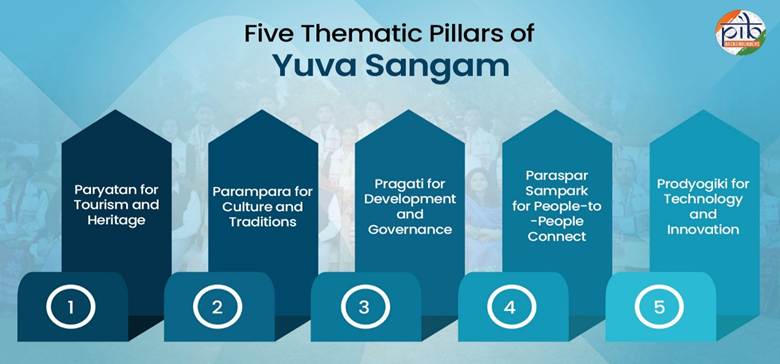
The programme is guided by the Five P’s framework[3]:
Yuva Sangam reflects a larger national vision. It supports the experiential learning approach of the National Education Policy 2020, where learning extends beyond classrooms into real-world contexts.
Yuva Sangam Phase-VI (2026): Expanding Youth Participation Across States
The sixth edition of Yuva Sangam is currently open, offering young Indians an opportunity to be part of a structured national exchange. Registrations were held from 2ndMarch 2026 to 25thMarch 2026, marking a defined window for participation this year. [4].
Phase-VI covers 22 States and Union Territories, continuing the model of paired interstate visits. Selected participants will travel to host States/UTs for five to seven-day structured exposure tours, where they engage with local culture, institutions and communities.[5].
The programme is anchored by 22 Higher Education Institutions (HEIs), which serve as nodal centres for implementation. These institutions coordinate with partner institutions in paired regions and work closely with[6]:
- Universities and colleges
- Government institutions and district administrations
- Community organisations and cultural groups
- Innovation hubs, startups and research centres
|
Sender State / UT
|
Nodal Institution
|
Paired State / UT
|
Paired Institution
|
|
Andhra Pradesh
|
IIT Tirupati
|
Maharashtra
|
IISER Pune
|
|
Delhi
|
IIT Delhi
|
Chhattisgarh
|
IIT Bhilai
|
|
Karnataka
|
IIIT Dharwad
|
Rajasthan
|
MNIT Jaipur
|
|
Punjab
|
IIT Ropar
|
Bihar
|
IIT Patna
|
|
J&K and Ladakh
|
IIM Jammu
|
Kerala & Lakshadweep
|
IIM Kozhikode
|
|
Meghalaya
|
IIM Shillong
|
Telangana
|
NIT Warangal
|
|
Madhya Pradesh
|
IIT Indore
|
Jharkhand
|
IIT Dhanbad
|
|
Himachal Pradesh
|
CU Himachal Pradesh
|
Puducherry
|
NIT Puducherry
|
|
Arunachal Pradesh
|
NERIST
|
Uttar Pradesh
|
IIM Lucknow
|
|
Haryana
|
NIT Kurukshetra
|
Tripura
|
NIT Agartala
|
|
Gujarat & UTs
|
IIM Ahmedabad
|
Odisha
|
NIT Rourkela
|
This ensures that participants are not just visiting places, but interacting with systems and institutions that shape development on the ground.
Both UG, PG students and off-campus youth are eligible to apply. Selection is carried out by the nodal Higher Education Institutions, with emphasis on balanced representation across gender, academic disciplines and regions, including rural and remote areas[7].
Participants are expected to be medically fit, maintain discipline, follow group guidelines and respect the cultural sensitivities of the host States/UTs.
Participants explore cultural heritage, engage with local communities, and visit institutions linked to governance, innovation and entrepreneurship. The experience is immersive and interactive. It allows youth to connect what they learn with what they see and experience.
In this sense, Yuva Sangam reflects the approach of the National Education Policy (NEP) 2020, which places strong emphasis on experiential learning and multidisciplinary exposure. It encourages learning beyond classrooms and promotes a deeper understanding of India’s knowledge systems, diversity and development pathways. Programmes like Yuva Sangam translate this vision into practice by creating opportunities for real-world learning across regions.
Programme Journey: Impact and Participation Across Previous Phases
Since its rollout in early 2023, Yuva Sangam has steadily built a footprint across the country. What began as a set of cultural-cum-educational exchanges has, over successive phases, grown into a structured and recurring platform for youth engagement across States and Union Territories.
The initiative has been implemented through a multi-ministerial effort, bringing together sectors such as culture, tourism, education, youth affairs and regional development. This has allowed each tour to go beyond a single theme, offering participants a layered understanding of the host State or UT.
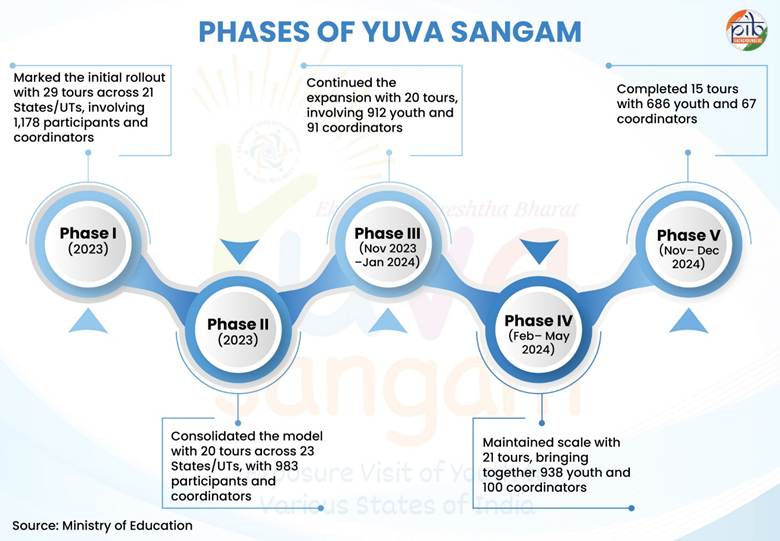
Each phase has added to this expanding network of exchanges:
Phase I (2023): Establishing the Foundation
The journey began with a clear focus—the North Eastern Region. Phase I placed it at the centre of the exchange, enabling youth from across India to spend 5–8 days in North Eastern States, while participants from the region travelled to other parts of the country. This two-way movement ensured that exposure was not one-sided, but shared.
A conscious effort was made to maintain balance, with an approximate 40:60 participation ratio between North Eastern and other youth. Conducted between 20 February and 7 April 2023, the phase saw 29 tours across 21 States/UTs, with 1,178 delegates (1,057 youth and 121 coordinators). With multiple ministries working in coordination—from Education to DoNER—Phase I laid down the operational blueprint for what Yuva Sangam would become.
Phase II (2023): Expanding Reach, Deepening Exposure
With the foundation in place, Phase II expanded both geography and experience. Conducted between 15 April and 25 June 2023, it covered 23 States/UTs through 20 tours, anchored by 20 Higher Education Institutions, and brought together over 900 youth along with 83 faculty and coordinators.
What stood out in this phase was the opportunity for participants to engage beyond the immediate itinerary. Interactions with national and state leadership, including the Hon’ble Prime Minister, Governors and Chief Ministers, added a new dimension. The programme began to move from exposure alone to engagement with institutions and leadership.
Phase III (November 2023 – January 2024): Scaling with Demand
By the time Phase III was announced, interest in the programme had grown significantly. Launched in October 2023, it received close to 30,000 registrations, reflecting strong demand from youth across the country. From this, around 1,000 participants were selected, making the process more competitive and structured.
The phase brought together 20 Higher Education Institutions across 22 States/UTs, with 20 tours conducted, involving 912 youth and 91 coordinators. At this stage, the programme had found its rhythm. The structure was clearer, delivery more consistent, and the experience more refined across regions.
Phase IV (February–May 2024): Momentum and Maturity
Phase IV marked a significant surge in both interest and participation. The registration window (25 January to 4 February 2024) witnessed an overwhelming response, with around 45,000 registrations in just 10 days—a 267% increase compared to Phase I.
The phase was implemented through 22 nodal Higher Education Institutions covering 25 States/UTs, reflecting both scale and deeper institutional integration. In total, 21 tours were conducted, bringing together 938 youth and 100 coordinators, making it one of the most extensive phases of the programme.
By this stage, Yuva Sangam had clearly moved beyond its initial rollout phase. It had emerged as a recognised and high-engagement national platform, combining scale with a consistent and structured learning experience for youth across regions.
Phase V (November–December 2024): Moving towards Continuity
Phase V continued this trajectory, signalling a shift from periodic implementation to a more ongoing national effort. As of 31 December 2024, 15 tours had been completed, with 686 youth and 67 coordinators participating, and more tours planned thereafter.
At this stage, the programme’s structure had stabilised, with consistent institutional participation and growing youth engagement. What began as an initiative had now evolved into a sustained platform for youth interaction across regions.
Across these phases, the numbers tell one part of the story. The more significant shift is in how these exchanges are experienced.
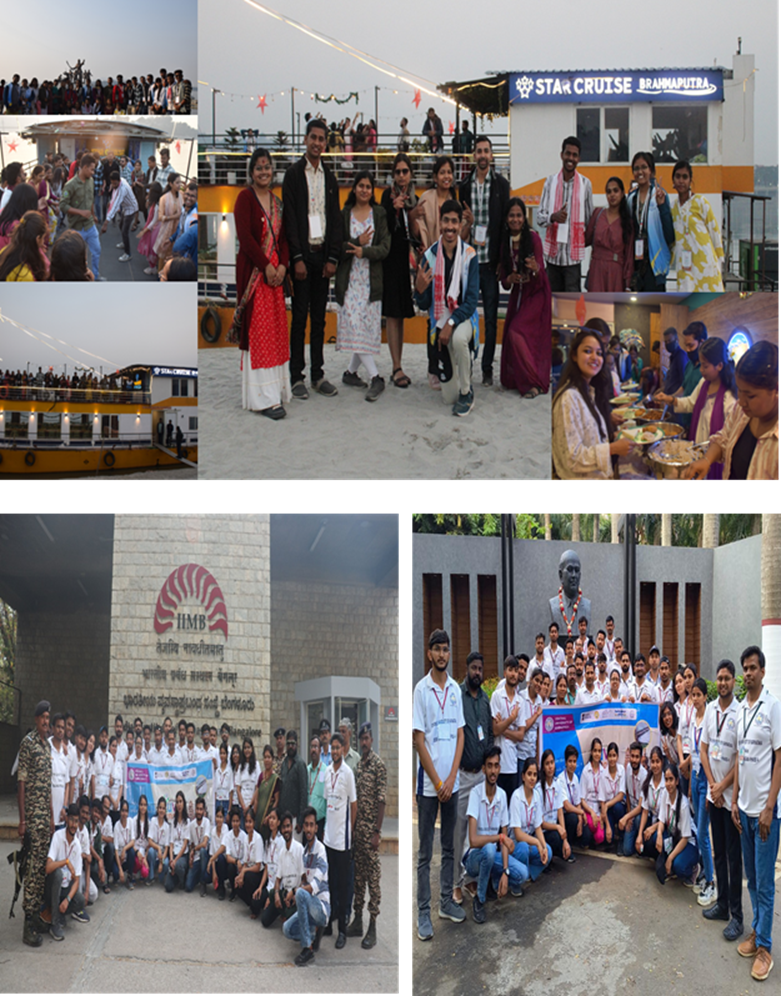
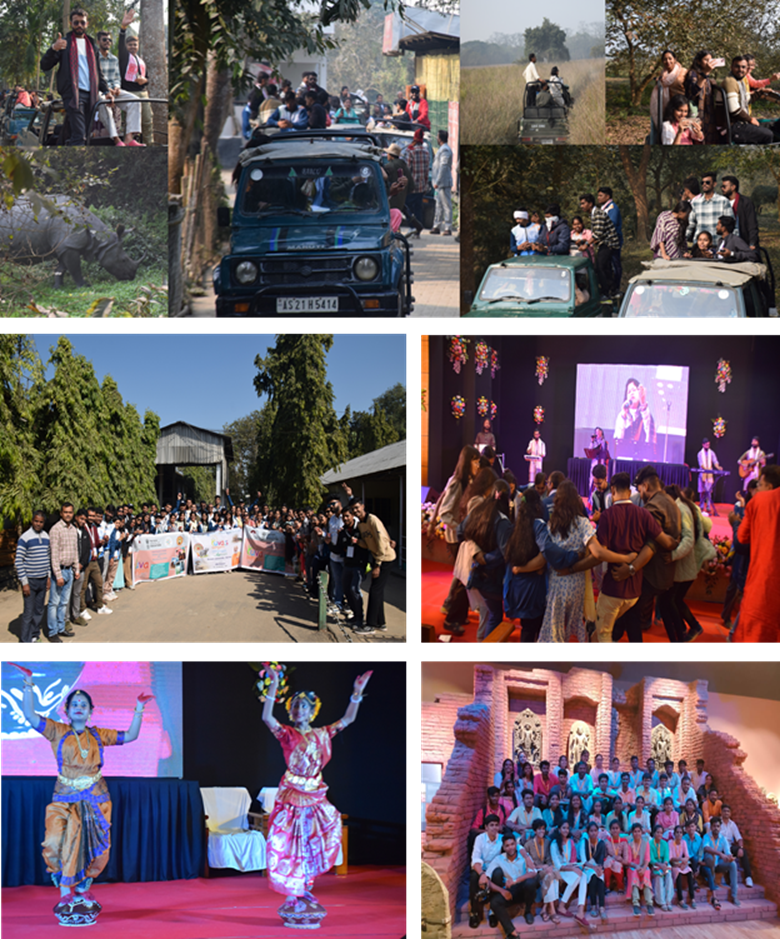
Over time, Yuva Sangam has created a growing network of young participants who have experienced India beyond their own regions. It has also established a model where exposure, mobility and interaction become central to how young people engage with the country.
Voices from Yuva Sangam: Experiences that Stay
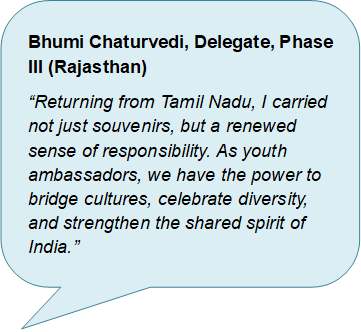
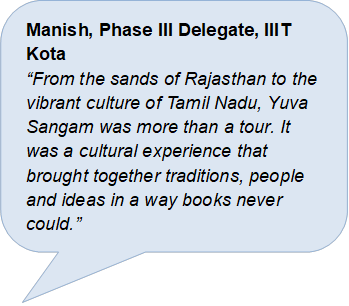
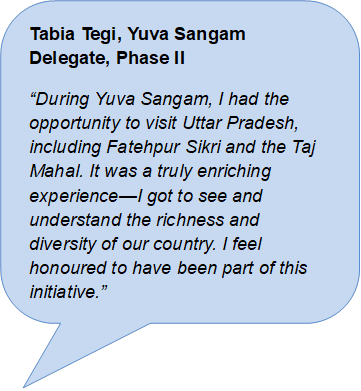
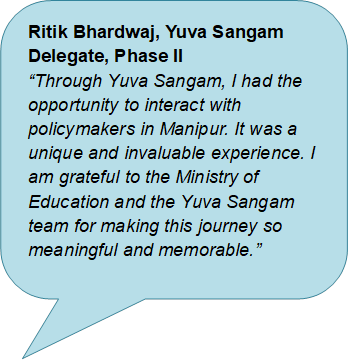
Across phases, a consistent theme emerges from participant experiences. Delegates often speak about stepping into unfamiliar cultures, interacting with people from different regions, and experiencing India beyond textbooks. The exposure to local traditions, institutions and communities creates a sense of connection that is both personal and lasting.
In several instances, this experience is shaped by unique moments within each phase. In Phase II, participants highlighted their interactions with national and state leadership as particularly significant, offering them insights into governance and public life that extended beyond academic understanding. In Phase IV, delegates described the tours as deeply immersive, where cultural engagement, institutional visits and community interaction came together to make learning more real and participatory.
Education and Youth Empowerment: Alignment with Union Budget 2026-27[8]
The Union Budget 2026–27 placed youth at the centre of India’s development story. Described as a “Yuva Shakti-driven Budget,” it links aspiration with capacity-building and treats young people as active partners in the journey towards a Viksit Bharat. In this wider context, Yuva Sangam becomes more than a youth exchange programme. It becomes a meaningful platform through which education, exposure and national integration come together.
Some of the Budget’s key announcements bring this connection into focus:
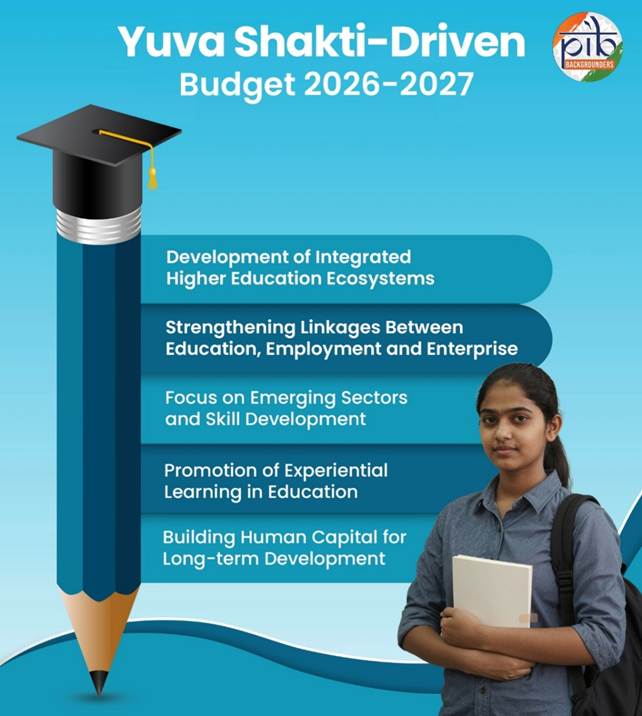
- Development of Integrated Higher Education Ecosystems
The Budget proposes support to States for creating five University Townships near major industrial and logistic corridors. These planned academic zones are envisioned to host universities, colleges, research institutions, skill centres and residential complexes. It points to a future where higher education is closely linked with research, skills and industry-facing opportunities.
- Strengthening Linkages Between Education, Employment and Enterprise
A notable proposal is the setting up of a High-Powered ‘Education to Employment and Enterprise’ Standing Committee. Its mandate is not limited to jobs alone. It will examine growth, employment, exports, the impact of emerging technologies including AI on jobs and skill requirements, and measures for upskilling and reskilling.
- Focus on Emerging Sectors and Skill Development
The Budget recognises the growing potential of the AVGC sector and proposes support for setting up AVGC Content Creator Labs in 15,000 secondary schools and 500 colleges through the Indian Institute of Creative Technologies, Mumbai. This is not a routine education measure. It signals a push towards future-facing skills, digital creativity and emerging sectors where young people will increasingly find opportunity.
- Promotion of Experiential Learning in Education
The Budget proposes setting up or upgrading four telescope infrastructure facilities to promote Astrophysics and Astronomy through immersive experiences. An immersive experience reflects a broader understanding that learning becomes deeper when it is experienced. This sits well with the approach of the National Education Policy 2020 and also strengthens the case for programmes like Yuva Sangam, where travel, observation and engagement become part of the learning process.
- Building Human Capital for Long-term Development
The Budget’s emphasis is not only on creating trained individuals, but on building a generation that can contribute meaningfully to India’s social and economic transformation. Yuva Sangam adds value here in a distinct way. It helps young people understand India across regions, cultures and institutions. It nurtures perspective along with participation. In a country as diverse as India, that kind of exposure is also a form of capacity-building.
Conclusion: Experiencing India, Building the Future
Yuva Sangam has shown how meaningful exposure can shape understanding. As the programme enters its newer phases, it is no longer just about exchange. It is about building a sustained framework for youth engagement across regions.
Phase-VI reflects this shift. With wider coverage across States and Union Territories and stronger institutional participation, it signals a move towards greater scale and continuity. As more Higher Education Institutions come on board and partnerships deepen, the programme has the potential to evolve into a more regular and structured national platform for youth mobility.
Looking ahead, this creates new possibilities. Exposure tours can become a consistent part of the learning journey. Institutional collaborations can strengthen academic and regional linkages. Most importantly, more young people can experience India beyond their immediate surroundings.
As India moves towards Viksit Bharat @2047, the focus on education, skills and human capital will continue to grow. In that context, Yuva Sangam adds an important dimension.
A generation that has travelled, engaged and learned across regions is better placed to contribute to a more connected, confident and forward-looking India.
References
https://ebsb.aicte-india.org/
https://www.ekbharat.gov.in/
https://www.pib.gov.in/PressReleasePage.aspx?PRID=2234587®=3&lang=1
https://www.indiabudget.gov.in/doc/Budget_Speech.pdf?utm{
https://ebsb.aicte-india.org/social-board/index.php?page=1 – Pictures of previous editions
https://www.pib.gov.in/PressReleasePage.aspx?PRID=1979688®=3&lang=2
https://www.education.gov.in/sites/upload_files/mhrd/files/document-reports/MoE_AR_En.pdf
https://www.education.gov.in/sites/upload_files/mhrd/files/document-reports/AR_2023-24_en.pdf
PIB Research
(Release ID: 2248923)
Visitor Counter : 9098