Posted On:
04 APR 2026 3:30PM by PIB Delhi
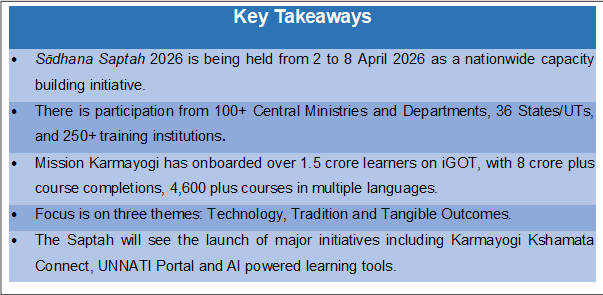
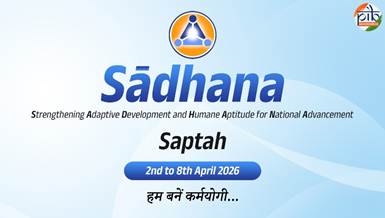
Strengthening Adaptive Development and Humane Aptitude for National Advancement (Sādhana) Saptah 2026 is being organised from 2 to 8 April 2026 as one of the largest collaborative capacity building initiatives in India, that aims to foster skills necessary for citizen centric governance. Organised by the Department of Personnel and Training, Capacity Building Commission and Karmayogi Bharat, the initiative brings together Central Ministries, States and Union Territories, and training institutions on a common platform to promote responsive and citizen centric governance. The initiative, with the tagline “Ham Bane Karmayogi”, also marks the Foundation Day of the Capacity Building Commission and five years of Mission Karmayogi.
Mission Karmayogi: Creating Capacity for People-Centric Governance
Sādhana Saptah is an initiative under Mission Karmayogi, also known as the National Programme for Civil Services Capacity Building. It is a Central Sector Scheme being implemented by the Department of Personnel and Training, that aims to build a future-ready, transparent and citizen-centric civil service by moving away from a rule-based approach to one that is role-based and driven by competencies. The mission reflects the vision of Prime Minister Shri Narendra Modi to transform governance by strengthening the human resource foundations of the government. It focuses on capacity building and competency-based learning so that officials can be equipped with the right skills, mindset and accountability to deliver better outcomes and service delivery for citizens.
The Mission is supported by two institutions. The Capacity Building Commission, set up in 2021, supports Ministries, Departments, and organizations in preparing and implementing their capacity building plans. The Karmayogi Bharat Special Purpose Vehicle, set up in 2022, is responsible for managing and operating the iGOT digital learning platform.
Capacity Building Commission (CBC) is the custodian of the Mission Karmayogi framework, to drive civil service reforms through capacity building and competency-based learning. It works to strengthen the human resource foundations of the government by focusing on developing individual and institutional capacities, promoting citizen-centric governance, future readiness, and fostering a culture of lifelong learning across all levels of public administration. The Commission designs frameworks, sets standards, and encourages collaboration to make governance more transparent, accountable, citizen-centric, and future-ready.
A key part of Mission Karmayogi initiative is the iGOT Karmayogi digital learning platform. It offers online training across behavioural, functional, and domain areas, allowing government employees to learn anytime and from anywhere.
The Mission is being implemented across all Ministries and Departments of the Government of India through existing Civil Service Training Institutions and the iGOT Karmayogi platform. Capacity building efforts are mainly delivered through this digital platform, while the capacity building plans are developed by individual Ministries and Departments, according to their specific capacity requirements.
Over the past five years, Mission Karmayogi has transformed capacity building across civil services by moving beyond rule-based approach towards a role-based framework. Learning is now aligned with competencies required for specific functions and responsibilities.
Mission Karmayogi: Transforming Capacity Building at Scale
Mission Karmayogi has brought a fundamental transformation in capacity building over the past five years. More than 1.5 crore learners have registered on the iGOT platform, with over 8 crore course completions and access to more than 4,600 courses available in multiple languages. In addition, over 130 capacity building plans have been developed, and learning outcomes have been integrated with performance appraisal systems.
This shift recognises that effective governance depends not only on administrative knowledge, but also on behavioural capabilities such as problem solving, collaboration, innovation and empathy. It enables Ministries, Departments and Organisations, along with training institutions, to align capacity building with organisational priorities and service delivery needs.
Sādhana Saptah builds on this foundation by reinforcing competency led capacity building at scale. Sādhana Saptah is being observed to emphasize and reaffirm this philosophy of nurturing Karmayogis. At its core, the initiative aims to ensure that improved skills and capabilities within the civil services translate into better service delivery on the ground. It reinforces the idea that strong governance is built on capable individuals and institutions working together towards the vision of Viksit Bharat 2047.
A Movement at National Scale
Sādhana Saptah brings together over 100 Central Ministries and Departments, 36 States and Union Territories, and more than 250 Civil Services Training Institutions under a unified national framework. For the first time, capacity building efforts across different levels of governance are aligned within a common structure, transforming learning into a shared national movement. This approach enables participation from officers at all levels and promotes exchange of ideas, best practices and collaborative problem solving across the country. Sādhana Saptah begins with a National Conclave on Mission Karmayogi in New Delhi, bringing together senior leadership from government, training institutions and policy experts
Three Themes of Sādhana Saptah
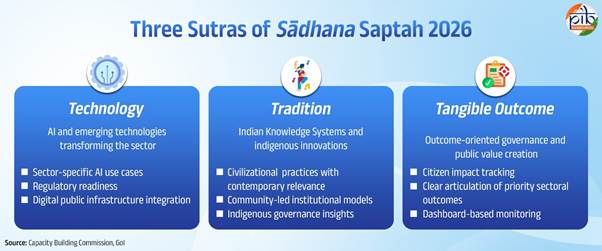
Sādhana Saptah is structured around three Sutras: Technology, Tradition and Tangible Outcomes, with a focus on building skills required for achieving the vision of Viksit Bharat 2047.
Technology: This will be the focus theme for 3rd and 4th April, during which the stress will be on exploring the how the latest and emerging technology can be leveraged to make governance more efficient and citizen centric. Applications of Artificial Intelligence in governance, Digital Public Infrastructure, data informed decision making, and emerging tools such as prompt engineering and automation platforms are some of the aspects that will be explored.
Tradition: The focus for 5th and 6th April is Tradition. The emphasis will be on Indian Knowledge Systems, ethical frameworks from Indian philosophy, and historical examples of community-based governance relevant to contemporary public administration. The idea is to explore how these can be mainstreamed in present day governance to make it more attuned to the needs of the citizens.
Tangible Outcomes: This will be the focus theme for 7th and 8th April. Emphasis will be on the importance of measuring public value, strengthening monitoring frameworks, and ensuring that policies translate into visible improvements in citizens' lives. Citizen impact tracking, clear articulation of priority sectoral outcomes for citizens and dashboard-based monitoring will be some of the focus areas for discussion.
Expected Outcome of Sadhana Saptah
At the end of the Saptah each Ministry / Department will be expected to come up with two priority technology interventions: two sector-relevant indigenous or traditional models and three measurable outcome commitments for FY 2026–27. These will then be compiled into a cross-sectoral compendium under ten identified sectors namely: Infrastructure, Resources, Security and Foreign Affairs, Governance, Finance& Economy, Welfare, Commerce, Human Development, Agriculture and Rural Development and Technology.
Key Initiatives to be launched
Several key initiatives are being launched during Sādhana Saptah to further strengthen Mission Karmayogi and deepen capacity building across the civil services ecosystem.
- Karmayogi Kshamata Connect: Aims to build capacities of frontline functionaries through structured learning modules, enabling them to deliver citizen centric services with improved efficiency and digital awareness.
- Rashtriya Jan Sewa Programme: Strengthens citizen service delivery by training youth volunteers and officials as facilitators, promoting sewa bhav at the grassroots level.
- UNNATI Portal: Unified New-Age National Training Institutions (UNNATI) portal establishes a unified digital backbone for training institutions, enabling real time monitoring, collaboration and data driven capacity building across the ecosystem.
- iGOT Learning Assessment Framework: Introduces a trust-based evaluation system to ensure that learning outcomes are applied in real workplace scenarios and improve governance impact.
- Karmayogi Gaan: Reflects the spirit of dedication, service and continuous learning, and will be integrated into training programmes to reinforce the ethos of Mission Karmayogi.
- AI Powered Amrit Gyaan Kosh Suite: Enhances creation and use of governance case studies through AI tools that support analysis, discovery and integration into training programmes.
- Capacity Building for Viksit Panchayat: Focuses on strengthening grassroots governance through e learning modules and AI enabled tools for better decision making and service delivery.
- Administrative Capacity Building for Scientists: A specialised programme designed to equip scientists with governance, leadership and decision-making skills as they transition into administrative roles.
Learning Pathways for Continuous Capacity Development
Sādhana Saptah provides multiple learning opportunities through curated courses on the iGOT Karmayogi platform, Samuhik Charcha sessions, thematic webinars and hands on workshops conducted by training institutions. These activities focus on competencies such as leadership, communication, data analysis, project management and digital governance.
The initiative strengthens a culture of continuous learning across governance and highlights the importance of building adaptive and future ready institutions. It reinforces the need for continuous investment in human resource development to support the vision of Viksit Bharat 2047.
Sādhana Saptah 2026 represents a significant step towards building a future ready civil services system in India. By promoting continuous learning, collaboration and innovation, it strengthens the foundation of effective governance.
As India moves towards the vision of Viksit Bharat 2047, the initiative will continue to play a key role in equipping civil servants with the skills and competencies required to meet emerging challenges and deliver better outcomes for citizens.
References:
https://www.pib.gov.in/PressReleasePage.aspx?PRID=2248331®=3&lang=2
PIB Research
See in PDF