Posted On:
13 APR 2026 4:32PM by PIB Delhi
|
Key Takeaways
- 1,656 mandis integrated across 23 States and 4 Union Territories by March 2026.
- Over 1.80 crore farmers, 2.73 lakh traders, and 4,724 Farmer-Producer Organizations were registered on the eNAM platform by March, 2026.
- Cumulative trade of 13.25 crore metric tonnes, with a total value of ₹4.84 lakh crore, recorded between 2016 and March, 2026.
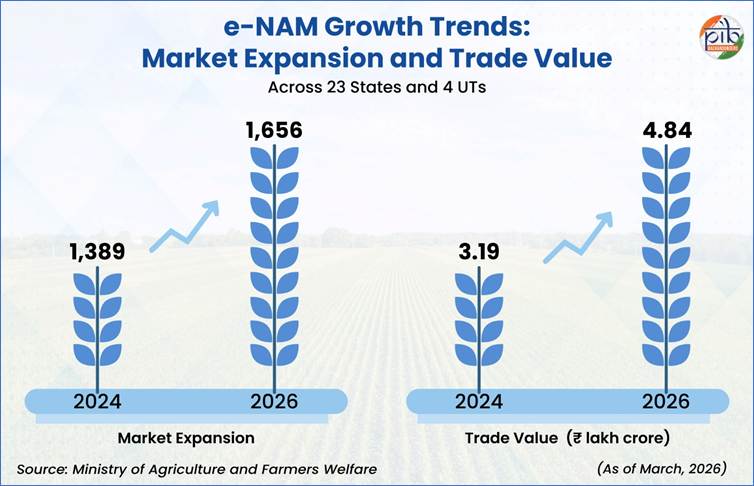
- Trade value increased from ₹3.19 lakh crore in 2024 to ₹4.84 lakh crore in 2026, indicating growing scale and deeper market engagement.
- By March, 2026, 204.76 lakh metric tonnes of agricultural produce had been traded in recent periods, reflecting sustained operational momentum.
- 247 commodities are covered under mobile-based price information services through the e-NAM app.
|
Agriculture has long constituted a foundational pillar of India’s socio-economic structure, sustaining nearly half of the country’s workforce and shaping its developmental trajectory. Agricultural marketing in India has historically evolved through a network of regulated mandis established under the Agricultural Produce Market Committee (APMC) framework, facilitating the structured, organized exchange of agricultural commodities across regions.
Prior to 2016, agricultural trade remained largely confined within these mandi systems across States and Union Territories, with each market governed by its own regulatory structure. APMC, as a decentralized model, facilitated robust local trading but also revealed limitations in inter-state market integration and broader market access. With the expansion and diversification of agricultural production, the need for a more integrated market structure that enhances market access, improves efficiency, and ensures transparent price discovery has become increasingly evident. In this context, the Government launched the National Agriculture Market (e-NAM) in April 2016 as a pan-India electronic trading platform to create a unified national market for agricultural commodities. By digitally integrating existing mandis, e-NAM enables seamless online trading, transparent price discovery, and broader market access for farmers, traders, and buyers nationwide.
One Nation, One Market: The Digital Engine of e-NAM
The e-NAM digital ecosystem comprises a multi-layered architecture encompassing a web portal, mobile application, dedicated helpline, human support infrastructure, and AI-enabled quality assessment systems. eNAM facilitates farmers’ access to a broader and more diverse pool of buyers, thereby strengthening opportunities for improved price realization. It encourages the adoption of formal digital payment systems, contributing to greater financial inclusion and transactional efficiency within the agricultural marketing ecosystem.
The e-NAM Web Portal: End-to-End Digital Agricultural Marketing
The e-NAM portal (enam.gov.in) facilitates end-to-end digital agricultural marketing by seamlessly linking mandis to a unified national market platform for the electronic trading of agricultural commodities. Its expanding network reflects increasing market integration, with the number of connected mandis rising from 1,389 in 2024 to 1,656 as of March 2026, spanning 23 States and 4 Union Territories.
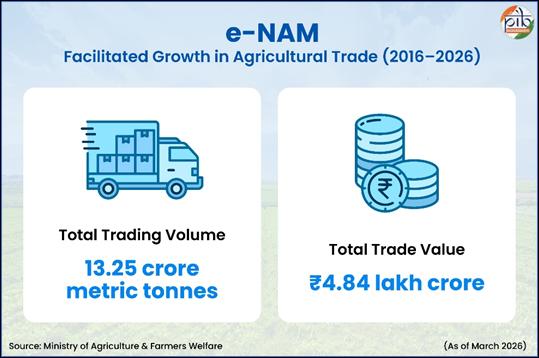
Since its launch (2016), e-NAM has facilitated significant growth in agricultural trade. Cumulatively, from 2016 to March 2026, the platform has enabled the trading of 13.25 crore metric tonnes of commodities, generating a total trade value of ₹4.84 lakh crore, reflecting its expanding scale and growing participation. Furthermore, the Government provides financial assistance of up to ₹75 lakh per mandi to support infrastructure development, strengthening the integration of mandis with the digital ecosystem, and improving overall market efficiency. This growth is also evident in its increasing stakeholder base. As of March, 2026, the platform has registered over 1.80 crore farmers, 2.73 lakh traders, and 4,724 Farmer-Producer Organizations (FPOs), indicating its widening outreach.
The portal supports the entire agricultural trade lifecycle, encompassing digital gate entry, lot creation with unique identifiers, quality assaying, competitive online bidding, real-time bid tracking, price discovery, and direct electronic payments to farmers’ bank accounts.
Additionally, it incorporates a live dashboard that offers real-time insights into commodity-wise trade volumes, mandi-level price trends, stakeholder registrations, and inter-state trade flows, thereby enhancing transparency and enabling informed decision-making.
|
e-NAM Portal-Key Digital Features
- Single-window service: Commodity arrivals, quality assaying, bidding, payment, all on one platform
- Unique Lot ID tracking: Each lot tracked from gate entry to final sale via mobile
- Live price dashboard: Real-time commodity prices, mandi arrivals, trade volumes, publicly accessible
- 12-language interface: Hindi, English, Gujarati, Marathi, Telugu, Bengali, Tamil, Odia and others
- Secondary sale module: Enables resale of already-purchased lots within the platform
- Inter-state trade facility: State Unified License enables traders to bid across State boundaries
|
From Clicks to Crops: e-NAM on the Move
The e-NAM mobile app, launched in October 2016, complements the web portal by providing a simplified, mobile-friendly interface for accessing trading and market-related services. It extends the platform’s reach to smartphone users, enabling farmers, traders, and other stakeholders to access market information and participate in trading activities in a timely and location-independent manner. As of December 2025, the application offers free price information for 247 notified commodities, enabling informed, timely decision-making.
A key advancement in the platform’s evolution was the introduction of the Platform of Platforms (PoP) on 14 July 2022. This technology-driven framework integrates a wide range of services through a unified digital interface accessible via the e-NAM mobile application. Through PoP, users can access services across the agricultural value chain, including logistics, warehousing, quality assurance, grading and packaging, agri-inputs, financial and insurance services, and advisory support such as weather updates and crop forecasting.
Furthermore, the platform enables integration with e-commerce platforms and private agri-market players, thereby broadening market access and strengthening end-to-end trading and allied services.
Voices to Solutions: Empowering Users in the e-NAM Ecosystem
The e-NAM provides a dedicated support and grievance redressal mechanism for farmers, traders, and other stakeholders. Users can access assistance through a toll-free helpline (1800 270 0224), which serves as the primary support channel nationwide, as well as through official email IDs such as nam@sfac.in and enam.helpdesk[at]gmail[dot]com.
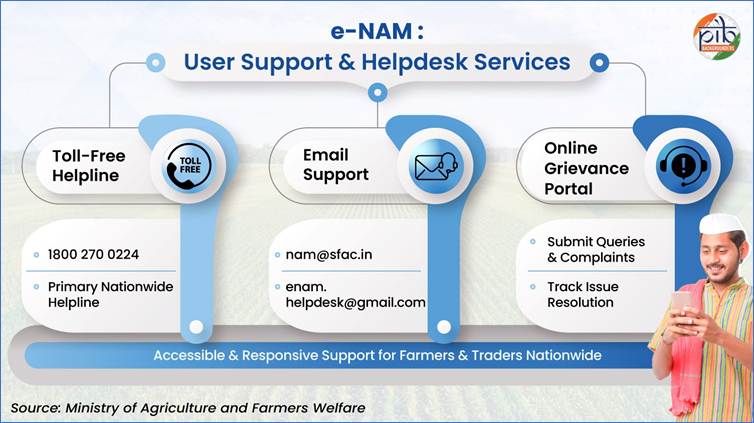
The platform offers an online grievance redressal system that allows users to submit queries and complaints directly through the portal. This integrated support framework ensures the timely resolution of issues and continuous technical assistance, particularly for farmers and first-time users navigating the digital marketplace.
e-Payment under eNAM: Payments, Transparency, and Inclusion
The e-payment system under e-NAM constitutes a critical component of its digital architecture, enabling seamless financial transactions within agricultural markets. By integrating trading and payment settlement into a unified electronic workflow, the platform transforms traditional mandi operations and enhances transactional efficiency. Under this system, sale proceeds are directly transferred to farmers’ registered bank accounts upon completion of the trade, thereby reducing dependence on intermediaries and streamlining settlement. Payments are processed electronically, ensuring timely, secure, and transparent transactions.
The platform integrates multiple digital payment modes, including NEFT, RTGS, internet banking, and UPI, enabling it to adapt across states. Furthermore, the e-payment system promotes financial inclusion by formalizing transactions and generating verifiable financial records. These records can facilitate farmers’ access to institutional credit and other financial services.
Strengthening Post-Harvest Infrastructure through e-NWR and e-NAM Integration
The growing emphasis on strengthening post-harvest management has highlighted the need to integrate scientific storage systems with efficient market access mechanisms. In this context, the Electronic Negotiable Warehouse Receipt (e-NWR) system has been integrated with e-NAM to enable a more seamless and efficient agricultural marketing framework. The Electronic Negotiable Warehouse Receipt (e-NWR) system constitutes a significant institutional reform in post-harvest agricultural management by enabling the digital documentation, transfer, and monetization of stored produce. Introduced under the Warehousing (Development and Regulation) Act, 2007, it functions as a secure electronic instrument that certifies ownership of commodities stored in warehouses accredited by the Warehousing Development and Regulatory Authority (WDRA).
Building upon the traditional Negotiable Warehouse Receipt (NWR), the e-NWR system enhances transparency, traceability, and ease of transfer, thereby facilitating the trading of commodities without physical movement. This establishes a critical linkage between storage and market access. Therefore, e-NWR facilitates scientific storage and ownership certification, and e-NAM provides a nationwide digital platform for efficient and transparent trading of such stored produce.
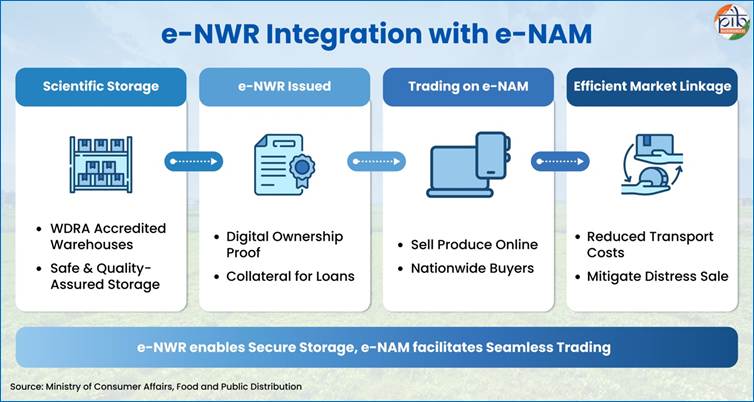
Within this integrated framework, farmers, traders, and Farmer-Producer Organizations (FPOs) can store their produce in WDRA-accredited warehouses, obtain e-NWRs, and sell directly on the e-NAM platform. This reduces dependence on physical transportation to mandis, thereby lowering logistics costs and post-harvest losses, while also mitigating distress sales.
Furthermore, e-NWRs can be used as collateral to access institutional credit, enhancing liquidity and enabling stakeholders to optimize the timing of sales. When combined with e-NAM’s price discovery and competitive bidding mechanisms, this integration strengthens market access and better price realization.
The system also promotes quality-based trading through standardized grading and assaying of stored produce. By aligning quality assurance with market access, the e-NWR–e-NAM integration enhances trust, encourages standardization, and contributes to more efficient and transparent agricultural markets.
The National Agriculture Market (e-NAM) marks a significant step in the ongoing transformation of agricultural marketing in India. By digitally integrating mandis nationwide and facilitating transparent, technology-driven trade, the platform has strengthened market linkages and expanded opportunities for farmers and other stakeholders.
Its integrated digital ecosystem, comprising the web portal, mobile application, Platform of Platforms (PoP), and associated support infrastructure, has improved price discovery, broadened market access, and encouraged the adoption of digital transactions. Complementary initiatives such as the Electronic Negotiable Warehouse Receipt (e-NWR) have further strengthened the value chain by linking storage, finance, and market access.
With its expanding scale, increasing stakeholder participation, and rising trade volumes, e-NAM is contributing to the emergence of a more integrated, efficient, and transparent agricultural marketing system. As the platform continues to evolve, it is well-positioned to deepen market connectivity, enhance value realization for farmers, and advance the vision of a unified national market.
Ministry of Finance
Ministry of Agriculture and Farmers Welfare
Ministry of Consumer Affairs, Food and Public Distribution
PIB Backgrounders
Click here to see pdf
****
PIB Research