Ministry of Earth Sciences
Long Range Forecast For the 2026 Southwest Monsoon Season Rainfall
The 2026 southwest monsoon seasonal (June to September) rainfall over the country is most likely to be below normal (95-90% of the Long Period Average (LPA)
Seasonal rainfall over the country is likely to be 92% of LPA with a model error of ± 5%
The LPA of the seasonal rainfall over the country based on the period of 1971-2020 is 87 cm
Weak La Niña–like conditions are transitioning to ENSO-neutral conditions over the equatorial Pacific
Atmospheric circulation features across the tropical Pacific remain consistent with weak La Niña–like conditions
The Monsoon Mission Climate Forecast System (MMCFS) suggests the development of El Niño conditions during the SW Monsoon season
Neutral Indian Ocean Dipole (IOD) conditions are present over the Indian Ocean and the latest Climate models forecast indicates that the positive IOD conditions are likely to develop towards the end of the southwest monsoon season
The northern hemisphere snow cover extent during the last three months (January to March 2026) was slightly below normal
Winter and spring snow cover extent over Northern Hemisphere as well as Eurasia has a general inverse relationship with the subsequent southwest monsoon seasonal rainfall over the country
IMD will issue the updated forecasts for monsoon season rainfall in the last week of May 2026
Posted On:
13 APR 2026 5:41PM by PIB Delhi
Since 2003, India Meteorological Department (IMD) has been issuing the operational long-range forecast (LRF) for the southwest monsoon seasonal (June-September) rainfall averaged over the country in two stages. The first stage forecast is issued in April and the second stage or update forecast is issued bythe end of May. In 2021, IMD has implemented a new strategy for issuing monthly and seasonal operational forecasts for the southwest monsoon rainfall over the country by modifying the existing two stage forecasting strategy. The new strategy uses both dynamical and statistical forecasting system. Multi-Model Ensemble (MME) forecasting system based on coupled global climate models (CGCMs) from different global climate prediction centres, including IMD’s Monsoon Mission Climate Forecast System (MMCFS) are used in dynamical forecast system.
As per the new LRF strategy, the first stage forecast issued in middle of April consists of quantitative and probabilistic forecasts for the country as a whole, and the spatial distribution of probabilistic forecasts for the tercile categories (above normal, normal, and below normal) of the seasonal (June-September) rainfall over the country.
In the second stage forecast issued around end of May consist of update for the seasonal rainfall forecast issued in April along with the probabilistic forecasts for the seasonal rainfall over the four homogenous regions of India (northwest India, central India, south Peninsula, and northeast India) and monsoon core zone (MCZ). In addition, quantitative and probabilistic forecasts for the country, and the spatial distribution of probabilistic forecasts for the tercile categories (above normal, normal, and below normal) of the June rainfall over the country are also issued during the second stage forecast.
In continuation to the above forecasts, monthly rainfall forecast is issued around end of June, July, and August respectively for the subsequent one month. In addition, quantitative and probabilistic forecasts for the country, and the spatial distribution of probabilistic forecasts for the tercile categories for the second half of the season rainfall is issued around end of July along with the forecast for August.
1.Forecast for the 2026 Southwest monsoon Season (June–September) rainfall over the country.
The forecast based on both dynamical and statistical models suggests that quantitatively, the monsoon seasonal rainfall is likely to be 92% of the Long Period Average (LPA) with a model error of ± 5%. The LPA of the seasonal rainfall over the country for the period 1971-2020 is 87 cm.
The five-category probability forecast for the Seasonal (June to September) rainfall over the country is given below. The forecast indicates that the probabilities for both below normal and deficient rainfall categories are higher than their respective climatological probabilities. The forecast probabilities for the “Above Normal” and “Excess” rainfall categories are lower than their respective climatological probabilities. Overall, the Southwest Monsoon seasonal rainfall over the country is most likely to be below normal (90–95% of LPA).
|
Category
|
Rainfall Range
(% of LPA)
|
Forecast Probability (%)
|
Climatological
Probability (%)
|
|
Deficient
|
< 90
|
35
|
16
|
|
Below Normal
|
90 - 95
|
31
|
17
|
|
Normal
|
96 -104
|
27
|
33
|
|
Above Normal
|
105-110
|
6
|
16
|
|
Excess
|
> 110
|
1
|
17
|
The MME forecast for the 2026 southwest monsoon seasonal rainfall was prepared based on the April initial conditions and using a group of coupled climate models that having highest prediction skill over the Indian monsoon region.
The spatial distribution of probabilistic forecasts for tercile categories (above normal, normal, and below normal) for the seasonal rainfall (June to September) is shown in Fig.1. The spatial distribution suggests that the below-normal seasonal rainfall is most likely over many parts of the country except some areas over Northeast, Northwest, and South Peninsular India, where normal to above-normal rainfall is likely. The white-shaded areas within the land area represent no signal from the model.
2.Sea Surface Temperature (SST) Conditions in the equatorial Pacific & Indian Oceans
At present, Weak La Niña–like conditions are transitioning to ENSO-neutral conditions over the equatorial Pacific. However, some atmospheric circulation features across the tropical Pacific remain consistent with weak La Niña–like conditions. The latest forecasts from the Monsoon Mission Climate Forecast System (MMCFS) suggest that ENSO-neutral conditions are most likely to continue during the April to June 2026 season. The Monsoon Mission Climate Forecast System (MMCFS) suggests the development of El Niño conditions during the SW Monsoon season.
Currently, neutral Indian Ocean Dipole (IOD) conditions are present over the Indian Ocean and the latest Climate models forecast indicates that the positive IOD conditions are likely to develop towards the end of the southwest monsoon season.
As sea surface temperature (SST) conditions over the Pacific and the Indian Oceans are known to have a strong influence on the Indian monsoon, IMD is carefully monitoring the evolution of sea surface conditions over these Ocean basins.
3.Snow Cover over the Northern Hemisphere
The northern hemisphere snow cover extent during the last three months (January to March 2026) was slightly below normal. Winter and spring snow cover extent over Northern Hemisphere as well as Eurasia has a general inverse relationship with the subsequent southwest monsoon seasonal rainfall over the country.
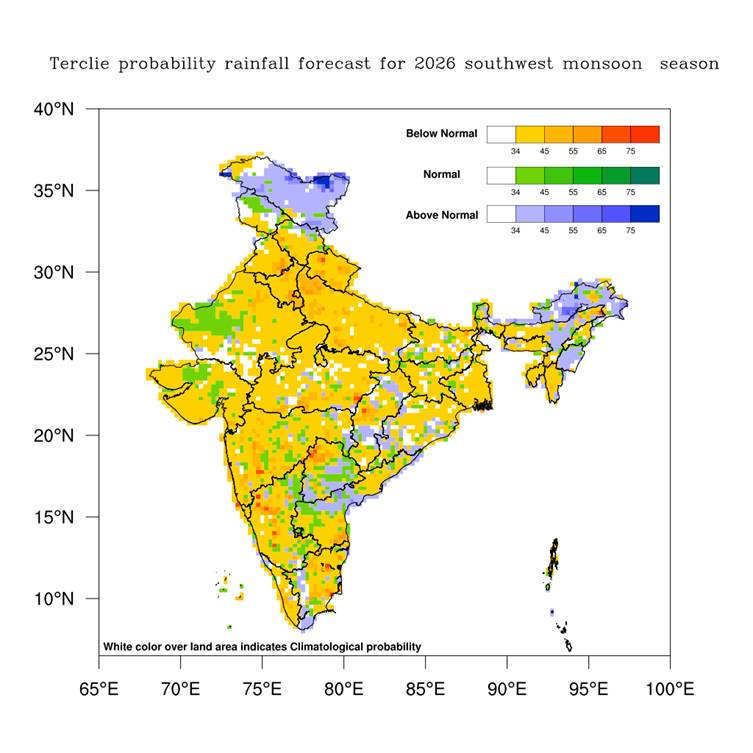
Fig.1.Probability forecast of tercile categories* (below normal, normal, and above normal) of the seasonal rainfall over India during the 2026 southwest monsoon season (June -September). The figure illustrates the most likely categories as well as their probabilities. The white shaded areas represent no signal from the model. (*Tercile categories have equal climatological probabilities, of 33.33% each).
*****
NKR/AK/NM/SG
(Release ID: 2251594)
Visitor Counter : 13242