Posted On:
18 APR 2026 10:17AM by PIB Delhi
|
Key Takeaways
- Archaeological Survey of India safeguards 3,686 centrally protected monuments, supported by strengthened conservation systems and scientific restoration methods.
- Heritage and monument preservation has advanced through large-scale digitisation, creation of national heritage databases, and wider adoption of scientific and digital tools for documentation and conservation.
- India’s global heritage profile has expanded, with 44 UNESCO World Heritage Sites, including the recent addition of the Maratha Military Landscapes.
|
India’s Approach to Monument Conservation
India’s cultural landscape is shaped by monuments, antiquities, manuscripts and historic sites that together reflect thousands of years of civilisational evolution. These structures and objects are not merely remnants of the past; they represent collective memory, inherited knowledge and a sense of continuity that binds generations.
Recognising this, the past decade has seen a renewed emphasis on strengthening the systems that safeguard India’s cultural assets. Heritage conservation has been increasingly integrated with tourism development, local livelihoods, and cultural diplomacy. This shift reflects a broader recognition of heritage as both a developmental asset and a source of India’s soft power on the global stage.
Tangible and Intangible Cultural Heritage
Cultural heritage in India encompasses both tangible and intangible forms, reflecting the country’s rich and diverse traditions.
According to UNESCO, Tangible Cultural Heritage includes heritage of “outstanding universal value,” such as historic structures and cultural landscapes. Examples include the Taj Mahal, Sanchi Stupa, and ancient temple architecture. In India, such heritage is protected under the Ancient Monuments and Archaeological Sites and Remains Act, 1958, which empowers the government, through the Archaeological Survey of India (ASI), to declare monuments as protected, regulate construction in surrounding areas, and ensure their conservation.
Intangible Cultural Heritage (ICH) refers to living traditions and practices passed down through generations, including performing arts, rituals, festivals, oral traditions, and traditional knowledge. UNESCO defines it as practices recognised by communities as part of their cultural identity and continuously recreated. Examples include Yoga, Vedic chanting, and Buddhist chanting of Ladakh. In India, Intangible Heritage is safeguarded through the UNESCO Convention for the Safeguarding of Intangible Cultural Heritage, 2003, supported by national schemes and constitutional provisions such as Article 29.
|
Legislative and Institutional Framework for Ancient Monuments
India’s heritage conservation is guided by a legislative and institutional framework that brings together dedicated organisations, legal safeguards, and policy mechanisms to ensure systematic protection and management of cultural assets.
Legislative Framework
India’s approach to monument conservation has evolved into a structured and continuous process, combining institutional mechanisms, legal safeguards, and participatory models. The key legislations on Protection and Conservation of Ancient monuments are:
- Article 49 – Protection of Monuments of National Importance
Article 49 of the Constitution places a duty on the State to protect monuments, places, and objects of artistic or historic interest declared to be of national importance. This provision forms the constitutional basis for legislative measures such as the Ancient Monuments and Archaeological Sites and Remains Act, 1958, and guides the State in ensuring preservation of cultural heritage.
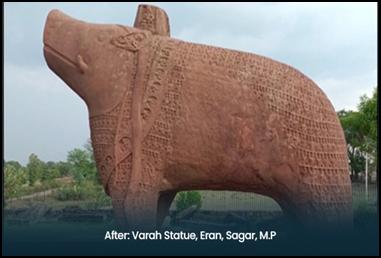
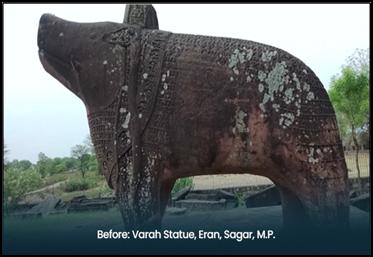
- Seventh Schedule – Division of Responsibilities
The Seventh Schedule of the Constitution provides a clear division of responsibilities between the Centre and the States in matters of heritage protection.
- Union List (Entry 67): Monuments and archaeological sites of national importance fall under the jurisdiction of the Central Government.
- State List (Entry 12): Monuments not declared of national importance are the responsibility of State Governments.
This division ensures coordinated governance and management of heritage across different levels of government.
- Article 51A(f) – Fundamental Duty of Citizens
Article 51A(f) of the Constitution enshrines the fundamental duty of every citizen to value and preserve the rich heritage of India’s composite culture. This provision reinforces that heritage conservation is not only a State responsibility but also a collective societal obligation, encouraging public participation in preservation efforts.
- National Policy for Conservation of Ancient Monuments, Archaeological Sites and Remains (2014)
It is a Government of India framework that guides the scientific preservation and management of monuments of national importance. Implemented primarily by the Archaeological Survey of India under the provisions of the Ancient Monuments and Archaeological Sites and Remains (AMASR) Act, 1958, the policy establishes principles for maintaining the authenticity, integrity, and longevity of heritage structures. It emphasises the use of scientific conservation methods, minimal intervention, and the integration of traditional materials and skills with modern techniques. The policy also recognises conservation as a continuous process, supported by documentation, research, capacity building, and community participation, while balancing the need for protection with public access and sustainable use of heritage sites.
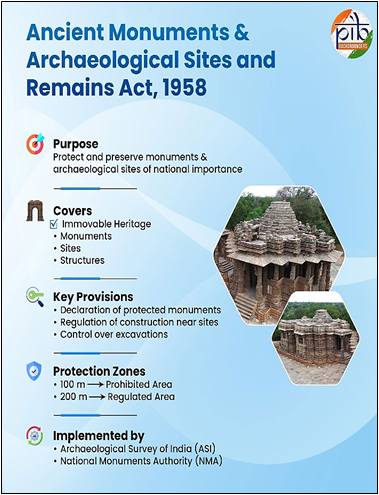
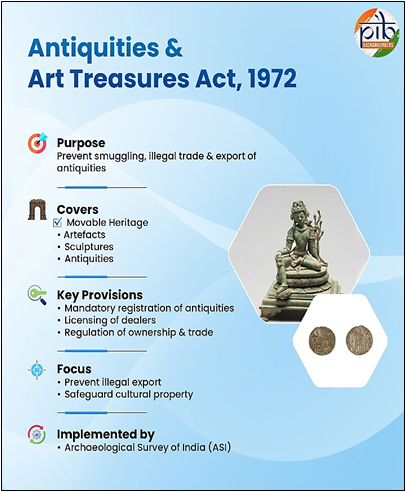
Institutional Framework
India’s institutional framework for heritage conservation is anchored in specialised government bodies responsible for the protection, preservation, and management of cultural assets. These institutions ensure effective implementation of laws and policies through coordinated, decentralised, and technically driven mechanisms.
- The Archaeological Survey of India (ASI)
Established in 1861 and functioning under the Ministry of Culture, the Archaeological Survey of India (ASI) is the country’s principal organisation for archaeological research and the protection of ancient monuments and sites of national importance. Operating under the Ancient Monuments and Archaeological Sites and Remains Act, 1958, it safeguards 3,686 centrally protected monuments across India. Its mandate includes structural and chemical conservation, archaeological exploration and excavation, epigraphy, and maintenance of site museums.
ASI carries out its functions through a network of around 38 Circles, which serve as regional administrative units. Each Circle, headed by a Superintending Archaeologist, is responsible for conservation, site management, inspections, and coordination with local authorities within its jurisdiction, ensuring decentralised implementation.
The ASI undertakes annual conservation programmes focusing on structural repairs, use of traditional materials, chemical treatment of monuments, and preventive conservation to address environmental and ageing-related deterioration.
The conservation of centrally protected monuments is undertaken through annual programmes and site-specific projects, and the conservation works are carried out regularly based on priority and the existing condition of the monument. For 2024–25 expenditure on conservation of monuments was 374 crores .
- National Mission on Monuments and Antiquities (NMMA)
Established in 2007, the National Mission on Monuments and Antiquities (NMMA) is implemented under ASI. It plays a crucial role in supporting conservation by building a reliable national database of India’s built heritage and antiquities. The Mission aims to document and create an inventory of all monuments and antiquities in the country—information that directly informs planning, prioritisation and monitoring of conservation work. It has so far documented 11,406 Built Heritage and Sites and 12.48 Lakhs antiquities of this country.
Emerging Frameworks for Monument Conservation
India’s approach to monument conservation is evolving through the integration of technology, collaborative models, and digital knowledge systems.
Comprehensive Conservation
Government of India has reimagined tangible heritage as a living engine of economic opportunity. By linking the conservation of physical heritage with livelihood generation and local development, India is charting a course where preservation and prosperity go hand in hand.
A standout example of this philosophy in action is the Adopt a Heritage 2.0 programme, which brings together government and private partners to upgrade visitor amenities at iconic monuments. Sites such as Agra Fort, Qutub Minar, Ajanta Caves, Red Fort, and Mehrauli Archaeological Park have benefited from improved infrastructure, better facilities, and enhanced site management. The results have been tangible: increased tourist footfall, a boost to local businesses, and new employment avenues in guiding, hospitality, transport, site maintenance, and the sale of handicrafts and souvenirs. These are not incidental benefits but deliberate outcomes of a policy that treats monuments as community assets.

The Government promotes the organisation of dance, music, and cultural festivals at heritage sites as a means of integrating monumental conservation with tourism and local economic development. Notable examples include the Konark Dance Festival, held annually against the backdrop of the Sun Temple in Odisha, and the Khajuraho Dance Festival, organised at the Khajuraho Group of Monuments in Madhya Pradesh. These festivals attract large numbers of tourists, artists, and cultural practitioners, thereby generating livelihood opportunities for local communities through hospitality services, handicrafts, transport, and cultural industries. For instance, the Konark Festival, held in an open-air setting near the monument, draws national and international visitors and is often accompanied by craft fairs and related cultural activities, further boosting local economies. Other heritage-linked festivals include the Modhera Dance Festival (Gujarat) and temple-based cultural events like Natyanjali festivals at Chidambaram.
The Government is also strengthening museums as key institutional tools for the scientific conservation, preservation, and dissemination of tangible cultural heritage. The Museum Grant Scheme supports the establishment, modernisation, and digitisation of museums, strengthening infrastructure and preservation of artefacts. It emphasises capacity building of museum professionals through training and skill development, while promoting technology-driven upgrades such as improved displays, lighting, and digital tools. The scheme also enables digitisation of collections, creation of online catalogues, and development of conservation facilities, enhancing both preservation and public access.
Technology-Supported Conservation
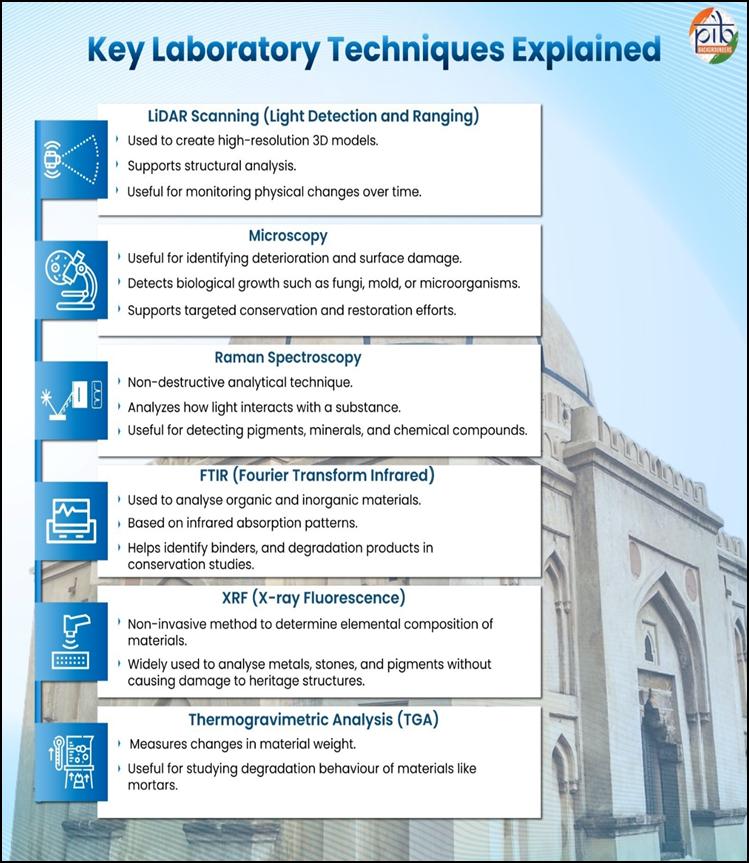
Technology has become an increasingly important pillar in India’s conservation ecosystem, complementing ASI’s traditional practices with tools that improve documentation, diagnostics and long-term preservation. Modern technologies/tools such as LiDAR scanning, GIS based mapping and drone-based surveys etc. are used as per requirement for proper documentation. There has been a growing use of scientific laboratory techniques to study heritage materials, understand patterns of deterioration and determine the most suitable conservation treatments.
In parallel, India has expanded the application of digital and spatial technologies that support accurate recording and proactive conservation planning. Key tools now used across heritage documentation and assessment include:
- 3D laser scanning – for high-precision mapping and digital documentation of complex structures
- Photogrammetry – to capture detailed architectural features and condition changes
- Drone-based surveys – for aerial mapping, structural monitoring and studying inaccessible or large sites
- Geographic Information Systems or GIS-based mapping – to analyse environmental pressures, track development around protected zones and inform long-term planning
In addition to these technologies, the Government of India has begun integrating Artificial Intelligence (AI) within the broader cultural and heritage ecosystem, particularly in areas such as digitisation, documentation, and accessibility of cultural assets. AI-enabled platforms are being used to process and organise large volumes of heritage data, including manuscripts and cultural knowledge systems, and to enhance public access through digital interfaces and language technologies.
Additionally, drone-based surveys have been undertaken in collaboration with institutions such as the National Institute of Science Education and Research (NISER), demonstrating the integration of scientific institutions in heritage conservation efforts.
The Conservation and Restoration of the Kedarnath Temple
The Kedarnath Temple represents a significant example of the use of advanced scientific techniques and institutional collaboration in heritage preservation. Following the 2013 disaster in Uttarakhand, the Government of India, through the Archaeological Survey of India (ASI), undertook structural and chemical conservation of the temple, including debris removal, stone resetting using original architectural profiles, and preservation of stone surfaces. Importantly, a geotechnical team from the Indian Institute of Technology (IIT) Chennai collaborated with ASI to carry out scientific structural assessment and foundation analysis of the monument. This included the use of geophysical testing methods such as Multi-Channel Analysis of Spectral Waves (MASW) to evaluate the stability of the temple structure and underlying foundation.
The IIT team’s assessment enabled evidence-based decisions regarding foundation strengthening and conservation strategy, ensuring that interventions remained non-invasive and structurally appropriate. This collaboration highlights how the Government has integrated engineering expertise with traditional conservation practices, combining modern scientific diagnostics with the use of locally sourced materials and traditional craftsmanship in restoration.
Public–Private Partnership
In recent years, heritage conservation has increasingly incorporated public–private partnership (PPP) models to complement government-led efforts. The “Adopt a Heritage: Apni Dharohar, Apni Pehchaan” initiative, launched in 2017 by the Government of India under the Ministry of Tourism in collaboration with the Ministry of Culture and the Archaeological Survey of India (ASI), is one such initiative. The scheme was further revamped as “Adopt a Heritage 2.0” in 2023, to strengthen corporate participation through a structured CSR-based framework. Under this initiative, entities designated as “Monument Mitras” develop and maintain facilities such as cleanliness, accessibility, illumination, signage, and visitor services, while conservation and preservation remain the exclusive mandate of the ASI. By combining government oversight with private sector efficiency, the programme improves visitor experience, promotes sustainable tourism, and fosters a shared sense of responsibility towards safeguarding India’s cultural heritage.
The initiative also reflects a broader shift towards participatory heritage management, where private sector involvement and citizen engagement complement government-led conservation efforts.
Flagship National Platforms for Cultural Heritage
A key initiative in this direction is the Indian Culture Portal, a comprehensive digital platform that aggregates content from museums, libraries, archives and cultural institutions onto a single interface – https://www.indianculture.gov.in/3d-explorations.
This platform allows users to experience monuments remotely through two formats—Virtual Walkthroughs and 360-degree Virtual Tours—thereby enhancing accessibility and public engagement with cultural heritage.
- Virtual Walkthroughs enable users to move through heritage sites in a guided, step-by-step manner, simulating a real visit. Examples include monuments such as:
-
- 360-degree Virtual Tours provide panoramic, interactive views where users can explore monuments in all directions. The Qutubh Minar Complex being one.
It also supports interactive learning through curated thematic sections, games and educational content, making cultural knowledge more engaging for a wider audience.
Global Heritage Recognition (UNESCO)
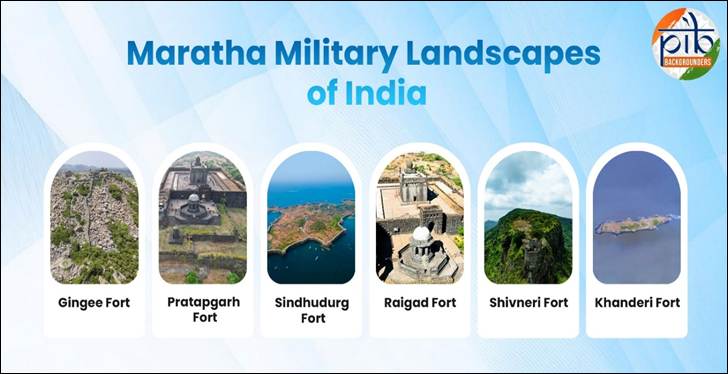
India’s presence on the global heritage map has strengthened considerably, with UNESCO inscriptions reflecting both the diversity and depth of the country’s civilisational legacy. The most recent addition—the Maratha Military Landscapes, inscribed in July 2024 marks India’s 44th UNESCO World Heritage Site, reaffirming the nation’s position among countries with the highest number of globally recognised heritage sites.
India’s expanding UNESCO footprint comprising 36 Cultural, 7 Natural, and 1 Mixed sites demonstrates how its historic monuments, archaeological landscapes and living traditions collectively contribute to global heritage.
Conclusion
India’s heritage-preservation landscape today reflects a maturing national commitment — one that recognises cultural heritage not merely as inherited wealth, but as an active, dynamic asset shaping the country’s collective future. Over the past decade, conservation practices have expanded in scale and sophistication, supported by a strengthened Archaeological Survey of India, modern scientific tools and structured protocols that ensure the long-term care of over 3600 protected monuments. Parallel investments in digitisation, including the documentation of manuscripts and the creation of integrated heritage databases, signal a shift towards knowledge-led preservation where accessibility, research and transparency reinforce physical conservation on the ground.
At the same time, India’s growing presence on the global heritage map demonstrates the country’s ability to present its cultural legacy with renewed confidence. Together, these advancements reveal a holistic approach to heritage management: conserving what time has tested, restoring what history entrusted, and digitising what must endure.
References:
UNESCO
Ministry of Culture
Ministry of Tourism
Ministry of Commerce and Industry
Ministry of Science and Technology
Ministry Of Law and Justice
Text Boxes
Click here to see pdf
***
PIB Research