PIB Backgrounder
Accelerating India’s High Value Crop Diversification
“From Coastal Plantations to Himalayan Nut Crops”
Posted On:
19 APR 2026 11:25AM by PIB Delhi
Key Takeaways
- The Union Budget 2026-27 emphasises promotion of high value crops across coastal, North Eastern and hilly regions to strengthen farm incomes and diversify farm outputs.
- India ranks second in the world in coconut production as per FAOSTAT 2024 with the sector supporting livelihoods of about 30 million people, including nearly 10 million farmers.
- India’s cashew exports stood at 369.17 USD Million in 2024-25, while cocoa exports reached 295.58 USD million during the same year.
- As of January 2026, India has around 150 million agarwood trees, with nearly 90 percent located in the North Eastern states under plantation and agroforestry systems
- Walnut exports were valued at 7.80 USD Million in FY 2024-25, with key markets including UAE, Turkey, Iraq, Singapore, Algeria, Qatar, Bhutan, Kuwait, Seychelles and Nigeria.
|
|
Introduction
Agriculture occupies a foundational place in the vision of a Viksit Bharat. Over the past decade, the sector has grown at 4.45 percent, the highest in comparison to previous decades. This growth tells a deeper story. A story of diversification and value enhancement. At the centre of this transformation lies horticulture, which has emerged as the nucleus of India’s high-value crop economy. From fruits and vegetables to flowers, spices, and plantation crops, horticulture is transforming rural landscapes. Unlike traditional staples, high-value horticultural crops generate superior returns per unit of land and contribute substantially to agricultural gross value addition. Horticulture strengthens nutrition, fuels agro-processing, supports exports, and creates local employment. In India’s journey toward sustainable and income-led agricultural growth, horticulture is not peripheral. It is pivotal.
High-value crops primarily refer to horticultural produce such as fruits, vegetables, flowers, spices, and aromatic plants. These crops are termed “high value” because they generate significantly higher net returns than traditional staple crops like cereals and pulses.
Horticulture as a Driver of Agricultural Growth in India
The horticulture sector accounts for approximately 37 percent of the Gross Value Output (GVO) within the agricultural crops sub-sector of Agriculture and Allied sectors and has emerged as a cornerstone of India’s agricultural growth trajectory. Over the past decade, horticultural production has increased substantially from 277.35 million tonnes in 2013-14 to 370.74 million tonnes in 2024-25. This expansion reflects broad-based growth across major segments, comprising:
- 117.65 million tonnes of fruits
- 217.80 million tonnes of vegetables and
- 35.29 million tonnes of other horticulture crops
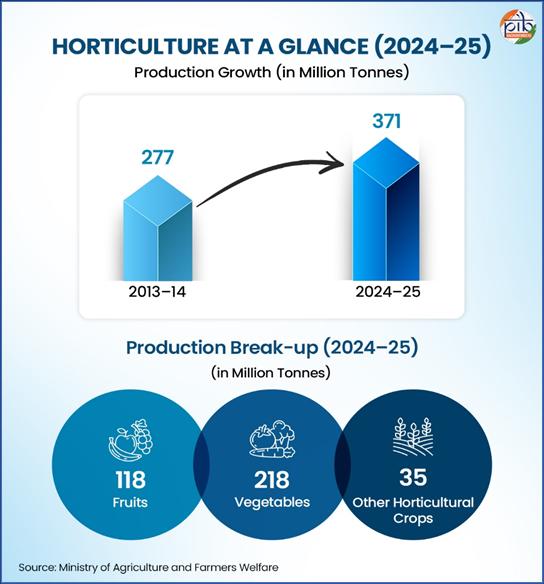
The sustained rise in output underscores the sector’s expanding contribution not only to aggregate agricultural production but also to value addition within the farm economy.
India’s global standing in horticulture further reinforces its strategic importance. The country ranks second worldwide in the production of vegetables, fruits and potato. Fruits account for 9.18 percent and vegetables account for 8.18 percent of global production. Additionally, India is the world’s largest producer of onions and shallots (dry excluding dehydrated), contributing close to 22.42 percent of global production. These indicators highlight India’s growing integration into global food supply chains and the significant potential of a high-value crop economy.
Regionally Anchored Strategies for High-Value Crop Development
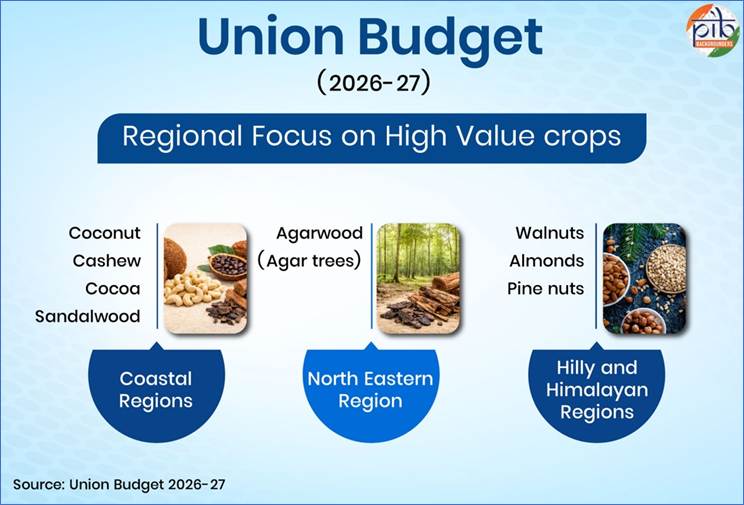
The Union Budget 2026-27 emphasized a crop-specific, regionally differentiated strategy to promote high-value agriculture, acknowledging its capacity to enhance farm incomes and diversify production systems. Targeted interventions have been proposed for coconut, sandalwood, cocoa, and cashew in coastal regions; agarwood cultivation in the North Eastern States; and premium nuts such as almonds, walnuts, and pine nuts in hilly areas. This geographically aligned policy framework seeks to leverage region-specific agroclimatic advantages, strengthen value chain integration, and incentivise a structural shift towards crops with higher economic returns and export potential.
Coastal Region Crops: Coconut, Cashew, Cocoa, and Sandalwood
India has a long coastline with numerous small and large islands, spanning several districts across maritime States and Union Territories. These coastal regions are home to a significant population and are characterised by diverse climate, topography, soils, livestock, fisheries, and crops. Such favourable agro-ecological conditions support the cultivation of high-value crops such as coconut, cashew, cocoa, and sandalwood, thereby strengthening livelihoods in coastal areas.
Coconut Sector: Growth, Regional Dynamics and Policy Interventions
The coconut sector constitutes a significant component of India’s horticulture economy, supporting the livelihoods of about 30 million people, including nearly 10 million farmers. India ranks second globally in coconut production, contributing around 22.44 percent of total world production and holds the third position in terms of area under cultivation, accounting for nearly 19.32 percent of the global coconut growing area. According to the Horticulture Statistics Unit, DA&FW India produced about 13.97 million tonnes coconut during 2024-25 from an area of 2.19 million hectares, with an average productivity of 6.36 tonnes per hectare. This highlights the sector’s substantial contribution to agricultural production, rural livelihoods, and the broader horticultural economy.
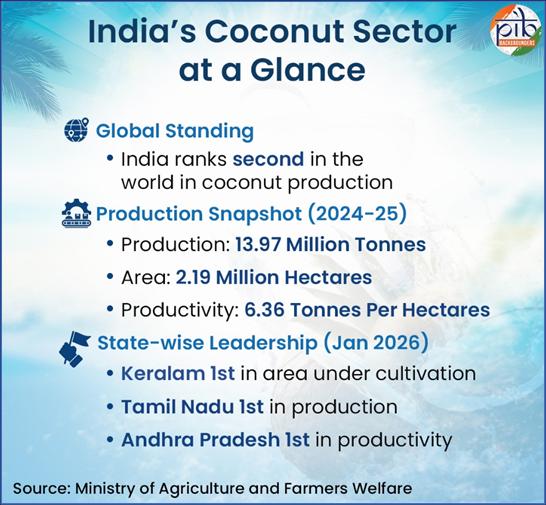
According to the Horticulture Statistics Unit, DA&FW Keralam has the largest area under coconut cultivation in the country, covering nearly 7.54 lakh hectares and producing about 35.44 lakh tonne. Tamil Nadu leads in overall coconut production, while Andhra Pradesh records the highest productivity, followed by West Bengal and Tamil Nadu. These regional variations highlight the diverse production strengths across India’s coconut-growing states. Beyond primary production, the coconut sector has emerged as an increasingly important contributor to agricultural exports, in line with the Government of India’s vision of achieving USD 2 trillion in exports by 2030 and USD 21 trillion by 2047.
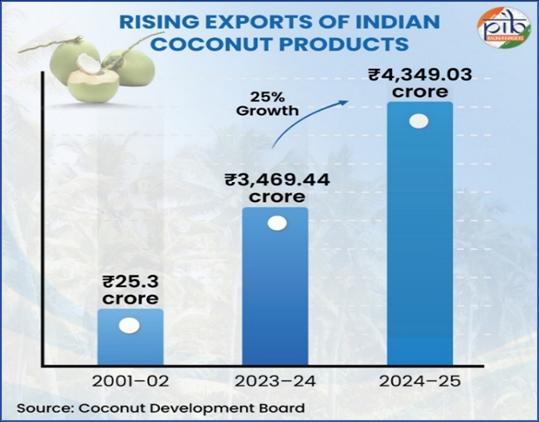
In 2024-25, exports of coconut and coconut-based products reached Rs.4,349.03 crore (USD 513 million), registering a 25 per cent increase over Rs.3,469.44 crore in the previous year. This reflects a marked transformation from 2001-02, when exports stood at only Rs.25.3 crore and were largely limited to traditional products such as raw coconut, coconut oil, and desiccated coconut. With growing global demand for products such as virgin coconut oil, coconut milk, coconut water, and other application-oriented products, the sector is steadily strengthening its position in global value chains.
Institutional and policy support
Institutional and policy support have also played a crucial role in the growth of India’s coconut sector. The Coconut Development Board, functioning under the Ministry of Agriculture and Farmers Welfare, has been instrumental in promoting the integrated development of coconut cultivation and related industries across 22 States and Union Territories. The Board has also facilitated the formation of Coconut Farmer Producer Organizations (FPOs), helping organise the largely fragmented sector and improve the socio-economic conditions of coconut farmers.
Complementing these efforts, the Government has implemented a multi-pronged policy framework that includes the Minimum Support Price for copra, targeted development programmes, skill development initiatives, and enterprise promotion across the value chain. These structured interventions focus on enhancing access to quality planting material, expanding cultivation, improving productivity, and strengthening market linkages.
Further, the Union Budget 2026-27 has proposed a Coconut Promotion Scheme to increase production and productivity, including replacing ageing and low-yielding trees with improved saplings and high-yielding varieties in major coconut-growing states.
Cashew and Cocoa Sector: Production, Trade, and Institutional Framework
Cashew and cocoa are administered and promoted through a unified institutional framework under the Directorate of Cashewnut and Cocoa Development. Together, these crops represent significant plantation commodities in India, contributing to agricultural diversification, rural livelihoods, and export earnings. The overview of the cashew and cocoa sectors illustrates their role as economically significant plantation crops with strong export potential.
Cashew: The Gold Mine of Wasteland
Cashew is a significant cash crop that was introduced to India in the sixteenth century. It is a highly nutritious and concentrated food, providing substantial energy and serving as an important source of invisible fat in the diet. The crop is known for its resilience and drought tolerance, and it adapts well to poor soil conditions. Due to these characteristics, cashew cultivation provides significant environmental benefits, including reducing soil erosion and supporting afforestation. Its ability to thrive on degraded and wastelands has led to it being described as the “Gold Mine of Wasteland,” as it transforms otherwise unproductive land into economically valuable and sustainable resources.
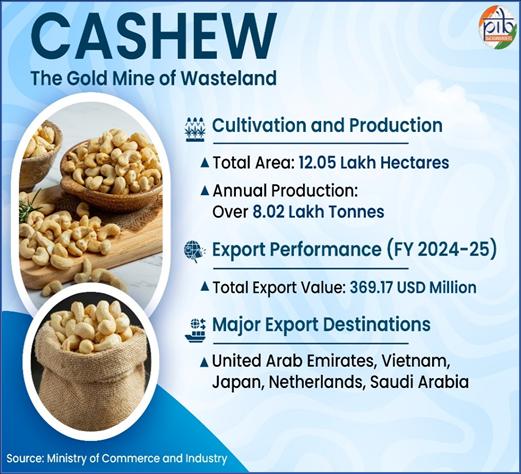
The cultivation of cashewnut in India extends across nearly 12.05 lakh hectares, with an annual production exceeding 8.02 lakh tonnes annually, underlining the importance of Cashewnut as a plantation crop in India’s coastal agrarian economy. Cultivation across States such as Odisha, Andhra Pradesh, Maharashtra, Tamil Nadu, Karnataka, Kerala, Chhattisgarh, West Bengal and parts of the North Eastern region ensures both regional balance and production stability.
This strong production base supports processing and export activities, enabling India to maintain a steady presence in global markets. In 2024-25, India’s cashew exports totalled USD 369.17 million, with major destinations including the United Arab Emirates, Vietnam, Japan, the Netherlands, and Saudi Arabia.
Cocoa: Intercropping and Commercial Potential
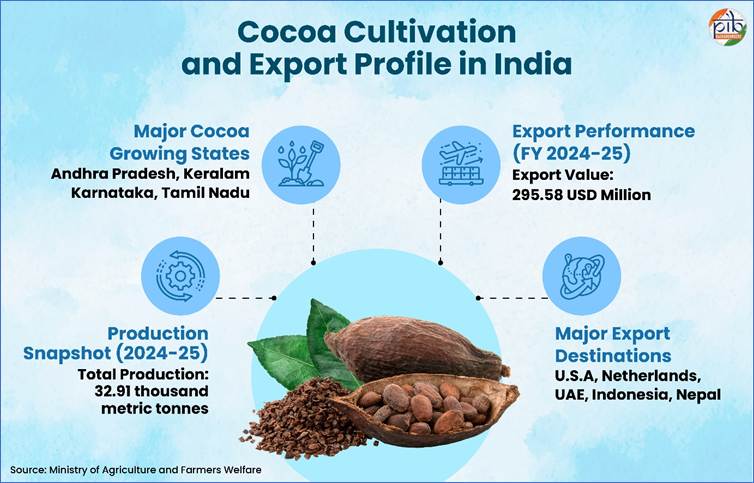
Cocoa is a commercial plantation crop cultivated for the seeds of its fruit, which are processed through fermentation to produce flavoured cocoa powder and other products. The main cocoa products include cocoa beans, cocoa powder, cocoa butter, cocoa fat and oil, as well as cocoa shell and husk by-products. In India, cocoa is rarely grown as a standalone crop and is mainly cultivated as an intercrop with tall plantations such as coconut and arecanut, where it utilises the available space and favourable shade conditions. With about 40-50 percent sunlight penetration, cocoa grows well under these conditions, providing farmers with additional income while also improving soil health.
The major cocoa-growing States are Andhra Pradesh, Keralam, Karnataka and Tamil Nadu. India has also established a presence in the global cocoa market. India’s total cocoa production in 2024-25 was about 32.91 thousand metric tonnes. In 2024-25, cocoa exports totalled USD 295.58 million, with key export destinations including the United States, the Netherlands, the United Arab Emirates, Indonesia, and Nepal.
Institutional Support: Directorate of Cashewnut and Cocoa Development
Dedicated institutional mechanisms have been established at the national level to promote the organised development of cashew and cocoa cultivation across India. The Directorate of Cashewnut and Cocoa Development, located in Kochi, Keralam, functions as a subordinate office of the Department of Agriculture and Farmers Welfare under the Ministry of Agriculture and Farmers Welfare. The Directorate is responsible for formulating and implementing development programmes for cashew and cocoa, and also monitors schemes carried out by state governments under the Mission for Integrated Development of Horticulture (MIDH).
Its key areas of focus include:
•Expansion of area under cashew cultivation
•Fresh planting programmes for cocoa
•Replanting of the senile area with high-yielding varieties
•Establishment and modernisation of cashew and cocoa nurseries
•Distribution of cocoa hybrid seedlings to tribal farmers
•Training of women beneficiaries on cashew value addition
• Organisation of workshops on cocoa cultivation
Building on these ongoing efforts, the Union Budget 2026-27 has proposed a dedicated programme for Indian cashew and cocoa. The initiative aims to make India self-reliant in raw cashew and cocoa production and processing, enhance export competitiveness, and position Indian Cashew and Indian Cocoa as premium global brands by 2030.
Sandalwood: Reviving a High Value Cultural Crop
Santalum album, commonly known as Indian sandalwood or chandan, is a highly valuable and culturally significant tree species in India. It is widely used in religious practices and is globally renowned for its premium essential oil, which is extensively used in the perfumery and fragrance industries. Although sandalwood is grown in several countries, Indian sandalwood continues to command a higher price due to its superior quality.
More than 90 percent of India’s sandalwood resources are located in Karnataka and Tamil Nadu. Due to its high economic value, sandalwood cultivation has strong potential to generate rural employment and increase export earnings through value-added products. Furthermore, the Union Budget 2026-27 has proposed promoting focused cultivation and strengthening post-harvest processing of sandalwood.
Harnessing Agarwood Potential in India’s North-East
India’s North-Eastern Region (NER) is characterised by rich ecological diversity, undulating landscapes, and abundant biodiversity. The region serves as an important hub for high-value plantation and agroforestry crops, among which Agarwood holds particular economic and cultural significance as a premium aromatic resource. As of January 2026, India hosts nearly 150 million agarwood trees, with about 90 percent located in the North-Eastern states, where cultivation is integrated into plantation and agroforestry programmes. Within the region, the agarwood market in Tripura alone is estimated to have an annual turnover potential of around Rs.2,000 crore.
Agarwood, also known internationally as oud or agar, is a highly valued resinous wood widely used in traditional medicine, religious practices, and luxury perfumery. The plant is primarily harvested for agarwood chips, powder (churan), and essential oil, while other value-added products include agarwood beads and, occasionally, carved artefacts. In addition, the leaves are used to prepare agarwood tea. The strategic roadmap approved by the Government in 2024 focuses on promoting sustainable cultivation, processing, and trade of agarwood.
In this context, the North-Eastern states have been encouraged to develop area-expansion plans supported by geospatial mapping initiatives, particularly in Tripura and Assam. Export promotion measures have also been strengthened through enhanced annual export quotas under the Convention on International Trade in Endangered Species of Wild Fauna and Flora (CITES), with limits set at 151,080 kg for agarwood chips and 7,050 kg for agarwood oil. Additionally, export applications have been integrated into the Directorate General of Foreign Trade (DGFT) portal to streamline regulatory processes.
These initiatives are expected to receive further impetus through policy measures outlined in the Union Budget 2026-27, which emphasise expanding cultivation, strengthening processing capacity, and enhancing the export potential of agarwood from the North-Eastern Region.
High-Value Nut Crops in India’s Himalayan and Hilly Regions
India’s hilly regions cultivate several nut crops suited to cooler climates and specific agro-ecological conditions, including walnuts, almonds, and pine nuts. Among these, Walnut is the most important temperate nut crop in the country. Jammu & Kashmir accounts for the majority of its cultivation, whereas Uttarakhand, Himachal Pradesh, Ladakh, Arunachal Pradesh, and Manipur make only a minimal contribution in comparison.
Indian walnuts vary in size and shell thickness and are broadly classified into paper-shelled, thin-shelled, medium-shelled and hard-shelled varieties. During 2024-25, walnut production reached at 3.22 lakh tonnes. In FY 2024-25, India’s walnut exports were valued at USD 7.80 million, with key destinations including the United Arab Emirates, Turkey, Iraq, Singapore, Algeria, Qatar, Bhutan, Kuwait, Seychelles and Nigeria.
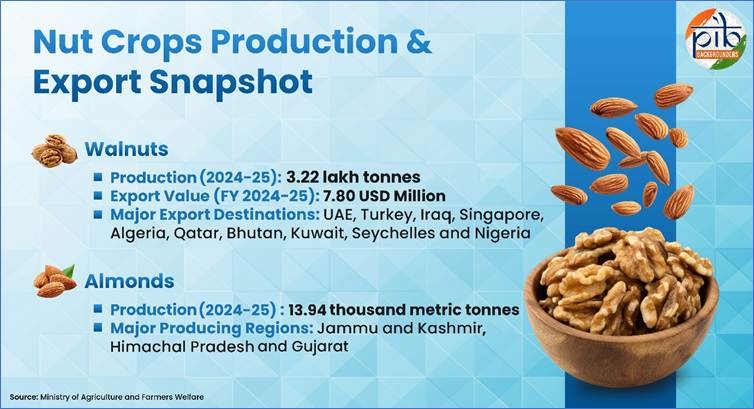
Almonds are another high-value temperate nut crop widely recognized for their nutritional and health benefits, particularly for cardiovascular and digestive health. According to the Horticulture Statistics Unit, DA&FW, India produced 13.94 thousand metric tonnes of almonds in 2024-25, with cultivation largely concentrated in Jammu and Kashmir, Gujarat, and Himachal Pradesh. Jammu and Kashmir accounts for more than 83 percent of the country’s production, with key processing and manufacturing hubs located across the Kashmir region.
Another important nut crop in the Himalayan region is Chilgoza (Pine nut), which produces the highly valued Chilgoza pine nuts. Often referred to as the “Champion of the Rocky Mountains,” this crop is an important source of livelihood for tribal communities in the Kinnaur district of Himachal Pradesh. Chilgoza pine grows in the inner arid valleys of the north-western Himalayas, a region characterised by low rainfall and heavy winter snowfall, making the species both ecologically adapted and economically important for local communities. The nuts are highly nutritious and commonly consumed raw or roasted, and they are valued for their high content of healthy unsaturated fats that help improve lipid profiles and support heart health.
To promote high-density cultivation of walnuts, almonds, and pine nuts, and to rejuvenate old and low-yielding orchards, the Union Budget 2026-27 has proposed a dedicated programme to enhance farmer incomes and encourage value addition through the participation of rural youth.
Conclusion
The Union Budget 2026-27 marks a strategic shift towards crop-specific and regionally aligned strategies for promoting high value agriculture in India. The focus on coastal plantation crops such as coconut, cashew, cocoa and sandalwood, alongside initiatives to strengthen agarwood cultivation in the North-Eastern states and support nut crops and floriculture in hilly and diversified agro-ecological regions, reflects an effort to leverage local agro-climatic advantages. Complementary measures, including institutional support, export-oriented interventions, and productivity enhancement programmes, further underscore the growing role of horticulture in advancing agricultural development. Collectively, these initiatives position high-value crops as a key pathway for diversification, value addition, and enhanced farmer incomes within India’s evolving agricultural landscape.
References
Cabinet Committee on Economic Affairs (CCEA)
https://www.pib.gov.in/PressReleasePage.aspx?PRID=2202999®=3&lang=1
Ministry of Finance
https://www.pib.gov.in/PressReleasePage.aspx?PRID=2219960®=3&lang=1
https://www.pib.gov.in/PressReleasePage.aspx?PRID=2221410®=3&lang=2
https://www.indiabudget.gov.in/doc/budget_speech.pdf
https://www.indiabudget.gov.in/economicsurvey/doc/echapter.pdf
Ministry of Agriculture and Farmers Welfare
https://agriwelfare.gov.in/Documents/AR_Eng_2024_25.pdf
https://agriportal.cg.nic.in/horticulture/HortiEn/Default.aspx
https://coconutboard.gov.in/docs/icj/icj-2025-11.pdf
https://coconutboard.gov.in/Statistics.aspx
https://coconutboard.gov.in/docs/icj/icj-2026-01.pdf
https://coconutboard.gov.in/docs/operational-guidelines.pdf
https://coconutboard.gov.in/docs/FPO-concept-note.pdf
https://coconutboard.gov.in/ProducerSocieties.aspx
https://ccari.res.in/dss/Orchids.html
https://www.pib.gov.in/PressReleasePage.aspx?PRID=1810905®=3&lang=2
Coastal Agricultural Resource Inventory.pdf
https://www.agriwelfare.gov.in/en/StatHortEst
Ministry of Commerce and Industry
https://apeda.gov.in/cashew
https://www.ibef.org/exports/cashew-industry-india
https://agriexchange.apeda.gov.in/
https://apeda.gov.in/CocoaProducts
https://agriexchange.apeda.gov.in/Production/India/Details?HSCode=NMVQ&product_Name=`%C2%8C%C2%80%C2%8C~&Category=m%C2%89~%C2%8B%C2%91~%C2%91%C2%86%C2%8C%C2%8B%C2%90
https://apeda.gov.in/Walnuts
https://agriexchange.apeda.gov.in/Production/India/Details?HSCode=NMSN&product_Name=t~%C2%89%C2%8B%C2%92%C2%91&Category=c%C2%8F%C2%92%C2%86%C2%91%C2%90
https://agriexchange.apeda.gov.in/Production/India/Details?HSCode=NMPU&product_Name=^%C2%89%C2%8A%C2%8C%C2%8B%C2%81&Category=c%C2%8F%C2%92%C2%86%C2%91%C2%90
https://agriexchange.apeda.gov.in/Production/India/Details?HSCode=NMPQ&product_Name=l%C2%8F%C2%80%C2%85%C2%86%C2%81%C2%90&Category=c%C2%89%C2%8C%C2%8F%C2%86%C2%80%C2%92%C2%89%C2%91%C2%92%C2%8F%C2%82
Ministry of Environment, Forest & Climate Change
https://iwst.icfre.gov.in/database/SIS/introduction.html
https://bsi.gov.in/uploads/documents/NonDetriment%20Findings%20(NDFs)/NDF%20Study%20Report%20of%20Aquilaria%20malaccensis%20(Agarwood)%20in%20India.pdf
https://www.pib.gov.in/PressReleasePage.aspx?PRID=2179422®=3&lang=2
Climate-Change-and-the-Vulnerable-Indian-Coast_compressed.pdf
Ministry of Development of North Eastern Region
https://necouncil.gov.in/sites/default/files/Final%20Report-%20Action%20Plan%20on%20value%20Chain%20Development%20of%20Horticulture-Fruits%20%26%20Vegetables%20Sector%20in%20NER.pdf
https://www.pib.gov.in/PressReleseDetail.aspx?PRID=2218232®=3&lang=1
https://www.pib.gov.in/PressReleasePage.aspx?PRID=2205285®=3&lang=2
Ministry of Science & Technology
https://himcoste.hp.gov.in/RnD_Website/Research%20and%20development%20Projects/Chilgoza%20Booklet.pdf
United Nations
https://www.fao.org/4/ac451e/ac451e0b.htm
https://www.fao.org/faostat/en/#rankings/countries_by_commodity
https://www.fao.org/faostat/en/#data/QCL
PIB Backgrounder
https://www.pib.gov.in/PressNoteDetails.aspx?ModuleId=3&NoteId=155126&id=155126&utm_®=3&lang=2
https://www.pib.gov.in/FactsheetDetails.aspx?id=150334®=3&lang=2
See In PDF
PIB Research
(Release ID: 2253483)
Visitor Counter : 13437