Ministry of Communications
Union Minister Shri Jyotiraditya M. Scindia releases revised guidelines for Technology Development and Investment Promotion (TDIP) Scheme to strengthen India’s global telecom footprint
₹203 crore outlay for 2026–31 to boost participation in global standards, support indigenous innovation and accelerate 6G ecosystem development
Expanded scope to support for participation of startups, and MSMEs in global standardization; support for pilot projects and proof-of-concept initiatives for real world deployment
Posted On:
22 APR 2026 7:11PM by PIB Delhi
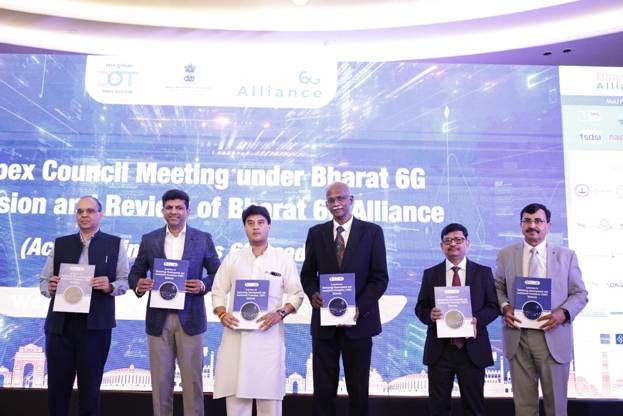
The Union Minister of Communications and Development of North Eastern Region, Shri Jyotiraditya M. Scindia, today released the revised guidelines for the Technology Development and Investment Promotion (TDIP) Scheme of the Department of Telecommunications, aimed at strengthening India’s participation in global telecom standardization and accelerating the development of indigenous telecom technologies. Union Minister of State for Communications and Rural Development, Dr. Chandra Sekhar Pemmasani; Secretary (Telecommunications) and Chairman, Digital Communications Commission, Shri Amit Agrawal also attended the event.
The revised TDIP Scheme, with a total outlay of ₹203 crore for the period 2026–31, has been designed as a comprehensive support framework to enable Indian entities to actively contribute to global standards, promote innovation, and enhance India’s competitiveness in next-generation telecommunications technologies, including 5G Advanced and 6G.
Strengthening India’s Role in Global Telecom Standardization
The scheme seeks to enhance India’s representation and influence in leading international telecom standardization bodies such as the International Telecommunication Union (ITU), 3GPP and oneM2M. It provides financial support to Indian stakeholders for participation in global meetings, submission of technical contributions, leadership roles in study groups, and hosting of international standardization events in India.
By enabling sustained and structured engagement with global standards bodies, the scheme aims to position India as a key contributor to the development of future telecom technologies and ensure alignment of domestic innovation with global frameworks.
The scheme also seeks to promote investment and market access for Indian telecom technologies by enabling their integration into globally accepted standards. By supporting Indian contributions in international standardization processes and facilitating their adoption, the scheme aims to strengthen India’s position from a technology participant to a global standard-setter, while driving creation of intellectual property, enhancing export potential and improving competitiveness of domestic telecom products and solutions.
Expanded Scope for Ecosystem Participation
The revised guidelines significantly expand the scope of the scheme to include startups, MSMEs, academia, research institutions, telecom service providers and industry players. This broader inclusion is expected to deepen ecosystem participation and foster collaborative innovation across the telecom value chain.
The scheme also supports pilot projects, proof-of-concept initiatives and technology demonstrations to facilitate transition from research to real-world deployment, thereby strengthening the innovation pipeline.
Institutional Framework for Implementation
The scheme will be implemented through designated agencies, including the Telecommunications Standards Development Society, India (TSDSI), Telecom Centres of Excellence, India (TCoE) and Telecommunications Consultants India Limited (TCIL), which will facilitate coordination, capacity building and effective utilization of resources.
These institutions will play a key role in mobilizing industry participation, supporting technical contributions, and enabling structured engagement with global telecom ecosystems.
Driving Indigenous Innovation and Global Competitiveness
This scheme complements other initiatives of the Department of Telecommunications, including the Telecom Technology Development Fund (TTDF) and the Bharat 6G Mission, in creating a comprehensive framework for next-generation telecom research, development and deployment.
The release of the revised TDIP Scheme guidelines marks a significant step towards strengthening India’s presence in global telecom standardization processes and accelerating the development of indigenous next-generation technologies. The scheme is expected to play a pivotal role in positioning India as a global leader in 6G and future communication systems.
***
NJ/ARJ
(Release ID: 2254633)
Visitor Counter : 5383