PIB Backgrounder
Rashtriya Panchayati Raj Diwas
Strengthening Grassroots Democracy in India
Posted On:
24 APR 2026 12:07PM by PIB Delhi
|
Panchayati Raj Institutions form the backbone of India’s grassroots democracy and have deep historical roots in village self-governance. They were strengthened by the 73rd Constitutional Amendment in 1993. With over 2.5 lakh Panchayats and 24.04 lakh elected representatives, including 49.75% women, local governance has become more inclusive. Digital interventions and platforms like eGramSwaraj, Meri Panchayat, Panchayat NIRNAY, AuditOnline, SVAMITVA, Gram Manchitra, SabhaSaar, Local Government Directory, Training Management Portal and Gram Urja Swaraj are improving transparency and efficiency. Strong funding support, capacity building, and scheme like Rashtriya Gram Swaraj Abhiyan (RGSA) further enhance capacity building, participatory planning and sustainable development.
|
Local Self-Governance and Power Decentralisation in India
National Panchayati Raj Diwas is observed every year on 24th April across the nation. This day commemorates the establishment of the Panchayati Raj System as a formal structure of local self-governance. It marks the implementation of the 73rd Constitutional Amendment Act, 1992, which came into force in 1993. This amendment granted constitutional status to Panchayati Raj Institutions. The provisions related to Panchayats are laid down in Part IX of the Constitution of India.
|
On this occasion, the Panchayat Advancement Index (PAI)–2.0 is being launched at Vigyan Bhawan, New Delhi along with three illustrated publications under the Panchayat Dharohar Initiative. A monograph on the rural heritage of Tripura, a monograph on the rural heritage of Tirupati, and Uttarkashi: Saumya Kashi – The Soul of Himalayan Heritage.
|
The Panchayati Raj system strengthens democracy at the local level. It enables social and political empowerment by bringing governance closer to the people. Across the country, there are more than 2.5 lakh Panchayats, comprising about 24.04 lakh elected representatives. Notably, women constitute approximately 49.75% of these representatives, reflecting a significant shift towards inclusive local governance.
The importance of this system is best seen in everyday life. In many villages, small needs like repairing a handpump, building a drainage system, or fixing a school classroom directly affect daily living. Earlier, such issues often waited for long approvals from distant offices. With Panchayati Raj Institutions, decision-making has moved closer to the people.
|
Historical Background of Panchayati Raj System
The Panchayati Raj System has roots in ancient India, where village assemblies (sabhas and samitis) managed local affairs. During British rule, this system weakened due to centralized administration. After independence, the need for decentralized governance led to the recommendation of the Balwant Rai Mehta Committee (1957), which proposed a three-tier Panchayati Raj structure. Rajasthan became the first state to implement it in 1959. This system was formally strengthened by the 73rd Constitutional Amendment Act, granting constitutional status to Panchayats and making Panchayati Raj institutions mandatory.
|
Structure and Objectives of Panchayati Raj Institutions
The Panchayati Raj system is based on the principle of decentralisation. Power is transferred from central and state governments to elected representatives at the village level.
The system operates through a three-tier structure:
- Gram Panchayat (GP): The first level is the Gram Panchayat, which functions at the village level. It is responsible for basic civic administration and local development activities such as water supply, sanitation, street lighting, and maintenance of village infrastructure.
- Block Panchayat (BP): The second level is the Block Panchayat, which functions at the intermediate level. It coordinates development plans across multiple villages and ensures better implementation of government schemes.
- District Panchayat (DP): The third level is the District Panchayat, which operates at the district level. It supervises and integrates development activities across blocks and ensures effective planning and resource allocation.
This structure ensures that governance is not just concentrated at the higher levels but is distributed closer to the people. This allows for better understanding of local needs. These bodies are elected and are responsible for local planning, infrastructure, public services, and welfare programs.
|
Gram Sabha: Foundation of Local Democracy
The Gram Sabha is the general body of all registered voters in a village and represents the most direct form of democracy. It is the only permanent unit in the Panchayati Raj system and is not constituted for a particular period. Although it serves as the foundation of the Panchayati Raj, it is not among the three tiers. The powers and functions of Gram Sabha are fixed by state legislature by law. It approves development plans, monitors expenditure, ensures transparency, and provides a platform for villagers to raise issues and participate in decision-making. Based on direct participation, it strengthens accountability and ensures every voter has the right to attend meetings and express opinions.
|
Objectives of Panchayati Raj System
The Panchayati Raj System is guided by a set of core objectives aimed at strengthening local governance and improving developmental outcomes:
- Ensuring active participation of people in the planning and implementation of development programmes.
- Enhancing accountability by making elected representatives directly answerable to local communities.
- Improving the efficiency and responsiveness of public service delivery in rural areas.
- Enabling more targeted and effective implementation of government schemes through local institutions.
- Promoting inclusive development by ensuring representation of marginalised groups, including women, Scheduled Castes, and Scheduled Tribes.
Initiatives to Strengthen Panchayati Raj System
Over the years, the Government has introduced several initiatives to strengthen Panchayati Raj Institutions and improve their functioning both on the ground and in the digital sphere. Panchayati Raj Institutions are undergoing rapid digital transformation, improving transparency, efficiency, and accountability. Over 95% of villages now have 3G/4G connectivity, strengthening last-mile service delivery. Common Service Centres, run by over 6.5 lakh Village Level Entrepreneurs (VLEs), provide easy access to digital services. Around 2.18 lakh Gram Panchayats are service-ready, with nearly 2.14 lakh already connected.
To build on this progress, the Government has launched several initiatives that enhance efficiency, expand access, and empower rural communities.
Flagship Digital & Technological Initiatives
SVAMITVA Scheme: Empowering Rural India through Technology
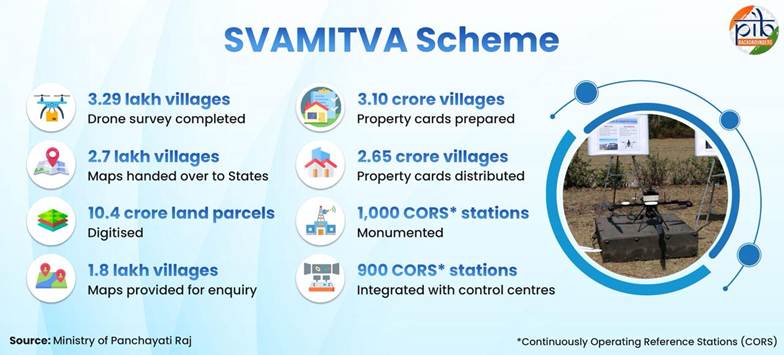
The SVAMITVA (Survey of Villages Abadi and Mapping with Improvised Technology in Village Areas) Scheme is a central sector initiative of the Government of India, launched on 24th April 2021. It aims to provide legal ownership rights to rural households by mapping inhabited village areas using drone and GIS technology and issuing property cards. The scheme uses CORS (Continuously Operating Reference Stations), which are permanently fixed ground stations that receive satellite signals to provide highly accurate location data. These stations are integrated with control centres where data is processed to support precise mapping.
The scheme seeks to create accurate land records, reduce disputes, and enable villagers to use property as a financial asset. It also supports Gram Panchayat-level planning and strengthens rural governance.
Key Highlights:
- As on 11th March 2026, drone survey has been completed in 3.29 lakh villages out of the targeted 3.44 lakh villages.
- 3.10 crore property cards have been prepared for 1.87 lakh villages and 2.65 crore cards have been distributed.
SabhaSaar: AI-Powered Meeting Documentation
SabhaSaar is an AI-based tool developed that automatically prepares minutes of Gram Sabha meetings. It converts audio and video recordings into structured documentation using Artificial Intelligence and Natural Language Processing. It reduces manual workload and strengthens monitoring, improved service delivery, and accountability in local governance.
The tool supports 23 regional languages through integration with Bhashini, the Government’s national language translation platform.
As on January 2026, SabhaSaar has been used by more than 1 lakh Gram Panchayats.
eGramSwaraj – Digital Platform for Panchayats
eGramSwaraj is a user-friendly web portal that improves transparency in planning, progress reporting, financial management, and tracking of assets in Panchayats. It is linked with the Public Financial Management System (PFMS), which allows online transfer of Central Finance Commission funds from States to Panchayati Raj Institutions. This also enables Panchayats to make real-time payments to vendors and service providers, making the system faster and more transparent. The platform is available in 22 Indian languages, strengthening accessibility and adoption at the grassroots level.
Key Highlights (2025–26):
- Over 2.55 lakh Gram Panchayats uploaded their development plans on the platform
- Over 2.59 lakh Gram Panchayats onboarded Public Financial Management System (PFMS) integration
- Panchayati Raj Institutions transferred ₹53,342 crores through the eGramSwaraj-PFMS interface
- Over 2.50 lakh Panchayati Raj Institutions made online payments
- Over 1.6 crore vendors registered on the platform, reflecting its scale and widespread adoption
Gram Urja Swaraj, under eGramSwaraj, is a digital dashboard that tracks renewable energy assets at the Gram Panchayat level in real time. It currently covers 2,080 Gram Panchayats, of these, 2,020 use solar energy, 60 use hydel (water) power, 69 use wind energy, and 106 use biogas systems, strengthening transparency and data-driven governance. Panchayats are also integrated with the Government e-Marketplace (GeM) for efficient procurement, alongside regular capacity-building programmes for better governance and implementation.
Meri Panchayat: Digital Platform for Transparent Rural Governance
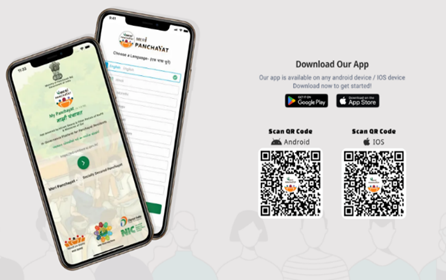
The Meri Panchayat App is an integrated m-Governance platform designed and developed by the National Informatics Centre (NIC). It aims to empower rural communities by improving better governance, accountability, and citizen participation in Panchayat affairs.
The initiative aligns with the government’s commitment to strengthen local self-governance and achieve the Sustainable Development Goals (SDGs) by 2030.
The app is powered by e-Gram Swaraj and other portals of the Ministry of Panchayati Raj (MoPR) and various ministries.
Capacity Building & Training
Rashtriya Gram Swaraj Abhiyan (RGSA)
The Rashtriya Gram Swaraj Abhiyan (RGSA) is a centrally sponsored scheme aimed at strengthening Panchayati Raj Institutions through capacity building, institutional development, and infrastructure support.
The main objectives of the Rashtriya Gram Swaraj Abhiyan (RGSA) are:
- Build leadership skills of elected Panchayat members so Gram Panchayats can work effectively.
- Develop governance capabilities of PRIs to deliver on the Sustainable Development Goals (SDGs) through local interventions.
- Strengthen Gram Sabhas to increase people’s participation in local governance.
- Use technology and e-governance to enhance accountability and services.
- Give more powers and responsibilities to Panchayats as per the Constitution and the PESA Act, 1996.
Key Achievements (2025–26) include:
- Over 45 lakh participants were provided training, including elected representatives and Panchayat functionaries.
- Exposure visit of 33,142 participants were conducted for cross learning.
- 632 Panchayat Learning Centres were set up to enhance the outreach of training and cross learning.
- 1,087 Gram Panchayat Bhawans constructed and computers were procured to strengthen Panchayat infrastructure.
Model Women-Friendly Gram Panchayat (MWFGP)
The Model Women-Friendly Gram Panchayat (MWFGP) is an institutional initiative aimed at strengthening women’s leadership in local governance. It focuses on building inclusive and gender-sensitive Panchayats that ensure women’s participation along with safety, rights, and empowerment at the grassroots level.
The programme is aligned with the localisation of the Sustainable Development Goals (SDGs). States and Union Territories are encouraged to begin with Theme 9: Women-Friendly Panchayat, under which one Panchayat in each district is developed as a model.
To support implementation, capacity-building has been strengthened to support awareness, guidance, and on-ground execution, promoting stronger and more effective women-led local governance.
Strengthening the Capacity of Elected Women Representatives (EWRs)
The Government has launched “Sashakt Panchayat–Netri Abhiyan” to enhance leadership, communication, and decision-making skills of Elected Women Representatives (EWRs). The focus is on practical and interactive learning for real governance situations.
As part of this effort, Ministry has launched a Special Training Module aimed at strengthening the leadership, communication, and negotiation skills of Women Elected Representatives (WERs). Designed as an interactive, game-based learning experience, the module combines theoretical inputs with practical skill-building to enable more effective participation in grassroots governance. So far, 1,48,904 Women Elected Representatives have been trained under this specialised module, contributing to enhanced confidence, decision-making capacity, and leadership at the Panchayat level.
Model Youth Gram Sabha (MYGS)
The Model Youth Gram Sabha (MYGS) is an initiative launched to actively engage India’s youth in grassroots democracy. It is implemented in collaboration with the Department of School Education and Literacy (DoSEL) and the Ministry of Tribal Affairs (MoTA). The initiative involves students of Classes 9 and 10 from Jawahar Navodaya Vidyalayas (JNVs) and Eklavya Model Residential Schools (EMRSs). They participate in mock Gram Sabha and Panchayat meetings. This helps them understand how local governance works.
The initiative aligns with the vision of Digital India, Good Governance, and Atmanirbhar Bharat, promoting participatory democracy among youth. It supports the broader goal of building empowered, self-reliant, and development-oriented Panchayats under the vision of Viksit Bharat.
Empowering Tribal Communities through PESA Implementation
The Provisions of the Panchayats (Extension to the Scheduled Areas) Act, 1996 (PESA Act) extends the provisions of panchayats to the Scheduled Areas, strengthening Gram Sabha-led governance across tribal regions. It covers 10 States, reaching 77,564 villages, 22,040 Panchayats, and 664 Blocks. PESA spans across 45 districts in their entirety, and to 63 districts in part, where only selected areas fall under its jurisdiction. This structure supports decentralised, community-driven governance.
PESA Act is applicable to Fifth Schedule areas of 10 States - Andhra Pradesh, Chhattisgarh, Gujarat, Himachal Pradesh, Jharkhand, Madhya Pradesh, Maharashtra, Odisha, Rajasthan and Telangana. Nine States have notified their State PESA Rules, except Odisha.
To strengthen implementation, a Centre of Excellence on PESA has been established at the Indira Gandhi National Tribal University (IGNTU), Amarkantak. The initiative focuses on customary practices, model Gram Sabhas, IEC materials in tribal languages, and best practices documentation, supported by a Programme Advisory Board.
Institutional Strengthening and Field Support
During Financial Year 2025-26, under RGSA, all 10 PESA States appointed dedicated staff at State, District, Block, and Gram Panchayat levels. More than 12,500 personnel are currently engaged in on-ground implementation of PESA.
Capacity Building and Knowledge Sharing
- 1744 training programmes conducted across PESA States during FY 2025-26
- 1,03,384 participants trained, including:
- 11,712 at State level
- 40,467 at District level
- 51,205 at Block level
- Jharkhand alone trained 47,242 participants, reflecting strong grassroots outreach
In addition, State-level Master Trainer programmes covered key themes such as Gram Sabha strengthening, Minor Forest Produce (MFP), minor minerals, land alienation, money lending, intoxicants regulation, and customary dispute resolution.
40 best practices of Gram Sabhas related to PESA have been published as “PESA in Action: Stories of Strength and Self Governance.” The compendium has been translated in Hindi, 4 regional and 4 major tribal languages.
Financial & Economic Strengthening
Rural governance in India has been strengthened through increased fiscal decentralisation and rising public investment in Panchayati Raj Institutions (PRIs). Under the 15th Finance Commission (2021–26), about ₹2.36 lakh crore was recommended for Rural Local Bodies, including Gram, Block, and District Panchayats. This has further increased to nearly ₹4.35 lakh crore under the 16th Finance Commission (2026–31), significantly enhancing local financial autonomy.
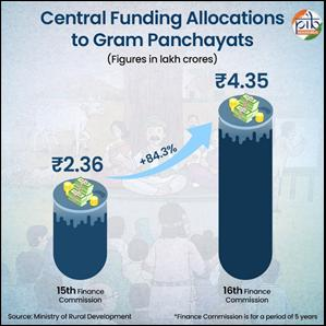
These funds are provided as untied grants for local needs and tied grants for basic services like sanitation and drinking water, ensuring flexibility along with accountability.
Rural development funding has also seen a sharp rise, with Union Budget allocations increasing by over 211% in the last decade, from ₹87,765 crore (2016–17) to ₹2.73 lakh crore (2026–27). This has strengthened convergence with schemes such as the Viksit Bharat- G RAM G Act, 2025 (earlier MGNREGA), Jal Jeevan Mission, and Swachh Bharat Mission, improving infrastructure and service delivery at the village level.
Overall, higher Finance Commission transfers and increased budgetary support have made rural governance more financially empowered, autonomous, and development-oriented.
Democracy at the Grassroots: Closing Note
Panchayati Raj Institutions embody participatory democracy in India, evolving from village assemblies into constitutionally empowered units of local self-governance. They drive inclusive development by aligning governance with grassroots needs and aspirations. Celebrating National Panchayati Raj Day highlights their role in strengthening local democracy and participation. Overall, they have made rural governance more responsive and accountable, reinforcing that national progress rests on empowered, self-reliant villages.
References
Ministry of Panchayati Raj
20260224312681468.pdf
https://panchayat.gov.in/notice/%e0%a4%b5%e0%a4%be%e0%a4%b0%e0%a5%8d%e0%a4%b7%e0%a4%bf%e0%a4%95-%e0%a4%b0%e0%a4%bf%e0%a4%aa%e0%a5%8b%e0%a4%b0%e0%a5%8d%e0%a4%9f-2025-26/
https://egramswaraj.gov.in/welcome.do?language=en
https://panchayat.gov.in/en/document/booklet-on-empowering-panchayati-raj-institutions-english/
https://panchayat.gov.in/en/document/booklet-on-9-year-achievements-of-mopr-english/
https://egramswaraj.gov.in/
https://meetingonline.gov.in/homepage
https://gpdp.nic.in/
https://panchayatcharter.nic.in/#/
https://egramswaraj.gov.in/urjaDashboard.do
https://panchayataward.gov.in/
Election Commission for UTs
https://secforuts.mha.gov.in/73rd-amendment-of-panchayati-raj-in-india/
LOK SABHA Questions
AU1825_2FBwha.pdf
https://www.google.com/url?sa=t&source=web&rct=j&opi=89978449&url=https://sansad.in/getFile/loksabhaquestions/annex/187/AU2828_Qx1TQC.pdf%3Fsource%3Dpqals&ved=2ahUKEwiYrJikrfyTAxWh8TgGHbalOwAQFnoECDkQAQ&usg=AOvVaw2L-HUd3O5GQDEQJ8h90l5y
RAJYA SABHA Questions
https://sansad.in/getFile/annex/270/AU2968_3lmOEq.pdf?source=pqars
Press Information Bureau
https://www.pib.gov.in/PressReleaseDetail.aspx?PRID=2226322®=20&lang=1
https://www.pib.gov.in/PressReleaseDetail.aspx?PRID=2247709®=1&lang=1
https://www.pib.gov.in/PressReleasePage.aspx?PRID=2209532®=3&lang=1
https://www.pib.gov.in/PressNoteDetails.aspx?NoteId=157722&ModuleId=3®=5&lang=16
https://www.pib.gov.in/PressReleasePage.aspx?PRID=2209532®=3&lang=1
https://panchayat.gov.in/en/e-gramswaraj/?utm_
https://www.pib.gov.in/PressReleasePage.aspx?PRID=2209532®=3&lang=1
https://www.pib.gov.in/PressReleasePage.aspx?PRID=2247156®=3&lang=1
https://www.pib.gov.in/PressReleseDetailm.aspx?PRID=2223118®=3&lang=2#:~:text=Similarly%2C%20Panchayat%20NIRNAY%20is%20an,of%20Gram%20Sabhas%20by%20Panchayats
Others
https://www.newsonair.gov.in/ministry-of-panchayati-raj-begins-two-day-pesa-mahotsav-in-visakhapatnam/
https://www.google.com/url?sa=t&source=web&rct=j&opi=89978449&url=https://secforuts.mha.gov.in/73rd-amendment-of-panchayati-raj-in-india/&ved=2ahUKEwiYrJikrfyTAxWh8TgGHbalOwAQFnoECDoQAQ&usg=AOvVaw1YOB5dc18YogAhCdXxkkGj
See In PDF
PIB Research Unit
(Release ID: 2255182)
Visitor Counter : 5280