PIB Backgrounder
Census 2027: India’s First Digital Enumeration Exercise
Posted On:
25 APR 2026 10:33AM by PIB Delhi
- Census 2027 will mark India’s first digital enumeration, leveraging mobile-based data collection to enable faster and more efficient nationwide data availability.
- The Cabinet Committee on Political Affairs, in its meeting on 30th April 2025, decided to include caste enumeration in the Census 2027.
- Backed by a strong institutional framework and ₹11,718.24 crore outlay, extensive preparatory measures - including training, pre-test, and administrative readiness - to ensure smooth nationwide implementation.
- With secure Critical Information Infrastructure (CII)-designated data centres and a large workforce - Census 2027 will deliver reliable data for targeted and inclusive policymaking.
Introduction
Census is the process of collecting, compiling, analyzing and disseminating demographic, social, cultural and economic data relating to all persons in the country or a designated area. The wealth of information collected through census makes it the richest source of data for planners, administrators, research scholars and other data users. Census serves as a critical foundation for governance, enabling informed decision-making across political, social, and economic domains. Census data enables informed policy making that are inclusive, targeted, and aligned with the diverse needs of the population.
The earliest references to conducting census in the country can be found in Kautilya’s Arthashastra (321-296 BC) and later in the writings of Abul Fazl in ‘Ain-e-Akbari' during the days of Emperor Akbar. The first modern population census in India was conducted between 1865 and 1872, though it didn't happen simultaneously across all regions. India conducted its first synchronous census in 1881. Since then, the Indian census has been providing reliable, time-tested data on various aspects of the population through extensive exercises held every 10 years. Each successive census refined its methods, increased coverage, and modified questions to better understand the population.
Census 2027 will be the 16th in the series of Indian census and 8th since independence. This will be the largest census exercise in the world and marks a major step forward with digital integration, strengthened data security, and streamlining processes, reinforcing evidence-based policymaking. It introduces several pioneering features, including mobile-based data collection, near real-time monitoring through the Census Management & Monitoring System (CMMS) portal, an optional self-enumeration facility, and extensive use of geo-referenced jurisdictions. Comprehensive caste enumeration will be done during the Population Enumeration phase.
Supported by advanced digital tools, the exercise aims to deliver faster, more accurate, and granular data while ensuring the highest standards of data security and public participation.
|
Historical Background of Indian Census
India’s Census has evolved into the world’s largest administrative and statistical exercise. The first population count was conducted during 1865-1872, followed by the first synchronous nationwide Census in 1881. Indian Census has since been conducted decennially. However, the Census due in 2021 could not be undertaken on schedule due to the COVID-19 pandemic. The Census 2027 will therefore mark the next enumeration in the series, and is the 16th Indian Census overall and the 8th since Independence.
|
Institutional and Legal Architecture of Census 2027
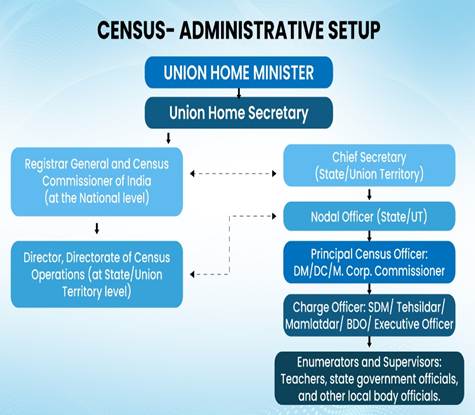
The Census 2027 is anchored in a robust institutional and administrative framework that ensures consistency, credibility, and nationwide uniformity in data collection. Post-independence, the Census is governed by the Census Act, 1948, and the Census Rules, 1990, ensuring a strong legal and institutional framework. The Census is a Union subject under the Seventh Schedule (listed at serial number 69) of the Constitution. As a Union subject, the exercise is centrally coordinated while implemented in close collaboration with State and Union Territory governments, enabling seamless execution across diverse regions.
The framework also guarantees strict confidentiality of individual data, reinforcing public trust and participation. The Census Act contains a significant provision - Section 15, under which personal information provided by people is treated as strictly confidential. It cannot be made public under the RTI Act, used as evidence in any court of law, or shared with any institution.
The intent of the Government to conduct the Population Census 2027 was notified in Gazette of India on 16th June, 2025. The Union Cabinet has approved a financial outlay of ₹11,718.24 crore for its implementation.
Two-Phase Enumeration Strategy and Reference Timeline
Census 2027 will be conducted in a structured two-phase format to ensure comprehensive and systematic data collection across the country.
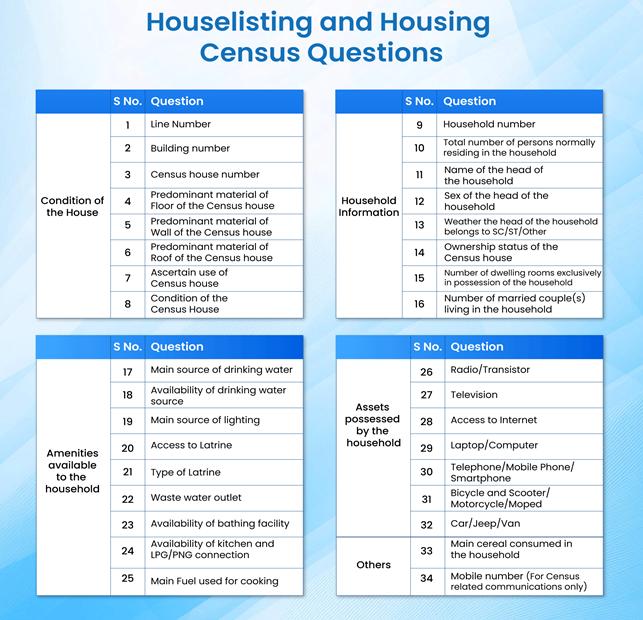
- Phase I: Houselisting and Housing Census (HLO) is scheduled between April and September 2026. It will be held in a period of 30 days in each State/ UT, as per the convenience of the State/UT Governments. There will also be an option of Self-enumeration during a 15-day period just before the 30-day period of house-to-house HLO work. This phase will gather detailed information on housing conditions, availability of amenities, and assets possessed by households, while also creating the essential frame for the subsequent phase.
- Phase II: Population Enumeration (PE) is scheduled for February 2027 and will focus on capturing detailed demographic, socio-economic, cultural, migration, and fertility-related information of individuals across households. As decided by the CCPA, enumeration of Castes will also be done during the second phase of Census. For UT of Ladakh and snow-bound non-synchronous areas of UT of Jammu and Kashmir and States of Uttarakhand and Himachal Pradesh, Phase II will be conducted during September 2026. Exact dates of the Population Enumeration and questions will be notified in due course.
Questions for the Houselisting and Housing Census
The Government has already notified a comprehensive set of questions for Phase I or the Houselisting and Housing Census phase in January 2026.
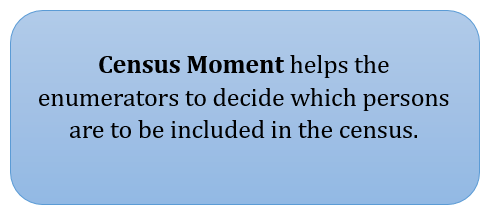
The Reference Date for Census 2027 has been fixed as 00:00 hours of March 1, 2027. For UT of Ladakh and snow-bound areas of UT of Jammu & Kashmir and States of Himachal Pradesh and Uttarakhand, the reference date will be 00:00 hours of October 1, 2026. This point of time is also referred to as Census Moment.
Salient Features of the Census 2027
The Census 2027 is set to introduce several significant administrative and technological advancements to enhance the accuracy, efficiency, transparency and speed of the enumeration process. These initiatives will modernize the census operations and generate more comprehensive and timely demographic data for evidence-based policymaking.
Caste Enumeration
Caste enumeration has emerged as a major feature of the Indian Census 2027. Until the 2011 Census, the exercise included the systematic enumeration of only Scheduled Castes (SCs) and Scheduled Tribes (STs). However, following the decision of the Cabinet Committee on Political Affairs dated 30 April 2025, Census 2027 will also undertake caste enumeration.
First Census by Digital Means
Census 2027 will mark India’s first census by the digital means, and the government has already begun extensive preparations for its successful implementation.
Census Management & Monitoring System (CMMS) Portal
As part of these efforts, a dedicated portal, namely Census Management & Monitoring System (CMMS) portal, has been developed for managing and monitoring the entire Census process on a near real-time basis. Officers at Sub-district, District, State and National levels can track enumeration progress, field performance, and operational readiness through an integrated dashboard.
Houselisting and Housing Census (HLO) Mobile Application
This is a secure offline app for enumerators to collect and upload houselisting data, accessible only to those registered on the CMMS portal. It enables direct field-to-server data transmission, eliminating paperwork. It will work on Android and iOS platform in 16 regional languages.
Houselisting Block Creator (HLBC) Web Mapping Application
Another innovation for Census 2027 is HLB Creator web mapping application to be used by the Charge Officers. It will facilitate digital creation of Houselisting Blocks using satellite imagery, ensuring geographic coverage across the country without omission and duplication.
Self-Enumeration Portal
An optional 15-day Self-Enumeration period will precede the house-to-house field visit. The Self-Enumeration Portal is a secure web-based facility that allows eligible respondents within a household to submit their household information online prior to field operations. Upon successful submission, a unique Self-Enumeration ID (SE ID) will be generated. This SE ID is to be shared with the enumerator, on the basis of which enumerator will be able to confirm the information.
|
Self-Enumeration Facility
A major citizen-centric innovation in the Census 2027 is the introduction of self-enumeration facility with the following features:
- The facility is accessible via a dedicated online portal - https://se.census.gov.in/;
- It will be available in 16 languages (Assamese, Bengali, English, Gujarati, Hindi, Kannada, Konkani, Malayalam, Manipuri, Marathi, Nepali, Odia, Punjabi, Tamil, Telugu, and Urdu);
- Respondents can fill details independently, after which a unique Self-Enumeration (SE) ID will be generated;
- User Guide, Flow chart, FAQs, necessary ‘Tool Tips’, Tutorial video and validation checks for questions are provided in the Self-Enumeration Portal itself to ensure accuracy of data.
- Data will be confirmed and integrated by enumerators during field visits.
|
Conduct in Shortest Possible Time
By leveraging technology at every stage from collection to data processing, the endeavor would be to make the Census data available at the shortest possible time across the country. Efforts will also be made to disseminate Census results with more customized visualization tools.
Comprehensive Preparatory Framework for Seamless Implementation
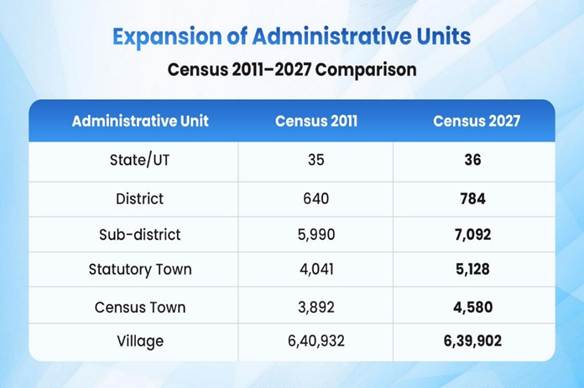
For providing a stable framework for enumeration activities, administrative units have been frozen as of 1 January 2026. A nationwide pre-test for phase-I covering around 5,000 census blocks was conducted in November 2025 to validate the methodology, digital tools and training systems.
To strengthen coordination and oversight, high-level meetings involving Chief Secretaries, State nodal officers, and Census officials were held in January 2026, alongside the completion of appointments of census functionaries at district and charge levels. Further, detailed instruction manuals have been prepared in 19 languages, supported by comprehensive guidelines and circulars to ensure consistency in implementation across regions.
In addition, a time-bound calendar of activities has been put in place to enable continuous monitoring and timely execution, thereby reinforcing the overall preparedness and administrative efficiency of the Census exercise.
Robust Data Security and Privacy Architecture
A comprehensive and multi-layered data security framework has been established for Census 2027 to safeguard the integrity and confidentiality of information at every stage. This includes:
- End-to-end encryption covering data collection, transmission and storage, along with secure transmission protocols to prevent unauthorized access.
- Data is hosted on certified and secure data centres, which have been designated as Critical Information Infrastructure (CII), ensuring heightened protection standards.
- Additionally, these systems comply with globally recognized ISO/IEC 27001:2022 standards, and are subject to regular security audits by reputed agencies.
Together, these measures ensure a resilient and secure data ecosystem for the Census exercise.
Capacity Building and Human Resource Preparedness
Human resource readiness forms a critical pillar of Census 2027, with extensive efforts directed towards training and capacity building. Approximately 31 lakh enumerators and supervisors, along with over 1 lakh census functionaries, have been mobilized to carry out the exercise efficiently. To equip them with the necessary skills, more than 80,000 training batches are being conducted for each phase, supported by phase-specific training modules. This structured approach aims to ensure high standards of data quality, accuracy, and operational efficiency throughout the Census process.
To complete various tasks for successful conduct of Census 2027, approximately 18,600 technical manpower will be engaged for about 550 days at the local levels. In other words, around 1.02 crore man-days employment would be generated.
Conclusion: Census as a Foundation for Future Governance
The Census remains a cornerstone of governance, providing reliable and comprehensive data for informed policymaking and inclusive development. It enables accurate assessment of population trends and ensures effective planning across sectors such as food, water, energy, and infrastructure. By offering granular insights at the local level, it helps in targeted delivery of government schemes and optimal resource allocation.
The upcoming Census 2027 is expected to further strengthen this framework by providing updated and detailed information. This will support more precise, data-driven planning and help address emerging challenges in a rapidly changing socio-economic landscape.
References:
Click here to see pdf
***
PIB Research
(Release ID: 2255461)
Visitor Counter : 77237