PIB Backgrounder
Small Hydro Power Development Scheme
Strengthening Energy Security for Sustainable Development
Posted On:
26 APR 2026 8:31AM by PIB Delhi
Key Takeaways
- India has harnessed around 5,171 MW of small hydro power, whereas the total estimated potential stands at 21,133.61 MW.
- Union Cabinet approved Small Hydro Power Development Scheme with ₹2,584.60 crore outlay.
- Scheme targets addition of ~1,500 MW small hydro power capacity across the country.
- Expected to generate 51 lakh person-days of employment during construction phase.
Introduction
Hydro Power, generated from the natural flow of water, is one of the most reliable and mature renewable energy sources in the world. Amid India’s rapidly evolving energy landscape, it plays a pivotal role in ensuring grid stability, energy security, and system resilience. Unlike intermittent sources such as solar and wind, hydro power provides firm, round-the-clock (RTC) electricity, along with the operational flexibility. As the country accelerates its transition towards a cleaner energy mix, Hydro Power remains indispensable.
Recognising this strategic importance, the Union Cabinet has approved the Small Hydro Power (SHP) Development Scheme that will support small hydro projects (between 1-25 MW capacity) to come up in different states. The scheme will especially benefit hilly and North Eastern states with high potential for such projects. The approval is for the period FY 2026–27 to FY 2030–31, with a total outlay of ₹2,584.60 crore. The scheme aims to unlock approximately 1,500 MW of new SHP capacity, with a strong focus on hilly regions and the North Eastern States rich in untapped small hydro potential and often constrained by energy access challenges. By promoting decentralised and locally generated power, the scheme seeks to deliver reliable electricity to remote and difficult-to-access regions while reducing dependence on conventional fuels.
Beyond energy generation, the initiative has the potential to catalyse inclusive growth. Small hydro projects, with their minimal ecological footprint, limited land requirements, and long operational life, offer a sustainable pathway for development. By fostering local investment, generating employment, and strengthening regional economies, the scheme is going to position small hydro as a cornerstone of India’s sustainable and self-reliant energy future.
|
Did You Know?
In India, the primary distinction between large and small hydropower projects lies in their installed capacity and the respective ministerial jurisdiction. Small Hydropower Projects (SHP) are defined as those with an installed capacity of up to 25 MW and are administered by the Ministry of New and Renewable Energy (MNRE). In contrast, large hydropower projects, with capacity exceeding 25 MW, fall under the purview of the Ministry of Power.
|
Key Features of the Small Hydro Power Development Scheme
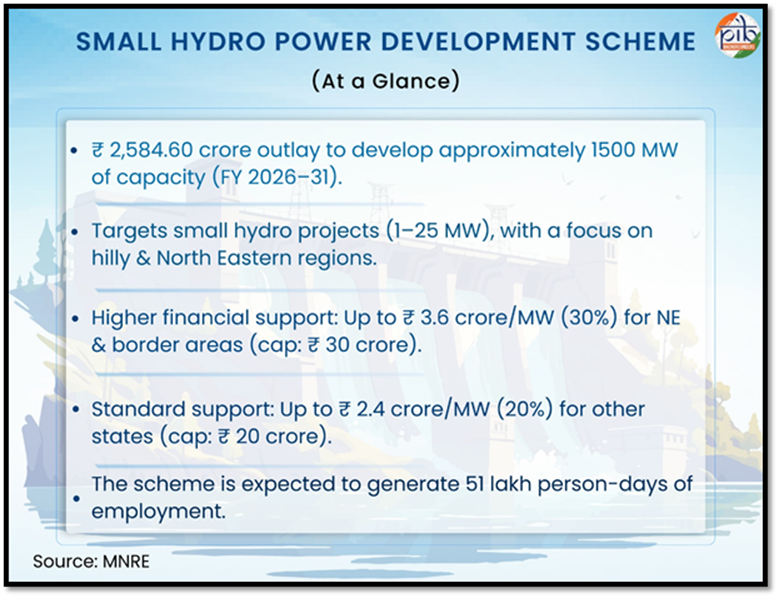
The scheme outlines a set of targeted measures to support implementation, improve project viability, and ensure a steady pipeline of SHP projects across regions. It focuses on addressing key constraints related to financing, project readiness, and execution, particularly in challenging geographies. Together, these measures are intended to enable faster and more efficient deployment of SHP capacity.
Financial Support Structure:
- Financial assistance to North Eastern States & International Border Districts of ₹3.6 crore per MW or 30% of project cost (whichever is lower), subject to a ceiling of ₹30 crore per project.
- Financial assistance to other locations of ₹2.4 crore per MW or 20% of project cost (whichever is lower), with a cap of ₹20 crore per project.
Investment and Economic Impact:
- The scheme is expected to attract investments of around ₹15,000 crore in the small hydro sector.
- It will also promote the use of indigenous plant and machinery, contributing to the vision of Atmanirbhar Bharat while boosting local manufacturing and supply chains.
Pipeline Development and DPR Support:
- To ensure long-term sector growth, the scheme provides support for the preparation of Detailed Project Reports (DPRs) for a minimum of 200 projects. An allocation of ₹30 crore has been made separately to assist central and state agencies in developing a strong future project pipeline.
Employment Generation:
- The scheme is expected to generate approximately 51 lakh person-days of employment during the construction phase. In addition, it will create sustained employment opportunities in the operation and maintenance of projects, particularly in rural and remote regions.
The approval of the SHP Development Scheme marks a significant step towards unlocking India’s untapped small hydro potential. By combining targeted financial support, infrastructure development, and sustainability, the scheme is set to strengthen clean energy capacity while driving inclusive growth in underserved regions.
Significance of Small Hydro Power for Sustainable Energy Development
Small hydro power plays a vital role in advancing clean, reliable, and decentralised energy in India. Particularly suited for remote and hilly regions, these projects utilise locally available water resources to generate electricity close to consumption centres. This not only improves energy access but also reduces dependence on long transmission networks and enhances overall efficiency.
- Decentralised and Efficient Power Supply: Located near demand centres, these projects minimise transmission losses, improve voltage stability, and ensure reliable power in geographically challenging areas, including border and hilly regions.
- Clean and Cost-Effective Energy Source: Small hydro power generates electricity without fuel consumption or emissions, making it a sustainable and economically viable long-term solution.
- Driver of Rural Development: By improving electricity access in underserved areas, these projects support infrastructure development and act as a catalyst for local economic growth.
- Employment and Livelihood Generation: They create both direct and indirect employment opportunities during construction and operation, while also promoting small-scale industries and self-employment.
- Environmentally Sustainable: With minimal land requirement and negligible displacement, small hydro power projects have a low ecological footprint and limited social impact. Their long operational life further strengthens their sustainability.
SHP offers a balanced solution that combines energy security with sustainable development. By delivering reliable, round-the-clock power and strengthening grid resilience, especially in remote areas, they contribute significantly to inclusive growth. Their ability to integrate environmental sustainability with socio-economic benefits makes them a key component of India’s clean energy transition.
Small Hydro Power Potential and Prospects in India
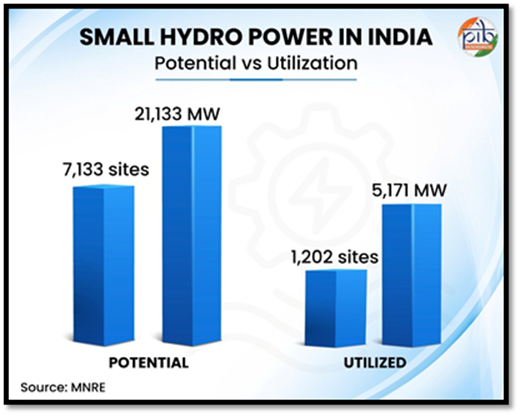
SHP is emerging as a vital and reliable component of India’s clean energy transition. It is particularly well-suited for hilly, remote, and difficult terrains where decentralised generation can deliver sustainable power, enhance energy access, and support local livelihoods.
India possesses a significant SHP potential of 21,133.61 MW across 7,133 identified sites. As of early 2026, approximately 5,171 MW (around 24.5%) has already been harnessed, demonstrating steady progress. The remaining over 15,960 MW represents a substantial opportunity for accelerated development through focused policy support and public-private collaboration.
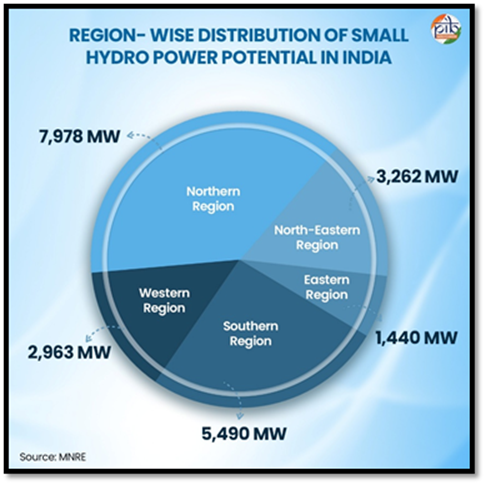
The regional distribution of this potential further reflects India’s rich geographical diversity and offers unique strengths across the country. The Northern region has 7,978 MW of SHP potential (around 38%) particularly across mountainous terrains. The North-Eastern region holds 3,262 MW (approximately 15%), positioning it as a key frontier for expansion, especially in hilly regions and the North Eastern States. The list is followed by Southern region with 5,490 MW of SHP (about 26%), supported by well-developed river systems and infrastructure. The Western region has a potential of 2,963 MW of SHP (around 14%), while the Eastern region accounts for 1,440 MW (about 7%), with strong potential in rural and tribal areas.
This distributed potential allows for a balanced, region-specific strategy. While the Northern and North-Eastern regions offer large untapped resources, the Southern and Western regions are better positioned for quicker implementation due to stronger infrastructure. With the recently approved Small Hydro Power Development Scheme, the Government of India is committed to harnessing this diverse potential through targeted incentives, simplified procedures, and enhanced financial support.
By adopting a focused yet inclusive approach, India is poised to unlock the full benefits of small hydropower strengthening energy security, promoting inclusive growth, and advancing the nation’s goal of a sustainable and self-reliant energy future.
Northern region
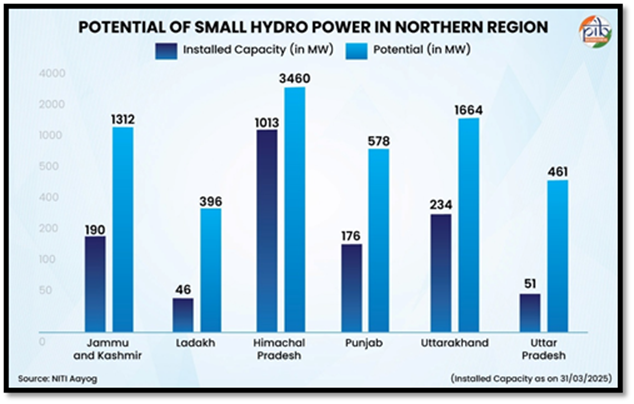
The Northern region forms the backbone of India’s SHP landscape, driven by its mountainous terrain, perennial rivers, and favourable hydrology, making it particularly significant for development in hilly regions. States such as Himachal Pradesh (3,460 MW), Uttarakhand (1,664 MW), and Jammu & Kashmir (1,312 MW) dominate the region’s potential, with Ladakh (395 MW) adding strategic importance. Despite this strong resource base, utilisation levels remain moderate, indicating substantial untapped capacity.
|
Did You Know?
Run-of-the-river projects generate electricity by using the natural flow of river water without building large dams. A portion of water is diverted through channels and pipes to run turbines and is then released back into the stream, ensuring minimal ecological disruption.
|
North-East region
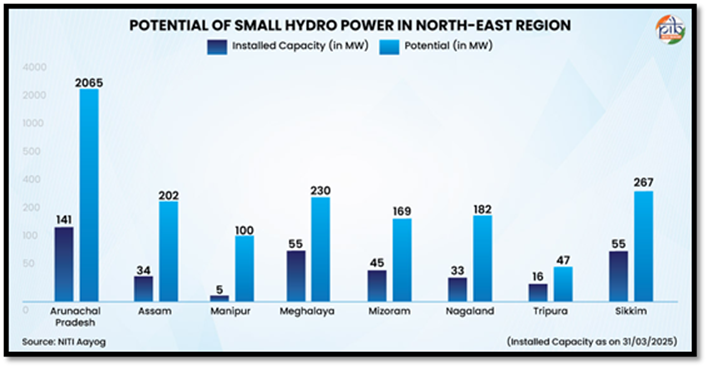
The North-Eastern region represents a high-potential growth frontier, particularly critical for expanding renewable energy in hilly regions and the North Eastern States.
Arunachal Pradesh (2,064.92 MW) constitutes the largest share of the regional potential, followed by Meghalaya (230.05 MW), Assam (201.99 MW), Nagaland (182.18 MW), Mizoram (168.90 MW), Manipur (99.95 MW), and Tripura (46.86 MW). With the inclusion of Sikkim (266.64 MW), the regional potential increases further.
SHP development in this region offers strong opportunities for decentralised and off-grid energy solutions, particularly in remote and tribal areas. It can significantly enhance energy access, promote local employment, and reduce reliance on conventional fuels. With targeted policy interventions, improved connectivity, and community-driven models, the North-Eastern region can emerge as a major engine of growth for India’s SHP sector.
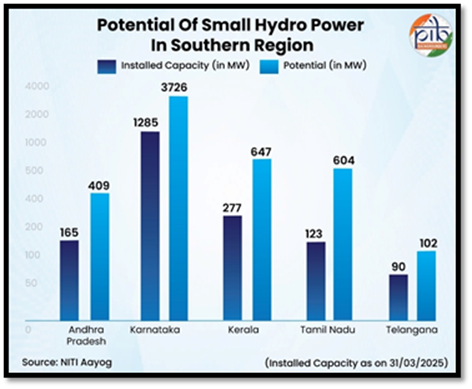
Southern region
The Southern region is a key contributor to SHP development, supported by strong infrastructure, established energy systems, and favourable river basins. Karnataka leads with 3,726.49 MW, accounting for nearly 68% of the regional potential, followed by Kerala (276.52 MW) and Tamil Nadu (123.05 MW). The region has achieved relatively higher utilisation levels compared to others, reflecting efficient project execution and strong grid connectivity.
With its robust infrastructure base, the Southern region is well-positioned to scale further through optimisation of existing assets and integration with other clean energy sources. It will continue to play a stabilising role in India’s SHP expansion, complementing growth in hilly regions and the North Eastern States.
Eastern region
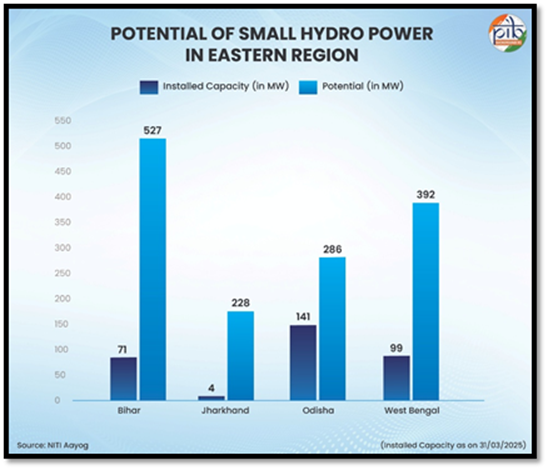
The Eastern region offers moderate but strategically important SHP potential, particularly for decentralised development in rural and tribal areas.
States such as Bihar (526.98 MW) and West Bengal (392.06 MW) lead the region, though overall utilisation remains relatively low. The region’s river systems and terrain provide favourable conditions for small-scale hydro projects.
Expanding SHP in this region can improve local energy access, agricultural productivity, and rural livelihoods, while supporting inclusive development. With targeted interventions, improved financing mechanisms, and decentralised deployment models, the Eastern region can complement national growth.
Western region
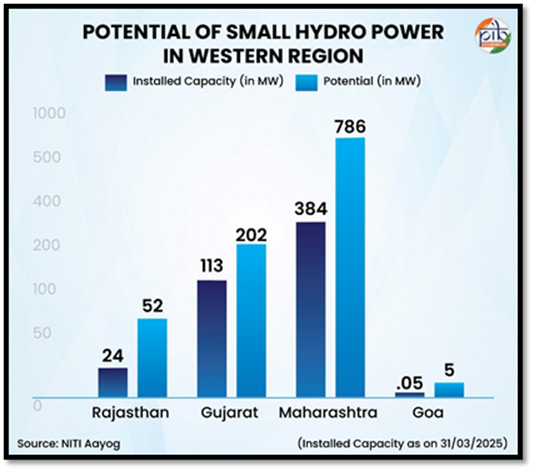
The Western region presents unique opportunities for SHP development, particularly through its extensive irrigation and canal-based infrastructure.
Maharashtra leads with 786.46 MW potential, followed by Rajasthan and Gujarat. The state has achieved relatively higher utilisation levels, while others continue to offer scope for expansion.
The region’s focus on canal-based and dam-toe projects provides a cost-effective pathway for scaling SHP capacity. By leveraging existing infrastructure and promoting innovative deployment models, the Western region can strengthen decentralised renewable energy generation. Alongside advancements in hilly regions and the North Eastern States, it can play a critical role in ensuring a balanced and diversified SHP growth trajectory.
|
Did You Know?
SHP projects on canal falls or dam toe utilize the drop in water levels in irrigation canals or just below dams and barrages to generate electricity. Water is diverted to the powerhouse and returned to the main canal after power generation, making use of existing water infrastructure.
|
Conclusion
The Small Hydro Power Development Scheme (2026-31) marks a decisive policy intervention by the Government of India to harness the unique strengths of small hydropower in the country’s clean energy journey. With an outlay of ₹2,584.60 crore aimed at adding 1,500 MW of new capacity, the scheme prioritises reliable, decentralised power generation, especially in challenging terrains where other renewable sources face limitations.
Beyond capacity creation, the initiative is designed to deliver broader developmental outcomes. By combining targeted financial support, streamlined project preparation, and promotion of indigenous manufacturing, it will stimulate private investment, strengthen domestic supply chains, and generate meaningful employment opportunities in remote and rural regions. This integrated approach positions small hydropower as an effective tool for inclusive growth and regional equity.
As India advances towards greater energy self-reliance and a sustainable future, small hydro power offers a balanced solution that combines environmental responsibility with socio-economic progress. With this focused push, the Government of India is confident that the scheme will illuminate underserved areas, enhance grid resilience, and contribute meaningfully to building a cleaner, stronger, and more self-sufficient India.
References
Press Information Bureau
NITI Aayog
Others
Click here to see pdf
****
PIB Research
(Release ID: 2255609)
Visitor Counter : 6546