Ministry of Statistics & Programme Implementation
EnviStats India: Frequently Asked Questions (FAQ), 2026
A structured thematic knowledge resource designed to build stakeholder capacity and strengthen environmental decision-making
Posted On:
27 APR 2026 3:26PM by PIB Delhi
- The FAQ 2026 provides a comprehensive and structured understanding of environmental-economic accounting, natural capital and ecosystem services within an integrated statistical framework.
- The publication incorporates updated concepts aligned with the System of Environmental-Economic Accounting (SEEA) and System of National Accounts (SNA) 2025, strengthening the integration of environmental and economic statistics.
- New sections on Forest Accounts and Pollination Services have been introduced, reflecting recent advancements in India’s environmental accounting system.
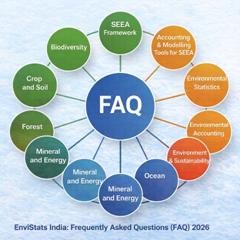
- The document spans a wide range of domains including biodiversity, crop and soil, forest, mineral and energy, ocean, residuals, and water & fish, providing a holistic coverage of environmental statistics and accounts.
- The FAQ enhances accessibility by translating complex statistical frameworks into clear, structured and policy-relevant explanations.
- The initiative aligns with global efforts, where the United Nations SEEA framework also provides FAQ-based knowledge resources to support understanding and implementation of environmental-economic accounting.
The Ministry of Statistics and Programme Implementation (MoSPI) adopted the UN System of Environmental Economic Accounts (SEEA) Framework in 2018, an agreed international framework for the compilation of the Environment Economic Accounts.
The publication “EnviStats India: Frequently Asked Questions (FAQ) 2026”, aimed at strengthening conceptual clarity and expanding awareness of environmental accounting. The document builds upon previous versions by incorporating new domains, updated methodologies, and emerging policy-relevant themes.
Notably, this initiative follows a global best practice approach. The United Nations, under the SEEA framework, also disseminates FAQ-based knowledge platforms to simplify complex accounting systems. MoSPI’s effort is aligned with this approach, adapting it to the Indian statistical and policy context.
Why this Publication Matters
Environmental-economic accounting represents a shift from viewing the environment as an external factor to recognising it as natural capital - an asset that generates measurable economic and social benefits.
However, the frameworks underpinning this approach - SEEA, ecosystem accounting, supply-use tables, valuation techniques - are inherently technical. The FAQ addresses this challenge by providing layered explanations, enabling users to move from basic concepts to applied understanding.
This makes the publication not just informational, but foundational for capacity building, supporting policymakers, researchers, and statistical practitioners in integrating environmental considerations into economic analysis.
What the FAQ 2026 Covers
The FAQ is structured as a comprehensive thematic knowledge system, covering the environment–economy interface such as :
- SEEA Framework and conceptual foundations
The concepts, principles, and definitions used in the System of Environmental-Economic Accounting (SEEA) framework are explained. It also outlines the scope of the framework, its relationship with other global frameworks, and the history and periodic revisions made by the United Nations over time.
- Accounting & modelling tools (ARIES, InVEST, ESTIMAP)
Explained the key tools available globally for assessing and modelling ecosystem services, including ARIES, InVEST, and ESTIMAP.
- Environmental statistics and FDES framework
The structure, concepts, and definitions used in the Framework for the Development of Environment Statistics (FDES) are presented. It also highlights the work undertaken by MoSPI prior to the adoption of this framework.
- Environmental accounting methodologies
The coverage is expanded to include the methods used to compile environmental accounts, including both physical and monetary accounting approaches. It also explains how data is organized to track changes in natural resources and environmental assets over time.
- Sustainability and policy linkages
How environmental accounting supports sustainable development and informs public policy are provided. It explains the connection between data, decision-making, and frameworks like sustainable development goals.
- Sectoral accounts (forest, ocean, minerals, water, biodiversity)
The concepts, methodologies, and data sources used in compiling environmental accounts for sectors such as forests, oceans, minerals, water, and biodiversity are explained.
- Ecosystem services including pollination
The concept of ecosystem services, including provisioning, regulating, and cultural services provided are explained.
Key Conceptual Contribution
- Establishes SEEA as the central integrating framework, linking environment and economy through standardized concepts, classifications and accounting structures.
- Explains the transition from basic environmental data → accounts → policy indicators, highlighting the role of accounting frameworks in data integration.
- Strengthens alignment with other global frameworks, particularly in recognizing natural resources as economic assets and incorporating sustainability.
- Expands coverage of ecosystem accounting, including ecosystem extent, condition and service flows in both physical and monetary terms.
- Introduces advanced tools and methodologies for modelling and valuation of ecosystem services, supporting analytical applications.
Policy Significance
The FAQ plays a critical role in strengthening the use of environmental statistics and accounts for evidence-based policymaking. By clearly articulating concepts such as natural capital, ecosystem services, and resource flows, it enables:
- Better assessment of resource efficiency and sustainability
- Integration of environmental considerations into economic planning
- Improved understanding of trade-offs between growth and conservation
- Strengthened monitoring of SDGs and climate-related indicators
The alignment of environmental-economic accounting with national accounts enhances the ability to evaluate long-term economic well-being and sustainability.
Conclusion
The release of EnviStats India: Frequently Asked Questions (FAQ) 2026 represents a significant step towards democratising environmental-economic knowledge. By transforming complex statistical frameworks into accessible and structured insights, the publication strengthens the foundation for integrating natural capital into policy and planning.
In line with global practices under the SEEA framework, this initiative reinforces India’s commitment to advancing environmental accounting and supporting a transition towards sustainable and resilient development.
The publication is available at the Ministry’s website www.mospi.gov.in
Scan the QR code to access the publication

****
Samrat/Pranab
(Release ID: 2255887)
Visitor Counter : 1682