PIB Backgrounder
Skilling India for a Future-Ready Workforce
Posted On:
29 APR 2026 11:10AM by PIB Delhi
Key Takeaways
- The Economic Survey 2025–26 underscores the importance of employment-focused skilling initiatives in bridging skill gaps and improving productivity.
- The Union Budget 2026–27 positions skill development as a cross-sectoral priority with several sector-specific initiatives.
- Key announcements include:
- Mega Textile Parks for value addition in technical textiles, AVGC Content Creator Labs in 15,000 schools and 500 colleges.
- Upgradation or establishment of four telescope infrastructure facilities to promote astrophysics and astronomy.
- Introduction of National Council for Hotel Management and Catering Technology to serve as a bridge between academia, industry and Government.
- The Khelo India Mission to strengthen tourism-linked hospitality education and India’s sports ecosystem.
|
Skilling Strengthening India’s Growth Engine
India is at a pivotal demographic moment. With one of the youngest workforces in the world, the country has significant potential for higher productivity and growing consumer demand. The Economic Survey 2025–26 highlights that employment-focused skilling initiatives help bridge skill gaps while improving productivity and expanding opportunities for decent work. Such initiatives also promote social mobility by enabling upward economic advancement, thereby supporting more equitable access to inclusive labour markets.
Data from the Periodic Labour Force Survey indicates a broadly stable labour market with typical seasonal variations. In February 2026, the overall Labour Force Participation Rate (LFPR) for persons aged 15 years and above remained stable at 55.9%. The period also reflected a strong recovery in the labour market, marked by increased participation of women and a notable decline in unemployment rates across both rural and urban areas.
Further focusing on the potential of young population and realising the importance of skilling ecosystem, the Union Budget 2026–27 positions skill development as a cross-sectoral priority. It is noteworthy that the recent interventions and initiatives reflect a sustained policy commitment to ensuring that India's young population is not just large in number, but prepared and empowered to contribute meaningfully to the country's economic future.
Budget Focus on Skilling: A Push for the Economy
The Union Budget 2026-27 introduces targeted initiatives to expand institutional capacity, modernize training infrastructure and align skills with emerging industry demands. These measures aim to enhance employability, promote entrepreneurship and create large-scale livelihood opportunities across urban and rural India.
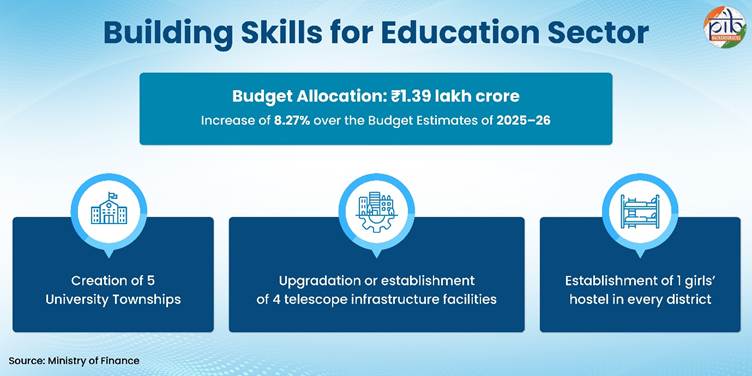
A skilled and educated population is key to realising India’s demographic potential. The Union Budget 2026–27 provides further impetus to the education sector with a total allocation of ₹1.39 lakh crore. This represents an increase of 8.27% over the Budget Estimates of 2025–26. The allocation focuses on expanding access, strengthening infrastructure, and making education more aligned with industry needs.
In this direction, the Budget has announced:
- Creation of 5 University Townships near major industrial and logistics corridors to host universities, colleges, research institutions, skill centres and residential complexes.
- Establishment of 1 girls’ hostel in every district through Viability Gap Funding (VGF)/capital support. This is announced to address access and retention challenges arising from extended academic and laboratory hours, in higher education STEM institutions.
- Upgradation or establishment of 4 telescope infrastructure facilities including the National Large Solar Telescope, National Large Optical Infrared Telescope, Himalayan Chandra Telescope and COSMOS-2 Planetarium to promote astrophysics and astronomy via immersive experiences.
The Indian Textile & Apparel industry contributes ~2% to Gross Domestic Product (GDP), about 11% of the manufacturing GVA and 8.63% to exports.As the sixth-largest textile & apparel exporter globally, the sector supports over 45 million direct jobs, with a strong presence in MSME clusters and significant participation of women and rural workers. To further support weavers and artisans of the industry, the Budget proposes the following:
Man-made fibres (MMF): Fibres made in factories, either from natural sources like cellulose (e.g., rayon) or from chemicals (e.g., polyester), created to match or improve natural fibres.
New-age fibres: Modern, innovative fibres such as lotus silk, bamboo fibre, or smart textiles that are eco-friendly, sustainable, or have special functional features.
|
- National Fibre Scheme to promote self-reliance in natural, man-made and new-age fibres.
- Textile Expansion and Employment Scheme for modernising traditional clusters through capital support, advanced machinery, technology upgradation and common testing infrastructure.
- National Handloom and Handicraft Programme to integrate existing schemes and provide focused, income-enhancing support to weavers and artisans.
- Tex-Eco Initiative to promote globally competitive and sustainable textiles and apparel.
- Samarth 2.0 to modernise and upgrade the textile skilling ecosystem through structured industry-academia partnerships.
- Mega Textile Parks which will focus on building scale, efficiency and value addition, particularly in technical textiles.
- Mahatma Gandhi Gram Swaraj Initiative to strengthen khadi, handloom and handicrafts through enhanced skilling, quality assurance and global branding linkages.
The growing healthcare needs of India's population shaped by demographic shifts, rising non-communicable diseases, and global demand for skilled professionals, point to the need for a skilled and expanded healthcare workforce. In this regard, the Budget sets out a phased outlay of ₹980 crore over three years with an aim to expand and strengthen education of allied and healthcare professionals.Key initiatives in the Budget include:
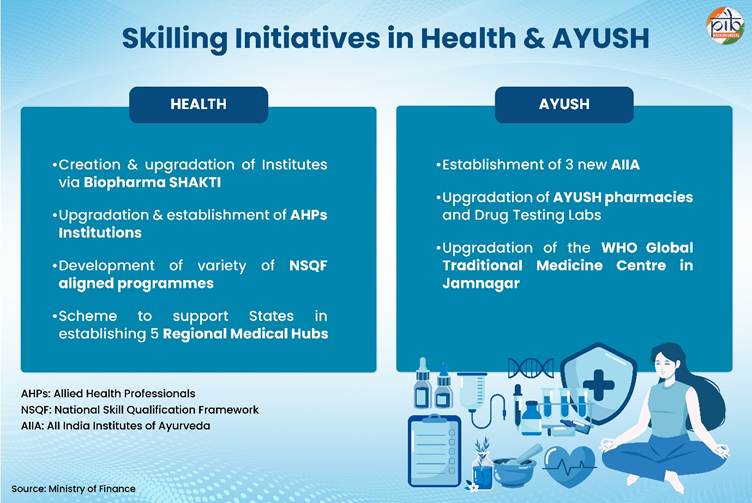
- Creation and upgradation of Institutes via Biopharma SHAKTI (Strategy for Healthcare Advancement through Knowledge, Technology and Innovation) with proposed outlay of ₹10,000 crore over five years to position India as a global biopharma manufacturing hub. The strategy includes setting up of 3 new National Institutes of Pharmaceutical Education and Research (NIPERs), upgradation of 7 existing NIPERs, creation of over 1,000 clinical trial sites, and strengthening of the Central Drugs Standard Control Organisation.
- Upgradation of existing Allied Health Professionals (AHPs) Institutions and establishment of new AHP Institutions in private and Government sectors. This covers 10 selected disciplines, including optometry, radiology, anesthesia, OT Technology, Applied Psychology and Behavioural Health. A total of 100,000 AHPs will also be added over the next 5 years.
- Formation of a strong care ecosystem covering geriatric and allied care services. This comprises development of variety of National Skill Qualification Framework (NSQF)-aligned programmes to train multiskilled caregivers combining core care and allied skills, such as, wellness, yoga and operation of medical and assistive devices. The focus is to train 1.5 lakh caregivers in the coming year.
- A scheme to promote medical tourism services will also be launched, which will support States in establishing five Regional Medical Hubs in partnership with the private sector. These hubs will integrate healthcare complexes that combine medical, educational and research facilities. They will have AYUSH Centres, Medical Value Tourism Facilitation Centres and infrastructure for diagnostics, post-care and rehabilitation. These Hubs will provide diverse job opportunities for health professionals including doctors and AHPs.
India’s AYUSH sector continues to gain global recognition, with yoga and Ayurveda emerging as important pillars of preventive and holistic healthcare. The Union Budget 2026- 27 reaffirms this commitment with an allocation of ₹4,408 crore for the Ministry of AYUSH. To further strengthen the AYUSH sector and meet global demand, the Union Budget puts forward the following initiatives:
- Establishment of three new All India Institutes of Ayurveda (AIIA) to strengthen education, clinical services and research;
- Upgradation of AYUSH pharmacies and Drug Testing Laboratories to ensure higher standards of certification ecosystem, and availability of skilled manpower;
- Upgradation of the WHO Global Traditional Medicine Centre in Jamnagar, to promote evidence-based research, training and awareness for traditional medicine.
Livestock remains a critical pillar of rural resilience, contributing nearly 16% to farm income, particularly for poor and marginal households. With a Budget allocation of ₹6,153 crore, the Union Budget 2026-27 reinforces the sector’s role in income diversification, nutritional security, and employment generation.
Further, to scale up availability of veterinary professionals by more than 20,000, the Union Budget introduces a loan-linked capital subsidy support Scheme to support establishment of veterinary and para-vet colleges, hospitals, diagnostic laboratories and breeding facilities in the private sector, with facilitation of collaboration between Indian and foreign institutions.
The Orange Economy driven by creativity, culture and intellectual property,has emerged as a significant contributor to modern economic growth. Globally, creative industries contribute between 0.5% and over 7% of GDP, with strong spillover effects across tourism and urban services.In India, the media and entertainment sector, valued at around ₹2.5 trillion in 2024, is projected to grow at nearly 7% annually, reaching about ₹3.06 trillion by 2027.
To strengthen the talent pipeline in high-growth creative segments, the Budget emphasises setting up AVGC (Animation, Visual Effects, Gaming and Comics) Content Creator Labs in 15,000 secondary schools and 500 colleges. With the AVGC sector projected to require nearly 2 million professionals by 2030, this initiative aims to build early-stage creative capacity, enhance industry-aligned skills, and strengthen India's presence in global digital content production.
The Indian design industry is expanding rapidly, with growing demand for skilled design professionals across sectors. To strengthen design education and support this growth, a new National Institute of Design is set to come up in the eastern region of India.
Tourism remains a high-impact driver of exports, employment, and India’s global cultural footprint. The travel and tourism sector contributed 5.22% to India's GDP in FY2024, close to pre-pandemic levels. The sector also supported an estimated 8.46 crore jobs, both direct and indirect, accounting for about 13.3% of total employment in the country. The Union Budget 2026-27 advances this momentum through targeted institutional and skill-based initiatives:
- Setting up of National Institute of Hospitality by upgrading the existing National Council for Hotel Management and Catering Technology. It will serve as a bridge between academia, industry and Government, strengthening hospitality education standards.
- A pilot scheme for upskilling 10,000 tourist guides across 20 iconic tourist sites through a standardised 12-week hybrid course, developed in collaboration with an Indian Institute of Management.
- National Destination Digital Knowledge Grid will be established to digitally document cultural, spiritual and heritage sites, generating new opportunities for researchers, historians, content creators and technology partners.
The Union Budget 2026–27 has increased financial support for the Ministry of Youth Affairs and Sports, with the overall allocation rising by ₹1,133 crore. This step aligns with the vision of placing India among the top 10 sporting nations by 2036 and the top 5 by 2047.The Ministry’s allocation has expanded from ₹3,346 crore (revised estimate) in 2025–26 to ₹4,479.88 crore (budget estimate) in 2026–27.
The higher allocation is expected to strengthen the implementation of centrally sponsored sports and youth development programmes, including athlete development initiatives, youth engagement programmes, coaching and support systems, integration of sports science, and sports infrastructure development.
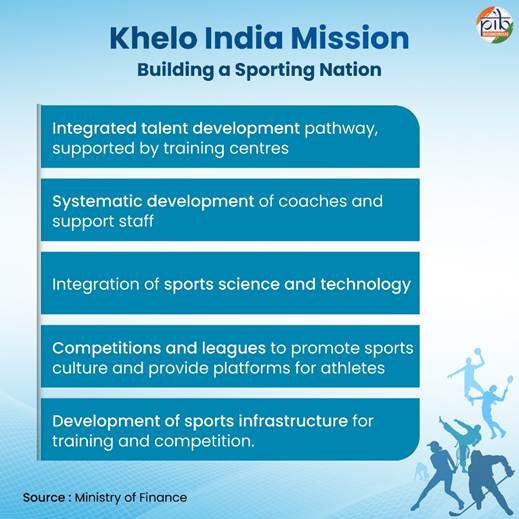
Building on this, the Budget includes the launch of Khelo India Mission to comprehensively strengthen the sports sector. The Mission will facilitate:
- An integrated talent development pathway, supported by training centres across foundational, intermediate and elite levels;
- Systematic development of coaches and support staff;
- Integration of sports science and technology;
- Competitions and leagues to promote sports culture and provide platforms for athletes; and
- Development of sports infrastructure for training and competition.
Policy Support Strengthening Skilling
The Government has always prioritised strengthening of a range of flagship skilling initiatives to develop a skilled and future-ready workforce. These programmes focus on large-scale training, apprenticeship promotion and vocational education across sectors. Together, they aim to enhance employability and align skill development with evolving industry needs.
Skill India Mission
Skill India Mission (SIM), launched in 2015, provides skill, re-skill, and up-skill training through an extensive network of skill development centres under major schemes. The mission focuses on all sections of the society across the country, and concentrate on enhancing the skills and employability of the working age population. Under this mission, following schemes are covered:
- Pradhan Mantri Kaushal Vikas Yojana (PMKVY),
- Jan Shikshan Sansthan (JSS),
- National Apprenticeship Promotion Scheme (NAPS),
- Craftsman Training Scheme (CTS) in Industrial Training Institutes (ITIs)
- Pradhan Mantri Kaushal Vikas Yojana (PMKVY) / PMKVY 4.0: It is a flagship short-term skilling initiative of the Ministry of Skill Development and Entrepreneurship. Over the course of its fourphases, it has progressed from a pilot incentive-based certification initiative to a large-scale, demand-driven and outcome-oriented skilling ecosystem.
Under its 4th phase, PMKVY 4.0, training is imparted in National Skill Qualification Framework (NSQF) aligned job roles developed by industry-led Sector Skill Councils (SSC), and several courses are delivered directly within industrial premises with trainers sourced from the employer ecosystem. Key achievements are highlighted below:
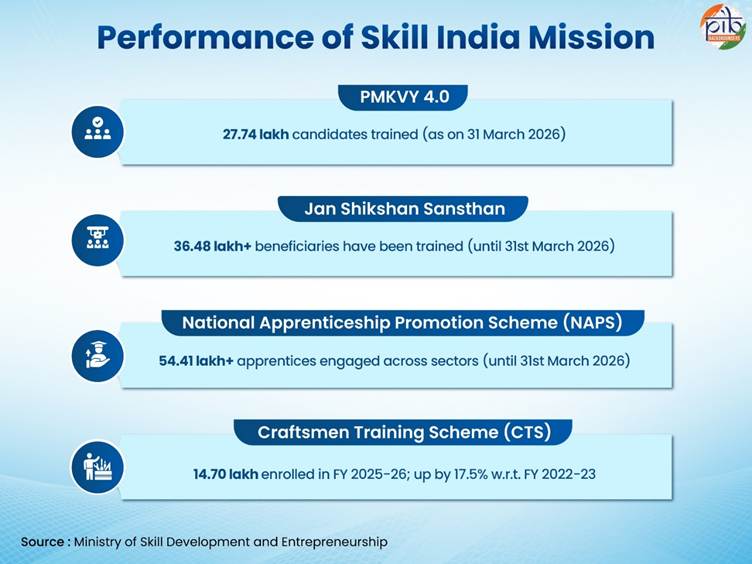
- PMKVY 4.0 has trained 27.24 lakh candidates across 38 sectors, covering 36 States and 737 districts as of 31 March 2026.
- Between April 1, 2024 and March 31, 2026, more than 10.91 lakh candidates were trained in sectors such as IT-ITeS, aerospace & aviation, agriculture, rubber, leather, apparel, electronics, construction and tourism & hospitality across 34 States and 737 districts.
- 69 customised courses and 154 future-skill job roles have been introduced to improve employability in emerging domains including AI, Industry 4.0, green jobs and digital services.
- Over 16,900 institutions are implementing PMKVY 4.0, including more than 6,800 Skill Hubs in schools, higher educational institutions and ITIs as on March 31, 2026.
- Jan Shikshan Sansthan (JSS): The JSS Scheme, initially launched as Shramik Vidyapeeth (SVP) in 1967, aims to provide skill training in a non-formal mode at the doorsteps of the beneficiary through registered Societies (NGOs) with 100% grant from the Government. It promotes inclusive, community-based skilling for non-literates, neo-literates and school dropouts. The following reflects the progress achieved:
- A total of 36,48,692 lakh beneficiaries have been trained since 2018 till 31 March 2026
- Courses are tailored to local demand including tailoring, embroidery, handicrafts, food processing and health-related services.
- 26, 720 tribal beneficiaries have been enrolled and 26,519 have been trained as of 31 March 2026
- To diversify skilling options, 32 new NCVET-approved courses at NSQF Levels 3, 3.5 and 4 have been introduced under JSS.
- Since December 2024, JSS products are marketed on the UdyamKart portal, directly connecting artisans and micro-entrepreneurs with buyers
- National Apprenticeship Promotion Scheme (NAPS): Launched in August 2016, the scheme is currently being implemented in its second phase, NAPS 2.0. The programme promotes apprenticeship training by providing partial stipend support to apprentices thereby strengthening the apprenticeship ecosystem, and offering advocacy support to stakeholders.Apprenticeship remains a key pillar for “earn while you learn” and industry-centric skill development. The Government contributes 25% of stipend (up to ₹1,500 per month) directly to apprentices’ bank accounts via NAPS portal.
- Since 2016, more than 54.41 lakh+ apprentices have been engaged across sectors such as automotive, IT-ITeS, electronics, retail and manufacturing until March 31, 2026
- In FY 2025–26, around 12.35 lakh apprentices were engaged. Additionally, about 6.42 lakh apprentices completed their On-the-Job Training in FY 2025–26.
- CoP (Certificate of Proficiency), launched in September 2025, is an additional recognition for apprentices who complete the full duration and practical assessment. As of March 31, 2026, 67,711 CoPs were generated.
- From 1st April 2025 to 31st March 2026, more than ₹562.75 crore were disbursed through 40.10 lakh Direct Benefit Transfer (DBT) transactions.
- Craftsmen Training Scheme (CTS): The CTS was introduced in 1950 to ensure a steady flow of skilled workers in different trades for the domestic industry. It also aims to raise quantitatively and qualitatively the industrial production through systematic training and reduce unemployment among the educated youth by providing them employable training.
- Under CTS, training is imparted in 169 courses through 14,688 ITIs (Government - 3,345 & Private - 11,343) across the country.
- As of March 2026, a total of 14 CTS courses has been developed and 22 existing courses have been revised in a span of three years. These courses align with industry requirements.
- The enrolment in ITIs has increased from 12.51 lakh in FY 2022-23 to 14.70 lakh in FY 2025-26.
Industrial Training Institutes (ITIs)
ITIs are the backbone of long-term vocational education in India. They have been set up with the objective to ensure a steady flow of skilled personnel to the industry.
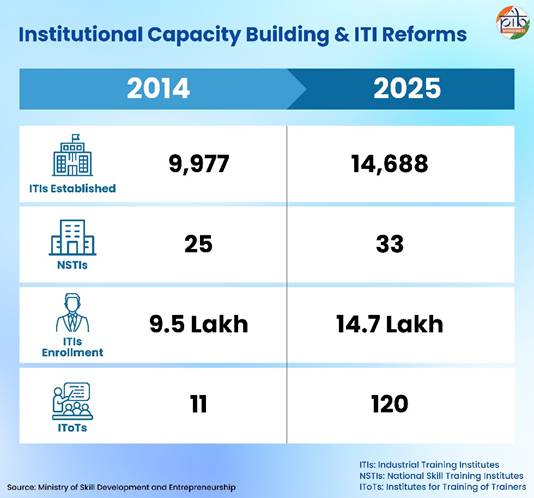
To further strengthen this ecosystem, PM–SETU (Pradhan Mantri Skilling and Employability Transformation through Upgraded ITIs) was launched in October 2025 as a Centrally Sponsored Scheme at an estimated cost of ₹60,000 crore.Key features include:
- Upgradation of 1,000 Government ITIs (200 hub ITIs and 800 spoke ITIs) in a hub-and-spoke model, with state-of-the-art infrastructure and modern equipment.
- Establishment of Special Purpose Vehicles (SPVs) with Anchor Industry Partners (AIPs) to co-own and co-manage clusters.
- Introduction and redesign of courses based on labour market demand, including high-demand traditional trades upgraded with modern technology.
- Many states including Haryana, Karnataka, Tamil Nadu and others are co-creating the upgradation of 1,000 ITIs around their core strength.
- Capacity augmentation of five National Skill Training Institutes(Bhubaneswar, Chennai, Hyderabad, Kanpur and Ludhiana) as National Centres of Excellence for Skilling with global partnerships.
Conclusion
India’s skilling ecosystem is undergoing a structural transformation with coordinated, technology-enabled and industry-aligned frameworks. The Union Budget 2026-27 strengthens this shift by integrating sector-specific skill programmes with infrastructure development. Initiatives spanning ITI upgradation, PMKVY 4.0, PM–SETU, NAPS and other reforms collectively aim to improve scale, quality, transparency and industry linkage across the skilling value chain.
As India progresses toward Viksit Bharat @2047, the Government is emphasising on demand-driven training, measurable outcomes and inclusive access. By aligning skills in sectors such as healthcare, care economy, AVGC, tourism etc.,the policy framework positions human capital as a core growth driver. Overall, India’s resilient and future-ready skilling ecosystem enhances productivity and accelerates formalisation. It also helps translate the country’s demographic advantage into broad-based, sustainable growth.
References
Ministry of Finance
https://www.indiabudget.gov.in/economicsurvey/doc/echapter.pdf
https://www.indiabudget.gov.in/doc/budget_speech.pdf
Ministry of Labour and Employment
https://eshram.gov.in/indexmain
Ministry of Textiles
https://www.pib.gov.in/PressReleasePage.aspx?PRID=2208051®=6&lang=1
Ministry of Health and Family Welfare
https://www.pib.gov.in/PressReleasePage.aspx?PRID=2221616®=3&lang=2
AYUSH
https://www.pib.gov.in/PressReleasePage.aspx?PRID=2221910®=3&lang=2
Ministry of Fisheries, Animal Husbandry & Dairying
https://www.pib.gov.in/PressReleasePage.aspx?PRID=2221788®=3&lang=2
Ministry of Information & Broadcasting
https://www.pib.gov.in/PressReleasePage.aspx?PRID=2221825®=6&lang=1
Ministry of Education
https://www.pib.gov.in/PressReleasePage.aspx?PRID=2221734®=3&lang=1
Ministry of Youth Affairs and Sports
https://www.pib.gov.in/PressReleasePage.aspx?PRID=2221706®=3&lang=2
Ministry of Skill Development and Entrepreneurship
https://www.pib.gov.in/PressReleasePage.aspx?PRID=2200373®=3&lang=1
https://www.pib.gov.in/PressReleasePage.aspx?PRID=2223182®=3&lang=2
https://www.pib.gov.in/PressReleasePage.aspx?PRID=2217881®=3&lang=2
https://www.pib.gov.in/PressReleasePage.aspx?PRID=2197057®=3&lang=1
https://dsde.uk.gov.in/apprenticeship-training-scheme/
https://www.pib.gov.in/PressReleasePage.aspx?PRID=2236969®=3&lang=2
https://www.pib.gov.in/PressReleasePage.aspx?PRID=2149336®=3&lang=2
ITI, Lala Hans Raj Gupta Industrial Training Institute
https://itilhrg.delhi.gov.in/itilhrg/craftsmen-training-scheme-cts
Niti Aayog
https://niti.gov.in/sites/default/files/2023-02/ITI_Report_02022023_0.pdf
IBEF
https://www.ibef.org/government-schemes/skill-india#:~:text=On%20July%2015%2C%202025%2C%20the,Hyderabad%20and%20Chennai%20were%20launched
Ministry of Statistics & Programme Implementation
https://www.pib.gov.in/PressReleasePage.aspx?PRID=2240676®=3&lang=2
PIB headquarters
https://www.pib.gov.in/PressReleseDetail.aspx?PRID=2228572®=3&lang=1
Click here to see pdf
****
PIB Research
(Release ID: 2256476)
Visitor Counter : 6026