PIB Backgrounder
Great Nicobar Project
Strategic Importance, Sustainable Development
Posted On:
01 MAY 2026 9:29AM by PIB Delhi
Key Takeaways
- The Great Nicobar Project seeks to transform Great Nicobar into a strategic maritime and economic hub by leveraging its proximity (about 40 nautical miles) to the East–West shipping route and reducing dependence on foreign transshipment ports keeping in view the defense and National Security purpose
- It includes major infrastructure components: a 14.2 million twenty foot equivalent unit( MTEU) International Container Transshipment Terminal, a Greenfield International Airport (4000 Peak Hour Passengers-PHP)., a 450 MVA gas–solar power plant, and a planned township.
- The development follows a regulated environmental framework, with clearance under the EIA Notification, 2006 and ICRZ Notification, 2019, 42 compliance conditions, diversion of 1.82% of island forest cover, and compensatory afforestation planned over 97.30 sq. km.
- Tribal welfare remains central, with no displacement proposed for Shompen and Nicobarese communities and a net increase in notified tribal reserve area through re-notification measures.
The Great Nicobar Project is a strategic project which aims to strengthen India’s presence in the Andaman Sea and Southeast Asia. The project seeks to balance port-led growth with calibrated environmental safeguards and protection of indigenous communities. By combining strategic, economic, and ecological priorities, the project seeks to ensure that development in Great Nicobar is sustainable, inclusive, and aligned with national interests.
The project includes:
- International Container Transhipment Terminal (ICTT) with a capacity of 14.2 million TEU (Twenty-Foot Equivalent Unit)
- Greenfield International Airport (4000 Peak Hour Passengers-PHP) A 450 MVA (Megavolt Ampere) gas and solar-based power plant,
- A new township spanning 16,610 hectares.
The development follows a sensitive and holistic approach. It considers the needs of indigenous communities and aims to protect the island’s ecological resources. The plan evaluates social, cultural, and environmental impacts carefully and prioritises options that balance environmental, social, and economic goals.
Core Infrastructure Components of the Great Nicobar Project
1. International Container Transhipment Terminal
India's ports lack deep water berths for large ships. Because of this, cargo is routed through Colombo and Singapore. India loses substantial revenue as a result. Countries like Myanmar, China and Sri Lanka are already building deep water facilities to capture this trade.
In this context, the International Container Transhipment Port (ICTP) at Galathea Bay is being developed as part of the Holistic Development of Great Nicobar Island under the Island Development programme. Along with the proposed airport, township, and power plant, the Galathea Bay transhipment port forms a major infrastructure component of the overall Great Nicobar Project. The port is strategically important because it is located close to the East-West international shipping route, about 40 nautical miles away, and has natural water depth of over 20 metres. This strategic location gives it an advantage to attract both gateway and transhipment cargo, reduce India’s dependence on foreign ports like Colombo, Singapore and Klang. The project is designed to enhance India’s national security, strategic and defence presence, strengthen the islands’ economic position, and accelerate holistic development in the region.
2. Greenfield International Airport
The island has world class ecological resources that can attract international and Indian tourists. An international airport is necessary to improve connectivity and open up the island to tourism. The island is close to international tourist destinations like Senang City, Phuket Island and Langkawi Island. Port Blair airport currently handles approximately 1.8 million passengers annually. The new airport is expected to handle at least 1 million passengers when it opens and grow to approximately 10 million passengers per year thereafter.
3. Township and Area Development
The planned township is intended to support the residential, commercial and institutional requirements arising from the port-led development of the island. It will provide essential urban infrastructure for personnel, service providers and associated economic activities, in line with the overall integrated development framework.
4. Power Plant
Reliable power infrastructure is essential for the operation of the transshipment terminal, airport and associated urban infrastructure. Currently, diesel generating sets are the major source of energy in the Andaman & Nicobar Islands. The primary objective of Power Plant is to provide good quality, reliable electrical energy without interruptions. The system is designed to ensure continuity of power supply even if one primary component fails. Renewable energy sources will also be planned for additional generation. An uninterrupted energy supply is a key component in increasing the GDP of the island.
Strategic and Economic Importance
The Great Nicobar Project is being implemented in three distinct phases-
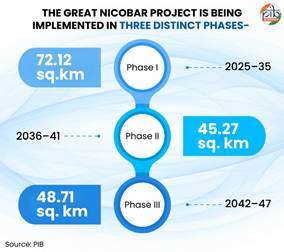
- Phase I (2025–35, 72.12 sq. km),
- Phase II (2036–41, 45.27 sq. km),
- Phase III (2042–47, 48.71 sq. km)
It covers a total area of 166.10 sq. km, which includes 35.35 sq. km of revenue land and 130.75 sq. km of forest land. This phased approach allows for systematic infrastructure development, while ensuring that environmental safeguards and tribal welfare measures are effectively integrated at each stage.
The project’s strategic and economic significance is underscored by the need to position Great Nicobar as a critical node in the Indian Ocean Region. The project ensures optimized land use, coordinated ecological management, and long-term regional benefits, while remaining fully compliant with Environmental Impact Assessment (EIA) regulations and statutory approvals.
Environmental Impact Assessment (EIA) is a tool to ensure proper use of natural resources for sustainable development. EIA is mandatory for specified categories of projects, as per the schedule of Environmental Impact Assessment Notification, 2006. Expert Committees for different sectors examine project proposals, assess environmental impacts, and recommend approval or rejection.
Environmental impact assessment of the Great Nicobar Island Project
- The project received prior Environmental Clearance under the EIA Notification, 2006 after a detailed process of screening, scoping, public consultation and appraisal.
- The Environmental Clearance includes 42 specific conditions covering air, water, noise, waste management, marine ecology, human health and disaster management, with a robust Environment Management Plan (EMP)
- Expert institutions such as Zoological Survey of India (“ZSI”), Salim Ali Centre for Ornithology and Natural History (“SACON”), the Wildlife Institute of India (“WII”), Indian Institute for Science (“IISc”) conducted studies, and the Zoological Survey of India stated that the project can proceed with proper safeguards.
- Three independent Monitoring Committees have been formed to oversee pollution, biodiversity, and the welfare of the Shompen and Nicobarese communities. The Committees are as follows:
- Committee to oversee pollution related matters
- Committee to oversee biodiversity related matters
- Committee to oversee welfare and issues related to Shompen and Nicobarese.
- An Overarching Committee has been constituted under the chairmanship of Chief Secretary, A&N Administration to ensure coordinated implementation of EC/CRZ conditions among all stakeholders. It serves as a central mechanism for oversight, monitoring, and inter-institutional coordination.
Environmental Safeguards and Compensatory Afforestation Plan
Before clearance, the project underwent multiple levels of statutory scrutiny, including preparation of an Environmental Management Plan (EMP). The EMP outlines mitigation measures for construction and operational phases.
Environmental Management Plan (EMP) is a plan to ensure sustainable development around a proposed project. It involves the industry, Government, Pollution Control Board, and local people.
It includes measures to reduce environmental impacts. Mitigation is done at the source and at the project site. During operation, the EMP focuses on minimizing continuous environmental impacts while supporting economic development.
The Great Nicobar Project will divert 1.82% of the total forest cover of the Andaman and Nicobar Islands. The estimated number of trees in this area is 18.65 lakh, though the maximum number expected to be felled is 7.11 lakh within 49.86 sq. km of forest. The tree felling will be carried out in a phased manner in line with proposed phase wise development of the key projects. Importantly, 65.99 sq. km of land will be preserved as green zones with no tree felling, ensuring ecological balance. Since the islands already have over 75% forest cover, compensatory afforestation cannot be carried out locally. Instead, afforestation is planned in Haryana, with 97.30 sq. km of land identified to compensate for Phase I diversion of 48.65 sq. km forest. Additionally, under, ‘Ek Ped Maa Ke Naam’, 2.4 million trees have been planted in Andaman and Nicobar Islands.
Tribal Welfare and Social Considerations
Great Nicobar Island is inhabited by the aboriginal Mongoloid tribes, the Shompens (about 237), who are hunter-gatherers, and the Nicobarese (about 1,094), who live in coastal settlements and depend mainly on fishing for survival. The Great Nicobar Project has been carefully designed to ensure that the Nicobarese and Shompen tribes are not displaced. Within the project area, the only tribal habitations are located at New Chingen and Rajiv Nagar, and the administration has explicitly stated that no relocation of tribal communities is proposed.
The Great Nicobar Project is fully aligned with the Shompen Policy of 2015 and the Jarawa Policy of 2004, which mandate that large-scale development proposals prioritize the welfare and integrity of Particularly Vulnerable Tribal Groups (PVTGs) and follow a structured consultation process. To safeguard tribal interests, an Independent monitoring committee has been mandated by the Ministry of Environment, Forest and Climate Change to oversee issues affecting the Shompen and Nicobarese during both construction and operation phases. Consultations have also been conducted with the Ministry of Tribal Affairs, the Directorate of Tribal Welfare, the Andaman Adim Janjati Vikas Samiti (AAJVS), and tribal experts including the Anthropological Survey of India to ensure safety, protection and well-being of the communities.
The project implementation framework is aligned with the provisions of Article 338A (9) of the Constitution, with due emphasis on safeguarding the interests of Scheduled Tribes and Particularly Vulnerable Tribal Groups in the region. Importantly, the Union Territory of the Andaman and Nicobar Islands has undertaken no new policy measures affecting these tribes beyond implementing this development project, ensuring that tribal rights and welfare remain central to the planning process.
Currently, Great Nicobar Island has 751.070 sq. km of land officially marked as Tribal Reserve. Out of the 166.10 sq. km that is proposed for development projects, 84.10 sq. km overlaps with the Tribal Reserve. However, within this portion, 11.032 sq. km has already been settled and used as revenue land since 1972. Consequently, the effectively remaining area measuring 73.07 sq. km is being de-notified for project purposes. To compensate, 76.98 sq. km is being re-notified as tribal reserve, resulting in a net addition of 3.912 sq. km to the tribal reserve. Specifically, in Phase I, only 40.01 sq. km of tribal area is involved in the project, with 11.032 sq. km already under revenue use since 1972.
Risk Assessment and Disaster Management
The island lies in a seismically sensitive and cyclone-prone region. To address this, a comprehensive risk assessment study has been conducted covering both natural disasters (tsunamis, earthquakes, cyclones) and anthropogenic risks (industrial hazards, accidents). A vulnerability and disaster management plan has been prepared, ensuring preparedness for emergencies. Moreover, the reliance on a hybrid power plant (gas and solar) ensures resilience against disruptions while reducing carbon emissions.
The Great Nicobar Project is an example of how holistic development can balance economic growth, ecological conservation, and social inclusion. It leverages Great Nicobar’s strategic location to strengthen India’s national security, maritime and defence presence in the Indo-Pacific, while simultaneously embedding strong environmental safeguards and tribal welfare mechanisms. By committing to wildlife conservation, compensatory afforestation, disaster preparedness, and social inclusion, the government demonstrates that development need not come at the expense of the environment.
Ultimately, the project represents a model for future large-scale infrastructure initiatives in ecologically sensitive regions, showing how economy and ecology, rather than being at odds, can reinforce one another to serve national and global interests.
REFERENCES:
Niti Aayog
Press Information Bureau
Ministry of Environment, Forest and Climate Change
Others:
Click here to see pdf
PIB Research
(Release ID: 2257174)
Visitor Counter : 16634