PIB Backgrounder
Medical and Wellness Tourism in India
Posted On:
02 MAY 2026 10:25AM by PIB Delhi
India is emerging as a leading hub for Medical Value Travel (MVT) by integrating advanced medical infrastructure with traditional wellness systems such as AYUSH. Strong policy support, digital facilitation, and initiatives like AYUSH Visa and Regional Medical Hubs are strengthening the ecosystem. Rising global healthcare costs and demand for holistic care are driving international patients to India for affordable, high-quality treatment and preventive wellness solutions.
India as a Global Healing Destination
Across the world, rising healthcare costs, long waiting times, and the growing burden of lifestyle diseases are driving patients to seek treatment abroad. This global shift has led to the emergence of a multi-billion-dollar Medical Value Travel (MVT) industry.
The global Medical Value Travel market was valued at about USD 115.6 billion in 2022. It is projected to reach around USD 286.1 billion by 2030. The market is growing at a compound annual growth rate (CAGR) of about 10.8%.
India has emerged as one of the most significant destinations in this evolving global landscape. Industry estimates place the medical tourism market at about USD 8.7 billion in 2025, with projections of USD 16.2 billion by 2030.
For centuries, India has been regarded as a sanctuary for those seeking healing, balance and recovery. Today, this ancient legacy has evolved into a dynamic Medical Value Travel ecosystem. It combines modern medical science with the timeless wisdom of traditional systems.
Through the flagship “Heal in India” initiative, the Government is positioning the country as a premier destination for integrated and holistic healthcare.

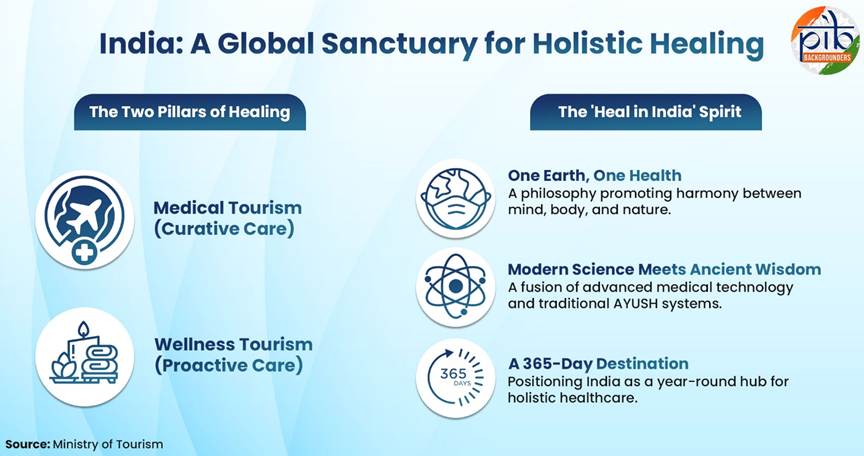
To understand the scope of this landscape, it is essential to distinguish between its two vibrant pillars:
- Medical Tourism: It focuses on curative interventions such as complex surgeries, organ transplants, and advanced diagnostic care provided by specialised hospitals and healthcare institutions.
- Wellness Tourism: It centres on preventive and holistic well-being through traditional systems such as Yoga, Ayurveda, Naturopathy and other AYUSH practices. It offers therapies that promote physical, mental and spiritual health.
Together, these two pillars form the foundation of India’s Medical Value Travel ecosystem. They address both advanced clinical treatment needs and the rising global demand for preventive healthcare.
According to the Medical Tourism Index 2020–21:
- India ranks 10th among the top 46 medical tourism destinations globally
- 12th among the world’s top 20 wellness tourism markets
- 5th among the top 10 wellness destinations in the Asia-Pacific region.
The 2025-26 Statistical Landscape
As per Ministry of Tourism estimates, in FY24, travel and tourism contributed 5.22 per cent to GDP, close to pre-pandemic levels. The sector also supported an estimated 8.46 crore direct and indirect jobs, accounting for about 13.3 per cent of total employment.
The latest data for 2025 highlights the sector's momentum:
- Foreign Tourist Arrivals (FTAs): In 2025, India recorded 9.15 million FTAs.
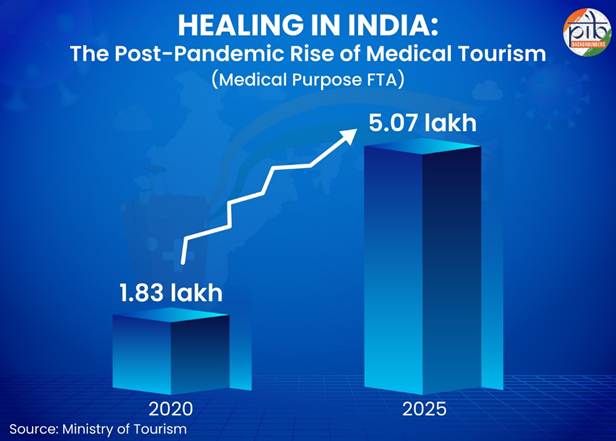
- Medical Purpose Arrivals: In 2025, 507,244 foreign nationals arrived specifically for medical treatment.
- Sectoral Share: 2025 data shows that medical tourism constitutes approximately 5.5% of total FTAs.
- Leading Markets: According to 2025 figures, the top source countries for medical tourists include- Bangladesh (3,25,127 arrivals), followed by Iraq (30,989), Uzbekistan (13,699), Somalia (11,506), Turkmenistan (10,231), Oman (9738), and Kenya (9,357).
- Patients from other countries primarily travel to India for specialised treatments such as:
- Cardiac surgery
- Orthopaedic procedures
- Cancer treatment
- Organ transplants
- Neurological interventions
- Cosmetic surgery
- Dental care
- Fertility treatment
- AYUSH-based wellness therapies
India’s Competitive Edge: Quality, Expertise and Affordability
India holds a unique advantage that places it 10th globally in the Medical Tourism Index (MTI). The government identifies several pillars of this competitive advantage:
Robust Medical Resources
India’s healthcare system is supported by one of the world’s largest pools of trained medical professionals.
India has 69,364 hospitals (43,486 private hospitals, and 25,778 public hospitals) with 1.2 million registered doctors, achieving WHO recommended doctor population ratio.
Furthermore, English serves as the primary language of medical education and clinical practice in India, enabling seamless communication with international patients. Over the past decade, India has significantly expanded its medical education capacity and healthcare infrastructure. This has strengthened the availability of skilled healthcare professionals across specialised disciplines.
Advanced Technology and Accreditation
India’s healthcare system is supported by robust quality assurance mechanisms and internationally recognised accreditation standards. Hospitals and healthcare providers across the country obtain accreditation from the National Accreditation Board for Hospitals and Healthcare Providers (NABH).
NABH establishes rigorous benchmarks for patient safety and quality of care. As of 2026, NABH has accredited over 1,299 hospitals using more than 600 safety parameters. Meanwhile, the Quality Council of India oversees systematic quality improvement.
NABH accreditation is recognised globally through its affiliation with the International Society for Quality in Healthcare (ISQua). In addition, several Indian hospitals hold Joint Commission International (JCI) accreditation. It places the hospitals among healthcare institutions that meet globally accepted standards of clinical excellence.
Medical Value Travel (MVT) service providers are primarily concentrated in the Southern and Western States of India. As of 2022, the concentration of JCI-accredited hospitals by city is as follows:
|
City
|
Number of JCI Accredited Hospitals
|
|
Delhi
|
9
|
|
Mumbai
|
6
|
|
Bangalore
|
3
|
|
Chennai
|
2
|
|
Hyderabad
|
2
|
|
Ahmedabad
|
2
|
|
Kolkata
|
1
|
|
Nagpur
|
1
|
|
Cochin
|
1
|
Other notable cities with a concentration of service providers include Pune and Nashik.
Cost-Effective Medical Treatment
India’s medical tourism appeal is significantly strengthened by its cost competitiveness. High-quality medical treatment in India is often available at substantially lower cost compared to many developed countries, while maintaining comparable clinical standards.
 This affordability is supported by advanced medical technology and skilled professionals.
It enables international patients to access specialised treatment without long waiting periods.
Strengthening AYUSH-led Medical Value Travel
India possesses a unique advantage in wellness tourism through its centuries-old traditional systems of medicine collectively known as AYUSH — Ayurveda, Yoga, Naturopathy, Unani, Siddha and Homeopathy.
As the birthplace of Yoga and Ayurveda, India continues to promote these systems as integral components of holistic health and preventive care.
- AYUSH Visa Facilitation: To streamline access for international patients, the Government of India introduced a dedicated AYUSH Visa on 27 July 2023. It enables foreign nationals and their attendants to travel to India specifically for treatment under recognised AYUSH systems.
- Quality Standards: Efforts are underway to strengthen credibility and standardisation in the sector. The Bureau of Indian Standards (BIS) has adopted ISO 22525, an international standard related to medical wellness tourism services.
- Insurance Coverage: Insurance coverage for AYUSH therapies has also expanded significantly. Under the Health Insurance Regulations of the Insurance Regulatory and Development Authority of India (IRDAI), insurers are permitted to cover treatments under AYUSH. As a result, around 27 insurance companies now offer more than 140 policy products covering AYUSH treatments.
- Global Engagement and Ecosystem Development: Medical Value Travel remains a key theme across major AYUSH initiatives. This includes the “Global Synergy in AYUSH: Transforming Health and Wellness through Medical Value Travel” Summit, held in Mumbai (2024) and Chennai (May 2025).
- Capacity building is being strengthened through initiatives such as the AYUSH sub-council under the Health Sector Skill Council.
- Global outreach is also expanding through platforms like the WHO Global Traditional Medicine Summit, the Know India Programme, and AYUSH initiatives showcased during Maha Kumbh Mela 2025.
Strategic Initiatives: Union Budget 2026-27 Highlights
The Government of India has unveiled a visionary path to cement the nation’s status as a global medical hub through the Union Budget 2026-27.
Regional Medical Hubs
A key proposal involves the establishment of five Regional Medical Hubs across the country in partnership with State Governments and the private sector. These Hubs are designed as integrated healthcare complexes that will house medical, educational, and research facilities under one umbrella.
To ensure a comprehensive healing experience, these hubs will feature:
- Specialised Centres: Every hub will include AYUSH Centres and dedicated Medical Value Tourism (MVT) Facilitation Centres.
- End-to-End Care: Infrastructure will be developed for advanced diagnostics, post-treatment care, and rehabilitation.
- Employment Generation: These complexes are expected to create diverse job opportunities for doctors and Allied Health Professionals (AHPs).
Infrastructure for Wellness
In addition to strengthening modern healthcare infrastructure, the Government is also expanding the country’s capacity in traditional systems of medicine.
- The establishment of three new All India Institutes of Ayurveda has been proposed to enhance education, research, and clinical services in Ayurveda.
- Simultaneously, the WHO Global Traditional Medicine Centre in Jamnagar is being upgraded to strengthen evidence-based research and global collaboration in traditional medicine systems.
These initiatives reflect the Government’s integrated approach to developing both medical treatment services and wellness-based healing traditions as complementary pillars of India’s healthcare ecosystem.
Roadmap for Quality and Governance
To maintain India’s competitive advantage, the Ministry of Tourism has formulated a National Strategy and Roadmap for Medical and Wellness Tourism.
The roadmap focuses on three key areas of governance:
- Institutional Framework: The National Medical & Wellness Tourism Promotion Board (NMWTB) serves as an umbrella organisation to coordinate between ministries, state governments, and the private sector.
- Quality Assurance: The government is strengthening NABH accreditation for hospitals, wellness centres, and dental clinics. It is also encouraging the registration and rating of Medical Value Trave (MVT) facilitators to build international trust.
- Skilling and Capacity Building: The Union Budget 2026-27 proposed a pilot scheme to upskill 10,000 guides in 20 iconic tourist sites through a 12-week training course. Additionally, paramedical and non-medical staff are being trained in cross-cultural sensitivities and foreign languages to better serve international patients.
By integrating these governance and quality measures, the government aims to project India as a 365-day destination for holistic healing. This integrated communication strategy, is promoted as a sub-brand of "Incredible India”. Through these initiatives, India is transitioning toward a more formalised, regulated, and trusted global hub for the "holistic health revolution".
Government Facilitation and Digital Transformation
The government has streamlined the international patient's journey through robust digital and policy interventions. A cornerstone of this is the liberalised visa regime, where the e-Medical Visa and e-Medical Attendant Visa facilities have been extended to nationals of 172 countries.
Additionally, new categories like the e-AYUSH Visa and e-AYUSH Attendant Visa have been introduced to support those seeking traditional Indian treatments.
Digital initiatives are further enhancing the "Heal in India" experience:
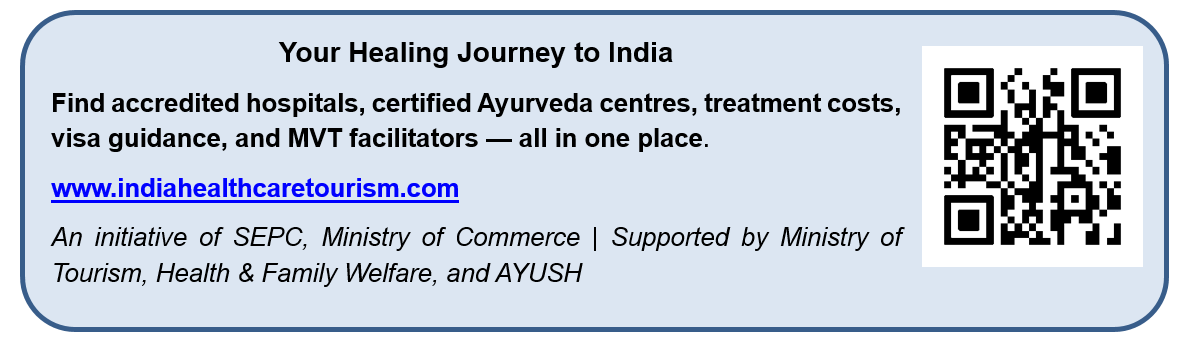
- Revamped MVT Portal: The government is upgrading the one-stop Medical Value Travel Portal to provide an "end-to-end" solution. It enables patients to explore, plan, and book services, as well as make payments and access post-operative care.
- Airport Facilitation: Plans include setting up MVT Concierge and Lounges at important airports. This is to greet travellers at the aerobridge and assist them through immigration, customs, and baggage claims.
Institutional Mechanism for Medical and Wellness Tourism
To ensure coordinated development of Medical Value Travel, the Government has established an institutional framework.
National Medical & Wellness Tourism Promotion Board (NMWTB): Constituted by the Ministry of Tourism in 2015, chaired by the Union Minister for Tourism. It promotes and facilitates medical and wellness tourism in India.
Multi-Stakeholder Platform: The Board brings together ministries, state governments, hospitals, wellness centres, accreditation bodies, and industry stakeholders. Together, they strengthen the Medical Value Travel ecosystem.
State-Level Coordination: States are encouraged to establish dedicated Medical and Wellness Tourism Promotion Boards or cells to support regional development and promotion.
Promoting Wellness and Cultural Integration
Wellness tourism represents an important component of India’s broader health tourism strategy. The country’s rich traditions in yoga, meditation, Ayurveda, and spiritual healing offer unique opportunities for integrating wellness with cultural tourism.
Yoga as a Global Brand for Holistic Health
Yoga is an invaluable gift of ancient Indian tradition derived from the Sanskrit root ‘yuj’ (meaning "to join" or "to unite"). It has emerged as a cornerstone of India’s global soft power. It symbolises the unity of mind, body, thought, and action, and promotes a holistic approach to well-being.

The 11th International Day of Yoga (IDY) 2025 served as the primary vehicle for integrating wellness into the national and global consciousness. Under the theme "Yoga for One Earth, One Health," the event aligned yoga with sustainability and global well-being.
India is positioned as a favoured destination for Yoga and traditional therapies, attracting Foreign Tourist Arrivals (FTAs). They travel specifically to maintain their wellness lifestyle or seek preventive healthcare. This journey is now significantly streamlined by the government’s dedicated e-AYUSH Visa facility.
Towards a Global Healing Hub
India’s medical and wellness tourism ecosystem is evolving into a globally trusted model of integrated healthcare. It combines modern medical infrastructure with traditional systems such as AYUSH. This enables both curative and preventive care.
Strong government policy, digital facilitation, and international quality standards support this growth. Expanding global outreach is further strengthening India’s position as a comprehensive destination for Medical Value Travel.
As global demand rises, India is poised to play a key role in shaping the future of global healthcare and wellness travel.
References
Press Information Bureau (PIB):
https://www.pib.gov.in/PressReleasePage.aspx?PRID=2222142®=3&lang=1
https://www.pib.gov.in/PressReleasePage.aspx?PRID=2225423®=3&lang=1
https://www.pib.gov.in/PressReleasePage.aspx?PRID=2153611®=3&lang=2
https://www.pib.gov.in/PressReleasePage.aspx?PRID=2221403®=3&lang=1
https://www.pib.gov.in/PressReleasePage.aspx?PRID=2221485®=3&lang=1
https://www.pib.gov.in/PressReleaseIframePage.aspx?PRID=2217203®=3&lang=2
Ministry of Tourism:
https://tourism.gov.in/wellness-medical-tourism
https://tourism.gov.in/sites/default/files/2022-05/National%20Strategy%20and%20Roadmap%20for%20Medical%20and%20Wellness%20Tourism.pdf
https://tourism.gov.in/sites/default/files/2026-02/Ministry%20of%20Tourism%20Annual%20Report_2025-26_english.pdf
National Accreditation Board for Hospitals & Healthcare Providers:
https://nabh-portal-live.s3.ap-south-1.amazonaws.com/wp-content/uploads/2026/01/21163729/NABH-Newletter-Issue-12-1.pdf
Ministry of AYUSH:
https://ayush.gov.in/assets/pdf/annualReport/DecadeAyushReport.pdf
FICCI:
https://www.ficci.in/sector/medical-value-travel-mvt?utm_
See In PDF
***
PIB Research
(Release ID: 2257447)
Visitor Counter : 10719