PIB Backgrounder
National Mission for Sustainable Agriculture
“Building Climate-Resilient Farming in India”
Posted On:
09 MAY 2026 11:29AM by PIB Delhi
Key Takeaways
- Since 2014-15, ₹2,119.84 crore has been released under Rainfed Area Development, covering 8.50 lakh hectares and benefiting 14.35 lakh farmers through Integrated Farming System.
- Implemented since 2015-16, about 109 lakh hectares have been covered under the PDMC scheme with ₹26,325 crore released as central assistance.
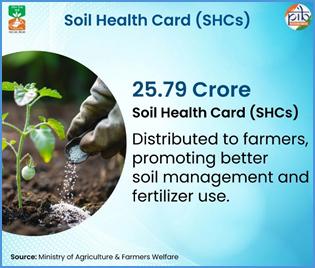
- Under the Soil Health Management, 97.53 lakh soil samples were collected and 92.87 lakh tested in 2025-26, while 25.79 crore Soil Health Card have been generated since 2015 to guide balanced nutrient management.
- Between 2014 and 2025, 2,996 climate-resilient crop varieties were released under the National Agricultural Research System.
|
Rainfed agriculture in India, which constitutes nearly 60 percent of the net sown area, remains a cornerstone of the country’s agrarian economy, contributing approximately 40 percent of total food production. Given its substantial role, the sustainable management of natural resources alongside the systematic development of resilient rainfed farming systems is critical to addressing the growing demand for food grains. In this context, the Government launched the National Mission for Sustainable Agriculture (NMSA) in 2014-15 under the framework of the National Action Plan on Climate Change. The mission was envisaged as a strategic intervention to mitigate the adverse impacts of climate variability on agriculture while ensuring long-term food and livelihood security.
Subsequently, from 2018-19, NMSA was operationalized as a sub-mission within the Umbrella Scheme of the “Green Revolution-Krishonnati Yojana”. Further institutional restructuring from 2022-23 resulted in its inclusion under the umbrella of Pradhan Mantri Rashtriya Krishi Vikas Yojana (PMRKVY), reflecting a consolidated approach to sustainable, climate-resilient agricultural development.
Integrated Policy Interventions for Climate-Resilient Agriculture under NMSA
The National Mission for Sustainable Agriculture (NMSA) promotes climate-resilient farming through a set of targeted and integrated interventions. It provides a strong foundation for sustainable agricultural development by enhancing water-use efficiency, improving soil health, and strengthening climate resilient agriculture. Key interventions under NMSA include the Rainfed Area Development (RAD) component, which encourages Integrated Farming Systems (IFS) for diversified and risk-resilient agriculture and Per Drop More Crop (PDMC) initiative, which promotes micro-irrigation to improve water-use efficiency. These efforts are further complemented by the Soil Health Management (SHM) component, supported by the Soil Health Card (SHC) Scheme, which promotes balanced nutrient use and sustains long-term soil fertility.
Rainfed Area Development (RAD): Strengthening Integrated Farming Systems (IFS)
The Rainfed Area Development (RAD) component has been implemented under the NMSA since 2014-15. It aims to promote sustainable agricultural production through agro-climatic zone-specific Integrated Farming System (IFS) models developed by the Indian Council of Agricultural Research (ICAR). It encourages a holistic approach by integrating multi-cropping, rotational, inter- and mixed-cropping systems with allied activities such as horticulture, livestock, and fisheries to enhance farmers’ income and resilience.
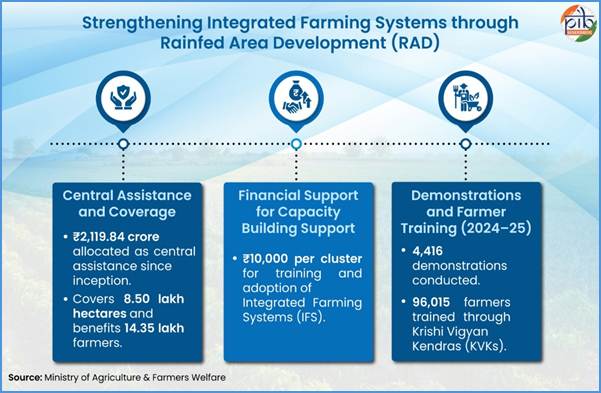
In FY 2025–26, an allocation of ₹343.86 crore was made to States/UTs for the implementation of RAD, under which 96,013 farmers received training.
National Rainfed Area Authority (NRAA)
NRAA serves as an expert body to provide knowledge inputs on the systematic upgradation and management of the country's dry-land and rainfed agriculture. The focus is on promoting rainfed agriculture by enabling knowledge-based interventions and efficient coordination with various agencies.
Improving Water-Use Efficiency through Micro-Irrigation Technologies
The Per Drop More Crop (PDMC) initiative is designed to enhance water-use efficiency by promoting the adoption of precision irrigation and other water-saving technologies. Subsidies are provided to beneficiaries to expand coverage of micro-irrigation systems.
PDMC primarily focuses on improving efficient use of water at the farm level through micro-irrigation techniques, particularly drip and sprinkler irrigation. Drip irrigation involves the targeted application of water to the root zone through emitters attached to lateral pipes, thereby minimizing losses and optimizing resource use. In contrast, sprinkler irrigation distributes water under pressure through a network of pipes and nozzles, simulating rainfall and ensuring uniform coverage across the field.
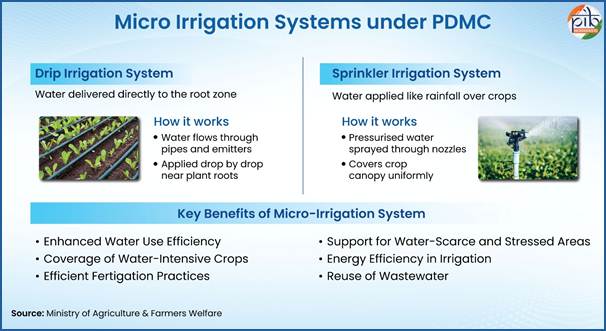
Implemented since 2015-16, about 109 lakh hectares have been covered under the scheme, with ₹26,325 crore released as central assistance, significantly improving water-use efficiency. Furthermore, the Government has set a target of bringing 100 lakh hectares under micro-irrigation over the five-year period from 2025-26 to 2029-30. Achieving these targets necessitates the annual coverage of at least 20 lakh hectares under micro-irrigation through the Per Drop More Crop (PDMC) scheme.
Soil Health Management (SHM): Improving Soil Health and Productivity through Integrated Nutrient Management
Soil Health Management (SHM) promotes location and crop-specific sustainable soil management practices, including residue management and organic farming. It supports systematic soil fertility mapping, balanced application of macro and micronutrients, and appropriate land-use practices. Additionally, SHM emphasizes the judicious use of fertilizers and the implementation of measures to mitigate soil erosion and land degradation, thereby ensuring long-term soil health and productivity.
Soil Health Card (SHC) Scheme: Translating Science into Farmer Advisories
Launched in 2015, the Soil Health Card (SHC) Scheme serves as the principal farmer advisory instrument under the National Mission for Sustainable Agriculture (NMSA). During FY 2025-26, a total of 97.53 lakh soil samples were collected, of which 92.87 lakh samples were tested. Cumulatively, 25.79 crore Soil Health Cards have been generated up to February 2026. These cards provide crop-specific nutrient recommendations, enabling farmers to rationalize fertilizer use and enhance soil health.
An evaluation conducted by NITI Aayog in 2025 indicates that the scheme has contributed to correcting nutrient imbalances, particularly by reducing excessive urea use, and has led to improvements in agricultural productivity. It has also supported the broader objectives of Integrated Nutrient Management (INM). Notably, 68.5 percent of surveyed farmers reported a significant improvement in soil health following the adoption of recommended practices, while 25.7 percent observed marginal improvements.
Enhancing Farmer Decision-Making through Soil Fertility Maps
The Soil and Land Use Survey of India (SLUSI) has been entrusted with preparing village-level soil fertility maps to delineate spatial variations in nutrient status at the cadastral level, building on district-level maps already developed nationwide. As part of this initiative, soil fertility mapping has been undertaken in 6,954 identified model villages to provide farmers with field-level, site-specific nutrient information for balanced fertilizer use.
These maps are publicly displayed within villages to enhance awareness and facilitate informed decision-making on nutrient management. To date, soil fertility mapping has been completed in 2,023 model villages.
Strengthening Agricultural Resilience through ICAR-Led Research Systems
The Indian Council of Agricultural Research (ICAR) launched the flagship programme National Innovations on Climate Resilient Agriculture (NICRA) in 2011 to develop and disseminate climate-resilient agricultural technologies. NICRA has significantly contributed to NMSA to develop capacity of farmers & stakeholders in the domain of climate change adaptation and mitigation measures by conducting capacity building programs and demonstrations on location specific promising climate resilient technologies. The initiative supports both short- and long-term research aimed at enhancing the adaptive capacity of farming systems to withstand extreme weather events, including droughts, floods, and heat waves.
Under NICRA, vulnerability assessments were conducted across 651 agricultural districts in accordance with Intergovernmental Panel on Climate Change (IPCC) protocols. Of these, 310 districts were identified as highly or very highly vulnerable. District Agriculture Contingency Plans have subsequently been developed, incorporating location-specific climate-resilient crops and management practices. To further strengthen farmers’ resilience, Climate Resilient Villages have been established in 448 villages across 151 vulnerable districts spanning 28 States/UTs, where appropriate technologies are demonstrated for wider replication.
Additionally, under the National Agricultural Research System led by ICAR, 2,996 Climate-resilient varieties of crops released during 2014-2025. Complementary agronomic practices, such as direct-seeded rice, zero-till wheat, stress-tolerant crop adoption, and crop residue management, have also been developed and promoted to mitigate climate-related risks and enhance agricultural sustainability.
Addressing the Food-Water-Climate Nexus through NMSA Interventions
The NMSA supports the United Nations Sustainable Development Goals (SDGs) of 2030, specifically SDG 2 (Zero Hunger), SDG 6 (Clean Water and Sanitation), and SDG 13 (Climate Action).
Under SDG 2, NMSA promotes sustainable food production through Rainfed Area Development (RAD), which supports Integrated Farming System (IFS) in improving productivity and stabilizing farmers’ incomes. The Soil Health Management (SHM) component encourages balanced nutrient use and maintains long-term soil fertility, strengthening food security.
In alignment with SDG 6, the Per Drop More Crop (PDMC) component improves water-use efficiency through micro-irrigation, precision water application, and soil moisture conservation, supporting sustainable water management in agriculture.
With respect to SDG 13, the National Mission for Sustainable Agriculture (NMSA) promotes climate-resilient cropping systems, natural resource conservation, and risk mitigation strategies, helping farmers adapt to droughts, floods, and other climate-related stresses.
Through these efforts, NMSA advances sustainable agriculture, efficient water use, and climate resilience in line with the SDG framework.
The National Mission for Sustainable Agriculture (NMSA) provides a consolidated approach to sustainable, climate-resilient agricultural development by integrating water-use efficiency, soil health management, and climate-resilient farming systems. Through targeted interventions such as Rainfed Area Development (RAD), Per Drop More Crop (PDMC), and Soil Health Management (SHM), the mission promotes sustainable agricultural production and efficient use of natural resources.
Supported by knowledge inputs and climate-resilient agricultural technologies under the National Innovations on Climate Resilient Agriculture (NICRA), these efforts improve productivity, support farmers’ income and enhance their capacity. In alignment with SDG 2, SDG 6, and SDG 13, NMSA continues to promote sustainable agriculture while ensuring long-term food and livelihood security in India.
Ministry of Agriculture & Farmers Welfare
Ministry of Finance
United Nations
Click here to see pdf
PIB Research
(Release ID: 2259279)
Visitor Counter : 9377