Ministry of Statistics & Programme Implementation
Posted On:
11 MAY 2026 4:00PM by PIB Delhi
|
Snapshots:
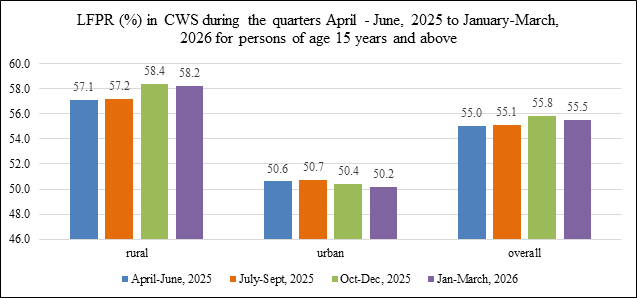
- The overall LFPR for persons (15+ years) reported as 55.5% in January-March, 2026 compared to 55.8% in the previous quarter.
- Female LFPR(15+ years) remained broadly unchanged at 34.7% in comparison to the previous quarter.
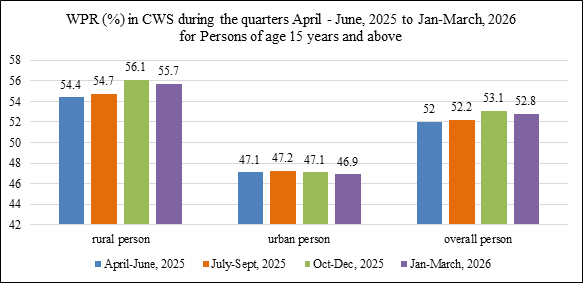
- Urban WPR(15+ years) maintains stability at 46.9% in January-March, 2026.
- Regular wage/salaried employees for persons (15+ years) in rural areas witnessed a modest rise during January-March, 2026 to 15.5% from 14.8% in the previous quarter.
- Share of rural employment for persons (15+ years) in both secondary and tertiary sector recorded an increase in January-March, 2026.
- Urban UR for persons (15+ years) showed declining trend.
|
A. Introduction
The Periodic Labour Force Survey (PLFS) conducted by NSO, MoSPI, is the primary source of data on activity participation and employment-unemployment conditions of the population. The PLFS survey methodology has been modified from January, 2025 to provide monthly and quarterly estimates of labour force indicators for both rural and urban India under the CWS framework.
Considering the need to generate high-frequency labour force indicators with wider coverage, the sampling methodology of the Periodic Labour Force Survey (PLFS) was revamped from January, 2025. The redesigned PLFS aims to achieve the following objectives:
- To generate key employment and unemployment indicators – namely Labour Force Participation Rate (LFPR), Worker Population Ratio (WPR) and Unemployment Rate (UR) – every month for both rural and urban areas at the all-India level under the Current Weekly Status (CWS).
- To extend the Quarterly PLFS results to rural areas, thereby producing quarterly estimates of labour market indicators for both rural and urban India under the CWS framework.
- To provide annual estimates of key employment and unemployment indicators in both Usual Status (ps+ss) and Current Weekly Status (CWS) for rural as well as urban areas.
Earlier PLFS Quarterly Bulletins released up to December, 2024, presented labour market indicators only for urban areas. The Bulletin for April – June, 2025 marked the first in the series to provide estimates for both rural and urban areas and the current Bulletin for January – March, 2026 is the fourth in the series. In this Quarterly Bulletin, efforts have been made to provide estimates of the number of workers in absolute terms.
This Quarterly Bulletin presents estimates of key labour force indicators—Labour Force Participation Rate (LFPR), Worker Population Ratio (WPR), Unemployment Rate (UR), and the distribution of workers by broad employment status and industry of work—in the Current Weekly Status (CWS), separately for rural and urban areas at the all-India level. In addition, state-level estimates of LFPR, WPR, and UR in CWS are also provided for selected States.
Key findings for persons of age 15 years and above following CWS:
- Labour Force Participation Rate (LFPR) remained steady: The overall LFPR among persons of age 15 years and above estimated at 55.5% in January-March, 2026, compared to 55.8% in the previous quarter. In rural areas, LFPR for persons of age 15 years and above observed as 58.2% in the present quarter while it stood at 58.4% in October-December, 2025. Urban LFPR for the same age group was 50.2% in January-March, 2026 compared to 50.4% observed in the preceding quarter.
- Female LFPR remained broadly unchanged: The overall LFPR of female aged 15 years and above remained broadly stable, recording 34.7% in January-March, 2026 compared to 34.9% in the previous quarter. During the current quarter, female LFPR in rural areas was estimated at 39.2% as against 39.4% in the preceding quarter, while in urban areas it stood at 25.4% compared to 25.5%.
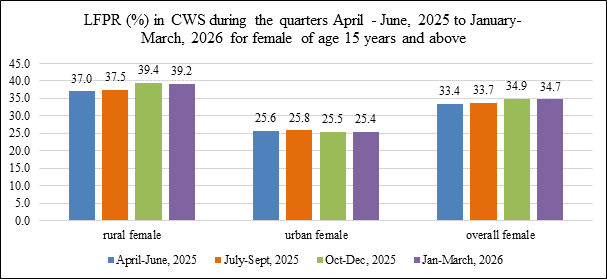
Female LFPR remained broadly unchanged, recording 34.7% in January-March, 2026.
|
- Urban workforce maintains stability: The overall Worker Population Ratio (WPR) for persons of age 15 years and above stood at 52.8% in January-March, 2026 compared to 53.1% in October-December, 2025. While rural WPR marginally declined to 55.7% in this quarter from 56.1% in the previous quarter, urban WPR maintained its stability at 46.9% in the current quarter compared to 47.1% in the preceding quarter.
|
Urban WPR for persons of age 15 years and above remained stable at 46.9% in January-March, 2026.
|
- Overall Unemployment Rate (UR) in urban areas exhibited declining trend: Overall UR in urban areas for persons of age 15 years and above exhibited declining trend during the quarter January-March, 2026 compared to the last two quarters. It stood at 6.6% during the present quarter compared to 6.7% in the previous quarter while it edged up marginally to 4.3% from 4.0% in rural areas.
Urban UR for persons of age 15 years and above showed declining trend.
|
- Regular wage/salaried employees in rural areas witnessed a rise: In rural areas, regular wage/salaried employees showed an upward movement, up to 15.5% during January-March, 2026 from 14.8% of the previous quarter. Share of self-employed persons aged 15 years and above declined to 62.5% during the quarter from 63.2% in October-December, 2025. In urban areas, the distribution of workers across different status remained broadly stable compared to the previous quarter.
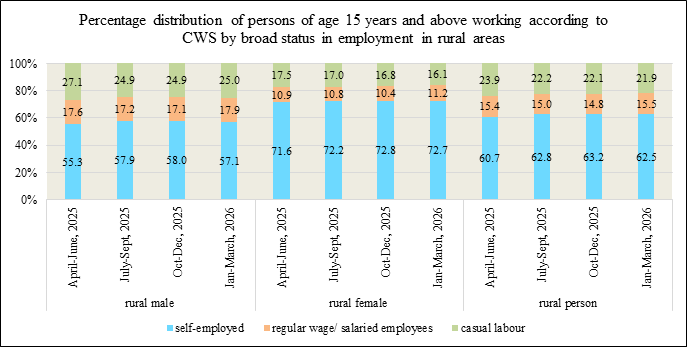
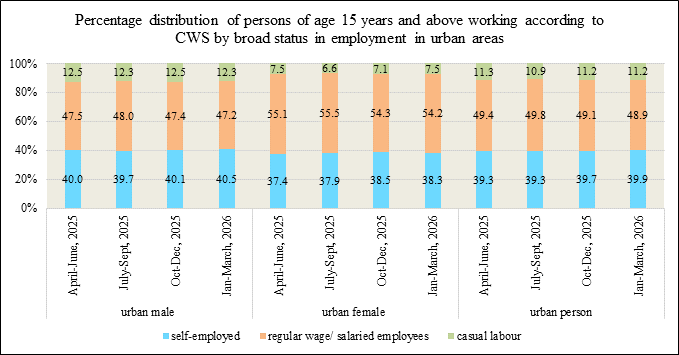
In rural areas, share of regular wage/salaried workers witnessed a modest rise during January-March, 2026.
|
- Increase in rural employment in both secondary and tertiary sector: The sectoral distribution of employment continues to exhibit similar structural pattern, with the rural workforce predominantly engaged in the primary sector and the urban workforce concentrated in the tertiary sector. In rural areas, the share of workers engaged in agriculture stood at 55.8% during January–March 2026, marking a decline from 58.5% in the previous quarter whereas share of employment in the tertiary sector increased from 20.6% in October–December, 2025 to 21.7% in the current quarter. The secondary sector along with mining and quarrying in rural areas also witnessed a rise from 20.9% in the previous quarter to 22.6% in the current quarter. In urban areas, the sectoral distribution of workers remained largely stable.
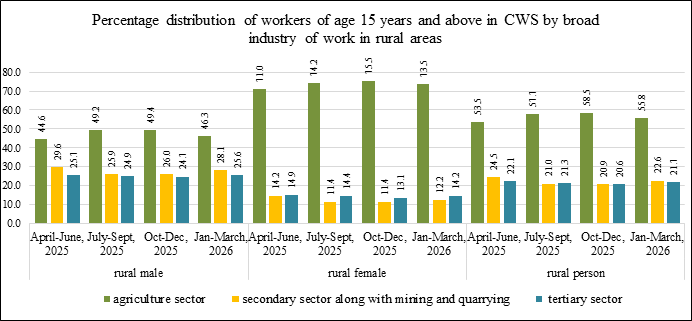
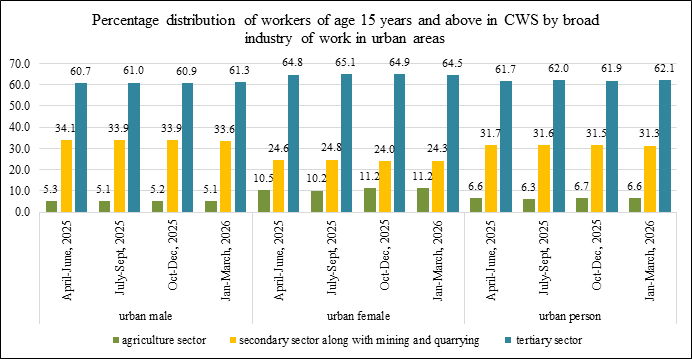
Share of rural employment in both secondary and tertiary sector recorded an increase in January-March, 2026.
|
Using the projected population figures of the Ministry of Health and Family Welfare (MoHFW), the absolute number of workers aged 15 years and above has been estimated. On average, 57.4 crore persons aged 15 years and above were employed in the country during the quarter January-March, 2026, of which 40.2 crore were male and 17.2 crore were female.
|
At the all-India level, the quarterly estimates are based on information collected from a total of 5,61,822 persons surveyed.
|
|
persons surveyed in rural areas
3,20,387
|
persons surveyed in urban areas
2,41,435
|
|
The Quarterly Bulletin for the quarter January-March, 2026 is available on the website of the Ministry (https://www.mospi.gov.in).
|
Scan the QR code to access the Publications/ Reports

|
Click here for PDF
***
Samrat/Pranab