Ministry of Earth Sciences
AI-enabled Systems introduced by IMD to provide Hyper-Local Weather forecasts: Dr Jitendra Singh
Advanced Forecast Systems to Provide Localised Weather Information up to 10 Days in Advance: Dr. Jitendra Singh
Government Introduces AI-enabled Monsoon Forecasting Platform for 16 States and Over 3,000 Sub-districts
Union Minister Dr Jitendra Singh Launches AI-based Monsoon Advance Forecast System and 1-km Resolution Rainfall Forecast for Uttar Pradesh
Dr Jitendra Singh Says IMD Has Become an Essential Part of India’s Everyday Governance and Public Decision-making
Posted On:
12 MAY 2026 4:03PM by PIB Delhi
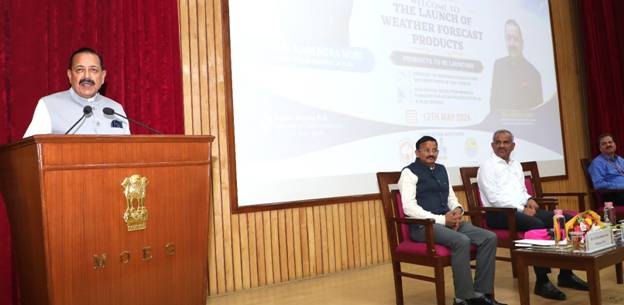
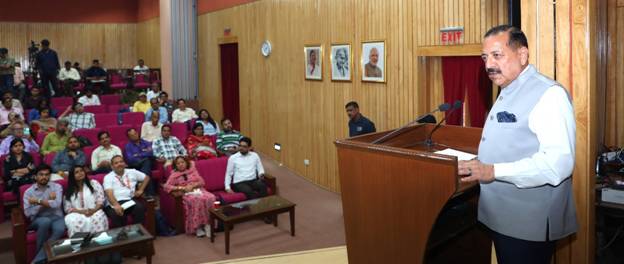
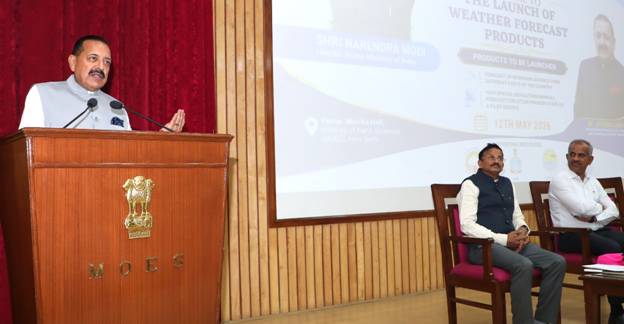
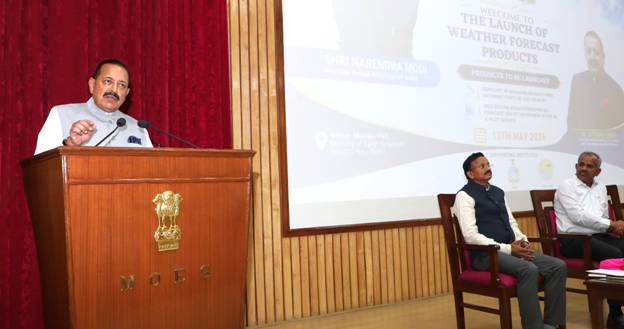
Union Minister of State (Independent Charge) for Science & Technology, Earth Sciences, and MoS PMO, Personnel, Public Grievances, Pensions, Atomic Energy and Space, Dr. Jitendra Singh today launched two advanced weather forecast products developed under the Ministry of Earth Sciences (MoES), aimed at delivering hyper-local, impact-based and AI-driven weather services across the country.
The two products launched today include, introduction of the first ever Artificial Intelligence (AI) driven system by India Metrological Department (IMD) in the form of AI-enabled “Forecast of Monsoon Advance over Different Parts of the Country” and a “High Spatial Resolution Rainfall Forecast for Uttar Pradesh” as a pilot service. The systems have been developed jointly by the India Meteorological Department (IMD), Indian Institute of Tropical Meteorology (IITM), Pune, and National Centre for Medium Range Weather Forecasting (NCMRWF).
Dr. Jitendra Singh said India’s weather forecasting capabilities have witnessed a major transformation during the last decade, with technology, data integration and advanced modelling significantly improving forecast accuracy and public trust in IMD services. He said IMD has today become an integral component of governance, disaster preparedness, agriculture planning and everyday public decision-making.
The Minister said the newly launched systems mark a major shift from conventional weather forecasting towards impact-based and decision-support forecasting, capable of providing precise, location-specific and actionable information to farmers, administrators, disaster managers and citizens.
The launch event was held at Mahika Hall, Ministry of Earth Sciences, New Delhi, in the presence of Secretary, Ministry of Earth Sciences, Dr. M. Ravichandran; Director General of Meteorology, IMD, Dr. Mrutyunjay Mohapatra; Director, IITM Pune, Dr. Suryachandra Rao; senior scientists and officials from IMD, IITM and NCMRWF, along with representatives from print and electronic media.
Referring to the rapid modernization of India’s weather infrastructure, Dr. Jitendra Singh said the country had barely 16 to 17 Doppler Weather Radars nearly a decade ago, while the number has now increased to around 50, with another 50 planned under Mission Mausam. He said this expansion of observational networks, automatic weather stations, high-performance computing systems and digital dissemination platforms has substantially improved forecasting capability and early warning systems across the country.
Dr. Jitendra Singh said the AI-enabled monsoon advance forecasting system will provide probabilistic forecasts of monsoon progression every Wednesday up to four weeks in advance. The product has been designed to support farmers across 16 States and more than 3,000 sub-districts through the dissemination framework of the Ministry of Agriculture and Farmers’ Welfare. He said the system combines AI-based forecasting models, extended range prediction systems and statistical techniques to provide operationally useful forecasts for agricultural planning and preparedness.
The Minister said the second product, High Spatial Resolution Rainfall Forecast for Uttar Pradesh, has been developed as a pilot service to generate rainfall forecasts at 1-km spatial resolution up to 10 days in advance. The system uses advanced AI-driven downscaling techniques and integrates data from Automatic Rain Gauges (ARGs), Automatic Weather Stations (AWSs), Doppler Weather Radars and satellite-based rainfall datasets.
Dr. Jitendra Singh said the initiative would be particularly useful for agriculture, water resources, renewable energy, urban planning, disaster management and infrastructure sectors. He said farmers would now be able to take more informed decisions relating to sowing, irrigation, crop protection and harvest planning with far greater local precision.
The Minister said India has witnessed nearly 40 per cent improvement in forecast accuracy for severe weather events during the recent decade compared to the previous decade. He added that cyclone track, intensity and landfall forecasts for 72 hours have improved by nearly 30 to 35 per cent during the last five years, while seasonal forecast errors have reduced significantly.
Dr. Jitendra Singh said changing climate patterns and increasing extreme weather events have made precise and timely forecasting more important than ever before. Referring to recent instances of erratic weather conditions, he said India now requires forecasting systems that are not only scientifically advanced but also capable of supporting real-time administrative and public decision-making.
The Minister said the Government under the leadership of Prime Minister Narendra Modi has undertaken several transformative initiatives to modernise weather forecasting and climate services in the country. He said Mission Mausam, expansion of radar networks, strengthening of observational systems, modernization of data communication infrastructure and enhancement of high-performance computing facilities are collectively contributing towards a more robust and technology-driven forecasting ecosystem.
Dr. Jitendra Singh said weather advisories and early warnings are now being disseminated through multiple channels including mobile applications, SMS alerts, WhatsApp, Kisan portals, television and other digital platforms to ensure wider public outreach and last-mile connectivity. He added that timely compliance with weather advisories by local administrations and stakeholders is equally important for minimizing damage during extreme weather events.
Secretary, Ministry of Earth Sciences, Dr. M. Ravichandran said the newly launched products are stakeholder-driven forecasting systems developed using a combination of numerical weather prediction models and AI-based data-driven approaches. He said the systems have been developed in response to increasing demand from agriculture and other sectors for highly localized and high-resolution weather forecasts.
Dr. Ravichandran said the monsoon advance forecasting system would now provide granular forecasts on monsoon progression at district-level scales, while the Uttar Pradesh pilot project demonstrates the capability of generating operational rainfall forecasts at 1-km resolution using dense observational networks and AI techniques. He added that similar services would gradually be expanded to other parts of the country as observational infrastructure continues to grow.
Dr. Jitendra Singh said the newly launched forecasting products represent another important step towards building a climate-resilient, digitally empowered and citizen-centric weather service system for the country, where scientific advancements directly contribute to societal and economic benefits.
******
NKR/AK/JK/SG
(Release ID: 2260258)
Visitor Counter : 3999