Ministry of Minority Affairs
Union Minister Shri Kiren Rijiju: “India remains one of the safest and most inclusive homes for minorities”
National Commission for Minorities Organizes Conference of State Minorities Commissions in New Delhi
Deliberations Focus on Institutional Strengthening, Minority Welfare and Inclusive Development
Posted On:
19 MAY 2026 6:19PM by PIB Delhi
The National Commission for Minorities (NCM), Government of India, today organized the Conference of State Minorities Commissions at Sushma Swaraj Bhawan, New Delhi. The conference brought together representatives of State Minorities Commissions, senior officials from State Governments and Union Territories, policymakers and eminent representatives from minority communities to deliberate upon issues concerning minority welfare, institutional strengthening and inclusive development.
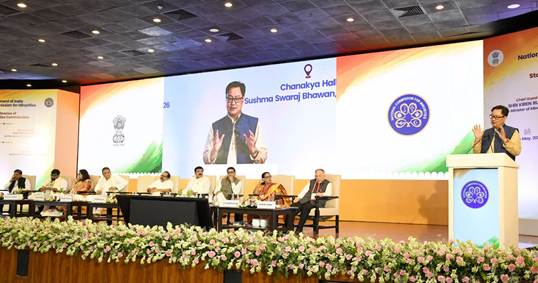
The conference served as an important platform for dialogue, coordination and exchange of ideas aimed at strengthening mechanisms for protection of minority rights and improving the delivery of welfare measures for minority communities across the country.
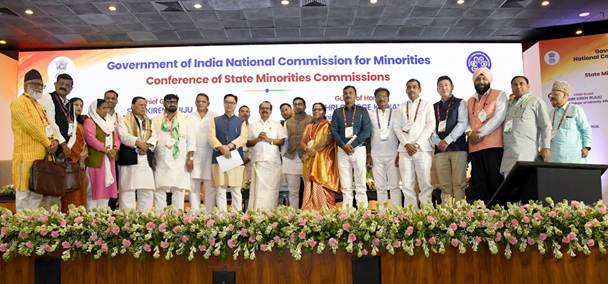
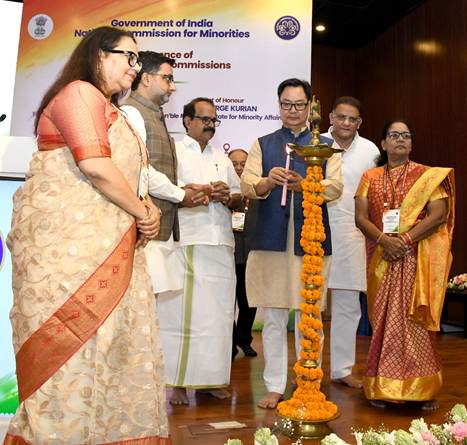
The conference was graced by Shri Kiren Rijiju, Union Minister of Minority Affairs, and Shri George Kurian, Minister of State for Minority Affairs. Distinguished dignitaries present on the occasion included Shri Berjis Desai, Member, NCM; Ms. S. Munawari Begum, Member, NCM; Smt. Alka Upadhyaya, Secretary, NCM; Shri Danish Azad Ansari, Minister of State, Government of Uttar Pradesh, Shri Mohammad Zama Khan, Minister of Minority Welfare, Government of Bihar and Dr Atya Nand, Joint Secretary, NCM.
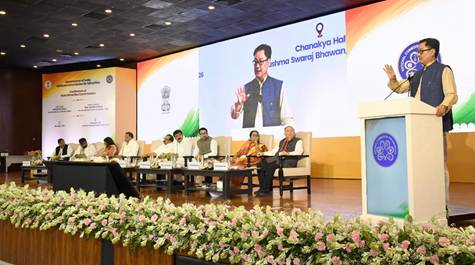
Speaking at the event, Shri Kiren Rijiju, Union Minister of Minority Affairs said, “The contribution of all minority communities to India’s growth and development is immense. The Parsi community has made extraordinary contributions to industry and the economy, Christians have played a significant role in education and healthcare, while Muslims, Buddhists, Jains and other minority communities have enriched India’s cultural, intellectual and social fabric in countless ways.”
He further added, “India continues to remain one of the safest and most inclusive homes for minorities. When we look at neighboring countries in the Indian subcontinent, we often see minority communities facing existential challenges and seeking refuge in India. From Afghanistan to Sri Lanka, minorities from across the region have looked towards India as a place of shelter, security and dignity.”
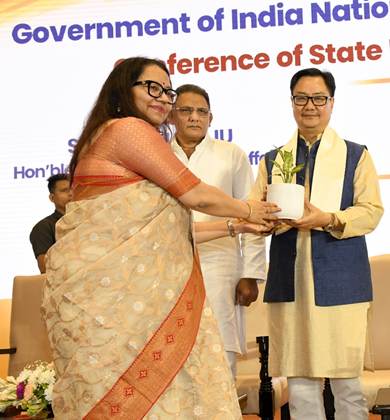
Addressing the gathering, Shri George Kurian, Minister of State for Minority Affairs, focused on welfare schemes like PMJVK that are empowering minority communities by building advanced infrastructure. He stressed the focus of the Central Government towards securing minority communities and taking them forward to make India a developed nation by 2047.
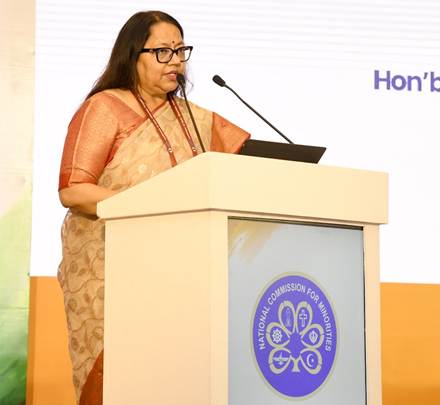
In her address, Smt. Alka Upadhyaya, Secretary, NCM, elaborated on the Commission’s robust grievance redressal mechanism. She informed that over the past five years, the Commission has maintained a strong record of grievance redressal, reflecting its commitment to timely intervention and resolution. Between 2021–22 and 2025–26, a total of 9,558 petitions were received, out of which 9,230 complaints were disposed of, demonstrating a consistently high disposal rate. The Secretary also elaborated on the new work being undertaken by the Commission on studies and outreach, including seminars focused on the Buddhist, Jain and Parsi communities.
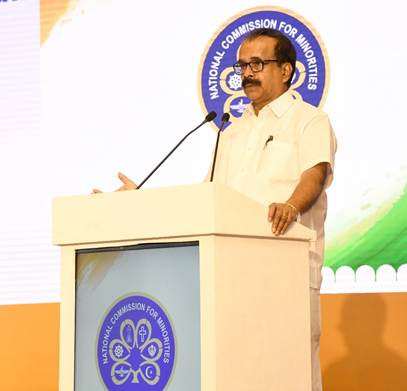
Shri Danish Azad Ansari, Minister of State, Government of Uttar Pradesh, elaborated on the Pasmanda Muslim community and highlighted the Government’s efforts for their welfare and empowerment, essential for Prime Minister Shri Narendra Modi’s vision of Viksit Bharat by 2047.
Shri Mohammad Zama Khan, Minister for Minority Welfare, Government of Bihar, stressed the requirement for minority welfare schemes and ensuring a sense of security.
Shri Berjis Desai, Member, NCM, highlighted certain limitations in the Commission’s jurisdiction and emphasized that stronger coordination among State Minority Commissions could bring meaningful change and further strengthen the protection of minority rights.
Ms. S. Munawari Begum, Member, NCM, underscored the immense potential of the PM VIKAS Yojana in empowering minority communities and noted that collective efforts, coupled with greater awareness, could pave the way for significant progress and development.
Technical Sessions
Technical Session–I: Role of Minorities in the Development of the Country
The session explored the immense contributions of minority communities to nation-building, socio-economic progress, education, entrepreneurship, philanthropy, culture and social harmony. The session was moderated by Dr. Michael V. Williams, Director, Mount Carmel Schools and representative from the Christian community. Distinguished speakers included Shri Atif Rasheed, former Vice Chairman, NCM, representing the Muslim community, who praised the range of welfare schemes from the Government of India to empower the Muslim community. Shri Manjit Singh GK, former President, Delhi Sikh Gurdwara Management Committee, representing the Sikh community, reiterated the role the Sikh community has played in building the nation. Ven. Bhikkhu Bhaddiya, Abbot and Founder-Chairman of Abhaya Dana Forest Monastery, representing the Buddhist community, stated that India gave Buddha and not Yudh to the world. Dr. Shugan Jain, Founder, International School of Jain Studies, representing the Jain community, elaborated on the community’s role and the Government’s efforts to recognize Jains as a minority community. Shri Adil Nargolwala, President, Delhi Parsi Anjuman, representing the Parsi community, gave a summary of the massive achievements of the Parsi community despite being the smallest minority community in India.
The speakers emphasized the invaluable role played by minority communities in strengthening India’s pluralistic ethos and contributing to sectors such as education, healthcare, social service, trade, arts and culture. Deliberations also highlighted the need to further promote equitable participation and inclusive opportunities for all sections of society.
Technical Session–II: Functioning of State Minorities Commissions – Problems and Challenges
The session focused on operational realities, institutional concerns and emerging challenges faced by State Minorities Commissions. The session included interventions by Shri Berjis Desai, Member, NCM, along with Chairpersons of State Minorities Commissions including Shri Tabibar Rehman, Chairman, Assam State Minorities Commission; Shri Hidyatullah Khan, Chairman, Jharkhand State Minorities Commission; Shri U. Nisar Ahmed, Chairman, Karnataka State Minorities Commission; Shri Pyare Jiya Khan, Chairman, Maharashtra State Minorities Commission; and Md. Deepak Shah, Chairman, Manipur State Minorities Commission.
Participants deliberated upon issues related to institutional capacity, administrative coordination, grievance redressal frameworks, staffing and resource constraints, and legal and procedural challenges affecting the effective functioning of State Minorities Commissions. Emphasis was laid on strengthening inter-state collaboration and institutional mechanisms to improve responsiveness to minority concerns.
Technical Session–III: Best Practices of State Governments/UTs for Welfare of Minority Communities:
The session provided a platform for States and Union Territories to showcase successful initiatives and innovative governance models. The session featured presentations by Shri Robert L. Chongthu, Principal Secretary, Bihar State Minority Welfare Department; Shri Soman Ali Ahmed, Secretary, Welfare of Minorities and Development Department, Assam; Shri Sabin Sameed, Director, Minority Welfare Department, Keralam; Shri Praveen Bakshi, Commissioner and Secretary, Social Welfare Department, Meghalaya; Thiru E. Saravanavelraj, Secretary, Backward Classes, Most Backward Classes and Minorities Welfare Department, Tamil Nadu; and Shri Nirmal Adhikari, Special Secretary-cum-Director, Minorities Welfare Department.
The participating States shared experiences relating to educational assistance, skill development, scholarship support, livelihood promotion, community welfare schemes and institutional innovations aimed at improving outreach and service delivery to minority communities. The exchange of best practices is expected to contribute to policy learning and greater convergence in welfare interventions across States.
The conference concluded with a renewed commitment towards collaborative action, stronger institutional coordination and sustained engagement for ensuring the protection of minority rights and welfare. The deliberations are expected to contribute meaningfully towards strengthening inclusive governance and enhancing the effectiveness of minority welfare mechanisms across the country.
*****
AK/MR
(Release ID: 2262912)
Visitor Counter : 976