Ministry of Statistics & Programme Implementation
Frequently Asked Questions (FAQs)
Index of Industrial Production - New Series with Base year 2022-23
Posted On:
26 MAY 2026 8:49PM by PIB Delhi
The Ministry of Statistics and Programme Implementation (MoSPI) is undertaking the revision of base year of the All India Index of Industrial Production (IIP) from 2011-12 to 2022-23 and plans to release the new series on 1st June, 2026. The MoSPI has compiled and is releasing, through this press release, the FAQs to assist users and other stakeholders in understanding the various aspects of compilation of IIP series.
|
Summary
- The base year of the All India Index of Industrial Production (IIP) is being revised from 2011-12 to 2022-23 under the aegis of the Technical Advisory Committee for base year revision of All India IIP (TAC-IIP).
- The Report of the TAC-IIP was released on 25th May, 2026 which inter-alia covered the scope and coverage, conceptual, methodological and operational issues in compilation of IIP in alignment with the international best practices.
- Item basket for the new IIP series has been finalised, covering 463 item groups which includes 120 new item groups.
- Beside the existing sectoral coverage, the new IIP series will also cover minor minerals, rare earth minerals, gas supply, water supply, sewerage and waste management.
- The new IIP series will release indices at greater granularity by providing separate indices for generation of electricity through Renewable and Non-renewable, Gas supply, Fuel minerals, Metallic minerals and Non-metallic minerals, Water supply, Sewerage & Waste Management.
|
FAQs on New IIP Series with Base year 2022-23
- What is Index of Industrial Production (IIP)?
Ans: The Index of Industrial Production (IIP) is a composite indicator designed to measure the changes in the volume of the production of Item basket over a period of time with respect to its base year.
- Who compiles and releases the Index of Industrial Production in India?
Ans: The Index of Industrial Production (IIP) is compiled and released by the National Statistics Office (NSO), Ministry of Statistics and Programme Implementation (MoSPI).
- What will be the time lag in releasing the IIP in new series with base year 2022-23?
Ans: The IIP will be released every month with a time lag of 28 days from the reference month.
- What is base year and why is it important?
Ans: The base year is a chosen year taken as a reference point (index = 100) to compare production over time. It is important because by comparing current data with the base year, we can know whether production has increased or decreased. Thus, the base year serves as a standard reference.
- What are the criteria for selection of base year for new IIP series?
Ans: The base year should represent a relatively stable economic period and align with the base year of other macroeconomic indicators such as GDP and WPI. Accordingly, the FY 2022-23 has been selected as the base year.
- Why is the base year being revised?
Ans: The IIP base year is revised to reflect structural changes in the economy, technological progress, and the growth of new industries and products. Revising the base year ensures that the index accurately represents current production patterns and provides more reliable data for economic analysis and policy-making.
- How many times has the base year of All India IIP been revised?
Ans: This is the 10th revision of base year of All India IIP. The first IIP was prepared with base year 1937 and thereafter the base year has been revised successively to 1946, 1951, 1956, 1960, 1970, 1980-81, 1993-94, 2004-05 and 2011-12.
- How is the scope of new IIP (2022-23) series different from the old IIP (2011-12) series?
Ans: The new IIP series (2022–23) keeps the existing sectors of Mining, Manufacturing, and Electricity. However, it expands the scope by including Gas Supply and Water Supply, Sewerage & Waste Management activities, giving a broader and more accurate picture of industrial production. In the Mining sector, the new series also includes minor minerals and rare earth mineral along with major minerals, making the index more comprehensive.
- What is the basis for selection of Item basket for Manufacturing sector?
Ans: The item basket for the Manufacturing sector is selected from the Annual Survey of Industries (ASI) data, focusing on items that significantly contribute to industrial output. For the new IIP series (base year 2022–23), ASI 2021–22 and ASI 2022–23 data have been used, and a structured methodology is followed to ensure representativeness and robustness.
- The Item basket is prepared at the industry group level (NIC 3-digit) to ensure adequate coverage.
- Where an item is produced across multiple industries, it is assigned to the industry where it records the highest output.
- Two separate sets of items are derived from ASI 2021–22 and ASI 2022–23, covering items contributing up to 90% of output in each industry group (at NIC 3-digit level); the common items between these sets form the core basket.
- If the common items cover less than 80% of Gross Value of Output (GVO) for any industry group in 2022–23, additional items from the ASI 2022–23 set are included until at least 80% coverage is achieved.
- To ensure inclusion of emerging products, items contributing more than 2% of output in any industry group are also included.
This methodology ensures that the Item basket is comprehensive, representative, and aligned with current industrial structure.
- What is the basis of the Item basket for the sectors other than Manufacturing?
Ans: The Item basket for sectors other than Manufacturing is selected based on the nature of activities and key measurable outputs of each sector. In certain cases, consultation with concerned Ministries/Departments is also undertaken—for example, MCDR minerals were identified with inputs from the Indian Bureau of Mines. Following are the sector wise details of the item/s identified:
- Mining & Quarrying: Includes 34 minerals comprising fuel minerals and metallic & non-metallic minerals regulated under the Mineral Conservation and Development Rules (MCDR), along with 1 rare earth mineral and 9 minor minerals.
- Electricity: Covers total electricity generation from both renewable and non-renewable sources.
- Gas Supply: Uses the volume of gas supplied/distributed through mains/pipelines as the item of measurement.
- Water Supply, Sewerage & Waste Management: Tracks water supply through tap connections, sewerage through sewerage/septage connections (reported in 500 Atal Mission for Rejuvenation and Urban Transformation (AMRUT) cities) and waste management through the quantity of waste collected and processed.
- What are the n.e.c. categories of the items?
Ans: The “n.e.c.” categories refer to “not elsewhere classified” product groups under National Product Classification for Manufacturing Sector (NPCMS) 2011 classification. These categories generally contain miscellaneous or non-specific products.
Annual Survey of Industries (ASI) is the basis for Item basket selection for manufacturing sector of the IIP. In ASI, NPCMS, 2011 is used for collecting item wise output and has a provision of n.e.c. category for reporting miscellaneous or non-specific product
- What is the difference in the treatment of n.e.c. items in new series as compare to old series?
Ans: As mentioned, since the n.e.c. items do not represent a specific product, the items were removed for the selection frame for the Item basket in 2011-12 series. The outputs of these items were then distributed proportionately among other items in the industry group. However, their exclusion as distinct items may lead to partial underrepresentation of certain niche or innovation-driven segments of manufacturing. The redistribution of the output also leads to increasing the impact of some items that would otherwise be having lower weights.
In new series, n.e.c. items are retained for the selection of the Item basket for All India IIP with base year 2022-23. To operationalize this, once n.e.c. item selected, corresponding factories reporting it, were revisited by field officers to identify specific items that fall under n.e.c. categories and include them appropriately in the Item basket. Overall, incorporating these items strengthens the IIP by ensuring that emerging, diversified and previously under-represented products are now part of measurement system.
- How were item groups created after selection of items?
Ans: The item groups were formed by aggregating products based on similarity within the industry group to ensure consistency, comparability, and operational feasibility in monthly data reporting.
- Does the new IIP series disseminate separate index for renewable energy generation?
Ans: Yes, electricity generation through renewable sources has been separately identified in the new IIP series.
- What is meant by “weight” in IIP?
Ans: Weights indicate the relative importance of sectors, industry groups, or items in the overall industrial production based on their contribution to Gross Value Added (GVA) or Gross Value of Output (GVO).
- How are the weights at sectoral level decided in the new series of IIP?
Ans: The sectoral level weights in the IIP are derived based on the share of each sector in the total Gross Value Added (GVA) at current prices in FY 2022-23, as per the National Accounts Statistics with base year 2022–23.
- How are the weights distributed at the NIC 2/3/4-digit level in the Manufacturing sector?
Ans: The total weight of the Manufacturing sector is distributed across NIC 2-digit industry groups in proportion to their respective GVA in ASI 2022-23. The weights derived at the NIC 2-digit level are further distributed to the 3-digit in proportion to their respective GVA figures in ASI 2022–23. The NIC 3-digit level weights are then distributed among the NIC 4-digits using their shares in GVA figures in ASI 2022–23.
- How are the weights distributed at the item level in the Manufacturing sector?
Ans: The 4-digit industry weights are distributed among the selected items in proportion to their Gross Value of Output (GVO) contribution within the respective 4-digit industry group as per ASI 2022-23.
- What are the changes in the Item basket in the IIP new series 2022-23?
Ans: Below is the comparison in the Item basket of IIP new series with old series:
|
Item Basket
|
Item group in IIP 2011-12 series
|
Item groups in IIP 2022-23 series
|
|
Mining and Quarrying
|
1 (29)
|
3 (44)
|
|
Manufacturing
|
405
|
455
|
|
Electricity & Gas supply
|
1
|
3
|
|
Water supply, Sewerage & Waste Management
|
--
|
2
|
|
Number of total item groups
|
407
|
463
|
- How many new item groups have been added in the new series in comparison to the old series?
Ans: In the new IIP series, a total of 120 new item groups have been added. Few examples are Cards with a magnetic stripe (e.g. Debit card, Credit card), CCTV camera, Articles of non-woven textiles, Parts of aircraft and spacecraft, Stents, Vaccine (other than veterinary).
- How many item groups have been dropped in the new series in comparison to the old series?
Ans: In the new IIP series, a total of 64 item groups have been dropped. Few examples are Kerosene, Fluorescent tubes and CFLs, Tubes for bicycle/ tricycle/ rickshaw tyres. Tubes for LMV tyres, Printing machinery, Sewing machines.
- What is the importance of increasing the number of item groups?
Ans: An expanded Item basket improves representativeness, captures diversification in industrial production, and reflects emerging industrial products and technologies.
- Is there a linking factor to be released at the time of launching of IIP new series?
Ans: Yes. At the time of launching the new series of the IIP with base year 2022–23, a linking factor will be released at the sectoral level to link the previous series with the new series.
The linking factor is calculated using the Geometric Mean (GM) method as follows:
Linking Factor= GM of the old series during new base yearGM of the new series during new base year

- What are the different Use based categories in the new series of IIP?
Ans: The six use-based categories of the 2011-12 series will continue in the new series of IIP. Though, the categories themselves were not changed; individual item classifications were reviewed in detail and updated under the use-based classification. The six use-based categories are as under:
- Primary Goods: Such goods which are directly obtained from natural sources and used for further processing and consumption in manufacturing and power-generating activities. E.g.: Ores and Minerals (incl. concentrates); Fuels (Diesel, Aviation Turbine Fuel, Petrol, LPG, etc.) and Electricity. The category informs on the sourcing part of the supply chains.
- Capital Goods: These include manufactured goods, other than intermediate goods, which are used in the production of other goods or services (but not as inputs). Typically, capital goods are tangible assets which are then used for the means of production, e.g. plant and machinery. Plants, machinery and goods are used for further investments. E.g.: Boilers, Air & Gas Compressors, Tractors, Transformers, Commercial Vehicles and all machineries like Textile Machinery, etc. The category is immensely useful in understanding the capital expenditure (capex) cycles.
- Intermediate goods: Any good/ product produced as incomplete product (not for final consumption) or which goes as input in production for further finishing or forming a part of a product are classified as Intermediate Goods. E.g.: Cotton yarn, Plywood, Steel tubes/pipes, Fasteners, Parts of automobiles, etc. Intermediate goods are essential building blocks in supply chains that are critical for boosting production efficiency and cost competitiveness of final product that materially affects foreign trade and Global Value Chains (GVCs).
- Infrastructure/ Construction Goods: Finished goods which are primarily used in infrastructure industry or construction industry as an input are classified under Infrastructure/ Construction Goods. This category was created to precisely categorize items which could not be classified under Consumer durables or Intermediate goods. E.g.: Paints, Cement, Cables, Bricks and Tiles, Rail materials, etc. These goods ensure efficient, safe, cost-effective trades and have pronounced impact on comparative advantage in international trade.
- Consumer Durable Goods: Products directly used by consumers and having a significant life span (typically more than one year) were classified as Consumer Durable Goods. E.g.: Pressure Cooker, Air conditioners, Tyres, Telephone and Mobile instruments, TV sets, Passenger cars, Two-wheelers (Motorcycles/ Scooters), Jewellery of gold, etc. Consumer durables are a key indicator of consumer and business confidence and drive an important part of aggregate demand.
- Consumer Non-Durable Goods: Consumer Non-Durable Goods will be the ones that are for the immediate use of the consumer and cannot be preserved for long periods. E.g.: Edible oils, Milk, Milk powder, Wheat flour, Rice, Biscuits/ Cookies, Sugar, Tea, Coffee, Medicines, etc. Such goods create a stable, continuous, and high-volume flow of consumer spending that drives GDP. A large part of this demand is non-discretionary and keeps the economy going regardless of economic cycles.
- Which type of data variable (quantity or value) be used for data collection?
Ans: Similar to previous series 2011-12, a hybrid approach in capturing the industrial output will be used. Volume measures are used for capturing output of homogeneous item groups and Value-based indicators are used where products are heterogeneous or where quality variations make quantity comparisons difficult. For items where the period of production is more than a month, the “work in progress” in value terms is to be taken as the measure of output.
- Is there a provision of substitution of factories in the currency of new series?
Ans: Yes. To address the challenges of prolonged non-response or closed factory, provision of substitution of the factories has been kept in the new series of IIP.
- Which type of formula will be used to compile the IIP in new series?
Ans: The Laspeyres fixed based type index formula will be used to compile the Index:
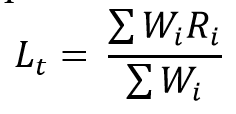
Where,
Wi = Weight assigned to item i in the base year
Ri = Production relative of item i, calculated as 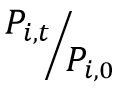
Pi,t = Production of item i in the current period (t)
Pi,0= Production of item i in the base period
- Which NIC classification will be used in dissemination of the Index at NIC 2-digit level?
Ans: The latest version of NIC i.e. NIC 2025 will be used to disseminate the Index in the new series of IIP.
- What is the preferred price deflator for value-reported items, and what will be used in the interim?
Ans: At present the Wholesale Price Index (WPI) is being used as deflator for value-based items. After release of Output Producer Price Index (Output PPI) the same will be utilized after examining its stability.
- How does the new IIP address missing values or temporary non-response from factories?
Ans: If a factory is non-responsive for less than 6 months, imputation methodology as recommended by the TAC-IIP will be used.
- What is the main role of the Technical Advisory Committee (TAC) constituted for the base year revision of All India IIP?
Ans: The terms of reference of the TAC-IIP included carrying out in-depth examination of the existing IIP framework and recommending necessary methodological and structural changes for base year revision.
- Has the methodology for compilation of chain-linked indices been finalized?
Ans: The methodology for compilation of chain-linked indices has been examined and recommended by the TAC-IIP. It has also been recommended that these indices may be brought out internally and a pilot may be released only after observing their stability and resilience.
- Will the seasonally adjusted IIP be released with new series?
Ans: Seasonal adjustment requires a sufficiently long and stable time series to reliably identify and estimate recurring seasonal patterns. In the new IIP series, seasonal adjustment would be taken up once sufficient years’ time series data becomes available.
- Where can users access IIP data?
Ans: The IIP data is released through official press release and publication of the Ministry of Statistics and Programme Implementation (MoSPI). The IIP data can be accessed from the e-Sankhyiki Portal (MoSPI) at: https://esankhyiki.mospi.gov.in
***
Samrat/Pranab
(Release ID: 2265637)
Visitor Counter : 8592