Ministry of Agriculture &
Farmers Welfare
Centre Accelerates Kharif Preparedness; Union Agriculture Minister Shri Shivraj Singh Chouhan Addresses Press Conference
‘Team Agriculture’ Unites at Kharif Conference to Shape the Future of Indian Farming: Shri Shivraj Singh Chouhan
Every State Has a Different Farming Model, Regional Strategies Are the Need of the Hour: Union Agriculture Minister
India Achieves Historic Foodgrain Output of Over 376 Million Tonnes: Shri Chouhan
India Becomes World’s Largest Rice Producer, Surpasses China: Union Agriculture Minister
Self-Reliance in Pulses and Oilseeds Is Our Top Priority: Shri Shivraj Singh
From Climate Change to Digital Farming, Kharif Conference to Shape New Agriculture Roadmap: Shri Chouhan
Posted On:
28 MAY 2026 5:23PM by PIB Delhi
Union Minister for Agriculture and Farmers’ Welfare Shri Shivraj Singh Chouhan today addressed a press conference on the Kharif Conference-2026 at the PUSA campus in New Delhi. During the briefing, the Union Minister said ensuring the country’s food security, improving farmers’ livelihoods and providing nutritious food to citizens remain the highest priorities of the Central Government. He said the Government of India, under the leadership of Prime Minister Shri Narendra Modi, has been continuously working to strengthen the agriculture sector. A two-day Agriculture Conference on the National Kharif Campaign-2026 is being organised on May 28 and 29, 2026, at the NASC Complex, Pusa, New Delhi. Agriculture ministers, scientists and senior officials from across the country are participating in the conference, along with representatives from ICAR, states and Union Territories. Detailed discussions and reviews on preparations for the upcoming Kharif season will be held over the two days.
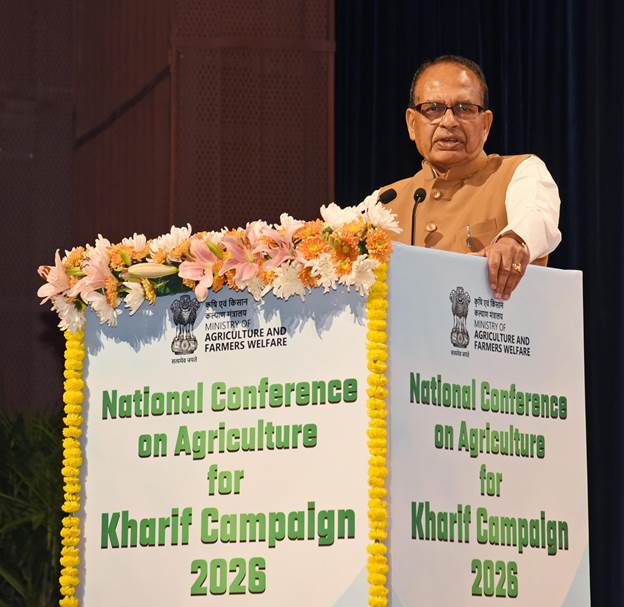
‘Team Agriculture’ Comes Together at Kharif Conference
Shri Chouhan said the Kharif Conference has brought together the entire 'Team Agriculture' under one platform. He clarified that Team Agriculture does not only mean the Central Government, but also state governments, scientists from the Indian Council of Agricultural Research, officials from the Centre and states, Farmer Producer Organisation representatives, and all stakeholders associated with the agriculture sector. He said agriculture is a state subject and better outcomes are achieved through active participation of states, while the Centre plays the role of a facilitator and partner. Discussions at the conference are focused on preparations for both Kharif and Rabi crops, availability of quality seeds for sowing, and effective implementation of various agricultural missions at the grassroots level.
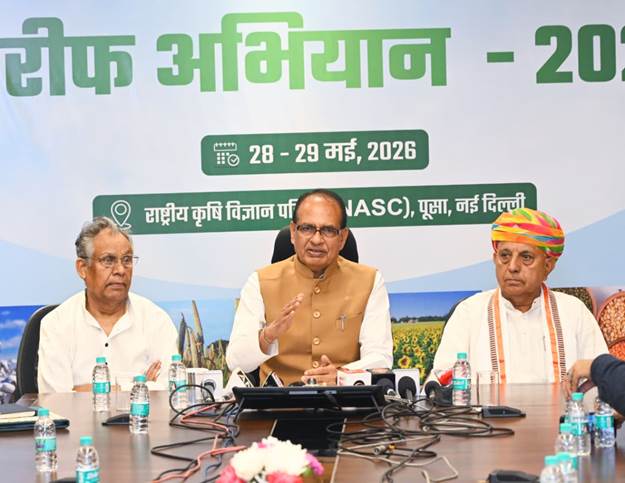
The Union Minister informed that virtual meetings had already been held with states ahead of the conference, during which extensive discussions took place on multiple issues. Based on these consultations, states have arrived at the conference with their respective preparedness plans. He stressed the need for serious discussions on challenges being faced by states and finding practical solutions through coordinated efforts.
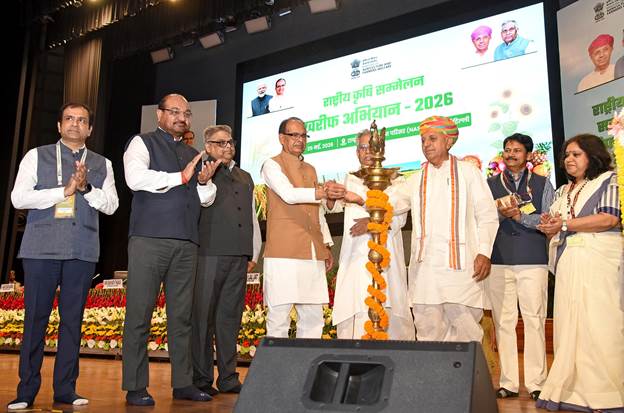
Earlier the conference used to be a one-day event, but considering the scale and diversity of the country, comprehensive deliberations could not be completed within a single day. Therefore, on the first day, officials are holding detailed discussions in groups with different states, while on the second day state agriculture ministers will also participate in the deliberations.
Regional-Level Discussions Introduced for Diverse Agricultural Conditions
The Union Agriculture Minister said that given India’s vast geographical and climatic diversity, the government has expanded the consultation process beyond the National Agriculture Conference and has now started organising Regional Conferences as well. He informed that three regional conferences have already been held in Jaipur, Lucknow and Bhubaneswar. Two more conferences are proposed for the North-East and southern India, with dates to be finalised soon.
Shri Chouhan said agricultural practices and climatic conditions vary significantly from one state to another, making regional-level discussions more practical and effective. “When discussions are held in smaller groups with states, it becomes possible to deliberate in detail on the specific issues and requirements of each state,” he said. The Minister further stated that the government is also considering organising regional conferences based on agro-climatic zones in the future. Referring to the ICAR classification, he said the country can broadly be divided into eight agro-climatic zones. “Our effort is to organise regional conferences based on these eight zones instead of only five, so that agricultural strategies and schemes can effectively reach the grassroots level,” he added. He also informed that a detailed presentation linked to the Kharif Conference has been prepared, covering extensive discussions on various agricultural subjects.
Record Production in Wheat, Rice, Maize and Oilseeds
Highlighting the achievements of the agriculture sector, Shri Chouhan said that due to the hard work of farmers, policy support from the Central Government under the leadership of Prime Minister Shri Narendra Modi, scientific research, and cooperation from states, India has surpassed all previous records in foodgrain production this year. “As Agriculture Minister, it gives me immense satisfaction to say that because of farmers’ hard work, government schemes and newly developed seed varieties, the country has achieved record production this year,” he said. The Minister stated that India’s estimated total foodgrain production for 2025-26 has reached 376.563 million tonnes, nearly 18.8 million tonnes higher than the previous year. India has also set a new benchmark in rice production. “Rice production has reached 154.024 million tonnes and India has now become number one in the world, surpassing China,” he said. According to the Minister, wheat production has reached 120.657 million tonnes, while maize production stands at 55.092 million tonnes - both record levels.
Shri Shivraj Singh Chouhan further said the country has achieved significant milestones in oilseed production as well. The estimated oilseed production for the year is projected at 43.059 million tonnes. Groundnut production has reached 13.074 million tonnes, while rapeseed-mustard production has climbed to 13.768 million tonnes, both at record levels. He added that pulse production has also registered growth and there remains strong potential for further increases in the coming years.
National Deliberations on Kharif Strategy
The Union Minister said separate missions have been created for pulses and oilseeds, and extensive discussions will be held with states on improving seed quality, increasing seed replacement rates, demonstrations and strengthening processing infrastructure. Shri Chouhan said the horticulture sector is witnessing rapid growth in the country and holds immense potential. Discussions during the conference will also cover the Mission for Integrated Development of Horticulture and the Cotton Mission. Describing climate change as a major challenge for agriculture, the Minister said changing weather patterns and erratic rainfall are rapidly altering farming conditions. “Temperatures are continuously rising, there are instances of excessive rainfall at one time followed by long dry spells. In such a scenario, discussions are necessary on measures to make agriculture safe and sustainable,” he said.
He informed that special focus will be placed on natural farming, Soil Health Cards and balanced use of fertilisers. The Minister pointed out that due to lack of awareness, many farmers use fertilisers in excess, making balanced application essential. He also said discussions would be held on integrated farming models to increase the income of small and marginal farmers. “Farm sizes in India are small. Therefore, emphasis will be placed on how farmers can earn higher income from limited landholdings,” he said.
He underlined the importance of adequate financing for agriculture, stating that farmers require support not only for crop production but also for post-harvest management and risk protection. He noted that agricultural credit distribution remains uneven across states, with some states receiving significantly lower agricultural credit than others. “If farmers have access to Kisan Credit Cards and sufficient investment capital, they will be able to undertake better farming practices,” he said.
The Union Minister informed that the conference will also deliberate on issues related to the Agriculture Infrastructure Fund, PM-AASHA scheme, digital agriculture, Farmer ID and strengthening Farmer Producer Organisations (FPOs). For these discussions, states have been divided into different groups where detailed deliberations will take place throughout the day. On the following day, presentations on various agricultural themes will be made in the presence of state agriculture ministers, and a joint agricultural roadmap for the Kharif crop season will be prepared by the Centre and states together. Shri Chouhan also said that the conference will hold extensive discussions on the 'Khet Bachao Abhiyan.' He added that the Centre and states will work in close coordination to achieve the targets collectively decided upon.
***
RC/MS
(Release ID: 2266270)
Visitor Counter : 3128