Posted On:
30 MAY 2026 2:33PM by PIB Delhi
In a historic first for Indian agriculture, Agriculture Ministers from 22 states came together on a single platform during the two-day National Kharif Conference held on May 28–29 at the PUSA campus in New Delhi, one of the country’s premier agricultural research centres. The conference culminated in a collective commitment to improve the lives of farmers and strengthen the agricultural sector through coordinated action and effective implementation.
Far more than a routine review meeting, the conference emerged as a national platform for commitment, coordination, and ground-level execution. Chaired by Union Minister for Agriculture & Farmers Welfare and Rural Development Shri Shivraj Singh Chouhan, the first day witnessed extensive discussions among senior officials from state agriculture and horticulture departments. On the second day, Shri Chouhan remained present throughout the proceedings as state Agriculture Ministers engaged in an unprecedented extended discussion that continued into the evening. Together, they charted a common roadmap on critical issues including Kharif preparedness, self-reliance in pulses and oilseeds, balanced fertilizer use, natural farming, and the proposed 'Khet Bachao Abhiyan' Campaign.
One of the most notable outcomes of the conference was the commitment made by Agriculture Ministers, following Shri Chouhan’s appeal, to not only support natural farming at the policy level but also to adopt and experiment with it on their own farms. The objective is to lead by example and inspire greater confidence among farmers.
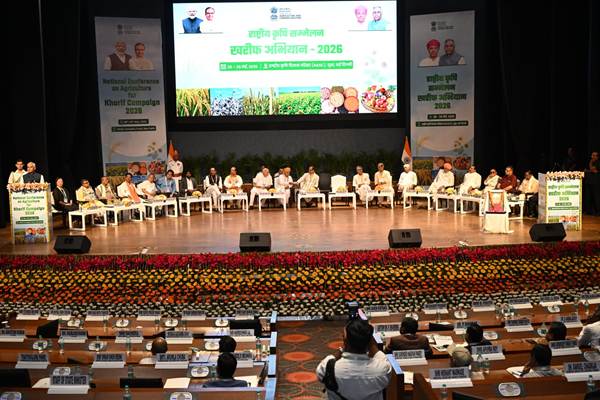
The National Kharif Conference once again demonstrated that under the leadership of Prime Minister Shri Narendra Modi, the Government of India views agriculture not merely as a question of production, but as a broader national responsibility encompassing soil health, environmental sustainability, nutrition security, farmer prosperity, and the well-being of future generations. During the conference, Shri Chouhan strongly urged state governments to simplify administrative procedures and remove unnecessary complexities so that farmers can benefit more effectively from government initiatives.
The first day of the conference brought together senior officials from across the country to discuss Kharif season preparedness, seed availability, fertilizer management, crop planning, water management, and region-specific challenges. Significantly, after delivering his opening remarks, Shri Chouhan chose to sit among the participants at the back of the hall for the entire session, listening closely to the discussions. On the following day, under his chairmanship, state Agriculture Ministers carried the discussion forward and transformed it into a shared policy commitment and action agenda.
At the concluding session, Shri Chouhan appreciated the seriousness, dedication, and active participation displayed by both officials and ministers. He remarked that he had rarely witnessed such committed engagement from participants. His observation reflected the spirit of the conference, where attendees presented themselves not only as administrators, but as thinkers, practitioners, and agents of change.
Perhaps the strongest message to emerge from the conference was that “Saving Farms Means Saving the Future.” Shri Chouhan emphasized that protecting farms is not only about safeguarding agricultural land, but also about preserving the environment, the nation, and the future of coming generations. In this context, special emphasis was placed on the balanced use of fertilizers.
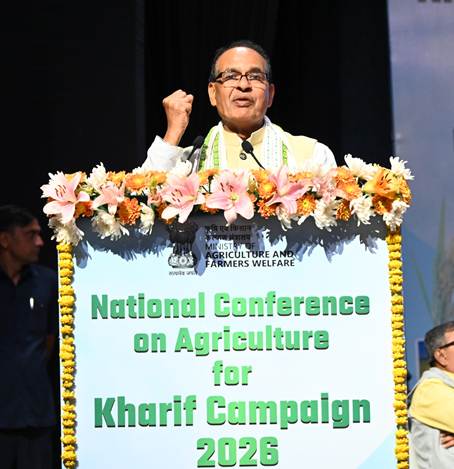
The Union Minister clarified that the objective is not to completely prohibit chemical fertilizers, but to promote their scientific, balanced, and judicious use. To achieve this, he called for a nationwide awareness movement and institutional campaign. Consequently, the conference proposed that the Khet Bachao Abhiyan be developed as a joint national initiative involving the Central Government, State Governments, the Indian Council of Agricultural Research, agricultural universities, Krishi Vigyan Kendras, and the wider scientific community.
Shri Chouhan also emphasized the need to establish coordinated implementation mechanisms, monitoring systems, and dedicated control rooms to ensure that the campaign evolves beyond an appeal and delivers measurable outcomes on the ground.
Another significant development was the public commitment made by state Agriculture Ministers to personally adopt natural farming practices on their own farms. Since most Agriculture Ministers are themselves connected to farming, this decision carries practical significance rather than being merely symbolic. Shri Chouhan stressed that when policymakers and public representatives demonstrate natural farming models themselves, even on a small scale, the message becomes more credible and inspiring for farmers.
Experiences from states such as Gujarat were highlighted as valuable examples in this regard. The Governor of Gujarat, Acharya Devvrat, also participated extensively in the conference and, during a special session, strongly advocated the expansion of natural farming practices across the country.
The conference further underscored that Kharif planning will no longer be confined to seasonal preparedness alone. Instead, it will be linked to a broader agenda encompassing self-reliance in pulses and oilseeds, soil health, prudent management of input costs, and sustained enhancement of agricultural productivity. The emerging policy vision seeks to simultaneously increase production while protecting and restoring the health of natural resources.
Another important aspect of the discussion was the communication strategy required to transform policy decisions into public movements. In his concluding remarks, Shri Chouhan emphasized that the decisions and campaigns finalized during the conference must be continuously communicated to farmers and the public through various outreach and awareness platforms. Such efforts, he said, would help transform agricultural reforms from administrative initiatives into people-centric movements driven by public participation.
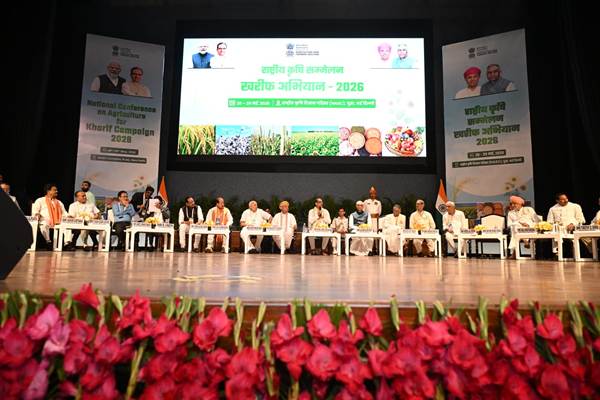
Shri Chouhan also stated that under the guidance of Prime Minister Narendra Modi, the Central Government seeks to build a culture of shared responsibility in agricultural governance rather than limiting itself to the announcement of schemes. He observed that achieving great goals does not require a great position, but a great resolve. This sentiment emerged as the defining spirit of the conference, with ministers and officials collectively committing themselves to fulfilling their responsibilities with dedication and purpose.
The two-day National Kharif Conference is being regarded as a landmark event because it elevated agriculture from a departmental subject to a national mission. The 'Khet Bachao Abhiyan' balanced fertilizer use, practical models of natural farming, and the goal of self-reliance in pulses and oilseeds will now move forward within defined timelines and implementation frameworks. The conference is therefore expected to mark a significant and positive turning point for the agricultural sector.
Concluding the conference, Shri Shivraj Singh Chouhan led participants in a collective pledge that the ideas and commitments emerging from these two days of intensive deliberation would be translated into action on the ground. This transition—from ideas to commitment, and from commitment to implementation—is being regarded as the most significant achievement of the National Kharif Conference 2026 and a reflection of an Agriculture India moving decisively towards action-oriented transformation.
****
RC / MS / MK