Posted On:
30 MAY 2026 5:09PM by PIB Delhi
In a significant step towards strengthening professional capacity in labour governance, social security administration, and regulatory compliance, the Pandit Deendayal Upadhyaya National Academy of Social Security (PDUNASS), Employees’ Provident Fund Organisation (EPFO), in collaboration with Gujarat National Law University (GNLU), Gandhinagar, launched the inaugural batch of the Executive Development Programme on “Labour Laws and Social Security Compliance (EPFO at Core)” during an online inaugural session held on 29 May 2026.
The Programme marks an important milestone in professional legal education and industry-oriented capacity building at a time when India’s labour and social security landscape is undergoing significant transformation. Designed as a practice-oriented executive learning initiative, it seeks to bridge the gap between legal understanding, regulatory compliance, and real-world implementation, equipping professionals to navigate the increasingly complex compliance environment emerging in the post-Labour Codes era.
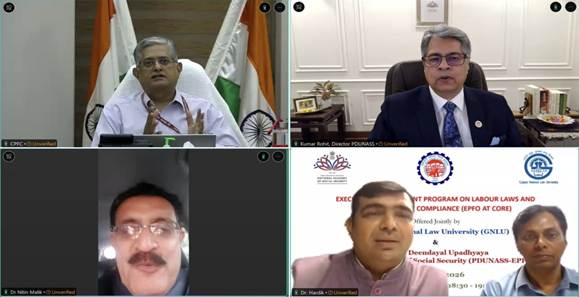
The inaugural session was graced by Shri Ramesh Krishnamurthi, Central Provident Fund Commissioner (CPFC), EPFO, and attended by Shri Kumar Rohit, Director, PDUNASS; Prof. (Dr.) S. Shanthakumar, Director, GNLU; Dr. Nitin Malik, Registrar, GNLU; senior EPFO officers, faculty members, industry leaders, and participants from across the country.
The Programme has generated strong national interest among employers, HR professionals, labour law practitioners, compliance officers, academicians, and corporate leaders. Against the originally planned intake of 60 participants, the inaugural batch enrolled 66 participants, making it oversubscribed even before commencement. Continued demand has prompted consideration of a second batch.
Addressing participants, Shri Ramesh Krishnamurthi noted that India is witnessing a transformative phase in labour governance and social security administration. He observed that the Labour Codes, particularly the Code on Social Security, 2020, together with rapid digitization, have increased the need for professionals who can combine legal understanding with practical implementation capabilities.
He emphasised that compliance today extends beyond statutory obligations and has become a cornerstone of responsible governance, ethical employment practices, institutional credibility, and sustainable organisational growth. Organisations that invest in robust compliance frameworks, he said, contribute not only to worker welfare and social protection but also to trust, transparency, productivity, and industrial harmony.
Highlighting EPFO’s transformation, he referred to initiatives such as Aadhaar-enabled services, Universal Account Number (UAN) integration, digital compliance platforms, online service delivery mechanisms, and technology-driven governance reforms. He expressed confidence that the Programme would serve as an important platform for professional learning by bringing together government, academia, and industry to address emerging compliance challenges and opportunities.
Speaking on the occasion, Shri Kumar Rohit, Director, PDUNASS, described the launch as a defining milestone for the National Academy of Social Security and the culmination of a shared vision developed through sustained collaboration between PDUNASS and GNLU.
Recalling the genesis of the initiative, he noted that the Programme emerged from the recognition that India’s evolving labour and social security ecosystem required a structured professional platform capable of bridging the longstanding gap between legal knowledge and practical implementation. He observed that changing workforce structures, digital governance systems, and increasing expectations of transparency and accountability demand professionals who can translate regulatory requirements into effective workplace systems and governance practices.
Emphasising the importance of continuous professional learning, Shri Rohit stated that employability and professional relevance increasingly depend on adaptability, practical competence, and the ability to respond proactively to emerging regulatory and technological developments. He further stressed that labour law compliance should be viewed not merely as a statutory responsibility but also as an instrument for advancing dignity, fairness, worker welfare, and institutional trust.
Highlighting the significance of the collaboration, he noted that the Programme represents a unique convergence of PDUNASS’s operational expertise and GNLU’s academic excellence, and expressed confidence that it would contribute to creating a future-ready cadre of compliance professionals capable of supporting India’s vision of Viksit Bharat 2047.
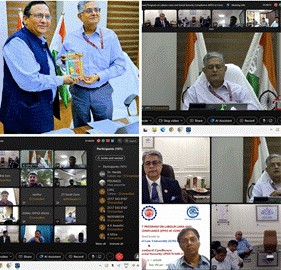
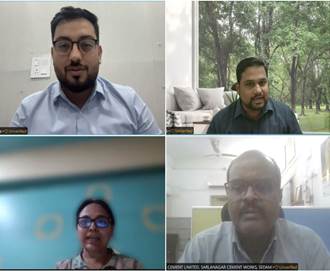
In his address, Prof. (Dr.) S. Shanthakumar, Director, GNLU, described the Programme as a pioneering example of meaningful academia-industry collaboration. He observed that contemporary labour governance requires professionals who can integrate legal knowledge with practical understanding and implementation skills.
He noted that the Programme aligns with GNLU’s commitment to advancing professional education that is academically rigorous, socially relevant, and responsive to industry needs. Labour laws and social security frameworks, he remarked, should increasingly be understood not merely as regulatory requirements but as strategic instruments for promoting employee welfare, strengthening governance systems, enhancing organisational resilience, and fostering sustainable growth.
Dr. Nitin Malik, Registrar, GNLU, welcomed the initiative and observed that the strong response from professionals reflects the growing demand for executive education programmes that combine academic rigour with practical relevance.
A distinguishing feature of the Programme is its practitioner-centric design. Developed jointly by the Standing Committee and Academic Committee of PDUNASS, the curriculum has been shaped by Shri Amit Vashist, Addl.CPFC, along with Shri Rizwan Uddin, Shri Uttam Prakash, Shri Vijay Kumar, Shri Prashant Sharma, Shri Sanjay Kumar Rai, Shri Ankur P. Gupta, Shri Harish Yadav, and Shri Ramanand, all serving as Regional Provident Fund Commissioners. The curriculum combines field experience, regulatory insight, operational understanding, and academic rigour to help participants understand not only the law but also its practical implementation.
The three-month Programme is being conducted online, with classes every Friday and Saturday from 6:00 PM to 9:00 PM, enabling participation by working professionals across India. The online component will be followed by a four-day contact programme at the GNLU campus in Gandhinagar featuring workshops, compliance simulations, case studies, expert interactions, and advanced discussions.
The inaugural session was jointly moderated by Dr. Hardik Parikh, Assistant Professor, GNLU, and Shri Manoranjan Kumar, Regional Provident Fund Commissioner.
With its distinctive blend of academic scholarship, practitioner expertise, and industry relevance, the Executive Development Programme on “Labour Laws and Social Security Compliance (EPFO at Core)” is poised to become a benchmark initiative in executive education. By bringing together government, academia, and industry on a common platform, the Programme seeks to develop a new generation of compliance professionals equipped to navigate the evolving landscape of labour governance and social security administration while contributing to the strengthening of India’s social security ecosystem.
***
Rini Choudhury/Anjelina Alexander