Posted On:
01 JUN 2026 6:54PM by PIB Delhi
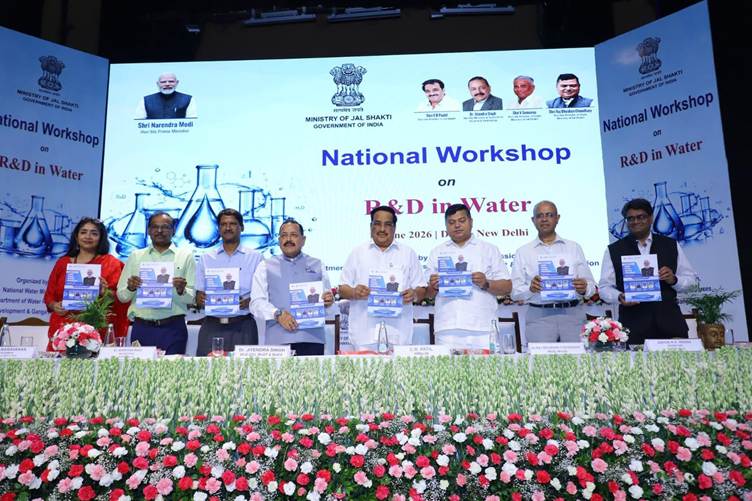
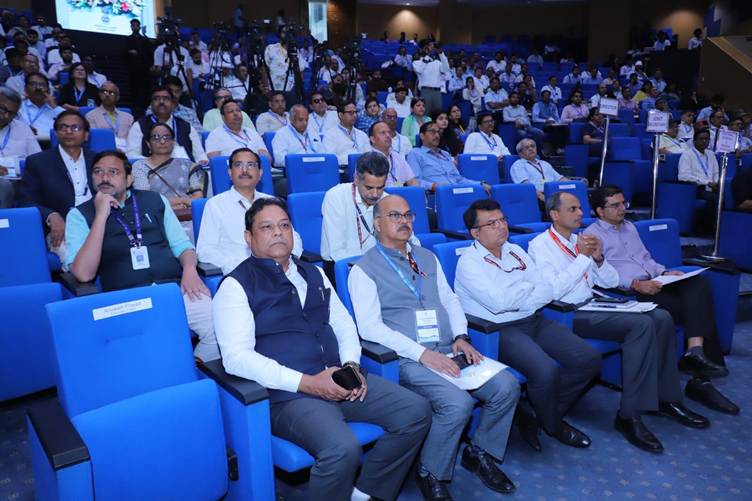
The National Workshop on R&D in Water brought together over 500 stakeholders from government, academia, research institutions, industry, MSMEs and startups to deliberate on strengthening India's water research and innovation ecosystem for achieving water security and climate resilience. The workshop was attended by Shri C.R. Patil, Union Minister of Jal Shakti; Dr. Jitendra Singh, Minister of State (Independent Charge) for Science & Technology; Shri Raj Bhushan Choudhary, Minister of State, Ministry of Jal Shakti; Dr. V. Narayanan, Secretary, Department of Space and Chairman, ISRO, CEO ANRF; Senior Secretaries, scientists, experts and industries from across the country.
Addressing the gathering, Shri C.R. Patil, Union Minister of Jal Shakti, emphasized that “Jal is the hallmark of our civilization” and development. He stressed that addressing emerging water challenges requires a three-pronged approach of research, technological innovation and Jan Bhagidari. Highlighting the Ministry’s efforts in promoting research and innovation, he noted that over 315 R&D projects have been undertaken in the water sector, including 113 projects directly supported by the Ministry.
Minister also highlighted the success of the Jal Sanchay Jan Bhagidari (JSJB) campaign, under which more than 1.5 crore water conservation structures have been reported across the country. He announced the launch of Jal Sanchay Jan Bhagidari: Catch the Rain (JSJB:CTR) Portal , a nationwide initiative aimed at further strengthening community-led water conservation through participation of citizens, industries, NGOs and government agencies. He also underscored the role of geospatial technologies and partnerships in supporting scientific water management and source sustainability.
Dr. Jitendra Singh underscored the importance of a Whole-of-Government and Whole-of-Nation approach involving academia, industry, MSMEs and startups for realizing the vision of Viksit Bharat 2047. He highlighted the launch of MAHA on Water (Mission for Advancement in High-Impact Areas for Water) and the growing role of science and technology in water management, he welcomed the Ministry of Jal Shakti–ISRO collaboration and underscored the potential of advanced technologies, including space-based applications, in addressing water challenges. He also appreciated the Ministry of Jal Shakti's achievements over the past twelve years and highlighted the launch of MAHA on Water as a major step towards fostering innovation in water resources management, climate resilience and drinking water security. He also announced a joint research call by ANRF and the Ministry of Jal Shakti to accelerate research-driven and scalable solutions for the water sector.
Shri Raj Bhushan Choudhary emphasized that water is a foundational resource that underpins agriculture, livelihoods, public health, economic growth and environmental sustainability. Highlighting the need to address emerging water challenges through a holistic approach, he stressed the importance of scientific research, technology-driven interventions and community participation in strengthening sustainable water management across the country. He underscored that innovation, evidence-based policymaking and people's participation will be key to ensuring long-term water security and realizing the vision of a water-secure and developed India.
Shri V. L. Kantha Rao, Secretary, Department of Water Resources, River Development & Ganga Rejuvenation, emphasized that water is a strategic resource requiring sustained investments in research and innovation. He highlighted the need for cutting-edge solutions in drinking water security, groundwater management, flood forecasting, river health and climate resilience, and underscored the importance of collaboration among the Department of Space, DST, ANRF, CSIR and other institutions to develop technology-driven solutions for sustainable water management.
Dr. V. Narayanan, Secretary, Department of Space and Chairman, ISRO, highlighted the transformative role of space technology, remote sensing and geospatial applications in water resources management. He welcomed the Ministry of Jal Shakti–ISRO partnership and emphasized the integration of satellite-based observations with field-level data for strengthening evidence-based water governance.
Shri Ashok Meena, Secretary, Department of Drinking Water & Sanitation, emphasized the need to translate research and technological advancements into practical, field-level solutions for strengthening climate resilience, drinking water security and source sustainability under the Jal Jeevan Mission. States and Union Territories encouraged to establish dedicated R&D committees to address local challenges related to water quality and resource sustainability. Highlighting the importance of data-driven water governance, he noted that the Ministry's collaboration with ISRO and BISAG-N is enabling village-level mapping and scientific planning, thereby strengthening sustainable water resource management from the village to the national level.
Dr. Shivkumar Kalyanaraman, CEO, ANRF, highlighted the significance of MAHA on Water (Mission for Advancement in High-Impact Areas for Water) as a transformative initiative to strengthen India's water research and innovation ecosystem. He emphasized that the mission will foster high-impact research in priority areas such as water resources management, drinking water security, climate resilience and emerging technologies, while promoting collaboration among academia, research institutions, industry, startups and government agencies. He emphasized that MAHA on Water has the potential to accelerate the development and deployment of innovative, scalable solutions for achieving a water-secure and sustainable future.
Major Launches and Strategic Announcements
The workshop witnessed the launch of several strategic initiatives aimed at accelerating innovation, research translation and technology adoption in the water sector.
MAHA on Water (Mission for Advancement in High-Impact Areas) was launched as a collaborative platform to foster convergence among government agencies, academic institutions, research organisations, industry and startups for addressing emerging water challenges through mission-driven research and innovation.
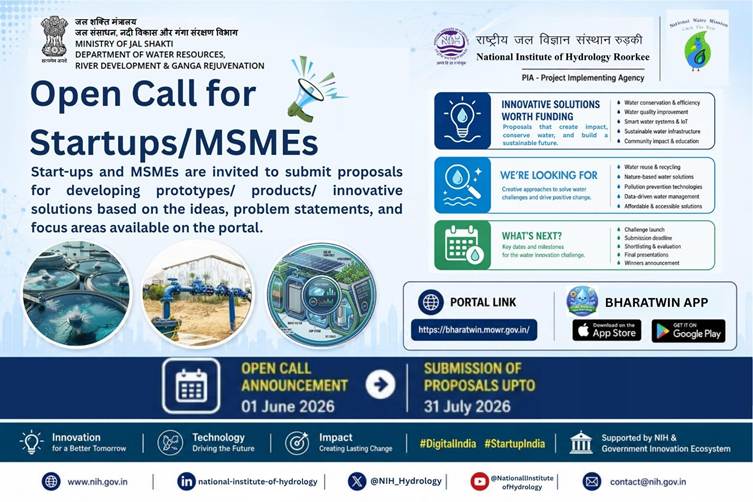
An Open Call for Startups and MSMEs under the Bharat Water Innovation Network (Bharat-WIN) was also launched to support product and prototype development in the water sector. The initiative aims to identify, nurture and scale innovative solutions for water conservation, water-use efficiency, source sustainability, water quality management and climate-resilient water systems. It seeks to strengthen innovation-to-impact pathways by facilitating collaboration among innovators, research institutions, industry partners, government programmes and end users, thereby accelerating the adoption and scaling of promising technologies.
The workshop also marked the launch of Jal Sanchay Jan Bhagidari: Catch the Rain (JSJB:CTR) Portal , a nationwide participatory campaign to further strengthen community-led water conservation efforts. Building on the success of the Jal Sanchay Jan Bhagidari initiative, the platform will facilitate citizen engagement, knowledge sharing, reporting of water conservation works and dissemination of best practices across the country.
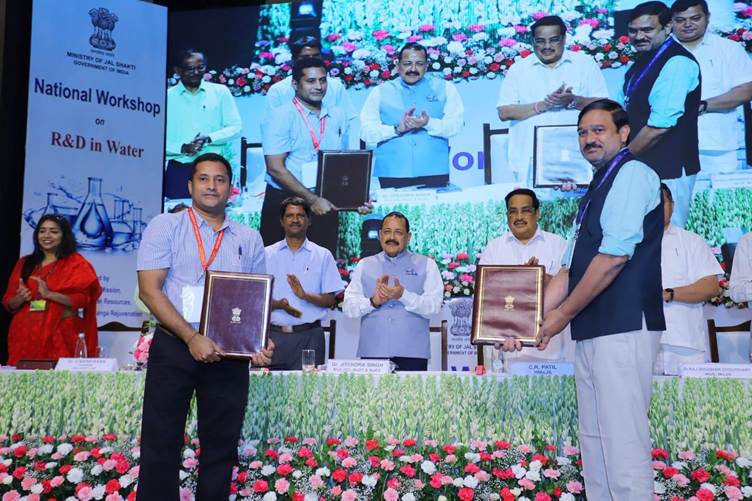
A significant milestone was the signing of a Memorandum of Understanding between the Ministry of Jal Shakti and ISRO to leverage space technology, remote sensing, satellite-based observations and geospatial intelligence for water resources planning, monitoring and decision-making. The partnership is expected to enhance scientific water governance and strengthen data-driven approaches for sustainable water management.
Technical Sessions Deliberate on National Priorities and Future Research Directions
The technical sessions brought together experts from central ministries, State governments, academic institutions, research organisations, industry, startups, development partners and civil society organisations to deliberate on emerging water challenges and future research priorities.
The deliberations covered diverse hydro-climatic and geographical contexts across the country, including Himalayan ecosystems, river basins, groundwater-dependent regions, coastal areas, urban centres and drought-prone landscapes. Discussions focused on critical themes such as climate change adaptation, groundwater sustainability, irrigation efficiency, water quality management, river and reservoir systems, flood and drought resilience, ecological restoration, urban water security, geospatial technologies, artificial intelligence and digital solutions for water governance.
Participants examined opportunities for strengthening collaboration between research institutions and implementing agencies, accelerating technology transfer, promoting innovation-driven entrepreneurship and improving the translation of scientific knowledge into field-level impact. Particular emphasis was placed on developing scalable and locally relevant solutions capable of addressing region-specific water challenges while supporting national priorities.
The deliberations highlighted the need for stronger convergence among government, academia, industry and communities to ensure that research outcomes contribute directly to improved water security, climate resilience, sustainable resource management and evidence-based policymaking.
Exhibition Showcases Emerging Technologies and Best Practices
An exhibition showcasing innovative technologies, research outcomes, geospatial applications, digital platforms, startup-led solutions and successful field interventions in the water sector was inaugurated during the workshop. The exhibition provided a platform for interaction among researchers, technology developers, policymakers, industry representatives and end users, facilitating knowledge exchange and identification of opportunities for collaboration and scaling.
A short film highlighting key achievements and outcomes of water-sector research and innovation over the past 12 years was also screened, showcasing advances in groundwater management, climate resilience, irrigation efficiency, remote sensing applications and water governance.
The workshop marked a significant step towards realizing the Hon'ble Prime Minister's vision of harnessing the collective strengths of government, science, industry and society to address national priorities through innovation and technology. By bringing together policymakers, researchers, startups, MSMEs, industry leaders and community stakeholders on a common platform, the workshop laid the foundation for a more integrated, collaborative and research-driven water sector ecosystem.
The recommendations emerging from the deliberations are expected to guide future investments in water research and innovation, strengthen partnerships across sectors, accelerate the translation of research into scalable solutions, and promote the adoption of advanced technologies for sustainable water management. The outcomes of the workshop
accelerate the deployment of cutting-edge technologies and contribute towards achieving water security, climate resilience and the vision of Viksit Bharat 2047.
***
ND/HM