Ministry of Commerce & Industry
Ministry of Commerce & Industry Holds Stakeholder Interaction in Chandigarh; Apprises Punjab and Haryana Industry and Farmers of Vast Export Opportunities under India’s New FTA Architecture
Significant opportunities exist in textiles and apparel, engineering, agriculture and food processing in Haryana and Punjab: Shri Nitin Kumar Yadav
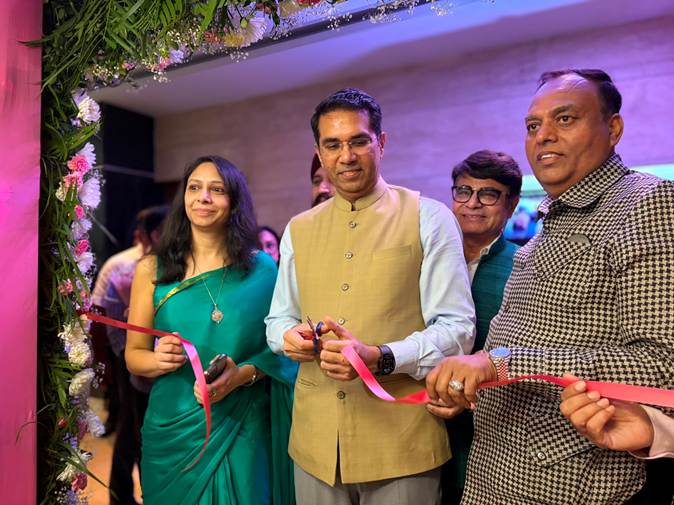
Shri Nitin Kumar Yadav Inaugurates APEDA’s Regional Office in Chandigarh
Posted On:
09 JUN 2026 4:45PM by PIB Chandigarh
The Ministry of Commerce & Industry convened a high-level Stakeholder Interaction at Chandigarh to sensitise exporters, industry bodies, Farmer Producer Organisations (FPOs), farmers and government officials from Punjab and Haryana on the wide-ranging export opportunities unlocked by India’s rapidly expanding Free Trade Agreement (FTA) network. The interaction aimed at channelising the region’s export potential particularly in textiles, engineering goods, agriculture, pharmaceuticals and chemicals into concrete trade outcomes through the new market access architecture.
Shri Nitin Kumar Yadav, Additional Secretary, Ministry of Commerce, addressed a press briefing on “Export Promotion of Agri Products & Meeting with Exporters and other Stakeholders from State of Haryana and Punjab”. During the occasion, he also inaugurated Chandigarh’s Regional Office of Agricultural and Processed Food Products Export Development Authority (APEDA). Likewise, Shri Abhishek Dev, Chairman, APEDA, virtually joined the inauguration of Regional Office, Chandigarh. He said that the Regional office will turn out to be a milestone in the field of Agricultural export in Punjab, Haryana, Himachal Pradesh and Chandigarh.
While interacting with the media persons, Shri Nitin Kumar Yadav said, “India’s overall exports have witnessed a significant leap over the past decade, with total exports — merchandise and services combined — rising from USD 468 billion in FY 2014–15 to an all-time high of USD 863 billion in FY 2025–26, reflecting a compound annual growth rate of 5.7 per cent.”
“During this period, merchandise exports grew from USD 310 billion to USD 442 billion, services exports surged from USD 158 billion to USD 421 billion at a CAGR of 9.3 per cent, and non-petroleum exports reached a new record of USD 387.9 billion, underscoring the depth and diversity of India’s export base,” he added.
The interaction apprised participants that the new FTAs provide 100 per cent duty-free access across tariff lines in textiles and apparel, engineering goods, electronics and pharmaceuticals — sectors of critical importance to Punjab and Haryana.
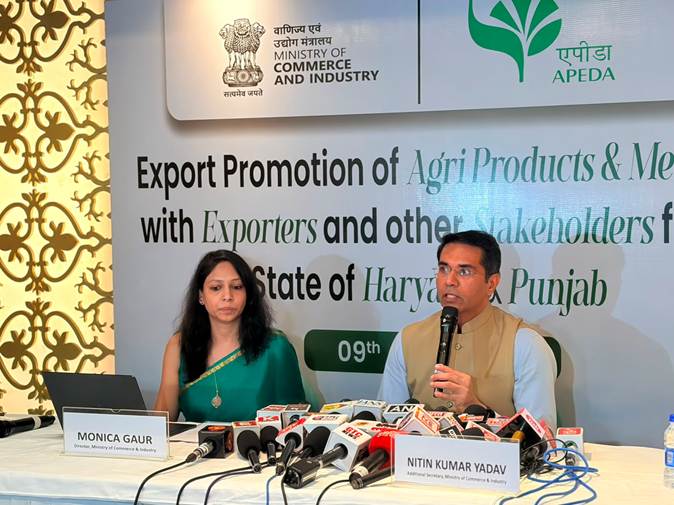
He further said India has concluded a series of landmark trade agreements that place the country at the centre of global value chains. The India-EFTA Trade and Economic Partnership Agreement (TEPA, 2025), backed by an FDI commitment of USD 100 billion, provides duty-free access for approximately 98 per cent of India’s exports, he said.
The India-EU FTA (2026), covering 27 high-income economies, is expected to benefit Rs. 3.2 lakh crore worth of Indian exports with tariff concessions on 99 per cent of bilateral trade by value, he asserted. Furthermore, he added that the India-Mauritius CECPA (2021) and the India-UAE CEPA together deliver zero-duty access on 99 per cent of India’s exports to these markets, with UAE bilateral trade already exceeding USD 80 billion. In February 2026, India and the United States reached a framework understanding for an Interim Bilateral Trade Agreement under the ‘Mission 500’ initiative, which aims to more than double bilateral trade to USD 500 billion by 2030, he said. Taken together, India’s nine FTAs now cover 38 countries and provide access to approximately 70 per cent of global GDP.
Shri Nitin Kumar Yadav further said, “For Punjab, significant opportunities exist in textiles and apparel, engineering, agriculture and food processing. For Haryana, key export products include Basmati Rice, Buffalo Meat, Non-Basmati Rice, Natural Honey, Dairy Products and Miscellaneous Food Preparations, with growing potential in pharmaceuticals and chemicals. Market access concessions available to exporters under each of the new FTAs across all major sectors were presented in detail.”
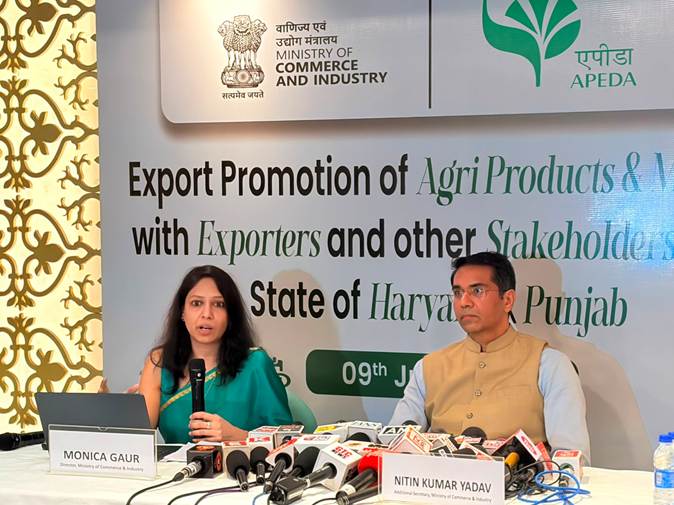
Smt. Monica Gaur, Director, Ministry of Commerce & Industry, Government of India, presented the significant export infrastructure developed across both states under its schemes. In Punjab, exporters have benefitted from infrastructure upgradation support; packhouse and quality compliance facilities have been strengthened at Amritsar Airport (AAI) to reduce transit time for perishables; and farmer and farm registration for horticulture crops has been deepened through the Hortinet traceability platform. In Haryana, Basmati.net and HortiNet systems have been integrated to ensure compliance with international food safety standards, and a week-long packaging excellence programme was conducted in March 2026 in collaboration with the Indian Institute of Packaging covering international packaging standards, export documentation and labelling requirements.
Landmark export milestones from the region were highlighted: Kinnow trial shipments from Abohar to Singapore and Russia (January 2025); India’s first-ever export of Ready-to-Eat ready to eat Popcorn from Dera Bassi to South Korea under the ‘Corn Trooper’ brand (January 2025); fresh Litchi from Pathankot to Qatar and UAE (June 2025); value-added Millet Products from Sangrur to Canada (June 2025); Foraged Rice Kernels (7,000 MT) from Haryana to Madagascar; and the first-ever FPC export of Soya Chaap from Aterna Village, Sonipat, to Toronto, Canada. India participated as the Official Partner Country at Gulfood 2026, Dubai, and was designated ‘Country of the Year’ at BIOFACH 2026, Germany, providing significant global visibility to agri-products from the region. India’s agricultural exports have grown from USD 40.95 billion (CY2014) to USD 52.76 billion (CY2024), and agri-marine-food exports crossed Rs. 4.3 lakh crore in 2025-26, reaching 206 countries, Shri Nitin Kumar Yadav said.
Likewise, the occasion witnessed a high-level stakeholder interaction focused on enhancing agricultural and processed food exports from Haryana, and Punjab. The stakeholders were also briefed on the Export Promotion Mission (EPM), approved by the Union Cabinet on 12 November 2025 with a total budgetary outlay of Rs. 25,060 Crore for six years from FY 2025-26, jointly implemented by the Department of Commerce, Ministry of MSME and Ministry of Finance. The EPM operates through two sub-schemes: ‘Niryat Protsahan’, which bridges the MSME trade finance gap through interest subvention on pre- and post-shipment credit, export factoring, credit cards for e-commerce exporters, and collateral support; and ‘Niryat Disha’, which addresses non-tariff barriers, export quality compliance, market access, export warehousing, inland transport support for low-export-intensity districts, and branding and packaging. The Mission marks a strategic shift from fragmented schemes to a comprehensive, digitally-driven framework aligned with the Viksit Bharat @2047 vision.
Shri Harpeet Singh, Regional Head, Chandigarh, APEDA, said that the interaction reaffirmed the Government’s commitment to empowering exporters, FPOs, farmers and MSMEs from Punjab and Haryana to leverage India’s new FTA architecture. The Ministry urged stakeholders to prepare product-specific export readiness plans, utilise APEDA’s financial assistance and traceability platforms, and actively engage with the Export Promotion Mission framework to scale their global presence in alignment with the Viksit Bharat vision.
Click for Hindi version
*****
PS/AK/RN
(Release ID: 2270744)
Visitor Counter : 176