PIB Backgrounder
Antyodaya in Action
Ensuring Dignity, Opportunity, and Growth for All
Posted On:
12 JUN 2026 12:05PM by PIB Delhi
|
For generations, India's most deprived communities have waited at the margins, underserved for long. This has changed over the last 12 years, with the Government adopting Antyodaya as its mantra. Inclusive, and quality education, skilling programmes, livelihood support, infrastructure, and cultural recognition have reached these communities at an unprecedented scale. The guiding objective is clear: to ensure that those who were left behind are placed at the forefront of opportunity and progress.
|
Antyodaya as a Governance Framework
"Recall the face of the poorest and the weakest man whom you may have seen," Mahatma Gandhi once advised, "and ask yourself if the step you contemplate is going to be of any use to him." For decades, this powerful idea was mostly found in books, while millions of Indians were left out of the country’s progress.
However, the past twelve years have seen a major change. India has moved from just talking about this ideal to putting it into action. This has ensured that those who were last in line become first in access to opportunity, dignity, and development. The focus has moved from fragmented delivery to saturation-based inclusion.
Tribal habitations saw greater infrastructure expansion. Students from deprived communities gained wider educational access. Sanitation workers received stronger institutional recognition and safety support. Backward and nomadic communities entered the focus of targeted welfare planning.
The change has also been visible geographically. Tribal regions, aspirational districts, and remote habitations became central to development planning and monitoring. Convergence across ministries strengthened last-mile delivery in areas once considered difficult to reach.
Tribal Communities at the Centre of Development
India's tribal communities have always been rich in culture, traditional knowledge, and resilience. What they lacked was equal access to infrastructure and services, like transport, education, healthcare, water, power and employment opportunity. The past 12 years have been about closing that distance — consciously, measurably, and at scale.
The shift has especially been visible in remote habitations including in areas inhabited by Particularly Vulnerable Tribal Groups (PVTG). Areas once seen as difficult to reach have become central to development planning and last-mile delivery.
Pradhan Mantri Janjati Adivasi Nyaya Maha Abhiyan (PM JANMAN)
|
Jharkhand: From Forest Floors to Market Shelves
In Gariyaband district of Jharkhand, the women of the Kamar PVTG community grew up watching their elders heal with forest herbs. It was a knowledge passed down quietly from mothers to daughters. For years, they sold those herbs raw at whatever price the market offered. The knowledge was theirs. But, the earnings rarely were.
PM JANMAN changed this. Under its Van Dhan Vikas Kendra initiative, 87 of these women came together to build something different. They set up a licensed unit to make Ayurvedic oils, powders, and medicines under the brand Chhattisgarh Herbals, with AYUSH certification. Skills were sharpened through entrepreneurship and digital literacy training. Sales have reached ₹159.59 lakh since inception. The women now lead production, packaging, and marketing without leaving their village. What was once quiet, inherited wisdom has now become a thriving business.
|
Pradhan Mantri Janjati Adivasi Nyaya Maha Abhiyan (PM JANMAN) is a programme targeted towards the Particularly Vulnerable Tribal Groups (PVTGs). They are among India's most isolated communities. Many lived without pucca housing, clean water, electricity, or road access. The government launched PM JANMAN in November 2023 to fill these gaps through coordinated effort of all concerned ministries. The programme targets 75 PVTG communities across 18 states and 1 UT, working through 11 interventions implemented by 9 ministries. Total budgetary outlay is ₹24,104 crore.
The 11 interventions cover housing, road connectivity, piped water supply, mobile medical units, Anganwadi Centres, hostels, electrification, mobile towers, multipurpose centres, Van Dhan Vikas Kendras, and vocational skilling.
Skilling and Livelihoods through Van Dhan Vikas Kendras (VDVKs):
A key component of PM JANMAN is the establishment of Van Dhan Vikas Kendras (VDVKs), which support PVTG communities in collecting, processing and selling forest-based products. It thereby creates local employment and income-generation opportunities. National Institute for Entrepreneurship and Small Business Development (NIESBUD) and Indian Institute of Entrepreneurship (IIE) are implementing skilling and entrepreneurship training across 15 states with the support of Tribal Cooperative Marketing Development Federation of India (TRIFED).
- 491 VDVKs operationalised out of a target of 500 (as of April 2026)
- 38,391 PVTG members trained under the Entrepreneurship Development Programme
PM-JUGA/ Dharti Aaba Janjatiya Gram Utkarsh Abhiyan
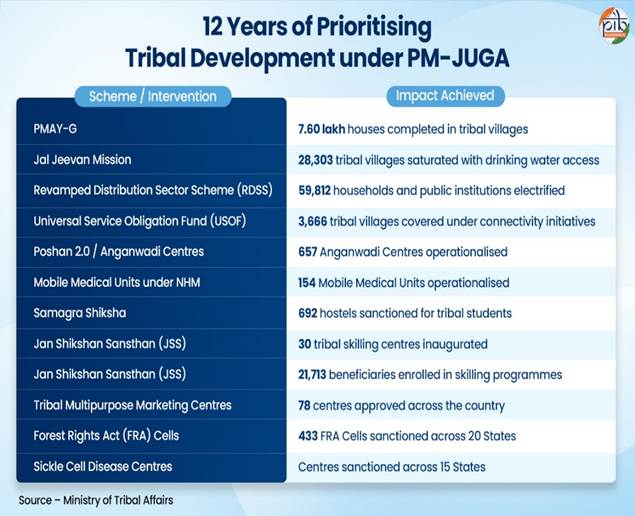
Dharti Aaba Janjatiya Gram Utkarsh Abhiyan (DAJGUA), now known as PM-JUGA was launched in October 2024. It combines the efforts of 17 ministries and focuses on filling long-standing gaps in tribal-majority villages and PVTG habitations.
Under PM JUGA, the emphasis has increasingly moved from isolated interventions to coordinated, mission-mode delivery across sectors and ministries.
Eklavya Model Residential Schools (EMRS)
Eklavya Model Residential Schools (EMRS) have emerged as a key intervention for expanding educational opportunities among Scheduled Tribe students. Established in tribal-dominated areas, these residential schools provide quality education, modern infrastructure and holistic development support from Classes VI to XII.
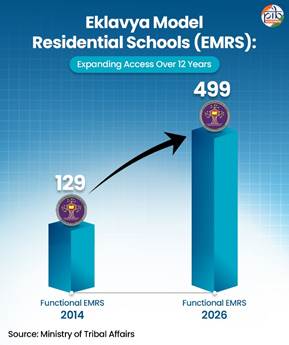
In the past 12 years, the expansion of Eklavya Model Residential Schools has transformed tribal education infrastructure across remote districts. The network grew rapidly after 2018, bringing modern residential schooling and quality education closer to Scheduled Tribe communities that remained underserved for generations.
As of 2026, over 1.56 lakh students are enrolled in 499 schools. 323 more schools are under construction.
Many students enrolled in EMRS became first-generation learners entering structured secondary education systems.
New campuses introduced facilities that were previously unavailable in several remote regions, including smart classrooms, science and computer laboratories, libraries, sports infrastructure, digital learning facilities, and separate hostels for boys and girls
|
From a Himalayan Village to IIT: Jatin Negi's Story
Sangla village in Himachal Pradesh's Kinnaur district borders Tibet. Winters mean two months without electricity and roads cut off by snow. It is here that Jatin Negi grew up.
He joined an Eklavya Model Residential School in Class 6. Structured learning, regular tests, and teachers who pushed him beyond textbooks changed everything. When his father passed away in Class 12, his teachers held him steady. He took a year off, studied relentlessly, and cleared JEE Advanced with an All-India Rank of 421. He is now studying at IIT Jodhpur.
His village had never heard of an IIT. Jatin's story is one of 597 — the number of EMRS students who cleared JEE and NEET in 2024-25, up from just 2 in 2022-23.
|
Support to Tribal Research Institutes (TRIs)
Tribal Research Institutes (TRIs) play a key role in documenting and preserving tribal languages, culture, traditions and indigenous knowledge systems. Supported across 29 States and UTs, they undertake research, record oral histories, document cultural practices, and promote awareness of tribal heritage through museums, archives, publications, festivals and outreach activities. TRIs also contribute to policy development and capacity building, ensuring that tribal knowledge informs both scholarship and governance. These efforts are further supported under the Tribal Research, Information, Education, Communication and Events (TRI-ECE) scheme. It funds research on subjects such as endangered languages, traditional medicine, community forest rights and PVTG livelihoods through institutions including IITs, IIMs, AIIMS, TERI and the Bhasha Research Institute.
Recognising Tribal Heritage and Freedom Fighters
|
In the past 12 years, the Government has sanctioned 11 Tribal Freedom Fighter Museums across 10 states to honour tribal leaders who fought against colonial rule. Four museums have been inaugurated in Jharkhand, Madhya Pradesh (2 museums), and Chhattisgarh. Seven more are under construction across Mizoram, Andhra Pradesh, Telangana, Kerala, Gujarat, Goa, and Manipur.
Janjatiya Gaurav Divas is observed every year on 15 November, the birth anniversary of Bhagwan Birsa Munda. It honours not just one leader, but the entire history of tribal resistance against colonial rule that mainstream India had long overlooked. The 150th Birth Anniversary of Bhagwan Birsa Munda was observed as Janjatiya Gaurav Varshfrom15th November 2024 to 15th November 2025.
|
Justice and Dignity for Scheduled Castes
Scheduled Caste (SC) communities have been at the centre of a targeted development strategy in past 12 years. This strategy combines economic empowerment, educational access, and dedicated budgetary support — moving beyond symbolic inclusion towards substantive equity.
Pradhan Mantri Anusuchit Jaati Abhyuday Yojana (PM-AJAY)
Launched in 2021, PM-AJAY focuses on integrated development of Scheduled Caste-majority villages. The scheme supports infrastructure creation, skill development, and livelihood opportunities in underserved SC communities.
Under PM-AJAY, the Adarsh Gram component takes an area-based approach to develop SC-majority villages through convergence of schemes, village development plans, and gap-filling support for critical local needs.
It covers 47,334 villages across 597 districts in 26 States. The programme reaches more than 4 crore Scheduled Caste citizens and over 83 lakh households.
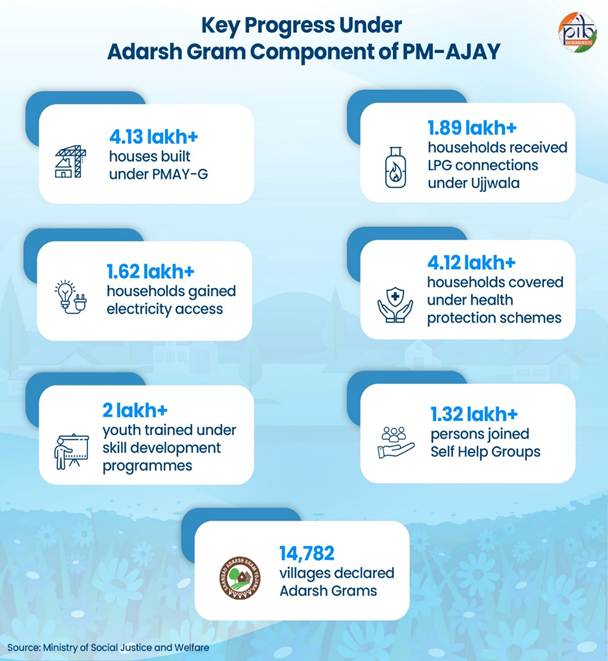
The programme has also strengthened village-level planning and infrastructure monitoring. More than 25,000 villages have completed infrastructure assessment exercises. This has helped in identifying gaps in roads, water supply, education, sanitation, and connectivity more systematically. A stronger emphasis has also been placed on youth participation and livelihood generation. Skill development, SHG participation, and village infrastructure creation has increasingly become part of a broader push towards long-term economic participation.
Development Action Plan for Scheduled Castes (DAPSC)
The Development Action Plan for Scheduled Castes (DAPSC) has created a dedicated framework for SC-focused spending across the nation. DAPSC is not a standalone scheme. It brings together schemes and interventions implemented by different Ministries and Departments for the welfare and development of SC communities. The framework ensures that Ministries earmark dedicated funds for schemes benefiting SC communities.
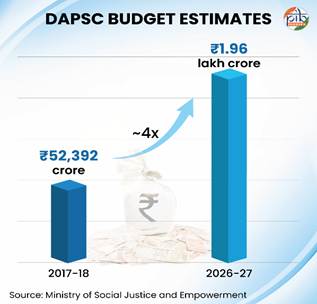
The framework today spans 38 Ministries and departments. It supports 239 schemes across education, housing, healthcare, skills, livelihoods, electrification, and social justice.
Scholarship Support for SC and Others
Scholarships for Higher Education for Young Achievers Scheme (SHREYAS)
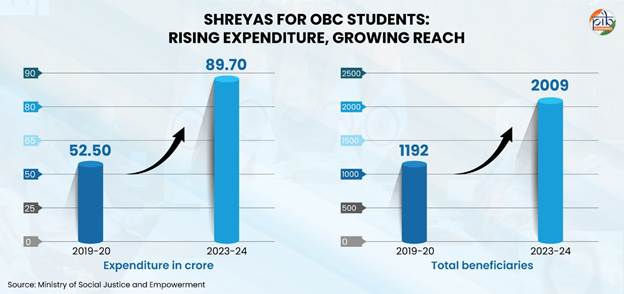
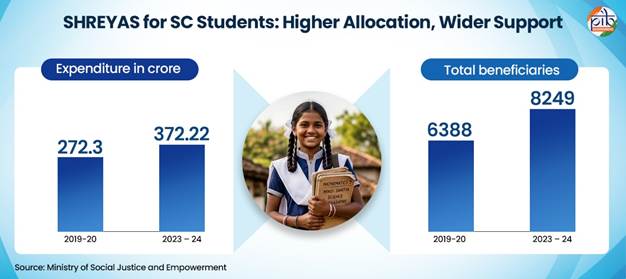
Launched in February 2019, SHREYAS supports SC, OBC and EBC students in pursuing higher education, research, competitive examinations and overseas studies. The scheme brings together multiple interventions that reduce financial barriers and expand access to quality educational opportunities. In 2025–26 alone, the Top Class Education component supported 4,156 SC students in premier institutions such as IITs, IIMs, AIIMS and NITs, with 30% of seats reserved for SC girls. During the same time period, the Free Coaching Scheme assisted 990 students preparing for competitive examinations, while the National Overseas Scholarship supported 72 students pursuing higher studies abroad. At the research level, fellowship schemes benefited 4,153 SC scholars and 1,969 OBC scholars during 2025-26 itself.
Scheme for Residential Education for Students in High Schools in Targeted Areas (SHRESHTA)
Access to quality residential schooling remains vital for Scheduled Caste students from low-income families. The SHRESHTA scheme, launched in June 2022, supports this need by enabling education from Classes IX to XII.
The scheme has two modes:
- Mode-I supports admission of meritorious SC students in private residential schools through National Entrance Test for SHRESHTA (NETS).
- Mode-II supports residential schools run by voluntary organisations and institutions. Eligible SC students with annual family income up to ₹2.5 lakh can appear for NETS.
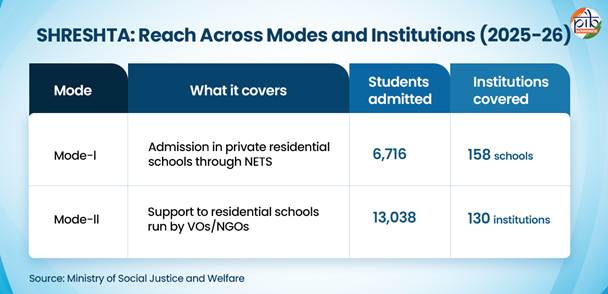
In 2025-26, SHRESHTA supported 19,754 Scheduled Caste students across 288 schools and institutions. The scheme worked through two routes of residential education.
|
Two Girls, One Scheme, One Resolve
There is a particular kind of determination that grows in children who know their families cannot afford for them to fail. Doli and Urmila have never met. One is from Himachal Pradesh, the other from Rajasthan. Separated by geographical distance but joined in similar stories.
Doli's father is a daily wage labourer. The risk of her dropping out from school was very real. Without support it would not have been possible for her to continue her studies. Under SHRESHTA's Mode-I, which provides direct financial support to SC students in quality schools, she stayed enrolled at Dalhousie Public School through the years that mattered most. She secured admission to IIT Delhi, where she is today pursuing Civil Engineering. "SHRESHTA gave me support, motivation, and the confidence to pursue my goals despite limitations."
Urmila's father farms a small plot in Balrao district, Rajasthan. Her support came through Mode-II — which empanels and funds quality residential schools to admit SC students. When she appeared for her Class XII boards, she scored 99.60%, securing first rank across Rajasthan.
Two girls, two families, two different edges of the same cliff — held back from it by the same scheme, working through different pathways. SHRESHTA did not discover their talent. It simply refused to let circumstance extinguish it.
|
Scholarships for School and Higher Education
The Pre-Matric and Post-Matric Scholarship schemes support Scheduled Caste students at different stages of education. The Pre-Matric Scholarship helps students in Classes IX and X stay in school. It also supports children from vulnerable families engaged in occupations such as manual scavenging and hazardous cleaning. The Post-Matric Scholarship helps students pursue higher and post-secondary education by covering educational expenses. Both schemes are implemented through a fully digital Direct Benefit Transfer (DBT) system.
Recent Progress
- Under the pre-matric scholarship scheme, ₹359.47 crore was released in 2025–26, benefiting 17.14 lakh students through DBT.
- Through efforts under post-matric scholarship scheme, Scheduled Caste enrolment in higher education reached 66.23 lakh in 2021–22, a 44% increase since 2014–15.
- Enrolment of SC female students rose to 31.71 lakh, reflecting a 51% increase since 2014–15.
- The Gross Enrolment Ratio (GER) of SC students in higher education increased from 18.9% in 2014–15 to 25.9% in 2021–22. The GER of SC female students rose from 18.1% to 26% during the same period.
- The GER of SC students in Classes XI–XII improved from 52.9% in 2019–20 to 61.5% in 2021–22.
Together, these schemes have helped improve retention, expand access to higher education and strengthen educational outcomes for Scheduled Caste students across the country.
From 2021-22, the scheme has become end-to-end digital mode. Funds reach verified students directly.
Upliftment of Backward and Nomadic Communities
Other Backward Classes (OBCs), Economically Backward Classes (EBCs), and Denotified and Nomadic Tribes (DNTs) had also remained on the edges of formal development. In the past 12 years, this scenario has changed. Scholarships, skilling, livelihoods, and legal identity have reached communities that had waited the longest.
PM-YASASVI – PM Young Achievers Scholarship Award Scheme for Vibrant India
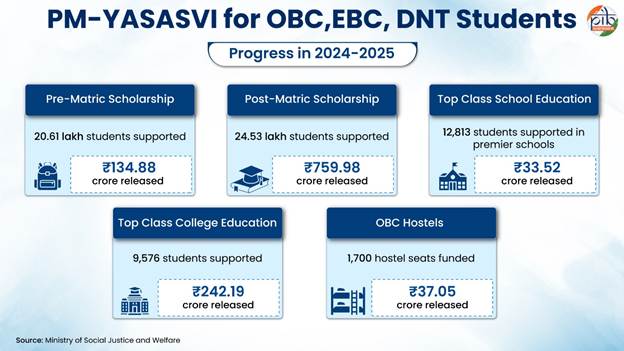
Launched in 2021–22, PM-YASASVI supports OBC, EBC and DNT students through five components: Pre-Matric Scholarship, Post-Matric Scholarship, Top Class School Education, Top Class College Education, and OBC Hostels. All benefits are transferred directly to Aadhaar-seeded bank accounts. At least 30% of seats are reserved for girl students across components.
Pradhan Mantri Dakshata Aur Kushalta Sampann Hitgrahi Yojana (PM DAKSH)
PM-DAKSH, launched in 2020-21, provides free, certified skill training to marginalised communities. The scheme connects them directly to wage employment and self-employment.
Who are covered:
- Scheduled Castes — no income ceiling
- OBCs — family income up to ₹3 lakh
- EBCs — family income up to ₹1 lakh
- Denotified and Nomadic Tribes — no income ceiling
- Sanitation workers and waste pickers — no income ceiling
PM-DAKSH has successfully trained over 2.08 lakh beneficiaries since the scheme started.
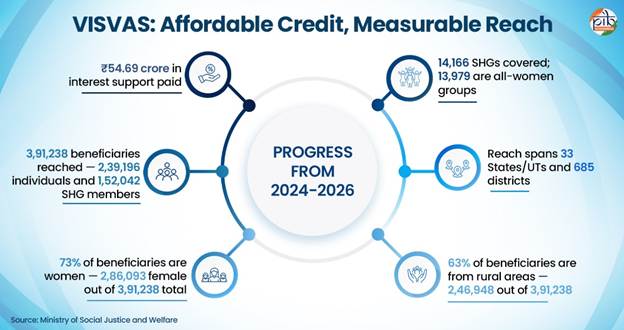
Vanchit Ikai Samooh aur Vargon ko Aarthik Sahaita (VISVAS) Yojana
VISVAS helps SCs, OBCs and Safai Karamcharis access affordable credit for income-generating activities. The scheme provides an interest subsidy of up to 5% per annum on eligible loans, with benefits transferred directly to beneficiaries through DBT. By lowering borrowing costs, it promotes entrepreneurship, self-employment and livelihood opportunities.
Key Achievements (2024-25 and 2025-26):
Scheme for Economic Empowerment of DNTs (SEED)
Launched in February 2022, SEED is a dedicated scheme for the welfare of De-notified, Nomadic and Semi-Nomadic Tribes (DNT/NT/SNT). The scheme supports four key interventions: free coaching for competitive examinations, health insurance coverage, community-level livelihood initiatives, and financial assistance for housing.
During the 2025-26 alone, ₹26.75 crore was disbursed to provide free coaching support to 4,485 DNT students. Simultaneously, to boost financial independence at the grassroots, ₹16 crore was channelled directly to 64,701 individuals to support their livelihoods during the same time period. Alongside economic and educational empowerment, the government prioritized social security. In 2025-26 itself, 73,569 Ayushman Bharat health insurance cards have been issued to DNT families, ensuring they have access to free, quality healthcare when they need it most.
Empowering Marginalised Minority Communities
Pradhan Mantri Virasat Ka Samvardhan (PM VIKAS)
PM VIKAS, launched in 2025, brings a structured response to the educational, economic and social development needs of minority communities. Five existing schemes—Seekho Aur Kamao, USTTAD, Hamari Dharohar, Nai Roshni and Nai Manzil—have been converged into a single integrated framework.
A key focus of PM VIKAS is industry-oriented skill development, ensuring that training is aligned with current market demand and employment opportunities. Training is provided in a diverse range of job roles, including airline cabin crew, gardening and nursery management, traditional hand embroidery, graphic design, electrician, and junior engineer-drone (R&D), among others. By combining skill development with entrepreneurship, leadership and cultural preservation, the scheme seeks to enhance employability and create sustainable livelihood opportunities for minority communities.
Progress (as on 10th June 2026):
- 73,200 candidates have enrolled for the scheme
- 12,429 candidates trained in various skills through 31 Training Partners and 353 Training Centres
- 1,405 candidates certified across job roles, including airline cabin crew, multi-skill technician, traditional hand embroider etc., across 2,557 batches
- Enrolment spans sectors including management, media and entertainment, healthcare, and agriculture and others
Restoring Dignity to Sanitation Workers
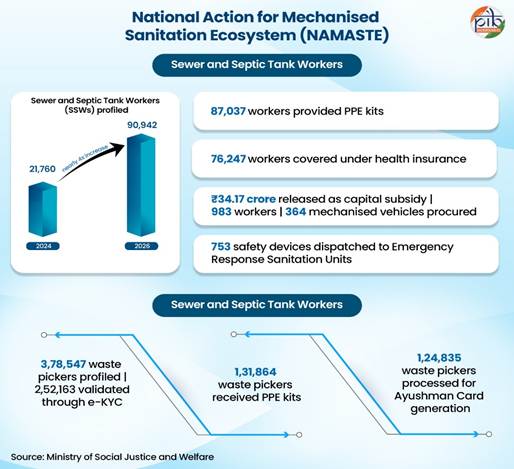
Sanitation workers have kept India's cities running, often at the cost of their own health, safety, and dignity. The NAMASTE scheme (National Action for Mechanised Sanitation Ecosystem) was launched in FY 2023-24 to change this. It is a structural reform replacing hazardous manual cleaning with mechanised systems, and building livelihoods with dignity and safety.
The scheme originally covered sewer and septic tank workers (SSWs). But, since June 2024, waste pickers in both urban and rural areas have also been included.
Transforming Deprived Regions – The Aspirational Districts Approach
The Aspirational Districts Programme was built by the Government on a simple conviction - that geography should not determine destiny. Launched in 2018, it targeted 112 of India's most underdeveloped districts across health, nutrition, education, agriculture, and financial inclusion. In 2023, it deepened further with the Aspirational Blocks Programme, reaching 500 blocks across 329 districts.
The results have been local, specific, and measurable. Each district identified its sharpest barrier and built a response around it.
|
Aspirational Districts Programme — Governance at the Last Mile
In flood-prone Lakhipur, Assam, vast riverine stretches had kept communities cut off from healthcare for years. The administration deployed Mobile Medical Units and boat camps across 1,176 locations between April 2023 – December 2024. The result: 100% screening coverage for both diabetes and hypertension across a target population of 25,308 people.
In Virudhunagar, Tamil Nadu, poor coordination and inadequate tracking of high-risk pregnancies had long contributed to maternal deaths. The district built a custom digital portal called Virucare, pairing real-time antenatal monitoring with targeted nutrition support for anaemic mothers. The district recorded zero maternal deaths between April 2023 and March 2024.
|
The Aspirational Districts and Blocks Programme has demonstrated that some of India's most complex development challenges can be addressed when the right systems, accountability structures, and people are in place at the grassroots.
Ongoing Journey Towards Equity
Before 2014, a significant gap separated public policy from many of India’s most deprived communities. Welfare schemes often existed in principle, but delivery was uneven and access remained limited. Large sections of tribal communities, Scheduled Castes, Other Backward Classes, nomadic groups, and minorities remained outside the reach of formal development.
The years that followed saw a concerted effort to bridge this divide. Rather than relying on a single initiative, a wide ecosystem of targeted interventions was built by the Government to address the distinct challenges faced by different communities. Education, skill development, livelihoods, financial inclusion, identity, infrastructure, cultural preservation, and social dignity were pursued in an integrated manner.
The impact among deprived communities is increasingly visible across the country—in ST students entering universities and pursuing PhDs, in SC entrepreneurs building enterprises, in villages connected by roads and electricity, and in minority community women creating sustainable livelihoods from their homes.
Progress has been steady and the foundations for more inclusive development have been firmly established. Today, India’s deprived communities are no longer viewed as peripheral to the nation’s growth story. They stand at the centre of it. They feel included in the idea of Viksit Bharat@2047.
References
Press Information Bureau
https://www.pib.gov.in/PressReleasePage.aspx?PRID=2236972®=3&lang=1
https://www.pib.gov.in/PressReleasePage.aspx?PRID=2248357®=3&lang=2
https://www.pib.gov.in/PressNoteDetails.aspx?NoteId=154915&ModuleId=3®=3&lang=2
https://www.pib.gov.in/PressReleasePage.aspx?PRID=2238355®=3&lang=2
https://www.pib.gov.in/PressReleasePage.aspx?PRID=2238355®=3&lang=2
https://www.pib.gov.in/PressReleasePage.aspx?PRID=2189515®=3&lang=2
https://www.pib.gov.in/PressReleseDetailm.aspx?PRID=2159087®=3&lang=2
https://www.pib.gov.in/PressNoteDetails.aspx?id=154377&NoteId=154377&ModuleId=3®=3&lang=2
https://www.pib.gov.in/PressReleasePage.aspx?PRID=1784229®=3&lang=2
https://www.pib.gov.in/PressReleasePage.aspx?PRID=2209488®=3&lang=2
https://www.pib.gov.in/PressReleseDetailm.aspx?PRID=2247766®=3&lang=2
https://www.pib.gov.in/PressReleasePage.aspx?PRID=2253348®=3&lang=2
https://www.pib.gov.in/PressReleasePage.aspx?PRID=2146466®=3&lang=2
https://www.pib.gov.in/PressReleasePage.aspx?PRID=2255017®=3&lang=1
Ministry of Tribal Affairs
https://tribal.nic.in/downloads/pm-janman/pm/index.html
https://nests.tribal.gov.in/
https://nests.tribal.gov.in/backend/web/dashboard/index
https://tribal.nic.in/downloads/Statistics/AnnualReport/AnnualReport2014-15.pdf
Parliament Questions
https://sansad.in/getFile/loksabhaquestions/annex/187/AU6227_bkLVA3.pdf?source=pqals
https://sansad.in/getFile/annex/270/AU3814_fWJmb3.pdf?source=pqars
Ministry of Social Justice
https://pmagy.gov.in/
https://e-utthaan.gov.in/home/eyJpdiI6IlJsWkJzNDdDcjU5Q3YxMmYvTzZyZnc9PSIsInZhbHVlIjoiTHFaNmtaTlJZOWJpcERPTUsrRXJIak9DQ1pOcmpHcHQ0Z0lsVWNFeDBPQT0iLCJtYWMiOiI5NWI5ZWEwNGNmZDkyNmNlN2FlMDI5MGE1YWVjYWEwZTczMmUxMDI0YzQwNDg0OWFkNzdiYTdhMzFmZWFiYzJjIiwidGFnIjoiIn0=
https://socialjustice.gov.in/writereaddata/UploadFile/71441776233188.pdf
https://visvas.dosje.gov.in/visvas/home
Others
https://pmvikas.minorityaffairs.gov.in/page/about-us
https://app.powerbi.com/view?r=eyJrIjoiZTgxY2RjNTktMTNkZi00NjlmLTkyZGYtMDViNTRlZWVkZDhkIiwidCI6IjcyNGI4ZWQxLTgxODMtNGNiOS1iNWIwLTFlZDY3YWZlYWNmMSIsImMiOjEwfQ%3D%3D
https://www.niti.gov.in/sites/default/files/2025-08/stories-of-chnage-aspirational-districts-and-blocks.pdf
Click here to see pdf
***
PIB Research
(Release ID: 2271997)
Visitor Counter : 3738