Ministry of Science & Technology
Unveiling the nature of a newly discovered supernova could help build the cosmic distance scale
Posted On:
12 JUN 2026 3:39PM by PIB Delhi
A detailed study of the evolution of the supernova SN 2023zcu, discovered in 2023 at the edge of the spiral galaxy NGC 2139, located approximately 90.7 million light-years away from Earth, can help estimate the distance of the local universe.
Supernovae (SNe) are one of the most violent explosions in the universe. Core-collapse supernovae (CCSNe) are one of these cosmic fireworks occurring when a massive star exhausts its nuclear fuel and can no longer support itself against the gravitational pull. This dramatic death can be so bright that it is visible in a distant galaxy. Supernovae are not just very bright, they are vital to the evolution of the cosmos because they act as giant recycling centers, creating and scattering heavy elements that eventually become the building blocks for new stars, planets, and even life itself.
The most common type of core-collapse supernova is Type IIP, which happens when a massive red supergiant star (about 8–17 times the mass of the Sun) reaches the end of its life. When the star’s core collapses into a proto-neutron star, the outer material falls inward, then bounces back from the surface, creating a powerful shock wave. When the shock reaches the surface, the star’s outer layers break away and expand into space. The supernova becomes brightest soon after this. As these layers keep expanding, they slowly cool down and lose energy—this stage is called shock cooling. After this, there is a phase lasting a few months when the supernova remains opaque.
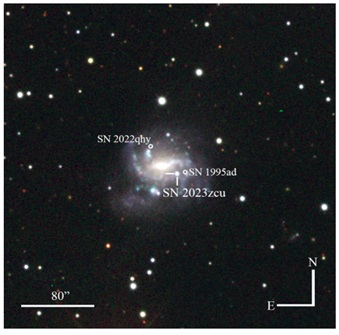
Fig I: The location of SN 2023zcu is marked in the host galaxy, along with the other two SNe 1995ad and 2022qhy, which previously exploded in the same galaxy.
During this time, its energy mainly comes from hydrogen recombining in the star’s outer layers. Because red supergiants have a large hydrogen envelope, the brightness stays nearly constant, creating a “plateau” in the light curve, which is a distinct characteristic apart from the other subclasses. The abundance of H is also evident in the spectroscopic evolution, with a prominent Hα P-Cygni profile.
On December 8, 2023, SN 2023zcu was discovered at the edge of the spiral galaxy NGC 2139, at a distance of 27.8 Mpc. The SN was discovered within a day after the explosion. Extensive photometric and spectroscopic observations have been conducted by ground- and space-based telescopes. The detailed study has been published in The Astrophysical Journal by Monalisa Dubey, Dr. Kuntal Misra, and Naveen Dukiya from Aryabhatta Research Institute of Observational Sciences (ARIES), India, an autonomous institute under Department of Science and Technology (DST), along with other international researchers. The paper provides a detailed analysis of the different phases of SN evolution, including precise distance measurements.
The supernova’s distance is estimated to be about 27 Mpc using the Expanding Photospheric Method (EPM). This method calculates distance by comparing the actual size of the expanding surface of the supernova with how bright it appears. It works especially well for Type IIP supernovae, because their thick hydrogen layer creates a clear, well-behaved surface that closely follows blackbody radiation. Additionally, their characteristic plateau phase provides stable, predictable conditions, and their relatively simple, hydrogen-dominated spectra allow more accurate measurements of temperature and expansion velocity, making the assumptions of EPM much more reliable than in other SN types.
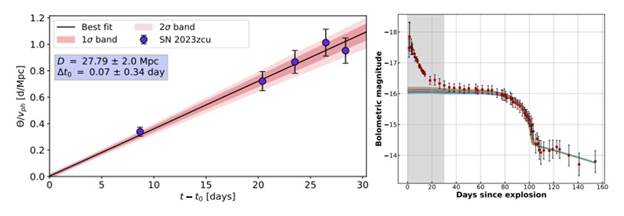
Fig 2: The distance measurement of the SN using the Expanding Photospheric Method (EPM) (Left panel). Semi-analytical modeling was performed on the bolometric light curve of the SN to estimate the progenitor's properties. (Right panel).
Early spectra show very little interaction between the supernova material and the surrounding gas, suggesting the star lost only a small amount of mass before the explosion. During the plateau phase, the spectra display strong hydrogen features along with lines from elements like iron, sodium, and calcium, indicating that new elements were formed in the explosion. In the nebular phase, the supernova material becomes transparent, and the spectrum shows mainly emission lines. Because the gas is very thin, special “forbidden” lines from elements like oxygen, iron, calcium, and magnesium also appear.
Bolometric luminosity is the total energy a supernova emits across all wavelengths of light, from ultraviolet to infrared, giving a full measure of its brightness. By modeling the bolometric luminosity, scientists estimate that the original star had a mass of about 12 times that of the Sun and an explosion energy of about 2 × 10⁵¹ ergs. These values are typical for explosions of red supergiant stars.
Frequent observations and regular monitoring of the supernova during its rise, plateau, and nebular phases help scientists better understand how it evolves. This study improves our knowledge of these powerful explosions.
Publication link: https://ui.adsabs.harvard.edu/abs/2026ApJ...999...93D/abstract
*****
NKR/FT
(Release ID: 2272106)
Visitor Counter : 1755