Ministry of Agriculture &
Farmers Welfare
Indore Declaration Marks New Chapter in Global Agriculture, Places Farmers at the Heart of BRICS Agenda
BRICS Nations Unite Behind Farmer-Centric Growth, Sustainable Agriculture and Food Security
India Leads Consensus on Future of Agriculture as BRICS Adopts Historic Indore Declaration
Four Major Global Agricultural Platforms Announced as BRICS Concludes Landmark Indore Meeting
Climate-Smart Farming, Digital Innovation and Farmer Welfare Drive BRICS Agriculture Consensus
Indore Emerges as Global Agriculture Diplomacy Hub with Adoption of Historic BRICS Declaration
BRICS Countries Launch New Era of Agricultural Cooperation Through Indore Declaration
‘Knowledge to Action’: BRICS Strengthens Agricultural Research, Innovation and Technology Transfer
Posted On:
13 JUN 2026 5:43PM by PIB Delhi
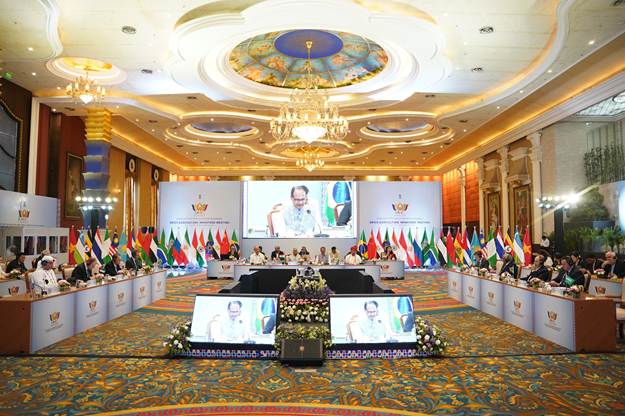
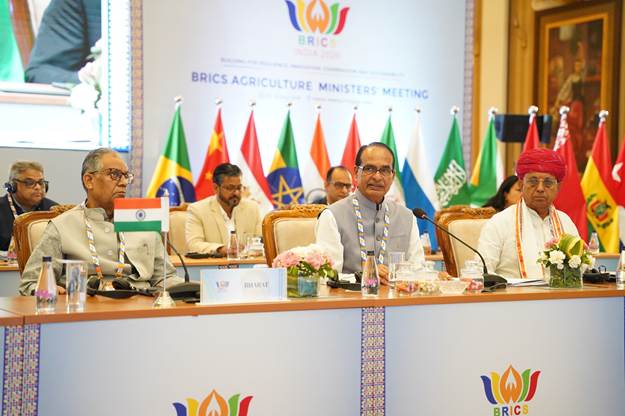
The BRICS Agriculture Ministers' Meeting held in Indore, concluded on Friday with the unanimous adoption of the 'Indore Declaration', marking a significant milestone in global agricultural cooperation. The declaration outlines several landmark decisions aimed at strengthening food security, farmer welfare, climate-resilient agriculture, agricultural trade and digital agriculture. Addressing a press conference, Union Minister for Agriculture & Farmers Welfare and Rural Development Shri Shivraj Singh Chouhan said that at a time of global crises and uncertainties, the BRICS meeting had sent a strong message of hope, trust and collective responsibility to the world.
Scale, Strength and Significance of the Meeting
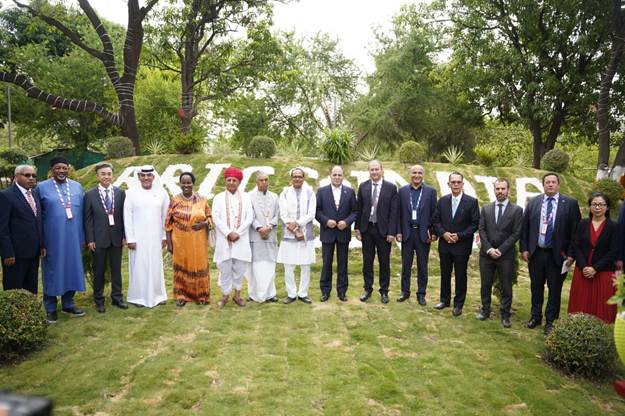
Interacting with the media in the presence of Union Ministers Shri Ramnath Thakur and Shri Bhagirath Choudhary, along with senior officials, Shri Chouhan said that both the Senior Officials' Meeting and the Ministerial Meeting of the BRICS Agriculture Working Group concluded successfully. He informed that nearly 100 delegates participated in the meetings, including around 60 foreign representatives from BRICS member and partner countries, reflecting the depth of engagement and seriousness with which BRICS nations are addressing issues related to agriculture and food security. Shri Chouhan noted that BRICS countries represent nearly half of the world's population, possess around 42 per cent of global agricultural land, and contribute approximately 42 per cent of global foodgrain production. Consequently, the collective voice of BRICS has emerged as a powerful force on the global stage.
He also expressed pride that India currently holds the BRICS Presidency under the leadership of Prime Minister Shri Narendra Modi and that both the official-level and ministerial-level agriculture meetings were organised in Indore in this context.
Four Major Priorities Discussed
The Union Minister said extensive deliberations were held around four key priorities:
Food security and nutritional security for BRICS countries and the world. Promotion of agricultural trade and cooperation among BRICS nations. Regenerative, climate-resilient and sustainable farming practices in response to climate change. Strengthening innovation, technology and partnerships in food systems and agriculture.
He emphasized that ensuring abundant food availability, improving nutritional outcomes and securing the livelihoods of farmers who feed the world remained central to the discussions. Shri Chouhan said a dedicated session was organised for small and marginal farmers, referred to as family farmers in several countries. Discussions focused on their challenges, access to agricultural inputs, credit availability, remunerative prices and market linkages.
Indore Declaration: A Farmer-Centric Global Commitment*
Shri Shivraj Singh Chouhan said that following extensive consultations, the joint declaration was unanimously adopted and would henceforth be known as the "Indore Declaration". He stated that the declaration places farmers at its core and records the shared commitment of BRICS countries to advance food security, nutrition, livelihoods, agricultural trade, innovation, investment, climate-resilient farming and sustainable agricultural development. "This document is a symbol of the collective will, shared responsibility and commitment of BRICS nations to build a safer, more prosperous and sustainable future through agriculture," he said. He added that member countries had agreed to work collectively and continuously to ensure that the initiatives outlined in the declaration are implemented effectively and deliver tangible benefits to farmers, rural communities and food systems.
Four New Institutional Initiatives Announced*
1. BRICS Network of Centres of Excellence on Agro-Ecology and Regenerative Agriculture
Shri Chouhan announced the establishment of the BRICS Network of Centres of Excellence on Agro-Ecology and Regenerative Agriculture. He said the network would serve as a platform for joint research, knowledge sharing and capacity building in natural, organic and regenerative agriculture, enabling member countries to learn from each other's best practices and promote climate-resilient and sustainable farming systems. Recalling India's long-standing emphasis under Prime Minister Shri Narendra Modi on natural farming, organic farming and balanced use of chemical fertilizers, Shri Chouhan said BRICS countries had collectively recognised the importance of these approaches. He informed that the Indian Institute of Farming Systems Research, Modipuram, would play a key role as India's Centre of Excellence under the network and contribute to collaborative research, knowledge sharing and training.
2. BRICS Network on Digital Agriculture
The second major initiative announced was the BRICS Network on Digital Agriculture. Shri Chouhan said the network would strengthen cooperation in artificial intelligence, geospatial technologies, digital public infrastructure and data-driven agricultural solutions. He said the initiative would act as a bridge between emerging technologies and agricultural innovation, ensuring that technological advancements directly benefit farmers. The network will be coordinated by IIT Delhi, while all member countries will contribute by sharing innovations, experiences and policy initiatives to ensure collective progress in digital agriculture.
3. Global Forum on Farmers' Rights in Seed Systems
The third major announcement was the establishment of the Global Forum on Farmers' Rights in Seed Systems. According to Shri Chouhan, the forum will focus on protecting farmers' rights related to seeds, conserving indigenous seed diversity and preserving traditional knowledge systems. He said countries like India possess agricultural traditions spanning hundreds and thousands of years, but many traditional seed varieties that represent both biodiversity and cultural heritage are facing existential threats. "While new and hybrid varieties are essential, preserving indigenous seeds is equally important," he said. The forum will work towards ensuring the conservation and continued availability of traditional seeds, recognising their importance in the context of climate change and food security, and safeguarding farmers' traditional knowledge.
4. BRICS AgriN - Agro Inputs, Genetic Resources and Information Network
The fourth initiative announced was BRICS AgriN (Agro Inputs, Genetic Resources and Information Network). The platform aims to strengthen cooperation among member countries in agricultural inputs, seeds and genetic resources. Shri Chouhan said the network would facilitate information exchange, technical cooperation, capacity building and partnerships so that superior varieties, genetic resources and best practices available in different countries could be shared more effectively. He added that the initiative would particularly benefit countries and farmers with limited access to such resources and information.
Existing Platforms to be Strengthened
The Union Minister said BRICS countries had agreed to further strengthen the existing BRICS Agricultural Research Platform and develop it into a robust "Knowledge-to-Action Hub". He stressed that research should not remain confined to laboratories but must quickly reach farmers' fields. "The objective is to expand innovations beyond limited circles and ensure that new technologies and solutions benefit a larger number of countries and farmers. This represents the true spirit of the 'Lab to Land' approach," he said.
Focus on Agricultural Trade
Shri Chouhan said BRICS nations reaffirmed their commitment to a fair, equitable, inclusive and transparent multilateral trading system. He said discussions on initiatives such as a BRICS Grain Exchange gained fresh momentum through a special dialogue organised by India. The Minister also informed that several bilateral meetings among member countries focused on facilitating agricultural trade, reducing customs and other barriers, enhancing research cooperation and promoting technology exchange.
Climate Change, El Niño, Carbon Credits and Food Loss
Highlighting the growing threat of climate change, Shri Chouhan said promoting regenerative, climate-resilient and sustainable agricultural practices was a shared responsibility because the Earth belongs not only to the present generation but also to future generations. Responding to questions on El Niño, he said its impact could affect India and several Asia-Pacific countries. However, countries are preparing themselves and discussions were held on collaborative strategies and information-sharing mechanisms to address such challenges. On carbon credits, he said an established mechanism already exists and farmers who follow prescribed procedures benefit from carbon credit systems. Climate-sensitive policies and regenerative agriculture offer practical pathways in this direction. Referring to technical discussions on food loss, Shri Chouhan said member countries examined ways to reduce post-harvest losses and minimise food wastage, which contributes to carbon emissions.
Fertilizer Prices, Inputs and Support to Farmers
Responding to concerns over rising fertilizer costs due to global conflicts and increasing raw material prices, Shri Chouhan said the Government of India had decided to continue providing fertilizers to farmers at affordable prices. He stated that urea would continue to be available at Rs 266 per bag and DAP at Rs 1,350 per bag, with the Central Government bearing the additional financial burden. "In times of crisis, standing with farmers is our duty," he said. He also cautioned against excessive and imbalanced use of pesticides and chemical fertilizers and said India was promoting natural farming, organic farming and balanced chemical use in mission mode while creating awareness through campaigns such as "Khet Bachao Abhiyan".
Technology Access for Small Farmers
On technology transfer and mechanisation, Shri Chouhan said that not every farmer can afford expensive machinery. Therefore, Custom Hiring Centres and group-based models have been developed across the country to provide agricultural machinery on rent, enabling small farmers to access drones and modern equipment.
Youth, Women and Innovation
Shri Chouhan said sustainable transformation in agriculture would not be possible without greater participation of youth and women. The issue received special attention during the meeting and has been explicitly incorporated in the joint declaration. He noted that agri-startups, agribusinesses, agripreneurship and technology-based services are increasingly attracting young people towards agriculture in India, with thousands of startups already operating successfully. He said youth are playing the most effective role in driving innovation and technological adoption, and BRICS countries must accelerate this trend through greater exchange of experiences and policy initiatives.
Indore Emerges as a New Hub of Global Agricultural Diplomacy
Praising Indore's hospitality, Shri Shivraj Singh Chouhan said delegates were deeply impressed by the warmth and traditional hospitality of the Malwa region. He said visits to Chappan Dukan, Rajwada and Mandu would remain memorable experiences for the visiting representatives. He informed that, taking forward Prime Minister Shri Narendra Modi's "Ek Ped Maa Ke Naam" campaign, delegates from member countries participated in a plantation drive at Meghdoot Garden and established the "BRICS Vatika". Earlier, Global Park and Euro-Russian Park had also been established at the site. Shri Chouhan acknowledged the contributions of the Government of Madhya Pradesh, the Chief Minister and his team, as well as various departments of the Government of India including Agriculture, External Affairs, Animal Husbandry and Fisheries, Commerce, Food Processing Industries and NITI Aayog. He said the successful organisation of the BRICS meetings in Indore represented a shining example of the "Whole of Government Approach" and "Team India" spirit, making the event truly unprecedented and historic.
*****
RC/MS
(Release ID: 2272502)
Visitor Counter : 3151