PIB Backgrounder
Ease of Living: India’s Journey of Inclusive Progress
Posted On:
15 JUN 2026 4:15PM by PIB Delhi
A decisive journey of governance between 2014 and 2026 reshaped daily life for Indian citizens. They experienced new opportunities through secure housing, clean fuel, safe drinking water, and improved sanitation. Reliable electricity, affordable lighting, and expanded transport networks brought comfort and connectivity to millions. Roads, upgraded railways, metro systems, and regional air routes reduced travel fatigue and strengthened access across regions. Financial inclusion opened banking and credit for excluded citizens through Jan Dhan and MUDRA. The urban infrastructure improved through Atal Mission for Rejuvenation and Urban Transformation. Digital reforms and participatory platforms like MyGov deepened accountability and citizen engagement. Together, these initiatives created resilience, dignity, and opportunity for families nationwide. India’s twelve‑year journey reflects inclusive progress, with governance reshaping daily life and strengthening growth foundations for millions.
|
Twelve Years of Transformation: India’s Ease of Living Story
India’s journey since 2014 reflects a decisive shift toward dignity, opportunity, and inclusive progress. The past twelve years have been characterized by a purposeful transformation of governance, enabled by ambitious programmes and reforms. Secure homes under Pradhan Mantri Awas Yojana, clean fuel through Pradhan Mantri Ujjwala Yojana, and safe drinking water under Jal Jeevan Mission reshaped everyday life. Sanitation improved nationwide through the Swachh Bharat Mission, while reliable electricity reached millions of households through SAUBHAGYA. Transport and connectivity expanded at historic speed, with new highways, tunnels, bridges, metro networks, and regional air routes.
Financial inclusion through Pradhan Mantri Jan Dhan Yojana and Pradhan Mantri Mudra Yojana empowered citizens with banking, credit, and security. Urban transformation under Atal Mission for Rejuvenation and Urban Transformation strengthened infrastructure and services across thousands of towns. Digital reforms and citizen platforms like MyGov deepened participation, accountability, and trust in governance. Together, these initiatives created a new environment of comfort, security, and opportunity.
Housing and Basic Amenities
Access to a secure, pucca (permanent) home is the foundation of a dignified life. Before 2014, the scale and pace of government housing delivery in both urban and rural India fell far short of need. The Pradhan Mantri Awas Yojana (PMAY) was launched in 2015 for urban areas. It expanded to rural areas under PMAY-Gramin in 2016, fundamentally redefining the ambition and delivery of affordable housing.
Pradhan Mantri Awas Yojna Urban (PMAY-U)
PMAY-U, launched in 2015, provides pucca houses to every eligible urban household. The scheme serves Economically Weaker Section (EWS), Lower-Income Group (LIG), and Middle-Income Group (MIG) categories across all urban areas of India.
PMAY-U 2.0, launched in 2024, provides financial assistance of up to Rs. 2.5 lakh under the Beneficiary-Led Construction (BLC) vertical to eligible families. The scheme requires a female family member to be the owner or co-owner.
Since its inception, over 1.25 crore houses have been sanctioned under PMAY-U. Of these, more than 98 lakh houses have been completed. Between 2005-14, only 8 lakh urban houses were completed under older schemes.
Pradhan Mantri Awas Yojna Gramin (PMAY-G)
PMAY-G, launched in 2016, provides Rs. 1.20 lakh and Rs. 1.30 lakh per house in plain areas and in hilly and difficult-terrain areas, respectively. Between 2016 and 2026, a total target of 3.98 crore houses was registered for construction. Of these, 3.91 crore houses have been sanctioned, out of which 3.05 crore houses have been completed. 75 percent of the sanctioned houses are owned by women or held in joint ownership. All houses comply with government programs for amenities such as toilets, drinking water, and electricity connections.
Atal Mission for Rejuvenation and Urban Transformation (AMRUT)
Launched in 2015, the Atal Mission for Rejuvenation and Urban Transformation (AMRUT) addressed the basic service gaps in a far wider set of urban centres. Phase I of AMRUT covered 500 cities, focusing on water supply, sewerage, green spaces, and transport. In October 2021, AMRUT 2.0 expanded coverage to all 4,800 statutory towns with ₹2.99 lakh crore outlay. This allocation was nearly three times higher than the original mission. Projects worth ₹2.79 lakh crore were sanctioned under AMRUT and AMRUT 2.0, compared to ₹62,983 crore under JnNURM before 2015.
Universal Access to Essentials
Before 2014, many citizens lacked essential services for a dignified life. Rural women especially faced challenges without clean cooking fuel, safe drinking water, and sanitation facilities. Targeted missions were launched to systematically address these gaps at scale across the nation. The results have been transformative, reaching crores of beneficiaries in every region. These initiatives represent one of the most significant improvements in daily living standards in independent India.
Pradhan Mantri Ujjwala Yojna (PMUY)
Pradhan Mantri Ujjwala Yojana (PMUY), launched in May 2016, transformed rural cooking practices by ensuring access to clean LPG connections. The scheme expanded nationwide, achieving its initial target of 8 crore connections by September 2019. To cover remaining households, Ujjwala 2.0 was introduced in August 2021 with a target of 1 crore additional connections. This target was achieved by January 2022. The Government further sanctioned 60 lakh more connections, reaching 1.60 crore by December 2022. In July 2024, another 75 lakh connections were completed. It was followed by approval of 25 lakh more in FY 2025–26, ensuring saturation of LPG access. Over 10.57 crore clean cooking gas connections have been provided, bringing access and dignity at scale.
National LPG coverage rose from 55.9% (April 2014) to 107.2% (April 2026), reflecting wider access. Consumers grew from 14.51 crore (April 2014) to 33.39 crore (April 2026), with doubled consumption. Rural access improved through expanded distributorships and bottling infrastructure by March 2026.
Jal Jeevan Mission (JJM)
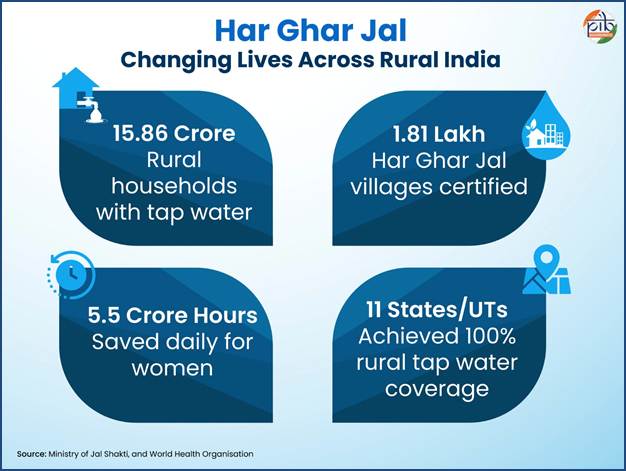
The Jal Jeevan Mission (JJM), with its goal of Har Ghar Jal, has delivered rapid expansion in piped water access. At the time of JJM's launch in 2019, only 3.23 (16.72%) crore rural households had tap water connections. As of June 2026, over 15.86 (81.94%) crore households enjoy clean piped water. In just six years, 12 crore new connections were added, supported by ₹2.08 lakh crore investment.
The Jal Jeevan Mission has delivered transformative results across rural India. Over 9 crore women are freed from fetching water, saving time and improving health. 1.81 lakh villages are certified as Har Ghar Jal by Gram Sabhas, ensuring universal access. Additionally, 11 States and UTs achieved complete rural household coverage, marking a milestone in water security.
Water quality has been equally prioritized in this mission. As of FY 2025-26, 2,843 laboratories tested 38.78 lakh samples. Over 24.80 lakh women were trained in using field testing kits, ensuring ownership and trust at the village level.
In March 2026, the mission was extended until December 2028 under JJM 2.0. The enhanced framework includes a larger outlay of ₹8.69 lakh crore, with ₹3.59 lakh crore central support.
Swachh Bharat Mission (SBM)
The Swachh Bharat Mission – Gramin, launched in 2014, provided toilets to all rural households, ensuring dignity and hygiene across villages. Sanitation coverage rose sharply from 39% in 2014 to 100% in 2019, marking a nationwide transformation.
The achievements of SBM-Gramin have been remarkable. As of June 2026, in total, over 12.14 crore household toilets and 2.76 lakh community sanitary complexes have been completed. More than 5.69 lakh villages are declared as ODF Plus. 5.34 lakh villages have arrangements for solid waste management, while 5.55 lakh villages have arrangements for liquid waste management.
Swachh Bharat Mission‑Urban: Launched in 2014, the mission transformed sanitation across cities and towns. Over 63 lakh household toilets and six lakh community toilets were built between 2014 and 2026. Urban waste processing rose to 82 percent in 2026 compared to 16 percent in 2014. Door‑to‑door waste collection reached 98 percent in 2026 compared to 43 percent in 2014.
The overall impact of Swachh Bharat Mission is measurable. Urban Local Bodies (ULBs) of all 35 States/UTs declared themselves ODF in October 2019. WHO estimated 3,00,000 fewer diarrheal deaths in 2019 compared to 2014.
Power For All: Reliable, Affordable and Clean Energy
Reliable electricity is the quiet force behind a comfortable daily life. Over the last twelve years, India has transformed power generation, transmission, and last-mile supply. The result is more light, more comfort, and more dignity in every home.
Generation Capacity and a Reliable, Cleaner Grid
Total installed power capacity has more than doubled in the last 12 years. It rose from 248 GW in FY 2014 to over 532 GW by March 2026.
Renewable sources now make up more than half of this capacity. Renewable Energy capacity reached 274.69 GW in March 2026 compared to 76.38 GW in 2014. India now has the 3rd largest clean energy capacity in the world. Solar power now contributes 150.26 GW compared to 2.82 GW in 2014. Wind power capacity rose 2.66 times, from 21.04 GW (March 2014) to 56.09 GW (March 2026). Nuclear power grew 84%, reaching 8.78 GW (March 2026) compared to 4.78 GW (March 2014). Hydro capacity stands at 51.4 GW (March 2026), while other sources (biomass, etc.) contribute 11.74 GW (March 2026).
For citizens, power is now available almost around the clock. Average rural supply rose from 12.5 hours in 2014 to 22.6 hours in 2026. Urban areas now receive up to 23.4 hours of supply each day. The national energy shortage fell sharply from 4.2% (2013-14) to just 0.03% (2025-26). Per capita electricity consumption rose from 957 KW (2013-14) to 1,460 KW (2024-25).
Record Capacity Fuelling High Power Demand
India achieved its highest ever peak electricity demand of 256.1 GW on 25 April 2026. This demand was met without shortage while maintaining exports to neighbouring countries. The milestone surpassed the earlier peak of 250 GW recorded in May 2024. Demand growth aligned with summer conditions, showing an 8.9 percent rise in April 2026. Record capacity addition of 65 GW during FY 2025–26 strengthened preparedness for future demand. Diverse generation sources, including solar, hydro, nuclear, and thermal, ensured reliability and grid stability.
|
The network of transmission lines (220 kV and above) grew to over 5 lakh circuit kilometres by January 2026. Transformation capacity reached 1,407 GVA (220 kV and above), and inter-regional transmission capacity touched 120 GW in January, 2026. India now runs as the world's largest synchronised national grid at a single frequency.
SAUBHAGYA: Bringing Power to Every Home
The Pradhan Mantri Sahaj Bijli Har Ghar Yojana (SAUBHAGYA), launched in 2017, gave free last-mile connections to unelectrified rural and urban homes. By March 2022, about 2.86 crore households had received an electricity connection. This marked the closing of the scheme as all the targets were achieved.
PM Surya Ghar: Turning Homes into Power Producers
The PM Surya Ghar Muft Bijli Yojana, launched in February 2024, helps families install rooftop solar panels with a generous central subsidy. Each home is eligible to receive up to 300 free units of electricity monthly. The subsidy goes up to Rs 78,000, credited directly to the beneficiary. By May 2026, over 40 lakh households had installed rooftop solar systems. The scheme targets one crore homes by FY 2026-27, backed by Rs 75,021 crore. Families now cut their bills and even earn by selling surplus power.
Unnat Jyoti by Affordable LEDs for All (UJALA): Affordable and Energy Efficient Lighting
Under the UJALA scheme, in the last twelve years, 37 crore LED bulbs were distributed, saving Rs.19,153 crore in household savings annually.
Reliable electricity now supports education, industry, and household comfort across both rural and urban regions. Cleaner energy sources have expanded rapidly, strengthening sustainability and reducing dependence on fossil fuels.
Financial Inclusion and Empowerment
Since 2014, India has introduced interconnected financial inclusion schemes that have built a comprehensive ecosystem covering savings, credit, insurance, and pensions. These initiatives expanded opportunities, strengthened security, and enabled millions to participate confidently in modern financial systems.
Pradhan Mantri Jan Dhan Yojna (PMJDY)
The JAM Trinity of Jan Dhan, Aadhaar, and Mobile became India’s welfare delivery backbone. Pradhan Mantri Jan Dhan Yojna (PMJDY) was the first pillar, opening banking access for crores of excluded citizens. It laid the foundation for direct transfers without leakages, ensuring benefits reached people transparently and securely.
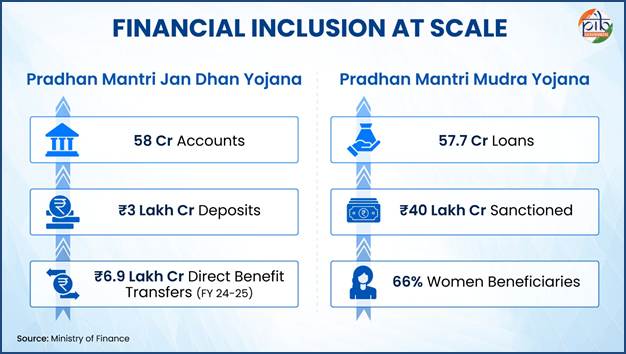
Announced in August 2014, PMJDY is the world’s largest financial inclusion initiative. Accounts grew from 14.72 crore in 2015 to over 58 crores by June 2026. Deposits rose to over ₹3 lakh crore as of June 2026, showing trust and active usage.
PMJDY accounts became the channel for welfare delivery at an unprecedented scale. In FY 2024–25 alone, ₹6.9 lakh crore was credited directly under Direct Benefit Transfer (DBT) schemes. DBT covers 327 schemes, making governance inclusive, accountable, and responsive to every beneficiary nationwide. As of June 2026, 40.60 crore RuPay debit cards were issued with accident insurance cover.
This extended financial protection and security to millions of newly banked citizens, improving daily life and reducing vulnerability.
Pradhan Mantri Mudra Yojna (PMMY)
For years, small and micro entrepreneurs had limited access to formal credit. They depended on informal lenders charging exploitative rates. PMMY, launched in 2015, recognised micro enterprises as growth engines and offered collateral-free institutional loans.
Since its launch, more than 57.7 crore loans worth ₹40 lakh crore have been sanctioned under PMMY. 66% of MUDRA loans were sanctioned to women, amounting to ₹16.88 lakh crore. Nearly half of the beneficiaries came from SC, ST, and OBC communities, combining credit access with social equity.
With a new Tarun Plus category in FY 2024–25, the loan ceiling rose to ₹20 lakh. This category supported entrepreneurs who repaid earlier loans. Labour Bureau studies showed PMMY loans generated 1.12 crore jobs between 2015 and 2018.
Transport and Connectivity
Connectivity is the strength of development, shaping opportunities and improving ease of living nationwide. In 2014, India’s transport infrastructure reflected slow highway construction, limited metro coverage, and sparse regional air connectivity. Modern intercity rail services were absent, leaving the common traveller with restricted and inefficient transport options. Between 2014 and 2026, India transformed transport across roads, rail, aviation, and urban transit at a rapid pace.
Roads and National Highways
India’s road network expanded significantly between 2014 and 2026, reshaping connectivity and daily mobility. At 63.73 lakh km, it is now the second-largest road network globally. National highways grew nearly 61%, from 91,287 km in FY14 to 1,46,572 km in March 2026. Four‑lane and above highways increased from 18,371 km in 2014 to 45,516 km. A total of 3,644 km of access-controlled high‑speed corridors/expressways are now operational nationwide, reducing travel time and congestion. By March 2026, 22,590 km of roads were completed under Bharatmala.
12 Years of Landmark Connectivity:
- Z Morh/Sonamarg Tunnel (2025) enhances Ladakh access, strengthening tourism and local livelihoods.
- Sudarshan Setu (2024) connects Okha with Beyt Dwarka, supporting pilgrimage and coastal activity.
- Maitri Setu (2021) links Tripura with Bangladesh, boosting trade and passenger movement.
- Atal Tunnel (2020) provides all‑weather connectivity between Manali and Lahaul Spiti, cutting the distance by 46 km.
- Dr. Syama Prasad Mukherjee Tunnel (formerly known as the Chenani-Nashri Tunnel, 2017) reduces Jammu–Srinagar travel time by two hours.
- Dhola Sadiya Bridge (2017) connects Assam and Arunachal Pradesh, strengthening Northeast access.
Recent projects advanced urban and regional mobility:
- Delhi–Dehradun Economic Corridor (2026) cuts travel time from six hours to 2.5 hours, featuring Asia’s longest elevated wildlife corridor.
- Ahmedabad–Dholera Expressway (2026) strengthens logistics and reduces travel time.
- Bridge over River Ganga NH-31 (2025) in Bihar reduces heavy vehicle routes by over 100 km.
- Urban Extension Road II (2025), Delhi’s third ring road, accelerates freight movement.
- The Delhi section of Dwarka Expressway (2025) eases congestion in Delhi and NCR.
Pradhan Mantri Gram Sadak Yojana (PMGSY): This scheme was launched to provide durable, all‑weather rural road connectivity. It linked villages to markets, schools, and hospitals, easing travel and improving everyday life. Budgetary support rose from ₹386 crore in 2014–15 to ₹19,000 crore in 2026–27. So far, 99.6% of eligible habitations were connected, with completed roads rising from 3.86 lakh km during 2000-2014 to 4.11 lakh km during 2014-2026. The number of bridges grew from 484 to 10,293 during the same period, reducing isolation and strengthening rural growth.
Budget allocation for road transport and highways increased almost ten times between 2014 and 2026. Expanding highways accelerated logistics, tourism, trade, and regional development across multiple regions.
Railways
Indian Railways remains the lifeline of the nation. It carries crores of passengers and millions of tonnes of freight daily. Since 2014, the focus has shifted decisively toward speed, comfort, safety, and capacity. Electrification of the rail network has advanced swiftly, expanding from 20% before 2014 to 99.6% by March 2026. It covers 69,873 route kilometers, enhancing efficiency while curbing fossil fuel reliance. Kavach, India’s indigenous automatic train protection system, monitors train movement and applies brakes to prevent collisions. Deployed across 3,103 route km with implementation underway on 24,427 km, it is installed on 4,277 locomotives and progressing on 8,979 more. As a result, train accidents declined sharply from 135 in 2014–15 to just 16 in 2025–26.
The scale of intent is visible in the budget itself. The Gross Budgetary Allocation for Railways rose nearly ninefold in this period. It climbed from about ₹32,000 crore in 2014-15 to about ₹2.78 lakh crore in 2026-27. This sustained investment has translated into visible ease in everyday travel.
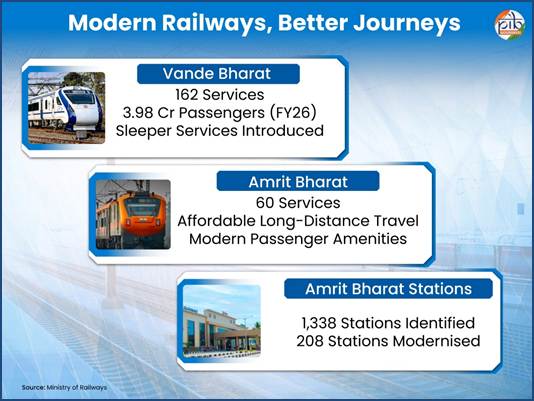
The first Vande Bharat Express was launched on 15 February 2019 as India’s indigenously designed semi-high-speed train. By March 2026, 162 services were operational nationwide, marking rapid expansion across Indian Railways. In FY 2025–26, the trains carried 3.98 crore passengers, showing a 34% rise from the previous year. Since its inception, over 9.1 crore passengers have travelled across nearly one lakh trips, reflecting strong public adoption. The futuristic Vande Bharat Sleeper service was introduced in January 2026, connecting Howrah and Guwahati. Within its first three months, the sleeper carried 1.21 lakh passengers across 119 trips.
The Amrit Bharat Express trains brought affordable comfort on long routes. The sixty operational fully non-AC Amrit Bharat train services serve travellers from Tier 2 and Tier 3 towns. These trains provide affordable, non‑AC, high‑capacity travel with modern seating and safety features. They ensure cost‑effective, comfortable mobility for weaker and lower‑middle sections, expanding inclusive long‑distance access.
- Amrit Bharat Station Scheme
The Amrit Bharat Station Scheme, launched in 2023, identified 1,338 stations for long‑term redevelopment. Among them, 157 stations are located in Aspirational Districts, ensuring inclusive infrastructure growth. By 01 April 2026, 208 stations were upgraded with modern facilities and improved passenger amenities. These upgrades include parking, waiting lounges, lifts, escalators, better toilets, and real‑time information systems. In FY 2025–26, 119 redeveloped stations were inaugurated, marking significant progress.
- High-Speed Rail Corridors
The Ahmedabad–Mumbai Bullet Train project is under construction, with its Surat–Bilimora section beginning operations in 2027. The 508 km corridor has been designed for operations at speeds up to 320 kmph. Seven additional bullet train corridors were announced in the Union Budget 2026-27 to connect major cities faster and more efficiently by High-Speed rail. These routes include:
- Mumbai–Pune
- Pune–Hyderabad
- Hyderabad–Bengaluru
- Hyderabad–Chennai
- Chennai–Bengaluru
- Delhi–Varanasi
- Varanasi–Siliguri
These announcements highlight the strategic role of high‑speed rail in India’s growth, integration, and sustainable development.
Civil Aviation – UDAN
In 2014, only 74 airports were operational, leaving smaller cities without air connectivity. The Regional Connectivity Scheme, Ude Desh ka Aam Nagrik (UDAN), launched in October 2016, transformed this landscape. As of 2026, 665 routes have been operationalised under UDAN across 95 airports, heliports, and water aerodromes. This resulted in India’s total number of airports expanding to 165 by April 2026. To sustain this expansion, the Government extended Viability Gap Funding (VGF) support, enabling airlines to operate new routes effectively. This assistance ensured affordable fares and strengthened regional connectivity, making air travel accessible for millions of citizens.
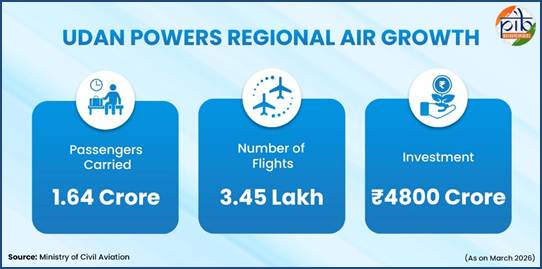
Since its launch, UDAN has carried more than 1.64 crore passengers on 3.45 lakh flights. Remote regions, including the North East, hilly states, and island territories, were connected to the national aviation grid for the first time. Investments exceeding ₹4,800 crore revived unserved airports, while 25 greenfield airports were approved after 2014, including Navi Mumbai, Noida, Mopa, Kannur, and Hollongi.
In March 2026, the Modified UDAN Scheme was approved, targeting 120 new destinations and aiming to serve 4 crore additional passengers. Plans include 100 airports, 200 modern helipads, and smaller airstrips in aspirational districts.
Passenger convenience also improved through initiatives like Digi Yatra, launched in December 2022, offering seamless, paperless travel. As of May 2026, over 9.3 crore passengers used this facility across 38 airports. UDAN Yatri Cafés, launched in 2024 and grievance redressal systems have enhanced passengers’ comfort. Together, these measures made air travel accessible, affordable, and reliable, reshaping mobility for millions of citizens.
Metro Rail
Metro rail has emerged as the most efficient solution for mass mobility, transforming urban transit across the country. In 2014, metro rail operated in only five cities with 248 km of network. By March 2026, India had 1,155 km of metro network operational across 26 cities. This expansion placed India as the third-largest metro network in the world.
Daily ridership grew from 28 lakh in 2013–14 to over 1.15 crore in 2026. The pace of commissioning increased ninefold, from 0.68 km per month before 2014 to approximately 6 km per month. Budgetary support also rose sharply, from ₹5,798 crore in 2013–14 to ₹29,550 crore in 2025–26.
India’s metro expansion delivered landmark achievements. Kolkata inaugurated the country’s first underwater metro tunnel beneath the Hooghly River in 2024. Kochi became the first city to operationalise a Water Metro service, connecting 10 islands with electric hybrid boats. In January 2026, the Economic Advisory Council to the Prime Minister (EAC‑PM) released a report titled Golden Decade of Infrastructure Development in India. The study found that metro rail access improves household loan repayment discipline and reduces financial stress. These milestones reflect how metro rail has reshaped urban mobility and reduced travel fatigue, bringing modern transit to millions of citizens.
Namo Bharat - Regional Rapid Transit System (RRTS)
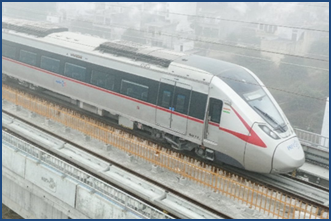
The Namo Bharat Train on the Delhi–Meerut RRTS began in 2023 and became fully operational in February 2026. It runs at 160 km/h with a design speed of 180 km/h, ensuring faster travel. The system features the world’s first European Train Control System (ETCS) Level II with Hybrid Level III signalling using LTE radio backbone. For the first time globally, Hybrid Level III radio‑based signalling operates on an LTE backbone on this corridor. This advanced technology makes train operations smarter and safer, enhancing passenger confidence and security throughout journeys.
Governance Reforms
Governance reforms have reshaped how citizens interact with institutions. The focus has been on reducing compliance burdens, strengthening accountability, and making services more transparent. Legislative changes and citizen‑facing platforms have created faster, fairer, and more predictable systems for everyday needs.
Legislative Simplification: Jan Vishwas Act
The Jan Vishwas (Amendment of Provisions) Act, 2023, marked a turning point in reducing compliance burdens. It amended provisions across multiple central laws, shifting minor defaults from criminal penalties to civil remedies. Citizens and enterprises no longer faced imprisonment for small lapses, reducing fear and encouraging voluntary compliance.
The Jan Vishwas (Amendment of Provisions) Act, 2026, expanded the scope significantly. It covers 784 provisions across 79 central Acts, decriminalises 717 provisions, and amends 67 provisions directly affecting citizens.
- Imprisonment clauses have been replaced with monetary penalties or warnings, reducing anxiety for minor procedural lapses.
- First‑time contraventions are addressed through advisory notices, ensuring fairness before punishment.
- Penalties are rationalised in proportion to offences, creating balanced and predictable enforcement.
- Provision to appoint Adjudicating Officers to ensure faster resolution and reduce delays in compliance cases.
- Provision to appoint Appellate Authorities to provide timely redressal and uphold principles of natural justice.
- Fines and penalties are subject to periodic revision, keeping enforcement relevant and responsive.
Citizen‑Facing Platforms
Citizen‑oriented platforms have become the frontline of responsive governance, offering faster grievance redressal and participatory channels.
- Centralised Public Grievance Redress and Monitoring System (CPGRAMS): A dedicated feedback portal available for Ministries, Departments, States, and Union Territories to monitor citizen satisfaction regarding grievance resolution. Between January 2025 and February 2026, approximately 6 lakh grievances were resolved, of which 69.8% were rated as satisfactory by the complainants. This demonstrated a fundamental shift toward accountable service delivery.
- MyGov: Launched in 2014, MyGov strengthens citizen participation in governance. The platform created a new era of interactive democracy, amplifying public voices in policymaking. With more than 60 million registered users, it acts as a dynamic bridge between citizens and the Government. MyGov has also launched State instances in 28 States and Union Territories, expanding participatory outreach nationwide. These instances are designed specifically for individual states. MyGov facilitates consultations, policy outreach, and scheme information, ensuring governance reflects collective wisdom.
These platforms gave citizens a direct voice and faster grievance resolution thereby improving trust in institutions.
PM GatiShakti National Master Plan
The PM GatiShakti Scheme, launched in 2021, has onboarded 58 Ministries and Departments for integrated planning. Their data layers are consolidated on the National Master Plan, enabling coordinated infrastructure development across sectors. 3,204 data layers from Central Ministries and States are being used on the GIS‑based portal. The platform extends beyond traditional infrastructure, covering social sectors like education and healthcare for inclusive growth. PM GatiShakti National Master Plan is also open to public and private entities for wider participation.
These reforms and platforms reduced compliance burdens, strengthened transparency, and improved everyday interactions. Citizens experienced faster services, fairer enforcement, and greater participation in decision-making. Routine processes became less stressful, more predictable, and more empowering, reflecting a decisive shift toward trust and convenience.
Ease of Living as the Foundation of Viksit Bharat
India’s governance journey from 2014 to 2026 is about lives becoming more dignified and empowered. Each house under PM Aawas Yojna freed families from insecurity, while each tap water connection reclaimed hours of drudgery. Women especially gained time for education and livelihoods. Each Jan Dhan account welcomed households into the financial mainstream, ensuring access to savings and credit. Roads, metros, and airports connected communities to opportunity, reducing isolation and opening doors to growth. These achievements are not statistics; they represent visible and real changes in everyday life across villages, towns, and cities.
As India advances toward Viksit Bharat by 2047, this foundation remains central to national progress. Inclusive growth, sustainability, and dignity for every citizen are complementary goals, not competing priorities. The twelve years from 2014 to 2026 proved that citizen‑centric, mission‑led, technology‑enabled governance can deliver outcomes at scale. These outcomes reshaped lives with speed and depth, offering lessons of transformation that the world can learn from.
References:
Ministry of Housing and Urban Affairs:
https://pmaymis.gov.in/pmaymis2_2024/PMAY_SURVEY/EligiblityCheck.aspx
https://www.pib.gov.in/pressreleasepage.aspx?prid=1777284®=3&lang=2
https://amrut.mohua.gov.in/uploads/AMRUT_2.0_Operational_Guidelines.pdf
https://sbmurban.org/
https://www.pib.gov.in/PressReleasePage.aspx?PRID=2220345®=3&lang=1
https://www.pib.gov.in/PressReleasePage.aspx?PRID=2066736®=3&lang=2
Ministry of Rural Development:
https://www.pib.gov.in/PressReleaseIframePage.aspx?PRID=1944744®=3&lang=2
https://pmayg.dord.gov.in/netiayHome/Home.aspx
https://www.pib.gov.in/PressReleasePage.aspx?PRID=2075171®=3&lang=2
Ministry of Power:
https://www.pib.gov.in/PressReleasePage.aspx?PRID=2256313®=3&lang=1
https://newsonair.gov.in/pm-surya-ghar-scheme-achieves-major-milestone-as-40-lakh-households-embrace-rooftop-solar/
https://www.pib.gov.in/PressReleaseIframePage.aspx?PRID=2111106®=3&lang=2
https://www.pib.gov.in/PressReleasePage.aspx?PRID=2217216®=3&lang=1
https://www.pib.gov.in/PressReleasePage.aspx?PRID=2090639®=3&lang=2#:~:text=36.87%20crore%20LED%20bulbs%20distributed,Introduction
Press Information Bureau:
https://www.pib.gov.in/PressNoteDetails.aspx?NoteId=154355&ModuleId=3®=3&lang=1
https://www.pib.gov.in/PressReleasePage.aspx?PRID=2182568®=3&lang=2
https://www.pib.gov.in/PressReleasePage.aspx?PRID=2191618®=3&lang=2
https://www.pib.gov.in/PressNoteDetails.aspx?NoteId=155102&ModuleId=3®=3&lang=2
https://www.pib.gov.in/PressReleasePage.aspx?PRID=2241822®=3&lang=2
https://static.pib.gov.in/WriteReadData/specificdocs/documents/2021/oct/doc202110101.pdf
Cabinet:
https://www.pib.gov.in/PressReleasePage.aspx?PRID=2237548®=3&lang=1
Ministry of Jal Shakti:
https://ejalshakti.gov.in/jjmreport/jjmindia.aspx
https://www.pib.gov.in/PressReleasePage.aspx?PRID=2226993®=3&lang=2
https://www.pib.gov.in/PressReleasePage.aspx?PRID=2114291®=6&lang=1
https://www.pib.gov.in/PressReleasePage.aspx?PRID=2114291®=6&lang=1
https://swachhbharatmission.ddws.gov.in/about_sbm
https://www.pib.gov.in/PressReleasePage.aspx?PRID=2040171®=3&lang=2
https://sbm.gov.in/sbmgdashboard/statesdashboard.aspx
https://www.pib.gov.in/PressReleasePage.aspx?PRID=2248393®=3&lang=1
https://www.pib.gov.in/PressReleaseDetail.aspx?PRID=2237010®=3&lang=2
https://www.pib.gov.in/PressReleasePage.aspx?PRID=2247224®=3&lang=1
Prime Minister’s Office:
https://www.pmindia.gov.in/en/government_tr_rec/leveraging-the-power-of-jam-jan-dhan-aadhar-and-mobile/
Ministry of Finance:
https://www.pmjdy.gov.in/account
https://www.pib.gov.in/PressReleaseIframePage.aspx?PRID=2069170®=3&lang=2
https://www.pib.gov.in/PressReleasePage.aspx?PRID=2249915®=3&lang=2
https://www.pib.gov.in/PressReleasePage.aspx?PRID=1896725®=3&lang=2
Ministry of Commerce & Industry:
https://www.pib.gov.in/PressReleasePage.aspx?PRID=2246226®=3&lang=1
Ministry of Personnel, Public Grievance and Pensions:
https://sansad.in/getFile/loksabhaquestions/annex/187/AU6033_XP4G1y.pdf?source=pqals
MyGov:
https://www.mygov.in/overview
Ministry of Civil Aviation:
https://www.pib.gov.in/PressReleaseIframePage.aspx?PRID=1657813®=48&lang=2
Ministry of Petroleum and Natural Gas:
https://sansad.in/getFile/loksabhaquestions/annex/187/AU3352_6sijmI.pdf?source=pqals
https://www.facebook.com/PetroleumMinIndia/videos/iea-applauds-india-for-pm-ujjwala-yojanadr-fatih-birol-executive-director-of-iea/378453946154485/
Asian Development Bank (ADB):
https://www.adb.org/publications/energy-resilience-social-protection-india
Cleck to See PDF
***
PIB Research
(Release ID: 2273017)
Visitor Counter : 5149