Ministry of Jal Shakti
DDWS Organises 9th District Collectors’ Peyjal Samvad
Five Districts Showcased Innovative Practices on Source Sustainability, Jan Bhagidari, Women Empowerment and O&M
Posted On:
16 JUN 2026 4:44PM by PIB Delhi
The Department of Drinking Water & Sanitation (DDWS), Ministry of Jal Shakti, organised the 9th edition of the District Collectors’ Peyjal Samvad today through video conferencing, bringing together senior officials, District Collectors/ Deputy Commissioner, and Mission Directors of State/UTs JJM, to deliberate on accelerating the implementation of Jal Jeevan Mission (JJM) 2.0 and sharing of best practices.
The Samvad was chaired by Shri Ashok K.K. Meena, Secretary, DDWS. Shri Kamal Kishore Soan, Additional Secretary & Mission Director, National Jal Jeevan Mission (NJJM), and Senior Officers from DDWS were also present during the Samvad.
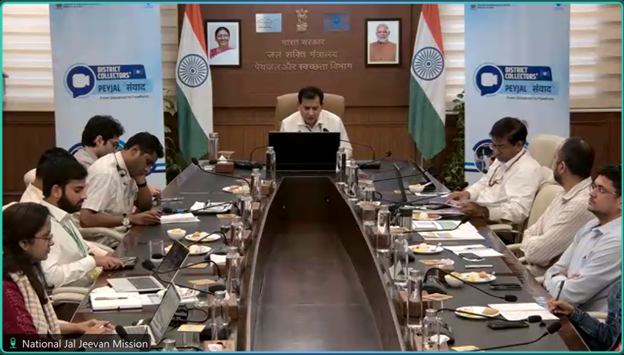
Addressing in the occasion, Shri Ashok K.K. Meena, Secretary, DDWS, emphasised that the focus of JJM 2.0 has now moved beyond infrastructure creation to ensuring reliable service delivery, sustainability, and community ownership of rural water supply systems. He highlighted three key priority areas of JJM 2.0 for district administrations:
i. Regular District Water and Sanitation Mission (DWSM) Meetings: He stressed the importance of conducting DWSM meetings every month and uploading of meeting minutes on the dedicated dashboard and said regular review and monitoring at the district level are essential for effective implementation of drinking water schemes, O&M, and service delivery. He noted that the conduct of DWSM meetings would be closely monitored and reflected in district performance assessments.
ii. Jal Seva Aankalan: He underlined the significance of the annual Jal Seva Aankalan process in assessing the status of drinking water service delivery and urged districts to familiarise themselves with the assessment process and utilise its findings for improving service delivery.
iii. Jal Arpan Ceremony: Emphasising community ownership, he called for the systematic commissioning and handing over of completed water supply schemes to Gram Panchayats through Jal Arpan ceremonies. He stated that after successful 15-30 days trials and commissioning, assets should be formally handed over to, enabling GPs to take responsibility for O&M. He encouraged districts to organise Jal Arpan events with the participation of public representatives, including MPs, MLAs, Panchayat representatives, and local communities, to celebrate the achievement of safe drinking water access and strengthen local ownership.
He expressed confidence that sharing the best practices by districts across the country would inspire improved performance and accelerate progress towards ensuring sustainable drinking water services for every rural household under the Jal Jeevan Mission.
Shri Kamal Kishore Soan, AS&MD, NJJM in his address advised districts to conduct regular DWSM meetings and upload the proceedings on the portal timely. He highlighted that source sustainability must remain a key priority, it is important to study how successful models can be standardised and replicated across areas. He emphasised that maintaining the groundwater table is critical for ensuring the long-term functionality of rural water supply schemes.
He advised that officers associated with water conservation, groundwater recharge, irrigation, water resources and Jal Sanchay se Jal Bhagidari initiatives should be invited to DWSM meetings. This would help improve convergence, enable regular review of ongoing water conservation activities and support better understanding of the local water table situation.
He further highlighted the need for better coordination with the Agriculture Department for the installation of automatic rain gauges across GPs. This will help districts assess local rainfall patterns, understand groundwater conditions and identify additional measures required to maintain the water table.
He underlined that Jal Arpan should not be treated as a symbolic handover activity. Its real objective is to ensure Jan Bhagidari and community ownership. He advised that before handing over schemes to GPs, the 15-day trial run should be completed and key information related to the scheme, including estimates, drawings and other details, should be shared with the community. He urged District administrations to prepare monthly Jal Arpan calendars.
AS & MD, NJJM also stressed the timely and effective utilization of FC grants for improving rural water supply service delivery. Unutilised 15th FC tied grants should be used in aligned with the guidance provided under the 16th FC. He urged that these resources should be linked with the priorities identified through District Improvement Plans.
He reiterated that effective fund utilisation, adherence to Finance Commission guidelines and corrective action based on District Improvement Plans will be critical for addressing field-level gaps, strengthening service delivery and ensuring sustainable operation and maintenance of rural water supply schemes.
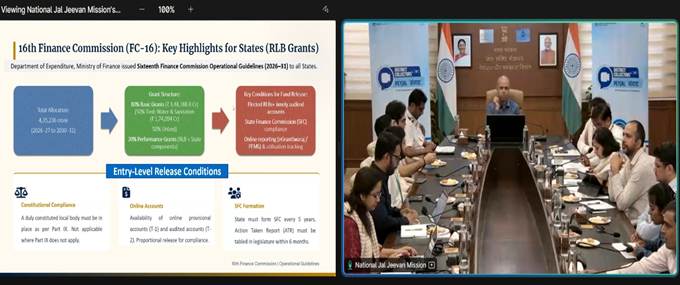
DDWS Presentation on 16th Finance Commission Grants for WaSH
Shri Y.K. Singh, Director (NJJM), presented on the pivotal role of the 16th FC Grants in strengthening the sustainability of rural water supply and sanitation services. He emphasised the need to align these grants with JJM and SBM-G to ensure effective O&M and long-term functionality of assets created in rural areas. With significant progress achieved under JJM, he highlighted the shift in focus from infrastructure creation to sustained service delivery, underscoring the central role of Gram Panchayats in managing in-village water supply systems, water quality and sanitation infrastructure.
The presentation highlighted that Finance Commission Grants, along with user charge collection, provide critical financial support for O&M at the Gram Panchayat level. Out of the total allocation of over ₹4.35 lakh crore under the 16th FC, 50% of the basic grants are tied to water and sanitation, amounting to approximately ₹1.74 lakh crore. These funds can be utilised for a wide range of activities, including source strengthening, chlorination, repair and maintenance of water systems, water quality monitoring, procurement of testing kits, payment of operators, and meeting energy requirements. The grants also support sanitation-related activities such as maintenance of community sanitation assets, waste management systems, greywater management and construction of toilets and related infrastructure.
He further stressed the importance of effective planning and utilisation of these grants through Gram Panchayat Development Plans (GPDPs), approved by Gram Sabhas and monitored through eGram Swaraj and PFMS. Emphasis was also laid on improving water quality surveillance, promoting greywater management, and strengthening solid and liquid waste management systems. States and local bodies were advised to ensure timely utilisation of funds, adherence to audit and reporting requirements, and proper planning to avoid delays in fund release and maximise the impact of available resources.
Innovative Best Practices Shared by Districts Through Presentations
During the Peyjal Samvad, a total of five districts presented their progress and best field practices which will further help other State’s districts to develop better under JJM 2.0. Each presentation was delivered by the respective District Collector/ District Magistrate/Deputy Commissioner/ District Officials.
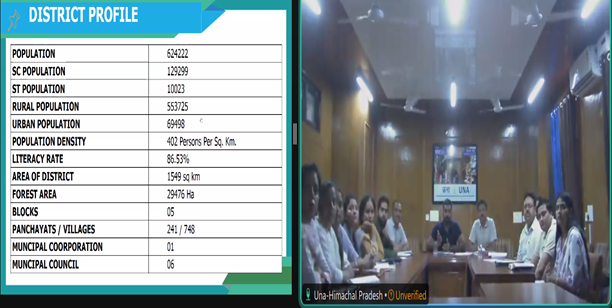
- Una, Himachal Pradesh - Shri Jatin Lal, Deputy Commissioner presented the district’s progress, achievements, and initiatives. He shared that Una faces issues related to scattered habitations, dependence on pumping schemes, voltage fluctuations, power outages, permissions from different departments. The district has also faced challenges arising from floods and natural disasters, for which field teams and disaster volunteers have been mobilized to minimize disruption and assess damages in pipelines.
The Deputy Commissioner informed that the district has taken steps to recharge groundwater during the monsoon period and maintain water sources for long-term water security, strengthening of district technical units, activation of village-level committees, promotion of digital governance, digital registry, and GIS/GPS-based monitoring of assets and schemes. These initiatives have helped the district improve tracking, transparency, and timely resolution of implementation-related issues.
The district also shared its efforts towards coordination with line departments and local administration for land-related matters, permissions, protection of infrastructure, and smooth implementation of water supply schemes. Regular coordination with departments such as revenue, police, and other administrative agencies has supported faster resolution of field-level challenges.
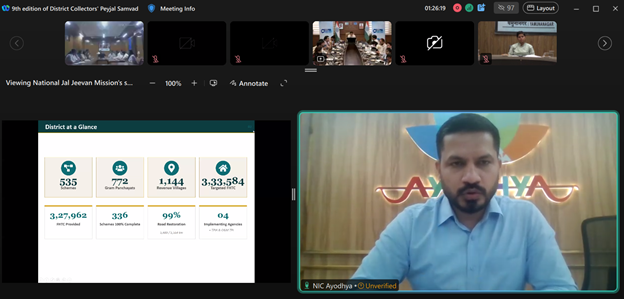
- Ayodhya, Uttar Pradesh - Shri Shashank Tripathi, District Magistrate highlighted that regular monitoring is being undertaken through the DWSM. A model scheme at Shadbashpur was showcased, where 24x7 water supply has been ensured, with nearly 700 household connections completed. A notable feature of this scheme is the active involvement of a woman operator in managing the water supply system. Overall, 17 women operators are currently managing various schemes across the district, a model widely appreciated for its potential replication in other regions.
Special emphasis has been placed on road restoration, a key concern for local communities during implementation. The district administration has integrated road restoration within the overall execution plan to minimize inconvenience to villagers.
The presentation also highlighted efforts toward source sustainability and water security. Recharge structures are being promoted at village level through GPs, Blocks, and individual stakeholders, along with rainwater harvesting systems at scheme sites to strengthen groundwater recharge.
Women’s participation remains a cornerstone of the programme. Women operators, plumbers, and Self-Help Group members are actively involved in operations, water quality testing, community engagement, and user charge collection. Additionally, a study by King George’s Medical University assesses the mission’s impact on women’s health. Skill development has also been strengthened through a CSR-supported training center at the Muzaffarpur-Jalalpur scheme site.
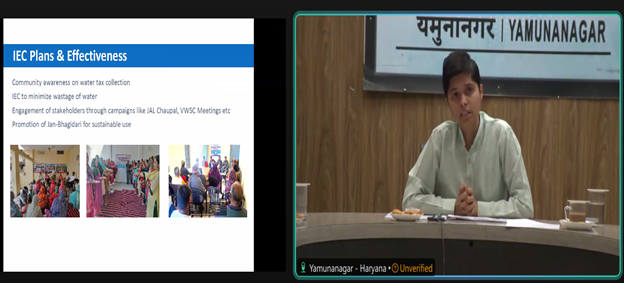
- Yamuna Nagar, Haryana – Ms. Preeti, Deputy Commissioner that, as part of ongoing reforms, the district has signed 60 Memorandums of Understanding between the Public Health Department and Gram Panchayats for the handover and management of water supply schemes. The district administration further noted that the remaining technical processes related to the handover are being addressed, and the process is being advanced in a time-bound manner.
A major focus of the district’s approach has been IEC activities. Awareness campaigns are being conducted across villages, schools, and community groups to reduce water wastage, encourage responsible water use, and promote service charge collection. She emphasised the important role of Self-Help Groups (SHGs) in water quality monitoring and community engagement. SHG members have been trained and oriented in water testing protocols, grievance redressal, and quality assurance.
The district also highlighted its efforts toward environmental sustainability. With the support of SHGs, around 1,000 trees have been planted, and members will monitor their growth over the next year. Regular monitoring is undertaken at the district, sub-divisional, and departmental levels, while a 24x7 helpline ensures timely grievance redressal.
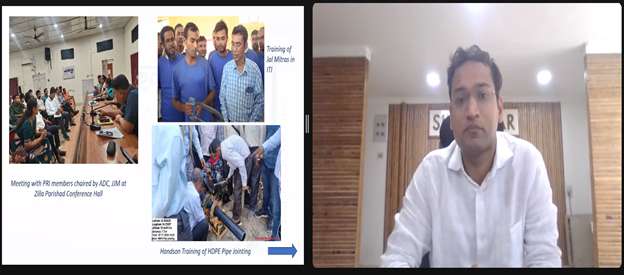
- District Sivasagar, Assam – Shri Mridul Yadav, Deputy Commissioner presented the progress under Jal Jeevan Mission, highlighting community-led operation and maintenance, tariff collection, and long-term sustainability of rural water supply schemes. He informed that the district has achieved around 76% tariff collection through convergence with Panchayats, Water User Committees (WUCs), SHGs, and active community participation. Regular DWSM meetings, field inspections, and inter-departmental reviews are conducted, while PHED and Panchayat officials jointly inspect schemes before handover.
The presentation emphasised the role of PRI representatives, WUCs, and Jal Mitras in ensuring functionality. Trained through ITIs, Jal Mitras support not only pump operations but also minor repairs, maintenance, and tariff collection, reducing dependence on contractors.
A key highlight was the “Nari Shakti Se Jal Shakti” initiative, showcasing women’s leadership in managing water supply systems. Women are actively involved in financial management, tariff collection, and monitoring service delivery, strengthening accountability and community ownership.
Digital innovation was also noted, with QR code-based tariff payments improving transparency and ease of collection. The Hati Muria-Ghatgalia scheme achieved 100% tariff collection across 350 households through strong community management. Even in challenging terrains near the Nagaland border, behavioural change has encouraged communities to contribute user charges, ensuring sustainability.
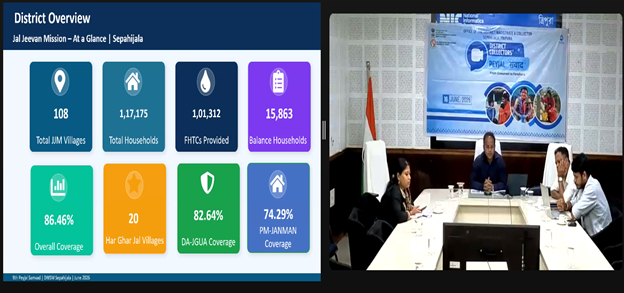
- Sephaijala, Tripura – Dr. Siddharth Shiv Jaiswal, District Magistrate & Collector presented the district's progress under JJM, highlighting significant achievements in rural drinking water coverage and sustainability initiatives. The district has achieved 86.46% tap connections coverage across 108 villages, a substantial improvement from just 3% coverage before the launch of the Mission. The remaining households are expected to be covered upon commissioning of ongoing schemes.
The Deputy Commissioner said that regular DWSM meetings are being conducted every month, complemented by technical inspections, third-party audits, and timely corrective actions. A robust grievance redressal mechanism through the state's public complaint portal has enabled prompt resolution of drinking water-related issues.
To strengthen source sustainability, the district is constructing 300 groundwater recharge structures, of which 82 have already been completed. These efforts contributed to the district receiving the prestigious National Water Award. Convergence with schemes such as VB-G RAM G is also being leveraged for water conservation and sustainability measures.
Jal Seva Aankalan and Jal Arpan Divas helped enhancing community participation and ownership of water supply systems. Extensive IEC activities, including school outreach, village campaigns, and training of 650 women in water quality testing using FTKs, are being undertaken to ensure long-term sustainability and safe drinking water for all.
These presentations showcased achievements, ongoing challenges, and best practices under JJM underlining the diversity of approaches adopted to accelerate progress under Har Ghar Jal.
In his concluding address, Shri Kamal Kishore Soan, Additional Secretary & Mission Director, NJJM, praised the innovative approaches shared by districts and underscored that the success of JJM 2.0 depends on the proactive leadership of District Collectors.
The 9th edition of District Collectors’ Peyjal Samvad was attended by participants across the country including District Collector/ Deputy Commissioner/ District Officials, Mission Directors, and State Mission Teams, from State/UTs.
***
ND
(Release ID: 2273591)
Visitor Counter : 1387