At MIFF 2026, Biplab Goswami decodes the long, lonely and beautiful journey from idea to screenplay
There is no formula to writing other than believing in yourself, says the Laapataa Ladies writer
Mumbai, 16 June 2026
How does a fleeting thought become a full-fledged screenplay? How does a writer stay committed to a story for years before it finally reaches the screen? These were some of the questions that screenwriter, editor and director Biplab Goswami addressed during his workshop, From Idea to Outline: The Anatomy of a Scene, which opened the much-awaited workshop series at the 19th Mumbai International Film Festival (MIFF) 2026 today.
Known for writing Laapataa Ladies, India's official entry to the Oscars 2025 and one of the most celebrated films of recent years, Goswami took participants through the often chaotic, deeply personal and intensely demanding process of storytelling.
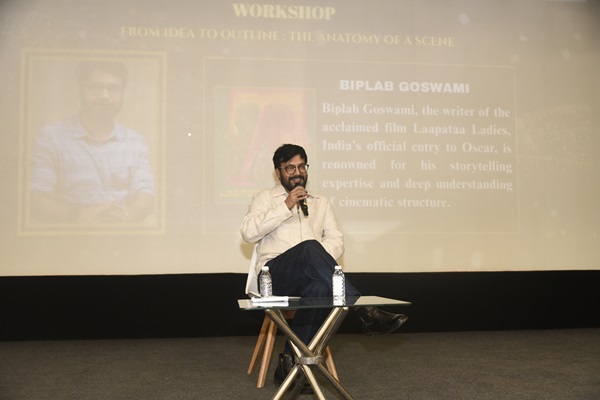
"There is no formula," he said repeatedly throughout the session. For Goswami, every story begins differently. Sometimes it emerges organically, sometimes from observation, and sometimes from a trigger that sparks an idea. "As writers, we are always searching. Sometimes we need ideation. Sometimes a story arrives on its own. There is no fixed route."
The writer spoke candidly about the emotional challenges that accompany the creative process. One of the biggest hurdles, he said, is continuing to write when there is no guarantee that a producer will back the project.
"You may have a good story, but no producer. That can be discouraging. But if you truly love cinema, you continue regardless," he said. "I write from the perspective of a writer, a director and a producer simultaneously. Even if there is no producer, I will keep writing."
Calling cinema an all-consuming passion, Goswami said filmmaking demands a certain obsession.
"Cinema is not for everyone. You have to be mad about it. Hungry for it. Sometimes absent-minded and forgetful because you are constantly living inside stories. Only then can you survive the process."
He described storytelling as a long journey filled with moments of doubt and exhaustion. "We begin wanting to create something. Then somewhere in the middle we get tired. Sometimes years pass before we reach the destination. But stories take time. You have to live with them."
The evolution of ‘Laapataa Ladies’ itself became a powerful example. Goswami revealed that he first registered the story in 2014, when it existed as a collection of just 22 scenes. "Then life happened. I had to survive financially. By the time the film was released, the world had changed. But I still had to tell the same story. The challenge was figuring out how to tell yesterday's story to today's audience."
The process, he admitted, was painful. "Day and night you think about the story. What should you write? What will the audience connect with? There is pressure. But eventually you find a way."
onJune16,2026.(1)BSHE.JPG)
One of the most engaging sections of the workshop focused on visualising the screenplay long before production begins. Goswami encouraged writers to become the first audience for their own films. "When I write, I watch the film on an imaginary screen. I become the first viewer. Then I imagine how audiences will watch it. I even mentally visit the editing table and see how scenes are structured. This exercise helps me understand the film from multiple perspectives."
His background as a film editor has significantly influenced his writing process. Stressing the importance of collaboration, he reminded aspiring filmmakers that cinema is never the work of a single individual.
"Film is a collective medium. Writers need to understand other departments too. Once you write something, you also need to detach yourself from it. If you become rigid and insist that everything remain exactly as you imagined, you will face problems. Other departments will have their own perspectives, and they should."
Asked about screenplay theories and storytelling formulas, Goswami remained sceptical of rigid frameworks. "I don't focus on theories. I focus on the story. Cinema is ultimately storytelling," he said. "Sometimes a surprising event launches the story. Sometimes there is a second take-off. Every story discovers its own rhythm."
onJune16,2026.(3)QK3H.JPG)
According to him, aspiring writers often become anxious when they have a promising idea but struggle to expand it into a complete screenplay. "Don't worry too much about how you are writing. Focus on what you are trying to achieve. Sometimes I start with a single line. Then it becomes a synopsis. Then scenes emerge. At other times, I write scene by scene from the beginning. There is no rule."
What matters most, he stressed, is persistence. "First believe in yourself. Then keep writing in whatever way works for you. Later, when you present it professionally, you can structure it according to industry standards."
Goswami also challenged the notion that writing can be mastered through shortcuts or technical tricks alone. "There are no shortcuts. Writing is difficult. You can learn techniques, but they will not automatically make you a good writer."
Instead, he urged participants to cultivate the habit of observation. "Observe people. Observe society. Observe expressions, relationships and situations. Those observations become your characters and your stories."
The session offered aspiring writers not just practical insights into narrative friction, character agency and scene construction, but also a reassuring reminder that every screenplay finds its own path. In a room full of emerging storytellers and film enthusiasts, Goswami's message was simple yet powerful: trust the story, trust the process, and most importantly, keep writing.
A film editing graduate from Satyajit Ray Film & Television Institute (SRFTI), Kolkata, Biplab Goswami is presently an Advisor at the Tripura Film and Television Institute (TFTI), Agartala.
About the 19th MIFF
The 19th edition of MIFF promises an immersive and enriching cinematic experience, featuring a thoughtfully curated lineup of acclaimed international films alongside an exciting array of industry-focused initiatives.
- This year, the Competitive Section of the festival has received 1,459 film entries from 47 countries, including India.
- The festival showcases films in more than 42 Indian languages and over 30 languages from outside India, reflecting its global reach and cultural diversity.
- Featuring works by acclaimed filmmakers from around the world, the festival will present some of the finest documentaries, short fiction films, animations, debut director films, and student films.
- Alongside the screenings, the 2nd edition of Doc Bazaar, enriching masterclasses, and an Open Forum by IDPA will further enhance the cinematic and creative exchange at the festival.
Step into the vibrant world of storytelling at MIFF 2026, where powerful cinema, creative minds, and inspiring voices come together to create an unforgettable celebration of documentary, animation, and short fiction filmmaking.
* * *
PIB Team MIFF | Nikita Joshi/Riyas Babu/Darshana Rane
Release ID:
2273680
| Visitor Counter:
1063