Ministry of Science & Technology
Researchers tracking air quality risks in the Himalaya, identify shift from clean to polluted air
Posted On:
17 JUN 2026 4:41PM by PIB Delhi
A new study by researchers has revealed that even pristine remote Himalayan regions are no longer untouched by air pollution, with measurable impacts on air quality and potential long-term health risks.
NMHCs are a group of reactive gases emitted from fuel use, vehicles, and other human activities that play a key role in forming ozone and secondary aerosols. It is important to trace them and evaluate their implications for regional air quality and potential impacts on human health.
Munsyari provides a unique environment to investigate the influence of local anthropogenic activities, including tourism, as well as regional transport processes on the distribution of NMHCs.
Researchers from Aryabhatta Research Institute of Observational Sciences (ARIES), an autonomous institute of the Department of Science and Technology (DST), spent a year (2022–2023) measuring non-methane hydrocarbons (NMHCs) in Munsyari, a high-altitude Himalayan tourist destination.
The researchers observed clear seasonal patterns, with lower NMHC levels during winter and the monsoon and significantly higher concentrations during spring and autumn. It was found that fuel usage (LPG and diesel), vehicular emissions, and local construction activities as the dominant contributors influencing air quality at this remote site. Importantly, the aromatic hydrocarbons such as benzene and xylene were found to strongly contribute to the formation of secondary pollutants like ozone, known to affect both climate and human health in the troposphere.
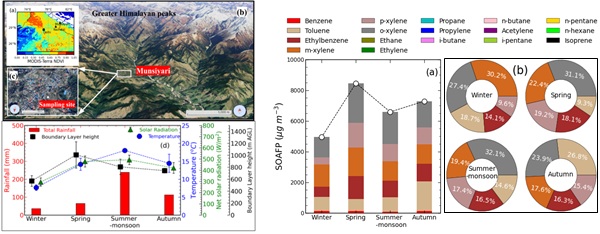
Fig. 1. (left) Location and meteorology of the sampling site in the Himalayas, and (right) seasonal change in the secondary organic aerosol (SOA) formation potential of NMHCs observed at a high-altitude rural site (Munsyari).
A regional comparison shows that NMHC levels at Munsyari are higher than those observed at another high-altitude site (Nainital), though they remain lower than levels reported in nearby urban centers such as Haldwani and Delhi.
These findings show that human-caused pollution is reaching even remote parts of the Himalayas. While immediate health risks are low, long-term exposure to benzene poses a cancer risk that exceeds safety limits. This study highlights that pollution is worsening, making constant monitoring and specific cleanup plans essential for these sensitive regions.
Publication link: https://doi.org/10.1007/s11356-026-37694-z
*****
NKR/FT/NM
(Release ID: 2274059)
Visitor Counter : 1491