Ministry of Chemicals and Fertilizers :
Department of Pharmaceuticals
12 Years of Transformative Growth in Pharmaceuticals Sector Driving Affordable Healthcare and Atmanirbhar Bharat
From 84 to 19,200+ Jan Aushadhi Kendras Bringing Affordable Medicines to Every Corner of India
North East Witnesses remarkable Expansion from 1 Jan Aushadhi Kendra to 417 in 12 Years
PLI Scheme for Pharmaceuticals attracts cumulative investment of ₹42,694 cr; creates over 1.13 Lakh Jobs; Medical Devices PLI Generates ₹29,400 Cr Sales
प्रविष्टि तिथि:
17 JUN 2026 5:31PM by PIB Delhi
India's pharmaceutical landscape has witnessed a remarkable growth and transformation in the last 12 years under the leadership of Prime Minister Narendra Modi. The Department of Pharmaceuticals under the Ministry of Chemicals and Fertilisers has advanced affordable healthcare, strengthened domestic manufacturing, fostered innovation and reinforced India's position as the "Pharmacy of the World" through a combination of people-centric initiatives and industry-focused reforms in the pharmaceutical sector.
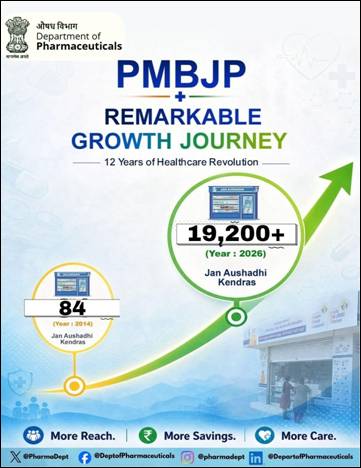
The expansion of the Pradhan Mantri Bhartiya Janaushadhi Pariyojana (PMBJP) is one of the Department's most impactful achievements. From around 84 functional Jan Aushadhi Kendras in 2014, the network has grown to more than 19,200 Kendras across the country in 2026, making quality generic medicines accessible at affordable prices to millions of citizens. The scheme has expanded significantly in remote regions, including the eight North Eastern States where the number of Kendras increased from just one in 2014 to 417 in 2026. Several states have recorded steady expansion under the scheme. Uttar Pradesh leads the country with 4,042 JAKs, followed by Kerala (1,791), Karnataka (1,665), Tamil Nadu (1,591), Bihar (1,183), West Bengal (937), Gujarat (918), Odisha (852), Rajasthan (718) and Maharashtra (741).
The national capital New Delhi has witnessed growth from 4 Kendras in 2014 to 645 Kendras in 2026, Jammu & Kashmir from 6 to 358 Kendras, Himachal Pradesh from 8 to 76, Punjab from 20 to 556 and Tripura from 1 to 33. By ensuring access to quality generic medicines at substantially lower prices, the Pradhan Mantri Bhartiya Janaushadhi Pariyojana has helped citizens save more than ₹40,000 crore on their healthcare expenses.
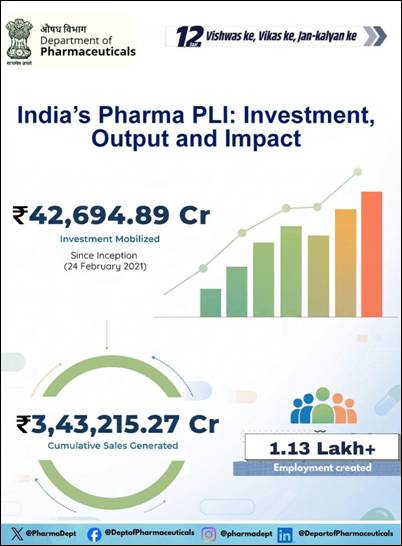
To strengthen domestic manufacturing and reduce import dependence, the Government of India launched the Production Linked Incentive (PLI) Schemes for Pharmaceuticals and Medical Devices in 2020-21. The PLI Scheme for Pharmaceuticals has attracted cumulative investments of ₹42,694.89 crore and generated cumulative sales of ₹3,43,215.27 crore, while creating employment for over 1.13 lakh persons. The scheme by incentivising production of high-value medicines such as biopharmaceuticals, complex generic drugs has strengthened India's capabilities and reinforced its position as the Pharmacy of the World.
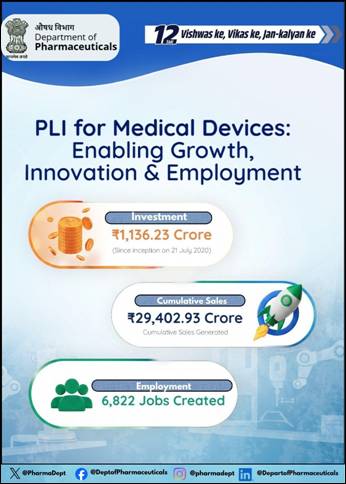
Similarly, the PLI Scheme for Promoting Domestic Manufacturing of Medical Devices has attracted investments worth ₹1,136.23 crore and generated cumulative sales of ₹29,402.93 crore. The scheme has created employment for 6,822 persons and accelerated the domestic manufacturing of critical medical devices, contributing to self-reliance in the Med Tech sector.
To boost domestic manufacturing of bulk drugs and reduce import dependence, under the Bulk Drug Parks Scheme three Bulk Drug Parks are being set up in Andhra Pradesh, Gujarat and Himachal Pradesh. These parks are creating world-class infrastructure, strengthening the pharmaceutical supply chain and supporting the vision of an Atmanirbhar and globally competitive pharmaceutical sector.
Under the Scheme for Promotion of Medical Device Parks launched on 21 July 2020, Medical Device Parks are being set up in Tamil Nadu, Uttar Pradesh and Madhya Pradesh. It aims to strengthen India's medical devices sector through shared infrastructure and reduced production costs and promote self-reliance in medical device manufacturing.
The Pharmaceutical & Medical Device Promotion and Development Scheme (PMPDS) has further strengthened the sector through policy support, stakeholder engagement and knowledge generation. Under the scheme, 47 stakeholder events and 12 sectoral studies have been conducted, facilitating industry-government collaboration, promoting innovation and supporting evidence-based policymaking.
Further, Biopharma SHAKTI (Strategy for Healthcare Advancement through Knowledge, Technology, and Innovation) announced in 2025-26 Budget with an outlay of ₹10,000 crore over 5 years aims to strengthen India's Bio pharmaceuticals sector and improve access to affordable biological medicines by supporting self-reliant ecosystem for biologics and biosimilars.
Together, these initiatives reflect the Government's commitment to building an Atmanirbhar Bharat, promoting investment and innovation, creating employment opportunities and positioning India as a globally competitive hub for pharmaceuticals, biopharmaceuticals and medical devices. As India moves towards the goal of Viksit Bharat@2047, the Department of Pharmaceuticals is suitably placed to play a critical role in ensuring accessible healthcare and fostering innovation led growth in the pharmaceutical sector.
***
PC/PM
(रिलीज़ आईडी: 2274104)
आगंतुक पटल : 473