Ministry of Jal Shakti
NMCG Scales Up Urban River Management Plans Across 63 Ganga Basin Cities
13 URMPs Completed Under Phase-I; Expansion Across Uttarakhand, Uttar Pradesh and Bihar
Posted On:
24 JUN 2026 5:35PM by PIB Delhi
In a major milestone towards river-centric urban planning, the National Mission for Clean Ganga (NMCG), in collaboration with the National Institute of Urban Affairs (NIUA), has completed Urban River Management Plans (URMPs) for 13 cities. Building on this progress, URMPs are being prepared for 27 cities under Phase-I and 33 additional cities under Phase-II, taking the overall coverage to 60 cities across the Ganga Basin. Supported under the Namami Gange Programme, the initiative represents one of the world’s largest coordinated efforts to integrate river health with urban planning.
The initiative is rooted in the vision articulated by Prime Minister Narendra Modi during the National Ganga Council meeting in Kanpur in December 2019, where he called for a shift from city-centric development to a river-centric approach that places rivers at the heart of urban planning and civic life. The initiative also highlights interventions being undertaken across cities in Uttarakhand, Uttar Pradesh and Bihar, where locally tailored strategies are being developed for ecological restoration, pollution abatement, flood resilience, cultural heritage conservation, eco-tourism, and citizen participation.
At its core, the URMP framework addresses urban river management across three key pillars — environmental, economic, and social. Its comprehensive ten-point agenda includes floodplain regulation, pollution abatement, rejuvenation of wetlands and water bodies, enhancement of riparian buffers, reuse of treated water, eco-sensitive riverfront development, ensuring quality return flows, economic utilisation of river resources, and sustained citizen engagement.
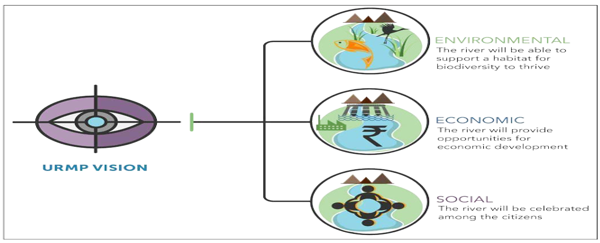
Cities are expected to implement these interventions through a combination of planning measures, regulatory reforms, infrastructure development, and community-led initiatives within defined timelines, making river health an integral part of long-term urban development.
From Pilot to Scaled Expansion and Coverage
The initiative builds upon successful pilot projects undertaken by NIUA with support from NMCG in cities such as Ayodhya, Kanpur, and Chhatrapati Sambhaji Nagar. These pilots demonstrated how URMPs can be tailored to local cultural, environmental, and economic contexts instead of following a one-size-fits-all model.
Encouraged by these outcomes, the programme is now being scaled up in a phased manner. Under Phase-I, supported by the World Bank, URMPs are being developed for 27 cities across Uttarakhand, Uttar Pradesh, Bihar, Jharkhand, and West Bengal, covering diverse geographies from Gangotri and Rishikesh in the upper basin to Howrah, Asansol, and Durgapur in the eastern region. Of these, URMPs for 13 cities have already been completed, while plans for 12 additional cities are targeted for completion by March 2027 (FY 2026–27).
URMPs for several cities including Haldwani-Kathgodam, Ramnagar, Rishikesh, Gorakhpur, Shahjahanpur, Bijnor, Prayagraj, Mirzapur, Chapra, Buxar, and Gaya have been completed. The initiative aims to strengthen urban resilience, improve river ecology, enhance wastewater and solid waste management, and promote sustainable development aligned with the vision of river rejuvenation under the Namami Gange Programme. With a long-term vision of covering all 97 cities along the main stem of the Ganga, the initiative seeks to establish a nationally consistent yet locally adaptable framework for river-sensitive urban planning across the basin.
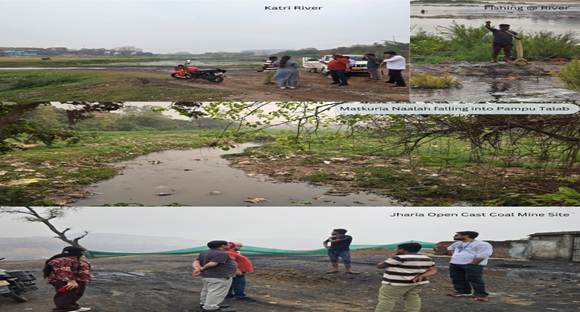
URMPs Across Three States
Across Uttarakhand, Uttar Pradesh, and Bihar, the Urban River Management Plans (URMPs) are demonstrating how river-sensitive planning can help cities strengthen ecological resilience, improve urban infrastructure, and reconnect communities with rivers. The plans integrate pollution abatement, blue-green infrastructure, flood management, biodiversity conservation, eco-tourism, and cultural heritage preservation into long-term urban development strategies. Several cities are also using nature-based solutions such as constructed wetlands, riparian restoration, sponge landscapes, bioswales, ecological drain rejuvenation, and groundwater recharge systems to improve river health and climate resilience.
In Uttarakhand, the URMPs for Haldwani-Kathgodam, Ramnagar and Rishikesh focus on restoring ecological linkages between cities and rivers while promoting sustainable tourism and public engagement. Haldwani-Kathgodam aims to reconnect the city with the Gaula River through riparian buffers and flood management interventions. Ramnagar's plan positions the Kosi River as part of the Corbett eco-tourism corridor through biodiversity-oriented riverfronts, avian parks, watch towers, and ecological public spaces that support sustainable livelihoods. In Rishikesh, the plan focuses on rejuvenation of tributaries, wetlands and associated river systems through wetland restoration, sewerage upgrades and faecal sludge management, demonstrating how spirituality, environmental restoration and urban resilience can coexist in Himalayan cities.
|
|
|
The URMPs in Uttar Pradesh focus strongly on flood resilience, pollution reduction, cultural riverfront rejuvenation and community participation. Gorakhpur's plan adopts a blue-green infrastructure approach using sponge parks, bioswales, constructed wetlands and ecological riverfronts to address urban flooding. Shahjahanpur's strategy emphasizes rejuvenation of the Garra and Khannaut rivers through eco-friendly ghats, water quality monitoring, wastewater treatment and public campaigns such as “Meri Nadi, Mera Shahar” to encourage citizen stewardship. In Bijnor, the URMP adopts a district-scale ecological planning approach linked to the Haiderpur Wetland and the broader Ganga ecosystem, focusing on biodiversity conservation, eco-tourism and wetland rejuvenation. Prayagraj's URMP envisions the city's rivers as “Living Heritage Corridors” integrating ecological restoration, tourism, flood resilience and heritage-sensitive riverfront development around the Sangam and associated cultural landscapes.
In Bihar, the URMPs for Buxar, Chapra and Gaya focus on strengthening the relationship between rivers, culture and urban resilience through integrated blue-green planning. Buxar's plan proposes an eco-sensitive and culturally vibrant riverfront along the Ganga with biodiversity zones, eco-parks, permeable ghat infrastructure, and canal rejuvenation through bioremediation and constructed wetlands.
Chapra's URMP addresses recurrent flooding and dynamic river morphology by prioritising floodplain zoning, ecological restoration of the Tel River corridor, decentralized wastewater treatment, and rejuvenation of ponds and wetlands as part of the city's blue-green network. In Gaya, the plan focuses on restoring the hydro-ecology of the Falgu River through groundwater recharge, floodplain restoration, phytoremediation of polluted drains and GIS-based waterbody monitoring.
URMP Implementation: Translating Plans into Action
The Urban River Management Plan initiative has now progressed beyond planning towards demonstrating on-ground implementation to validate the URMP framework, build confidence among Urban Local Bodies (ULBs), and create scalable models that can be replicated across river cities in the Ganga basin.
To facilitate this transition from planning to execution, NMCG and NIUA are promoting the implementation of selected interventions identified through the URMP process. These interventions focus on addressing urban-river challenges through nature-based solutions, ecological restoration, innovative technologies and community-centric approaches. The objective is to develop demonstrable pilot projects that generate measurable environmental and social outcomes while providing evidence for wider adoption across cities.
Pilot Interventions in Kanpur
Kanpur has emerged as one of the leading examples of translating URMP recommendations into action. Building upon the city's experience under the Namami Gange Programme and previous river-sensitive planning initiatives, selected interventions are being undertaken as demonstration projects to illustrate how urban river management can be implemented on the ground.
One of the key initiatives focuses on the rejuvenation of the COD (Central Ordnance Depot) Drain, identified through the planning process as a critical urban watercourse requiring ecological restoration. A detailed project framework is being developed to transform the drain from a degraded urban channel into an ecologically functional corridor through appropriate restoration measures, thereby improving environmental quality and strengthening the connection between urban communities and natural water systems.
Another important intervention involves the rejuvenation of urban water bodies using Lake Assessment and Monitoring Analysis System (LAMAS) technology. The initiative seeks to restore the ecological functionality of selected water bodies through innovative assessment, treatment and management approaches. In addition to environmental benefits, rejuvenated water bodies contribute to improved public spaces, enhanced urban aesthetics, recreational opportunities, and greater resilience to climate-related challenges such as flooding and water scarcity.
Enabling Future Implementation Across River Cities
To accelerate implementation across the Ganga basin, the Performance Based Incentive Grant (PBIG) initiative under the NMCG–World Bank partnership is emerging as an important mechanism to encourage Urban Local Bodies to undertake priority interventions identified through URMPs. NMCG is working towards supporting the implementation of select marquee projects emerging from various city plans, including development of riparian buffers, preparation of Faecal Sludge and Septage Management (FSSM) plans, restoration of water bodies and wetlands, eco-friendly riverfront development, and technology-enabled applications for river management. These efforts are expected to help cities move from planning to action while creating replicable models for sustainable and river-sensitive urban development.
Looking ahead, the initiative envisions expanding the URMP framework beyond the Ganga Basin to other river systems across the country. This scale-up aims to institutionalise river-sensitive urban planning as a national model, enabling cities across India to adopt integrated, basin-based approaches for sustainable development. By placing rivers at the centre of urban planning, the initiative represents a transformative step towards building resilient, sustainable and future-ready cities while safeguarding one of India's most vital ecological and cultural lifelines.
***
ND/HM
(Release ID: 2277477)
Visitor Counter : 2032