PIB Backgrounder
The Digital India
11 Years of Transformation
Posted On:
27 JUN 2026 4:51PM by PIB Delhi
Digital India Programme has shaped how citizens connect, learn, transact, and access public services across the country. Over the past 11 years, India has built one of the world’s largest Digital Public Infrastructure ecosystems at scale. Digital platforms have expanded healthcare, education, skilling, agriculture, and welfare access, especially in rural and underserved regions. India has also emerged as a global leader in digital payments and digital governance innovation. With India Stack now reaching multiple countries, Digital India is strengthening India’s global leadership in inclusive, citizen-centric, and technology-driven development.
The Evolution of Digital India
The Digital India Programme completes 11 years on 1 July 2026, marking a major milestone in India’s digital transformation journey. Before 2015, public services often meant long queues, paperwork, and limited connectivity. Digital India helped bridge the digital divide by expanding internet access and bringing services online. It strengthened digital governance and made services faster, transparent, and more accessible. Millions now use digital platforms for healthcare, education, banking, and welfare delivery. Government investments in digital infrastructure improved connectivity across rural and urban India. The programme also promoted the democratisation of digital technologies through affordable internet and digital access at population scale.
Over the last decade, Digital India has become the foundation of India’s digital economy and Digital Public Infrastructure. India now leads global real-time digital payments, with UPI handling nearly 49% of worldwide transaction volume. The digital economy contributes nearly 12–14% of India’s GDP. It is expected to contribute around one-fifth over the next decade. Digital India accelerated innovation, startup growth, and technology adoption across sectors. It also strengthened India’s capabilities in Artificial Intelligence, cloud computing, and cybersecurity. As India moves towards Viksit Bharat 2047, Digital India continues driving inclusive growth, technological self-reliance, and citizen empowerment nationwide.
The Nine Pillars of Digital India
The Digital India Programme was built around 9 pillars to provide a unified framework to expand digital access and foster innovation.
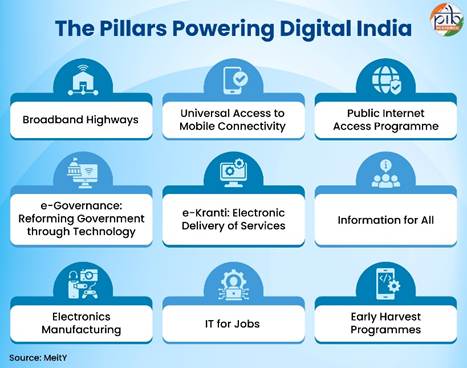
Pillar 1: Broadband Highways
Mobile connectivity is critical for bridging the digital divide nationwide. Under BharatNet-1 and BharatNet-2, a target was set to connect more than 2.22 lakh Gram Panchayats across the country. As of Jan 2026, around 2.15 lakh Gram Panchayats i.e. nearly 97% have been connected, with close to 7 lakh Km of optical fiber cable laid nationwide. This has significantly strengthened e-governance, digital payments, online education, telemedicine, and local entrepreneurship in rural India.
Pillar 2: Universal Access to Mobile Connectivity
Reliable broadband is essential for digital governance and inclusive economic growth. The broadband Internet subscriber base increased to 106.58 Cr. at the end of March 2026. This strengthened reliable last-mile digital connectivity across rural India.
Pillar 3: Public Internet Access Programme
Accessible digital centres help citizens access services near their homes. More than 6.5 lakh Common Service Centres and 1.6 lakh post offices now deliver digital services. These centres provide e-governance, banking, and citizen services in rural and underserved regions.
Pillar 4: e-Governance: Reforming Government through Technology
Designed to deliver services electronically, e-Governance promotes paperless, integrated, and public-centric administration. Today, platforms such as DigiLocker and the National Single Sign-On ecosystem enable seamless access to certificates, applications, payments, and public services, reducing paperwork while improving ease of living.
Pillar 5: e-Kranti: Electronic Delivery of Services
As the service delivery pillar of Digital India, e-Kranti has accelerated the shift from physical to digital governance. Integrated platforms such as e-Hospital, e-Sanjeevani, and e-Courts have simplified access to certificates, healthcare and justice services, making governance more efficient and citizen-centric.
|
Did You Know? The e-Courts, Mission Mode Project has transformed India’s paper-based judicial system into a digital justice ecosystem. Over 660 crore pages have been digitised, while 1.07 crore cases have been filed online.
|

Pillar 6: Information for All
This pillar strengthens transparent and participatory governance by making government information easily accessible and encouraging citizen engagement through digital platforms. Initiatives such as MyGov and Open Government Data enable citizens to access information and stay connected with government programmes and services in real time.
Pillar 7: Electronics Manufacturing
Digital India has strengthened India's electronics manufacturing ecosystem through policy support, innovation, and investment. Electronics production has increased from ₹1.9 lakh crore in FY 2014-15 to about ₹12 lakh crore as of March 2026. Today, India is the world's second-largest mobile phone manufacturer, reflecting its growing role in global electronics value chains.
India's digital economy is creating large-scale employment opportunities. The IT and ITeS industry is estimated to have generated USD 283 billion in revenue in FY25, according to NASSCOM. India’s 2,100+ Global Capability Centres (GCCs) employ around 26 lakh professionals across engineering, analytics, cyber security, and AI-driven roles.
Pillar 9: Early Harvest Programmes
Quick-impact initiatives such as biometric attendance, secure government email, public Wi-Fi hotspots, eBooks, SMS-based weather alerts, and digital communication platforms demonstrated the immediate benefits of technology-led governance.
These 9 pillars provide the strategic framework for Digital India, laying the foundation for a connected and future-ready nation.
Flagship Initiatives That Powered an Inclusive Decade
Digital India Programme has evolved from an initiative to bridge the digital divide into one of the world's largest DPI ecosystems, powering governance across sectors.
JAM Trinity: The Foundation of Digital India
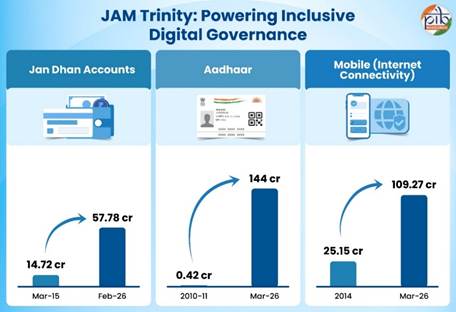
The JAM Trinity — Jan Dhan, Aadhaar, and mobile connectivity — revolutionised financial inclusion and welfare delivery in India. It brought millions into the formal banking system and enabled seamless access to government services.
Jan Dhan Yojana expanded banking access rapidly nationwide. Bank accounts increased from 14.72 crore in March 2015 to 57.78 crore by February 2026. Deposits rose from ₹15,670 crore to ₹2.94 lakh crore during the same period.
Additionally, Aadhaar created a trusted biometric identity platform for secure and instant digital authentication. Aadhaar enrolments increased from 0.42 crore in 2010-11 to over 144 crore by March 2026.
Mobile connectivity further strengthened the JAM ecosystem by expanding digital access across India. As of March 2026, 85.5% of Indian households owned at least one smartphone, while over 109 crore people had internet access.
Together, JAM became the backbone of Digital India’s inclusive governance architecture. As of June 2026, Direct benefits transferred worth over ₹51 lakh crore, transferred directly to 176 Crore citizens, improving transparency and digital governance nationwide.
|
Case Study: How India Revolutionized its Digital Identity
Before Aadhaar, millions of Indians lacked a verifiable identity, limiting access to banking, welfare schemes, and public services. Aadhaar addressed this challenge through a secure biometric-based digital identity platform. Symbolising the programme’s focus on inclusion, Smt. Ranjna Sonawane, a tribal woman from Tembhali village in Maharashtra, became the first Aadhaar holder. Aadhaar expanded access to banking, Direct Benefit Transfers, and government services not only for mainstream citizens, but also for tribal and underserved communities across India. The transformation gained further momentum after the Aadhaar Act, 2016 granted statutory authority to UIDAI and recognised Aadhaar as a foundational Digital Public Infrastructure (DPI).
Aadhaar restructured India's financial inclusion by enabling bank account opening and authentication at scale, and easy access to financial services.
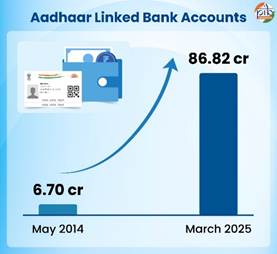
Welfare Without Middlemen: Aadhaar has transformed welfare delivery by enabling secure and transparent service delivery. Over 98% of Public Distribution of food grains are now Aadhaar-authenticated. Eligible beneficiaries benefit from over 3,100 Direct Benefit Transfer (DBT) schemes and more than 360 public services using Aadhaar-based authentication.
Verification Goes Paperless: Aadhaar also simplified identity verification across sectors. Cumulative e-KYC transactions reached 2,393 crore as on 30 April 2025, reducing paperwork and enabling faster access to public services.
Its latest evolution, the Aadhaar App, has crossed 3.1 crore downloads within five months of launch. It enables services like digital updates of mobile numbers and addresses, extending paperless verification to everyday use cases.
A Model the World Is Watching: Today, Aadhaar is recognised globally as a benchmark for DPI, with countries including Egypt, Nigeria, Indonesia, and Papua New Guinea studying the model. It stands as one of the world's largest and most trusted digital identity systems, inspiring digital governance models across the globe.
|
DigiLocker:
DigiLocker is replacing physical documents with a secure digital wallet, and transforming document storage and verification across India. As of March 2026, the platform has registered over 70.69 crore users and issued more than 850+ Cr documents, making verification faster, paperless, and more reliable.

Unified Payments Interface (UPI)
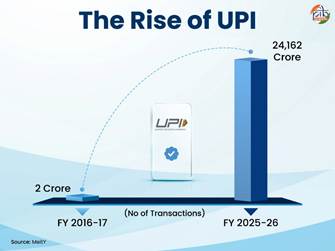
Completing ten years in 2026, UPI is transforming digital payments through instant and secure transactions for citizens and businesses. What began as a simple payment platform now powers daily digital commerce across India. Transactions increased from just 2 crore in FY 2016-17 to over 24,162 crore in FY 2025-26. UPI’s global footprint now extends to nine countries, with Cambodia becoming the latest to enable seamless UPI-based payments for travellers.Click here to read more
|
Did You Know? BHIM (Bharat Interface for Money) is the Government-backed UPI app developed by the National Payments Corporation of India (NPCI). It enables instant money transfers using UPI, making secure and cashless digital payments simple and accessible for millions of users across India.
|
Digital Platforms Powering Public Health
Over the last decade, Digital India is transforming public healthcare by making services faster, connected, and more accessible. The Online Registration System (ORS) enables patients to book appointments digitally while reducing queues and paperwork. As of 24 June 2026, ORS has recorded over 1.37 crore online appointments. Supporting this ecosystem, the cloud-based eHospital platform is digitising hospital operations, while eBloodBank is improving blood availability and management across healthcare institutions.

Healthcare access is expanding further through eSanjeevani. The telemedicine platform is connecting patients with doctors remotely, especially in rural and underserved regions. It is reducing travel costs and waiting time while expanding specialist healthcare access nationwide. As of 24 June 2026, eSanjeevani has facilitated over 48 crore consultations and onboarded more than 2.3 lakh healthcare providers, making telemedicine a major pillar of public healthcare delivery.
While responding to the COVID-19 pandemic, India expanded its digital health ecosystem through platforms such as Aarogya Setu and CoWIN. Aarogya Setu, initially supported contact tracing and health advisories. It later evolved into a National Health App under the Ayushman Bharat Digital Mission. CoWIN, became the digital backbone of India’s vaccination programme. It managed over 220 crore vaccine doses and emerged as a global model for digital public health systems.

Tele MANAS provides free tele-counselling and mental health support nationwide through 14416 and 1-800-891-4416. As of June 2026, it has received over 40.42 lakh calls, with 53 Tele MANAS cells, 23 mentoring institutes, and 5 Regional Coordinating Centres across the country. Additionally, MANAS (Madak-Padarth Nished Asoochna Kendra) enables citizens to anonymously report drug trafficking and related offences through the toll-free number 1933 and the UMANG app. The platform also provides counselling and rehabilitation support. As of June 2026, it has received over 2.16 Lakh Drug-Related Inputs over 16,200 Actionable Drug Trafficking Intelligence Inputs, strengthening the nationwide Drug-Free Bharat campaign.
Empowering Commerce Through Technology
Government e-Marketplace (GeM) has transformed public procurement by making it transparent, efficient and paperless. As of June 2026, it has recorded a cumulative Gross Merchandise Value (GMV) of over ₹18.4 lakh crore, including ₹5 lakh crore in FY 2025–26, while enabling over 11 lakh MSMEs to access government markets.
Open Network for Digital Commerce (ONDC) is creating an open and interoperable digital commerce ecosystem that connects buyers and sellers across platforms. By June 2026, ONDC had expanded to over 20 crore buyers, 5 lakh sellers, presence in 1,000 cities, and nearly 90 lakh monthly transactions. ONDC has also integrated India Post as a logistics service provider, strengthening reliable and wider e-commerce delivery across the country. By promoting interoperability and reducing platform dependency, ONDC is enabling greater market access for small businesses and fostering inclusive growth in digital commerce.
These platform has streamlined procurement processes, market access for small businesses and promoting competitive pricing. GeM and ONDC have also strengthened ease of doing business and advanced the broader digitalisation of public service delivery in India.

Did You know? eSaras and Indiahandmade are enabling Self-Help Groups, weavers and artisans to directly access digital markets, supporting rural livelihoods and preserving traditional crafts. Integration with ONDC has further expanded their visibility across 11+ buyer apps.
Technology-Enabled Public Services for Social Welfare

UMANG has become a single digital gateway for government services, expanding from 166 services in 2017 to 2572 services by June 2026. Transactions have grown from 3.9 crore to 796.69 crore, reflecting widespread digital adoption. By integrating diverse citizen services onto one platform, UMANG has improved accessibility, convenience and ease of availing public services across the country.
Goods and Services Tax Network (GSTN) has modernised indirect taxation by integrating registration, return filing, tax payments and e-invoicing. As of April 2026, gross GST collections reached nearly ₹2.43 lakh crore. The platform has enhanced tax compliance, improved transparency and enabled faster, technology-driven administration of the GST regime.
POSHAN Tracker enables real-time monitoring of nutrition services, connecting 13.35 lakh Anganwadi Centres and caters to over 8.9 Cr beneficiaries, including pregnant women, lactating mothers, children (0-6 years), and adolescent girls (in Aspiration districts and NE States). The digital platform has enabled data-driven monitoring and helped improve the efficiency of nutrition and welfare programmes for women and children.

|
Did You Know? The Poshan Helpline (dial 1515) is a dedicated government support mechanism designed for beneficiaries of Mission Saksham Anganwadi & Poshan 2.0 and the Pradhan Mantri Matru Vandana Yojana (PMMVY). It provides instant access to information, grievance redressal, and technical support in 17 languages
|
PM GatiShakti has created a GIS-based platform for integrated infrastructure planning. As of February 2026, the Network Planning Group had evaluated 352 projects worth ₹16.10 lakh crore, with 201 sanctioned and 167 under implementation. By enabling coordinated planning across sectors and ministries, the platform has improved efficiency, reduced logistics gaps and accelerated infrastructure development.

MY Bharat (Mera Yuva Bharat) https://mybharat.gov.in/ is India's largest DPI for youth, providing a unified, secure, and scalable platform that connects young citizens with opportunities for volunteering, experiential learning, internships, jobs, skill development, leadership, innovation, and national initiatives. Launched on 31 October 2023, the platform has registered over 2.21 crore youth, enabled 1.52 lakh+ volunteer opportunities, 28,000+ Experiential Learning Programmes (ELPs), and onboarded 1.19 lakh+ organizations. Built with AI, multilingual support, mobile-first services, gamification, open APIs, and real-time analytics, MY Bharat enables governments and partner organizations to engage, recognize, and empower millions of youth through a single national digital ecosystem, advancing the vision of Digital India and Viksit Bharat@2047.
Did you know?
MY Bharat showcased the strength of India's DPI by setting a Guinness World Record for the "Most Users to Take an Online Quiz in One Week," with 390,812 verified participants.
AgriStack: Empowering Farmers Through Technology

Developed under the Digital Agriculture Mission, AgriStack is a farmer-centric DPI powering services such as e-NAM for online agricultural trading and Kisan e-Mitra, an AI-powered chatbot providing instant farming information and government scheme support. By integrating farmer, land, and crop data, it enables seamless access to credit, insurance, subsidies, procurement, and personalized advisory services. As of March 2026, over 9.20 crore Farmer IDs have been generated.
|
Did You Know? India has established 731 Krishi Vigyan Kendras (KVKs) to promote scientific and technology-driven agriculture. Through the Kisan Sarathi digital advisory platform, farmers receive real-time guidance from KVKs, ICAR and agricultural universities, making agricultural knowledge more accessible while supporting climate-resilient and farmer-centric farming practices.
|
Digital Platforms Driving Educational Access
Digital India is bridging educational gaps by making quality learning accessible beyond classrooms and geographical boundaries.
DIKSHA (Digital Infrastructure for Knowledge Sharing) is transforming school education through curriculum-linked digital learning resources and teacher training. The platform provides QR-coded textbooks, interactive content, and AI-enabled learning tools for students and educators. It is also supporting inclusive education through Indian Sign Language resources and accessible digital content. As of March 2026, DIKSHA has crossed over 2 crore registered users nationwide.
Additionally, SWAYAM (Study Webs of Active Learning for Young Aspiring Minds) and SWAYAM Prabha are expanding access to quality education beyond classrooms. SWAYAM offers free online courses from Class IX to postgraduate level through leading institutions and, as of January 2026, hosts over 4,400 courses across disciplines. Complementing this, SWAYAM Prabha broadcasts educational content through 48 dedicated DTH channels, ensuring learning access even in areas with limited internet connectivity.
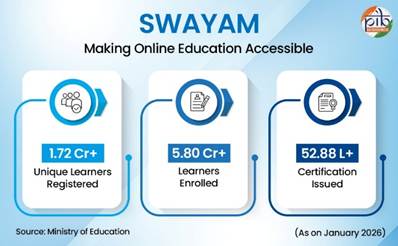
Building on these initiatives, PM e-Vidya integrates DIKSHA, SWAYAM, SWAYAM Prabha, community radio and dedicated educational television channels under a single framework to provide uninterrupted, multi-mode learning. It is expanding access to quality education while promoting inclusive learning through specially designed content for differently-abled learners.
|
Did You Know? APAAR (Automated Permanent Academic Account Registry) provides every student with a unique digital academic identity, securely storing academic records and enabling paperless verification for admissions, scholarships and other services. As of June 2026, over 33.74 crore APAAR IDs have been generated.
|
Powering India's Digital Workforce
Digital India is building a future-ready workforce by expanding digital skills, emerging technologies, and employment opportunities nationwide.
PMGDISHA bridged the rural digital divide by training citizens in smartphone usage, internet access, digital payments and online services. By March 2024, it had trained 6.39 crore rural citizens, surpassing its target.

FutureSkills Prime is preparing learners for emerging technologies such as AI, cloud computing, cybersecurity and data analytics. It has registered over 26 lakh candidates and connects learners with jobs through NASSCOM’s Talent Connect.
Skill India Digital Hub (SIDH) is a unified platform for skilling, certification and employment services. As of March 2026, it h ad enrolled over 32 lakh candidates and offers courses under PMKVY, PM Vishwakarma, government schemes and Digital Learning Partners.

IndiaAI Mission is strengthening AI education, infrastructure and responsible AI adoption. It is promoting AI skilling across schools, higher education institutions and professional training programmes through initiatives such as IndiaAI Kosh. Read More About India AI Mission
Did you know?
India hosted the IndiaAI Impact Summit in February 2026, becoming the 1st country in the Global South to host a global AI summit. It brought together participants from over 100 countries.
India's Digital Leadership and the Road Ahead
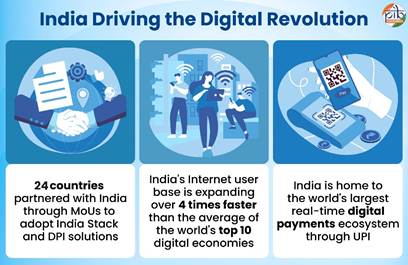
India is emerging as a global leader in Digital Public Infrastructure (DPI), driven by scalable and citizen-centric digital governance platforms. As of February 2026, India has signed MoUs with 24 countries for cooperation on India Stack and DPI systems, covering digital identity, payments, data exchange, and service delivery. UPI is now live in over eight countries, including the UAE, Singapore, France, Mauritius, and Sri Lanka, strengthening India’s global fintech presence. Platforms such as Aadhaar, DigiLocker, CoWIN, GeM, DIKSHA, UMANG, and eSanjeevani are increasingly shaping international digital governance models. India also launched India Stack Global and the Global DPI Repository during its G20 Presidency in 2023, expanding global access to Indian digital solutions. As Digital India enters its next decade, India is positioning technology as a tool for inclusive growth, digital empowerment, and global cooperation.
References
Ministry of Communications
Ministry of Finance
Ministry of Panchayati Raj
Ministry of Electronics & IT
Ministry of Commerce & Industry
Ministry of Law and Justice
Ministry of Agriculture & Farmers Welfare
Rajya Sabha
Others:
Click here for pdf file.
******
(Release ID: 2278422)
Visitor Counter : 11925