Ministry of Health and Family Welfare
Union Health Minister Shri Jagat Prakash Nadda Chairs 16th Conference of the Central Council of Health and Family Welfare
Health is the Cornerstone of Viksit Bharat 2047; States Are Equal Partners in India's Health Success Story: Shri J.P. Nadda
Healthy India is the Foundation of Viksit Bharat 2047: Union Health Minister
“National Health Policy 2017 Ushered in a Paradigm Shift Towards Holistic Healthcare”
Union Health Minister Unveils Landmark Policy Frameworks and Flagship Programmes to Strengthen India's Public Health System
Posted On:
29 JUN 2026 6:01PM by PIB Delhi
The 16th Conference of the Central Council of Health and Family Welfare (CCHFW) was held today under the chairmanship of Union Minister of Health and Family Welfare, Shri Jagat Prakash Nadda. The Conference served as a significant platform to review the progress of key national health programmes, deliberate on emerging public health priorities and strengthen Centre-State collaboration for improving healthcare delivery across the country.
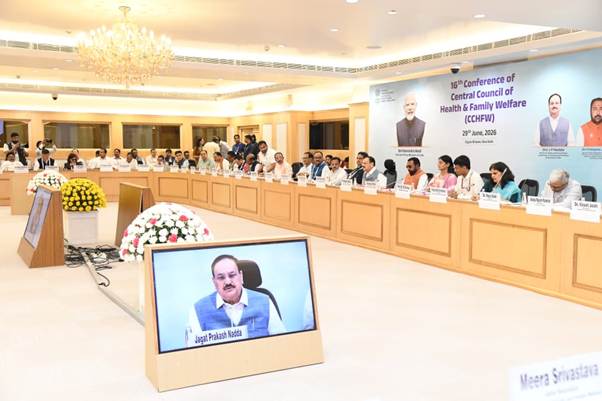
The Conference served as a vital platform for the Centre and States to discuss emerging healthcare challenges, review progress of flagship health programmes and chart the roadmap for achieving universal access to affordable, equitable and quality healthcare across the country.
Addressing the Conference, Union Minister for Health and Family Welfare, Shri Jagat Prakash Nadda, said that under the visionary leadership of Prime Minister Shri Narendra Modi, India has set the goal of becoming a Viksit Bharat by 2047, when the nation completes 100 years of Independence. He emphasized that a developed India cannot be achieved without a healthy India and that health remains one of the most critical pillars of national development.
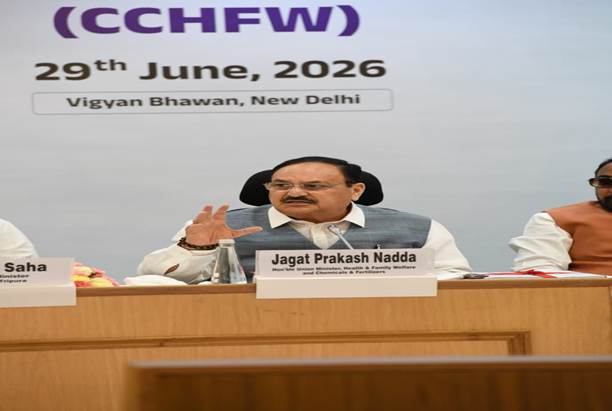
The Union Health Minister highlighted that the last twelve years have witnessed transformational changes in India's healthcare sector. He noted that the National Health Policy, 2017 marked a paradigm shift in the country's healthcare approach by shifting the focus from predominantly curative care to a holistic, inclusive and comprehensive healthcare system encompassing preventive, promotive, curative, palliative and rehabilitative care.
Shri Nadda said that to deliver quality healthcare to nearly 1.5 billion people, the Government had focused on strengthening the foundation of the healthcare system. He informed that nearly 1.85 lakh Ayushman Arogya Mandirs have been established across the country, serving as the first point of contact for citizens while creating a robust linkage between primary, secondary and tertiary healthcare. He further stated that tertiary healthcare infrastructure has been significantly strengthened through the establishment of 23 new AIIMS and more than 157 medical colleges, particularly benefiting aspirational and underserved districts.
Reiterating that health is a State subject, Shri Nadda said that every achievement in the health sector belongs equally to the States and Union Territories. While the Union Government provides policy guidance, technical support and financial assistance, successful implementation depends upon the commitment and proactive efforts of the States. He congratulated all States and Union Territories for their significant contribution to improving health outcomes across the country.
Highlighting India's progress in key health indicators, the Union Health Minister said that the Maternal Mortality Ratio (MMR) has declined from 130 per one lakh live births in 2014 to 87 per one lakh live births. Referring to the United Nations Maternal Mortality Estimation Report 2024, he noted that India has achieved an 86 percent decline in maternal mortality, compared to the global decline of 48 percent, describing it as a remarkable achievement for a country of India's size.
He further stated that since 1990, India's Under-Five Mortality Rate has declined by 79 percent, compared to the global decline of 61 percent, while Neonatal Mortality has declined by 70 percent, significantly higher than the global decline of 54 percent. He also noted that India's Total Fertility Rate has reached 2.0, while life expectancy has increased to 70.3 years, reflecting sustained improvements in public health.
Shri Nadda highlighted the achievements of Mission Indradhanush, under which 5.46 crore children who had missed routine immunisation and 1.32 crore pregnant women have been vaccinated. He also informed that since the launch of the nationwide HPV Vaccination Drive on 28 February this year, more than 50 lakh adolescent girls have already been vaccinated, acknowledging the active support of States in achieving this milestone.
Speaking about communicable disease control, Shri Nadda said that according to the WHO Global Tuberculosis Report, India has achieved a 21 percent decline in TB incidence, compared to the global decline of 12 percent, while treatment coverage has reached 92 percent, significantly above the global average of 78 percent. He further highlighted that India has eliminated Neonatal Tetanus, achieved Polio-free status, made substantial progress towards Kala-azar elimination, and that Trachoma is no longer a public health concern. He added that the number of districts with a leprosy prevalence of less than one case per 10,000 population has increased from 542 to 654, while the country has achieved an 81 percent reduction in malaria cases, an 80 percent reduction in malaria-related deaths, and a 39 percent reduction in the population requiring Mass Drug Administration for Lymphatic Filariasis.
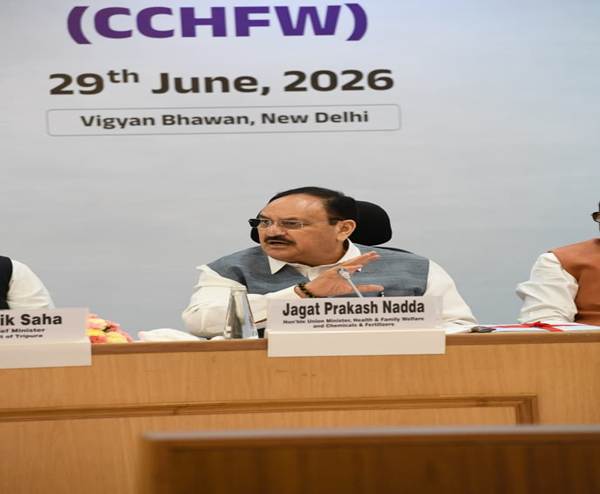
Emphasising the importance of preventive healthcare, Shri Nadda informed that since 2018, Ayushman Arogya Mandirs have screened over 42 crore people each for hypertension and diabetes, leading to the diagnosis of 7.3 crore hypertension and 5 crore diabetes cases. He added that screening has also covered 35 crore people for oral cancer, 16 crore women for breast cancer, and 9 crore women for cervical cancer, enabling early diagnosis and timely treatment. He further informed that more than 65,000 Ayushman Arogya Mandirs have been certified under the National Quality Assurance Standards (NQAS), reflecting the Government's commitment to quality healthcare.
The Union Health Minister also highlighted major reforms undertaken in drug regulation and food safety. He stated that the Central Drugs Standard Control Organisation (CDSCO) has adopted risk-based inspections covering more than 1,000 pharmaceutical manufacturing units, while the Food Safety and Standards Authority of India (FSSAI) has introduced several reforms to improve ease of doing business, including instant licensing, deemed registration for street vendors, revision of licensing thresholds, and perpetual licence validity, benefiting millions of food business operators across the country.
Concluding his address, Shri Nadda commended the efforts of all States and Union Territories and urged them to continue working with the same spirit of partnership and commitment to build a healthier, stronger and more prosperous India, reaffirming that the success of the country's healthcare reforms depends on the collective efforts of both the Centre and the States.
On the occasion, the Union Health Minister launched several landmark policy documents and programme initiatives aimed at strengthening healthcare delivery across the country.
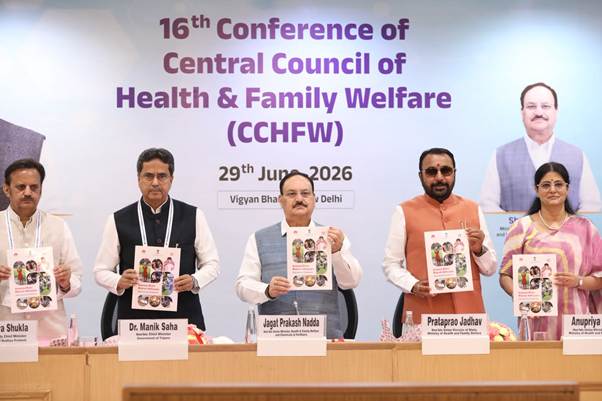
Among the key initiatives launched was the Operational Guidelines on National Ambulance Services (NAS), 2026, a comprehensive framework that establishes uniform national standards for emergency medical transport services across all States and Union Territories. The Guidelines seek to enhance the quality, accessibility and efficiency of pre-hospital emergency care by standardizing ambulance infrastructure, staffing, equipment, response protocols, digital integration and quality assurance mechanisms.
Shri Nadda also released the SUMAN Roadmap 2030, a comprehensive strategic framework designed to strengthen maternal and newborn healthcare services across the country. The roadmap outlines targeted interventions to improve service quality, ensure respectful maternity care, reduce preventable maternal and neonatal deaths, and accelerate India's progress towards achieving the Sustainable Development Goals related to maternal and child health.
The Conference also witnessed the launch of the Samagra Shishu Bal Swasthya Karyakram (SSBSK), a unified programme that integrates Home-Based Newborn Care (HBNC) and Home-Based Care for Young Child (HBYC) into a seamless continuum of care. The programme aims to strengthen community-based healthcare for children from birth to five years of age through regular home visits, early identification of illnesses, counselling on nutrition and child development, and timely referrals whenever required.
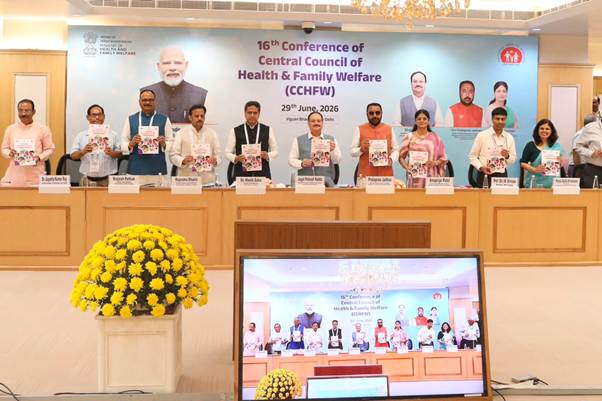
Another major initiative launched during the Conference was the Anemia Mukt Bharat Abhiyaan, marking the next phase of India's efforts to eliminate anaemia as a public health concern. Building upon the achievements of the Anemia Mukt Bharat programme, the revamped initiative expands its scope through saturation-based screening, digital beneficiary tracking, case-based management, strengthened nutrition interventions and a stronger emphasis on dietary diversification and behaviour change communication across all beneficiary groups.
The Conference concluded with a renewed resolve by the Centre and States to work together in achieving the vision of a healthier India through stronger public health systems, enhanced service delivery and people-centric healthcare reforms.
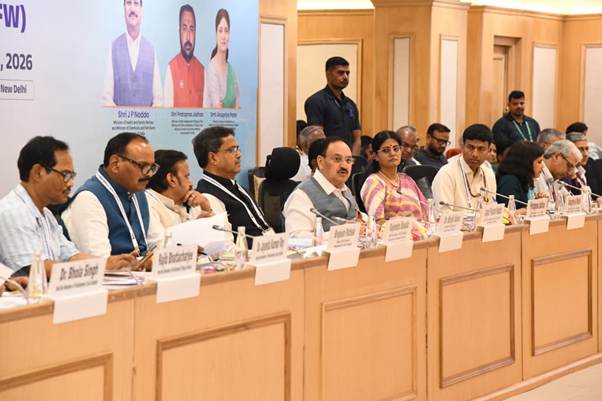
Dr. Manik Saha, Chief Minister, Tripura; Deputy Chief Minister of Madhya Pradesh, Shri Rajendra Shukla; Deputy Chief Minister of Uttar Pradesh, Shri Brijesh Pathak, Union Minister for State for Health and Family Welfare and AYUSH; Shri Prataprao Jadhav; Smt. Anupriya Patel, Union Minister of State for Health and Family Welfare; State Health Minister from various states; Member (Health) Niti Aayog, Dr. M. Srinivas; Shri Rajiv Bhattacharya, Member Parliament and Member of CCFHW, Smt. Punya Salila Srivastava, Secretary (Health); Smt. Aradhana Patnaik, AS & MD, NHM and State secretaries and senior official of Union Health ministry and industry experts were also present during the meeting
*****
SR
HFW/ HFM Addresses 16th CCHFW Meeting /29 June 2026/10
(Release ID: 2279056)
Visitor Counter : 2357