Ministry of Health and Family Welfare
Union Health Minister Shri Jagat Prakash Nadda Addresses the 10th Convocation of the Institute of Liver and Biliary Sciences
Government Has Focused Equally on the 'Hardware' and 'Software' of Medical Education Under Prime Minister Shri Narendra Modi's Leadership: Shri J.P. Nadda
A Viksit Bharat Can Be Realised Only Through a Swasth Bharat: Shri Nadda
“Super-Speciality Education is a Privilege That Carries a Responsibility Towards Society”
Posted On:
30 JUN 2026 2:42PM by PIB Delhi
Union Minister of Health & Family Welfare Shri Jagat Prakash Nadda, today addressed the 10th Convocation of the Institute of Liver and Biliary Sciences (ILBS) in New Delhi.
Addressing the graduating students, Shri Jagat Prakash Nadda described the convocation as a momentous occasion in their academic and professional journey. Congratulating the graduating class, he said that they were privileged to receive their degrees from a globally recognised and renowned institution such as the Institute of Liver and Biliary Sciences (ILBS), which has earned distinction for excellence in patient care, medical education, research and innovation.
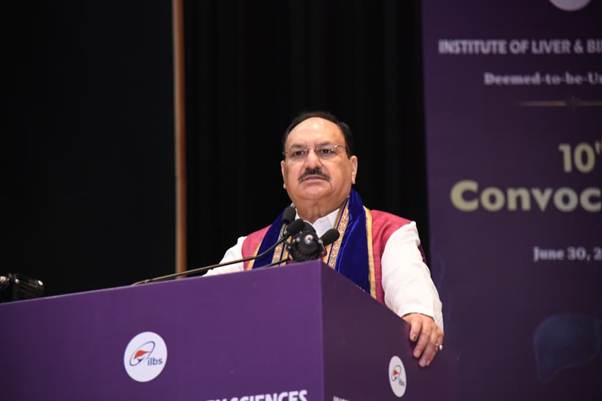
Highlighting the Institute's contributions to public health, Shri Nadda said that ILBS has emerged as a cornerstone in creating awareness about fatty liver disease among households across the country. Through its pioneering clinical services, research and public outreach, the Institute has significantly enhanced understanding of fatty liver disease, its risk factors, prevention and long-term health implications.
The Union Health Minister emphasized that the Government, under the visionary leadership of Prime Minister Shri Narendra Modi, has adopted a comprehensive approach towards strengthening medical education by focusing on both its "hardware" and "software". Explaining the approach, he said that while the "hardware" comprises world-class infrastructure, medical institutions and healthcare facilities, the "software" represents the enabling ecosystem, policy framework and academic environment that empower students, researchers and healthcare professionals to excel. He remarked that the true strength of a nation's healthcare system lies not merely in creating institutions, but in building an ecosystem where excellence can flourish.
Underscoring the transformative impact of policy reforms, Shri Nadda stated that students must appreciate how visionary policymaking and a supportive ecosystem together create lasting change. He noted that at the end of the twentieth century, India had only one AIIMS. During the tenure of former Prime Minister Shri Atal Bihari Vajpayee, six more AIIMS were approved. Since then, under the leadership of Prime Minister Shri Narendra Modi, sixteen new AIIMS have become operational, taking the total number of AIIMS in the country to twenty-three.
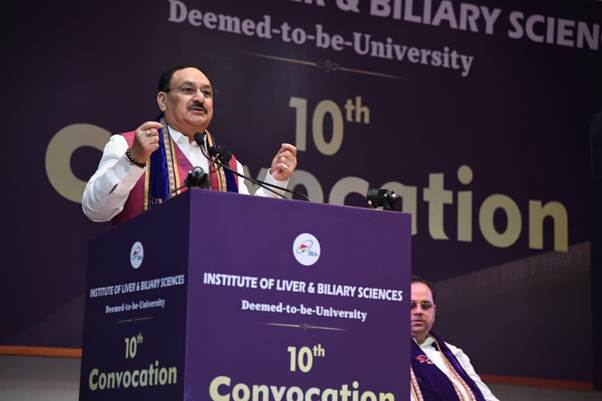
The Union Minister further highlighted the unprecedented expansion of medical education infrastructure across the country. He informed that the number of medical colleges has increased from 387 to 818. Similarly, undergraduate medical seats have risen from around 50,000 to over 1.20 lakh. Referring to the Prime Minister's announcement from the Red Fort, Shri Nadda said that the Government has set a target of creating an additional 75,000 undergraduate medical seats over the next five years, and that nearly 25,000 seats have already been added, reflecting steady progress towards achieving this objective. He further stated that postgraduate medical seats have expanded from approximately 30,000 to over 80,000, significantly strengthening the availability of specialist doctors in the country.
Shri Nadda stated that to provide quality healthcare to nearly 1.5 billion people, it is essential to strengthen the very foundation of the healthcare delivery system. In this context, he highlighted the establishment of more than 1.85 lakh Ayushman Arogya Mandirs across the country, describing them as the first point of contact for citizens seeking healthcare services. He said these centres have transformed the country's approach towards comprehensive primary healthcare by placing equal emphasis on preventive, promotive, curative and rehabilitative care.
Emphasising the importance of preventive healthcare, the Union Minister highlighted the remarkable achievements of Ayushman Arogya Mandirs in population-based screening for non-communicable diseases. He informed that over 42 crores individuals have been screened for hypertension, leading to the diagnosis of more than 7.3 crores cases. Similarly, over 42 crores people have undergone diabetes screening, with nearly 5 crores diagnosed. More than 35 crores people have been screened for oral cancer, resulting in the detection of over 2.3 lakh cases. Breast cancer screening has covered over 16 crore women, leading to the diagnosis of more than 86,000 cases, while over 9 crore women have been screened for cervical cancer, with around one lakh cases detected. Shri Nadda said these figures demonstrate how timely screening and early diagnosis are strengthening preventive healthcare and enabling better treatment outcomes.
The Union Minister observed that the vision of a Viksit Bharat cannot be realised without a Swasth Bharat. He stressed that preventive healthcare, early screening and timely diagnosis will remain central pillars of India's healthcare strategy in the years ahead.
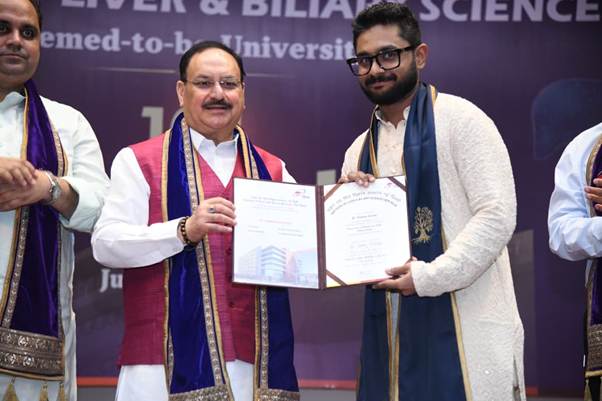
Addressing the graduating students, Shri Nadda remarked that pursuing super-speciality education is both a privilege and a responsibility. He urged them to give back to society through dedicated service, uphold the highest standards of medical ethics, preserve compassion in their professional lives, and remain committed to serving humanity with integrity and excellence. He encouraged them to shoulder the responsibility of building a healthier and stronger India through their knowledge, skills and commitment.
The convocation marked an important milestone for the graduating students, as degrees and academic distinctions were conferred upon candidates from various super-speciality and allied disciplines in liver diseases, hepatology, transplant medicine and related fields.
The Institute of Liver and Biliary Sciences (ILBS), an autonomous super-speciality institute under the Government of the National Capital Territory of Delhi, has established itself as a premier centre of excellence in patient care, medical education and research in hepatology, liver transplantation, biliary sciences and allied disciplines. Through its integrated approach to clinical services, academic excellence and cutting-edge research, the Institute has made significant contributions towards addressing the growing burden of liver diseases in the country.
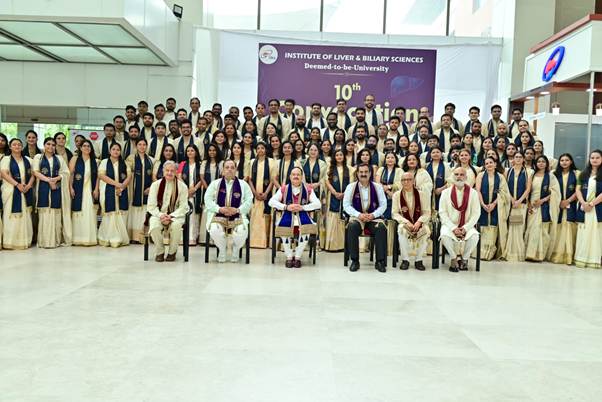
The convocation ceremony was attended by distinguished faculty members, healthcare professionals, researchers, students, alumni and other eminent dignitaries.
***
SR
HFW/HFM Addresses 10th Convocation of ILBS /30 June 2026/1
(Release ID: 2279327)
Visitor Counter : 1278