Ministry of Science & Technology
Thermal signatures of three decades of solar storms at Earth reveal new clues for space weather forecasting
Posted On:
30 JUN 2026 3:53PM by PIB Delhi
Indian astrophysicists have uncovered new insights into how large solar eruptions called Interplanetary Coronal Mass Ejections (ICMEs) evolve thermally during their journey from the Sun to the Earth, and how this thermal state influences their potential to disturb Earth’s magnetic environment that influence radio communications, aviation routes, and power grids.
ICMEs are massive blasts of magnetized plasma released from the Sun’s outer atmosphere, which then travel through interplanetary space. When those ICMEs are directed towards us and encounter Earth’s magnetic field, they can disturb it and cause geomagnetic storms. These storms have adverse effects on satellite operations, GPS and radio communications, aviation routes, and power grids, while also producing colorful, dazzling auroras in Earth’s upper atmosphere. The level of activity of the Sun has an 11-year cycle, and more ICMEs are created during the maxima of these cycles. The peak of the current cycle, no. 25, was in 2025.
A research team from the Indian Institute of Astrophysics (IIA), Bengaluru, an autonomous institute under the Department of Science and Technology (DST), Government of India, performed the first long-term statistical investigation of ICME thermal behaviour at 1 Astronomical Unit (AU) from the Sun (near Earth), utilizing publicly available observations spanning 29 years across three solar cycles (23, 24, and the rising phase of 25) from 1995 to 2024. The analysis by Soumyaranjan Khuntia and Wageesh Mishra revealed distinct thermodynamic states for ICMEs linked to different phases of the solar activity cycle and the geo-effectiveness of solar storms.
While most earlier studies focused on ICME speed, magnetic structure, or isolated case events, the thermal evolution of ICMEs, how they gain or lose heat during interplanetary travel, has remained less understood. The new study bridges this gap by using in situ solar wind plasma measurements from satellites at L1 (a point 1.5 million km away from the Earth, in the direction of the Sun) and applying a polytropic framework to quantify the ICME thermal state on an event-by-event basis.
In this study, the scientists utilized the OMNI database (maintained by the Space Physics Data Facility at NASA Goddard Space Flight Center), which combines measurements from multiple spacecraft near L1 to provide solar wind conditions at Earth’s bow shock (the boundary where the fast solar wind first encounters and is abruptly deflected by Earth’s magnetic field). The dataset was obtained from the NASA CDAWeb repository. This data is a rich source of measurements of ICME properties when they arrive near Earth at 1 AU from the Sun.
The scientists calculated how pressure/temperature vary with density technically called the polytropic index for each ICME magnetic ejecta (ME), which helped characterized the evolution of the internal plasma of these massive ejecta as they approached Earth.
Contrary to the ad hoc assumption that CMEs cool as they expand, the study shows that ICMEs are thermodynamically active (participates in energy transfers). Nearly 45% of magnetic ejecta exhibit heating signatures at 1 AU, particularly near solar maximum, suggesting active in-transit heating processes.
The analysis further reveals a shift from more heating-like states in Solar Cycle 23 to more cooling-dominated states in Solar Cycle 24. This systematic modulation with solar activity suggests that the thermal evolution of CMEs is influenced by the global state of the solar magnetic environment, a novel and significant insight for heliophysics and space weather science.
The study published in Monthly Notices of the Royal Astronomical Society (MNRAS) also establishes a connection between the ICME thermal state and the severity or geoeffectiveness of solar storms observed at Earth. The most geoeffective storms tend to be associated with ICMEs in a heating state (low Gamma) and are characterized by strong magnetic fields, low plasma beta (indicating magnetic pressure dominance), compressed sheath regions, and enhanced expansion speeds.
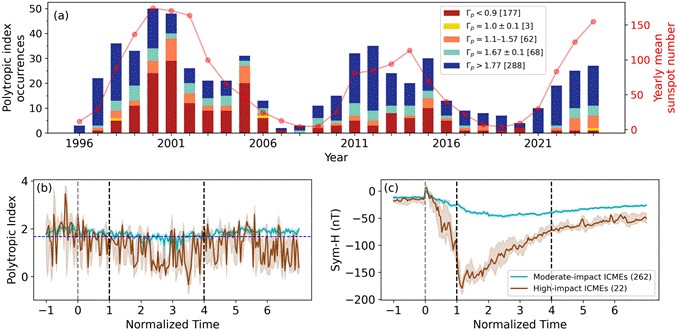
Fig: (a) Annual occurrence of heating and cooling ME across SC23, 24, and the rising phase of SC25. Superposed Epoch Analysis (SEA) showing the median values of (b) polytropic index (Gamma) and (c) Sym-H parameter across the pre-ICME, sheath, ME, and post-ICME regions. The curves represent: brown for High-impact ICMEs and cyan for Moderate-impact ICMEs. Gray dashed vertical lines mark the starting sheath region, and Black vertical dashed lines mark the boundaries for the ME region
This combined thermal–magnetic viewpoint offers a multi-dimensional diagnostic framework that could improve the forecasting of space weather impacts.
“Understanding the thermal behaviour of ICMEs en route to Earth opens exciting possibilities for space weather prediction. If thermal signatures such as polytropic index trends can be anticipated from remote sensing or early in situ observations, they could serve as precursors for the potential geoeffectiveness of approaching solar storms,” said Soumyaranjan Khuntia, lead author and doctoral scholar at IIA.
“Our work establishes the polytropic index as a meaningful diagnostic of ICME thermal state and connects it to the geomagnetic response at Earth. Combined with plasma and magnetic field properties, this knowledge enhances our ability to forecast the impacts of severe space weather events,” said Wageesh Mishra, Associate Professor at IIA.
Mishra further added that future efforts will integrate observations from India’s Aditya-L1 solar mission, including coronagraphic and solar wind instruments, to better track the thermal evolution of CMEs closer to the Sun and refine predictive models for space weather forecasting.
Publication link: https://academic.oup.com/mnras/article/545/4/staf2242/8383415
ArXiv link: https://arxiv.org/abs/2512.15155
***
NKR/FT/NM
(Release ID: 2279357)
Visitor Counter : 1529