Ministry of Science & Technology
National Education Policy has democratized opportunities, enabling youth from towns like Doda to compete with metro cities: Dr. Jitendra Singh
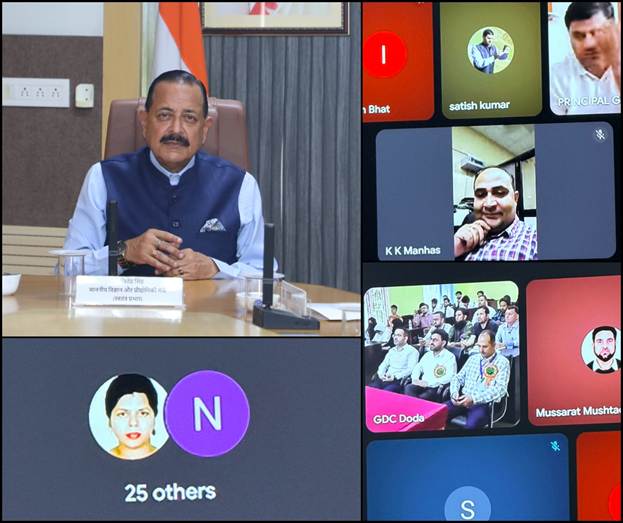
Dr Jitendra Singh virtually addresses the 2-day hybrid mode Conference organised by Govt Degree College Doda
NEP 2020 shifts education towards aptitude, skills and entrepreneurship; Tier-2 and Tier-3 youth are leading India's startup revolution, says Dr. Jitendra Singh
Doda can emerge as a unique hub for Himalayan StartUps and innovation, says Dr. Jitendra Singh
Lavender Revolution has demonstrated the power of science-led rural entrepreneurship: Dr. Jitendra Singh
Posted On:
11 JUL 2026 5:40PM by PIB Delhi
Addressing the 2-day hybrid mode Conference organised by Govt Degree College Doda,Union Minister of State (Independent Charge) for Science & Technology, Earth Sciences and Minister of State in the Prime Minister's Office, Personnel, Public Grievances & Pensions, Atomic Energy and Space, Dr Jitendra Singh today said the National Education Policy (NEP) 2020 has democratized aptitude-based learning and created a level playing field for students from Tier-2 and Tier-3 towns such as Doda to compete with their counterparts in metropolitan cities.
Dr. Jitendra Singh said NEP 2020 has broken the rigidity of conventional education by allowing students to pursue subjects based on aptitude rather than compulsion, while shifting the focus of higher education from degrees to skills, innovation and entrepreneurship. "A degree is no longer a trophy, and employment no longer means only a government job," he said, adding that the policy has prepared India's youth for the emerging knowledge economy.
Speaking on the theme "Implementation of the National Education Policy 2020 in Jammu & Kashmir: Challenges of Inclusion, Equity and Accessibility" through virtual mode, Dr. Jitendra Singh congratulated Government Degree College, Doda, particularly Principal Dr. Javed Iqbal, for organizing a timely academic deliberation on one of the most significant educational reforms undertaken in independent India. He described the institution as one of the oldest and most distinguished educational centres in the region, carrying a rich legacy of higher learning that has served generations of students across erstwhile Doda district.
Recalling the educational history of the region, Dr. Jitendra Singh said there was a time when students from far-flung areas travelled long distances to Doda and Bhaderwah to pursue higher education because educational institutions were scarce. He said the district possesses a strong academic heritage and has the potential to evolve into a major educational hub by building upon its longstanding legacy and expanding opportunities for future generations.
The Minister said NEP 2020 has fundamentally changed the education landscape by replacing rigid academic pathways with flexibility and multidisciplinary learning. Students are no longer confined to subjects chosen under circumstances or social expectations, but are free to pursue disciplines aligned with their aptitude and passion. This, he said, has improved academic standards, made classrooms more vibrant and strengthened the relationship between teachers and students by encouraging learning driven by curiosity rather than compulsion.
Sharing an example from one of the early institutions implementing the policy, Dr. Jitendra Singh said a literature professor had expressed her delight at finding students from science streams voluntarily attending her classes simply because of their genuine interest in literature. Such experiences, he said, reflect the transformative spirit of the National Education Policy.
Dr. Jitendra Singh said the country has also moved beyond the mindset that education is meant only for securing government employment. He observed that the present era belongs to skills, creativity, innovation and entrepreneurship. Referring to India's startup ecosystem, he said the country had nearly 350 startups in 2014, whereas today their number has crossed 2.3 lakh, making India the world's third-largest startup ecosystem. More than half of these startups, he noted, are emerging from Tier-2 and Tier-3 cities, demonstrating that innovation is no longer confined to metropolitan centres.
Highlighting the Lavender Revolution initiated under the CSIR Aroma Mission, Dr. Jitendra Singh said the success story of Bhaderwah and Doda has disproved the notion that entrepreneurship is restricted to information technology or metropolitan regions. Beginning from a small patch of land in Bhaderwah, lavender cultivation has expanded across Doda district, neighbouring areas, Kashmir Valley and several other Himalayan states, creating new livelihood opportunities and strengthening the rural economy. He said the model has shown that technology-enabled agriculture, local resources and scientific interventions can generate sustainable employment and successful enterprises.
The Minister encouraged Government Degree College, Doda to develop a distinct institutional identity by promoting entrepreneurship in areas where the region enjoys natural advantages. He suggested establishing incubation support for Himalayan products, aroma-based enterprises and allied sectors in collaboration with the Ministry of AYUSH, the Department of AYUSH, Government of Jammu & Kashmir, and CSIR's Aroma Mission. Such initiatives, he said, would not only generate livelihoods but also promote wellness products, tourism and value-added rural enterprises.
Dr. Jitendra Singh informed that the region is witnessing the development of several important institutions and facilities, including a Himalayan laboratory and other scientific infrastructure, creating opportunities for greater synergy among research institutions, academia, industry and startups. He said educational institutions should actively participate in this emerging ecosystem by connecting students with research, innovation and enterprise.
The Minister also called upon colleges to familiarise students with flagship government initiatives that support entrepreneurship and self-employment, including the Pradhan Mantri Mudra Yojana and PM Vishwakarma Yojana. He said policy reforms have advanced rapidly and educational institutions must ensure that awareness about these opportunities reaches students so they can convert their knowledge and traditional skills into sustainable livelihoods.
Referring to the transformative role of technology, Dr. Jitendra Singh said digital connectivity has removed geographical barriers, enabling talented youth from remote regions to access quality learning resources, prepare for competitive examinations and build successful careers without leaving their hometowns. The increasing representation of candidates from remote areas in national competitive examinations and the growing number of startups emerging from smaller towns, he said, reflect this changing reality.
Calling the present period one of the most promising for India's youth, Dr. Jitendra Singh said the generation currently pursuing education will lead the country during the centenary year of Independence in 2047. He urged teachers and educational institutions to mentor students with a long-term vision so that they become innovators, entrepreneurs, responsible citizens and nation-builders capable of contributing to the vision of Viksit Bharat.
*****
NKR/AK/NM
(Release ID: 2283683)
Visitor Counter : 977