PIB Backgrounder
Index of Services Production:
Measuring the Pulse of India's Services Economy
Posted On:
14 JUL 2026 8:57PM by PIB Delhi
Index of Services Production: A Window into Services Sector Performance
India has significantly strengthened its statistical and administrative data ecosystem over the past decade. Some key developments include availability of high-frequency GST data, launch of Annual Survey of Incorporated Services Sector Enterprises (ASISSE), and the expansion of digital administrative databases, enabling more robust evidence-based policymaking.
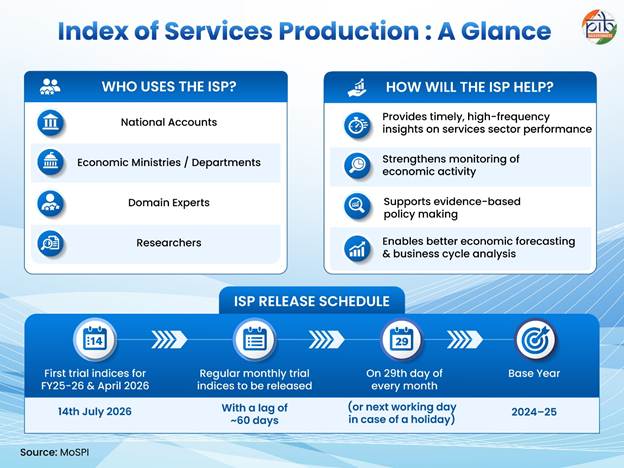
Building on these reforms, the Government has introduced the Index of Services Production (ISP), a new macroeconomic indicator to capture the performance of the services sector. The ISP is India's first high-frequency indicator dedicated to measuring services sector output. It tracks short-term changes in the volume of output produced by the formal services sector relative to a specified base year.
As services account for the largest share of India's economy, the ISP is expected to strengthen economic monitoring, improve national accounts estimation, and support more informed policy decisions.
First Release: Trial Index of Services Production
The Government has released the first sub-sectoral trial ISP for 19 sub-sectors for April 2026, covering ~60% of the services sector.
|
Out of the 19 sub-sectors, 14 recorded double-digit growth in April, 2026 as compared to April, 2025.
|
|
Top 5 sub–sectors with strong monthly growth include accommodation and food (37.2%), retail trade (30.8%), administrative & support services (28.7%), real estate (27.7%) and telecommunications (22.8%).
|
|
The yearly top 5 sub-sectors for 2025-26 include accommodation and food (35.6%), retail trade (30.5%), repair services (25.1%), wholesale trade (23.6%) and road transport (22.6%).
|
Key Features of the Index
With the introduction of ISP, India is advancing its statistical system with global standards. Some of the key features of the index include:
Need for Deflator
The ISP tracks short-term changes in the volume of services produced. Since primary service data is usually collected in value terms, it captures the effects of both the prices and value addition. A price deflator is therefore required to remove the effects of change in prices from nominal service revenue.
A price deflator transforms "value-based" (nominal) data into "volume-based" (real) data, providing accurate measurement of actual changes over time.
|
Building India’s ISP Framework
The Ministry of Statistics and Programme Implementation (MoSPI) constituted a Technical Advisory Committee (TAC) in May 2025 to develop the ISP's conceptual and methodological framework. TAC comprised experts from academia, industry associations, ministries and departments representing the services sector. The proposed framework has been developed with reference to international best practices.
The OECD Compilation Manual for Index of Services Production (2007) is the most comprehensive set of guidelines on ISP compilation. Eurostat, the statistical office of the European Union is another key global guide for ISP.
Notably, several advanced economies regularly publish an ISP or equivalent indicators, such as France, Spain, and Slovenia. Beyond the EU, South Korea publishes a monthly Service Industry Activity Index while the United Kingdom compiles a comprehensive Monthly Index of Services.
Sectoral Coverage of the Index of Services Production
The ISP initially covers service sub-sectors where reliable, high-frequency data is available.
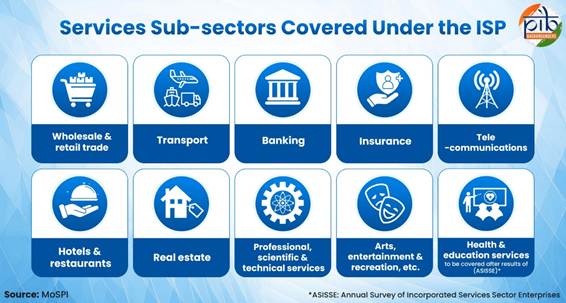
Excluded services sub-sectors from the ISP are- public administration and defence, financial services excluding banking and insurance (such as activities of the central bank, money market funds), social work activities without accommodation, services of membership organisations, personal services, activities of private households with employed persons, activities of extraterritorial organisations, health and education services provided by Government and gambling and betting activities.
These sectors are either related to core government activities or are dominated by non – market activities and the informal sector.
|
The Data Ecosystem Powering ISP
Three main data sources are used for compiling the ISP- administrative data, GST and ASISSE-
- Administrative/secondary data for ISP of air transport, railway transport, banking and insurance.
- ASISSE data (once available) for health and education (excluding Government) sectors. Launched in April 2026, it aims to develop a comprehensive database of the incorporated services sector.
DID YOU KNOW?
GST data will be used for the first time in statistical applications.
|
GST data for wholesale trade, retail trade, repair and maintenance, accommodation and food, road transport, water transport, warehousing and support activities for transportation, postal & courier, telecommunications, information and broadcasting, real estate, information and computer related services, professional, scientific & technical services including R & D, administrative & support services and arts, entertainment & recreation, etc.
Why ISP Matters?
India's economy has undergone a significant structural transformation over the past few decades. It is driven by economic reforms, technological advancements, and increasing integration with global markets. The services sector has become a key driver of economic growth and employment generation.
- It is the largest contributor to India’s GDP, contributing over 50% of the Gross Value Added (GVA) since 2013-14. In 2024 -25, share of services GVA stood close to 52.9%.
- The sector accounts for ~30% of total employment across India and generated ~40 million jobs over the past six years.
- India’s services exports maintained strong momentum in FY2026-27. Across April-June 2026-27, services exports are estimated at USD 103.41 billion, registering a 6.16% Y-o-Y growth.
- The Government aims to position India as a world leader in services, targeting a 10% share in global services by 2047.
As the services sector is central to India's growth, a dedicated short-term indicator to track its performance has become essential. The Index of Industrial Production (IIP) measures only industrial activity and does not capture short-term trends in the services sector. To address this gap, the Government has introduced the ISP.
A New Milestone in India's Economic Measurement
The launch of the ISP reflects India's commitment to modernising its statistical framework in line with a rapidly evolving economy. By bringing high-frequency data and robust methodology together, the ISP offers timely insights into India’s largest economic sector. As a monthly indicator, it strengthens economic monitoring, improves policy responses and deepens the understanding of India's growth trajectory.
References
Ministry of Statistics & Programme Implementation
https://www.pib.gov.in/PressReleasePage.aspx?PRID=2284450®=48&lang=1
https://www.pib.gov.in/PressReleasePage.aspx?PRID=2277392®=3&lang=1
https://www.pib.gov.in/PressReleasePage.aspx?PRID=2255933®=3&lang=1
https://www.pib.gov.in/PressReleasePage.aspx?PRID=2269286®=48&lang=1
https://www.pib.gov.in/PressReleasePage.aspx?PRID=2249336®=3&lang=1
Ministry of Commerce & Industry
https://www.pib.gov.in/PressReleasePage.aspx?PRID=2284139®=3&lang=1
PIB Archives
https://www.pib.gov.in/PressNoteDetails.aspx?NoteId=157804&ModuleId=3®=48&lang=2
Click here to see pdf
****
PIB Research
(Release ID: 2284646)
Visitor Counter : 4739