PIB Backgrounder
India–UK CETA Comes into Effect
Strengthening Bilateral Trade and Investment
Posted On:
15 JUL 2026 4:35PM by PIB Delhi
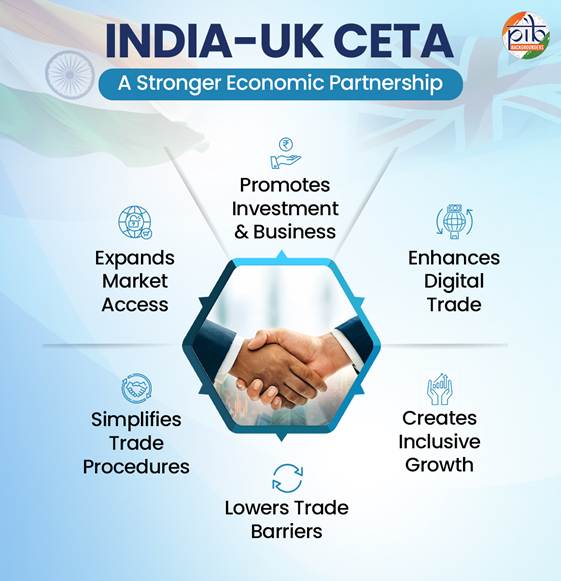
The India-UK Comprehensive Economic and Trade Agreement (CETA) marks a major milestone in the economic partnership between the two countries. It seeks to deepen trade and investment through improved market access, simplified trade procedures, enhanced services commitments, and greater professional mobility. CETA further creates new opportunities across agriculture, fisheries, manufacturing, services, and other key sectors by reducing trade barriers and improving export competitiveness. At the same time, it safeguards India's sensitive sectors through calibrated market access and phased tariff liberalisation. The agreement promotes digital trade, innovation, sustainable development, and stronger people-to-people linkages. By strengthening bilateral cooperation across multiple areas, the agreement lays the foundation for a more inclusive, future-oriented economic partnership.
|
India–UK CETA: A Landmark Trade Agreement
The India-UK (United Kingdom) Comprehensive Economic and Trade Agreement (CETA) is a modern, comprehensive and landmark trade agreement. It seeks to deepen economic integration between India and the UK through enhanced market access, trade liberalisation and tariff concessions. India will benefit from one of the most ambitious services commitments ever offered by the UK under a Free Trade Agreement . By granting zero-duty access on nearly 99% of India's exports, covering almost 100% of the trade value, the CETA is expected to strengthen India's export competitiveness. The agreement is also expected to expand bilateral trade, attract investment and create new opportunities for businesses.
Beyond its economic and commercial significance, the CETA has been designed as an inclusive and future-oriented agreement. It seeks to ensure the benefits of trade reach every section of the society. More than a trade agreement, the CETA lays the foundation for a resilient, innovation-driven and people-centric economic partnership.
India- UK Bilateral Trade
India and the UK share a strong and expanding economic partnership. In 2025, India recorded a GDP of USD 3.96 trillion, while the UK economy stood at USD 3.84 trillion, reflecting the significance of both economies in global trade.
Merchandise trade between the two countries reached USD 25.12 billion in 2025- 26, with India's exports to UK valued at USD 13.44 billion and imports at USD 11.68 billion, resulting in a trade surplus of USD 1.76 billion.
Services trade has been equally robust, with total bilateral services trade touching USD 35.44 billion in 2024. India exported services worth USD 21.66 billion to the UK and imported USD 13.78 billion, generating a services trade surplus of USD 7.88 billion.
How CETA Benefits Key Stakeholders
The CETA has been designed to deliver broad-based benefits across various sectors of the economy. It also ensures that the gains from trade are widely shared.
- Indian farmers and fisherfolk are expected to benefit from improved access to the UK market through tariff elimination. This is likely to create new export opportunities and strengthen incomes.
- The agreement recognises the importance of sustainable livelihoods for forest-dependent communities. It encourages responsible resource management and environmental cooperation.
- Labour-intensive sectors such as textiles, leather, footwear, gems and jewellery, handicrafts, food processing, auto components, plastics, and organic chemicals are poised to witness higher exports. This is likely to boost employment generation.
- The agreement places strong emphasis on inclusive and future-ready growth. It expands opportunities for women, youth, MSMEs, businesses, and professionals. Dedicated provisions promote greater participation of women and under-represented groups in trade, innovation, and entrepreneurship. It also reinforces commitments to internationally recognised labour rights, gender equality, and fair working conditions.
- Improved access to the UK services market, mobility provisions, and recognition of professional qualifications create new opportunities. These opportunities benefit skilled Indian professionals and young talent.
- Small and Medium Enterprises stand to gain from simplified customs procedures, paperless trade, and digital systems. These measures reduce compliance costs and improve market access. Indian MSMEs will also benefit from duty-free access to 99% of Indian exports entering the UK. It includes textiles, leather, jewellery, footwear, and food products- saving 4- 16% in tariffs.
- Businesses benefit from streamlined trade facilitation measures, digital cooperation, and stronger integration into global value chains. This enhances ease of doing business and supports sustained economic growth. The agreement further promotes digital trade facilitation and electronic certification. It leverages established mechanisms such as the Single Window and Authorised Economic Operator (AEO) frameworks.
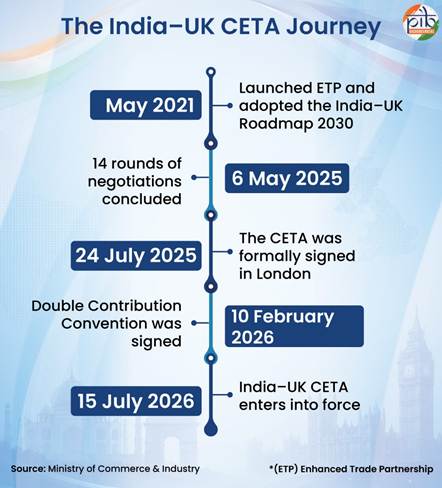
From Vision to Reality: The India–UK CETA Journey
The India–UK Trade Agreement is the culmination of years of sustained engagement, negotiations, and strategic cooperation between the two countries.
Beyond Trade: India-UK Strategic Partnership
India and the UK share a strong and multifaceted partnership built on trade, investment, people-to-people ties, and strategic cooperation.
The UK is India's 6th largest inward investor. It has made cumulative equity investments of USD 35 billion until September 2024. India's outward investment in the UK stood at USD 19 billion until March 2024.
As of July 2025, there are 971 Indian companies operating in the UK that employ over 1 lakh people. Moreover, there are 667 British companies operating in India, with over 5 lakh people.
Mobility and Professional Exchange
India and the UK signed the Migration and Mobility Partnership (MMP) Agreement on 4 May 2021. The agreement aims to facilitate faster movement of working professionals which is an important pillar of the India-UK economic partnership.
In November 2022, the Young Professional Scheme between India and the UK was announced, made on the sidelines of the G20 Bali Summit. Under the scheme, 3,000 visas are issued every year. Graduates aged 18–30 years receive a two-year visa. The scheme allows them to live and work in each other's country.
Indian Diaspora in the UK
The UK is home to a large Indian diaspora of 1.864 million people, according to the 2021 Census. This accounts for 2.6% of the UK's population which was estimated at 68 million in 2022. The census also recorded 369,000 Indian passport holders living in the UK.
The Indian diaspora has high rates of employment and professional qualifications. It has made valuable contributions to academia, literature, arts, medicine, science, sports, industry, business, and politics.
According to Grant Thornton’s and FICCI’s March 2022 report 'India in the UK: The diaspora effect', over 65,000 companies are owned by the Indian diaspora.
Safeguarding National Interests While Expanding Market Access
The India–UK CETA balances trade liberalisation with the protection of India's strategic sectors, domestic industries, and long-term development priorities.
India has offered tariff concessions on 89.5% of its tariff lines, covering 91% of the UK's exports. 24.5% of the UK's export value will receive immediate duty-free access, with concessions on other products to be implemented gradually.
Sensitive sectors which include agriculture and strategically important industries have been protected through exclusions or phased tariff reductions.
- Products under agriculture include dairy, cereals and millets, pulses, apples, edible oils, oats, and vegetables.
- CETA also protects high-value products such as gold, jewellery, lab-grown diamonds, certain essential oils, critical energy fuels, marine vessels, worn clothing, critical polymers, their monofilaments, smartphones, and optical fibres.
- Strategically important products have been considered carefully. These include sectors where domestic capacity is being developed under Make in India and the Production Linked Incentive (PLI) Scheme. Tariff concessions are phased over 5, 7, or 10 years through gradual tariff reductions.
- Further, India has gradually and selectively opened its market for alcoholic beverages.
- For automobiles, India has adopted a calibrated, phased, and development-oriented quota-based liberalisation strategy. At the same time, it continues to protect sensitive segments of India's automotive industry.
- Quota-based, phased market opening with an annual quota of 37,000 passenger vehicle CBUs has been provided at preferential tariffs. This balances enhanced market access with domestic industry priorities.
- Sensitive segments including small and mid-segment ICE vehicles and affordable EVs remain protected. EV access has been cautiously regulated, with concessions commencing only from Year 6, allowing Indian manufacturers to strengthen scale, technology, and competitiveness.
- Greater concessions are offered to large-engine ICE vehicles (above 3000 cc petrol / 2500 cc diesel), with in-quota tariffs dropping to 10% over five years and out-of-quota tariffs reducing to 50% over 10 years.
Sectoral Gains from the India–UK CETA
The India-UK CETA is poised to deliver significant gains across key sectors of the Indian economy through enhanced market access, tariff concessions, and improved trade facilitation.
Textile Products
|
Sector Overview
|
The UK imports textiles and clothing worth USD 28.8 billion while India's global textile exports stand at ~USD 37 billion
India exports USD 1.79 billion to the UK and holds a 6.1% market share
India is also the 4th largest supplier of textiles to the UK
|
|
Key Provisions under CETA
|
Zero-duty access on 1,143 tariff lines
Elimination of tariff disadvantage vis-à-vis Bangladesh, Pakistan and Cambodia
|
|
Key Beneficiaries
|
Ready-Made Garments (RMG), home textiles, carpets, handicrafts
|
|
Key Product Categories
|
Products that stand to gain include women’s cotton dresses, cotton shirts/blouses, terry cotton toilet and kitchen linen, artificial fibre dresses, knitted cotton dresses, men’s cotton formal shirts, cotton T-shirts and vests, mattresses, cushions and bedding products
|
|
Opportunities under CETA
|
Enhanced competitiveness of Indian textiles and apparel in the UK
|
Sector Overview: India's agricultural exports were valued at USD 45.05 billion in 2022–23, rising from USD 41.3 billion in 2020–21. India exports agricultural products worth more than USD 57 billion globally. UK's global agricultural and processed food imports are worth USD 90 billion+, wherein India’s exports to UK are only USD 1.11 billion. This highlights significant untapped export potential. The UK is also a high-value market for Indian products such as tea, mangoes, grapes, spices, and marine products.
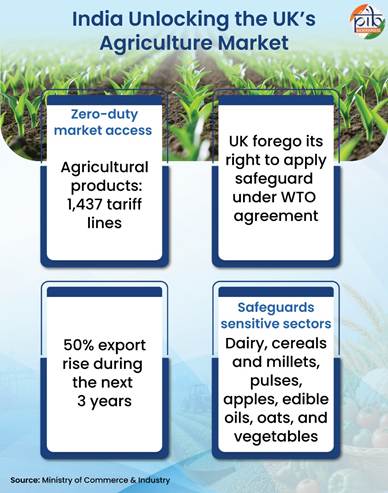
Key Provisions under CETA: The agreement provides zero-duty market access for agricultural products across 1,437 tariff lines. These account for 14.8% of all tariff lines under the agreement. Further, the UK has agreed to forego its right to apply safeguards under WTO agreement on Agriculture.
Key Beneficiaries: The India-UK CETA will allow Indian farmers to fetch premium prices for agricultural products in the UK market. Farmers will also benefit from commitments to acknowledge traditional knowledge, especially in the patent process for genetic resources. In addition, the CETA will facilitate inclusive and tech-agnostic innovation across diverse sectors, including agriculture sector. Further, the agreement is expected to benefit producers from Andhra Pradesh, Tamil Nadu, Punjab, Maharashtra (grapes and onions), Gujarat (groundnut and cotton), Kerala (spices), and the North Eastern States (horticulture).
Growth Opportunities under CETA: Duty-free access across key agricultural categories is expected to increase agricultural exports by over 50% during the next 3 years. The agreement is expected to strengthen exports of fresh grapes, processed food preparations, bakery products, preserved vegetables, fruits, nuts, fresh and chilled vegetables, sauces, and prepared sauces. It also places Indian agricultural products on par with major EU exporters, including Germany and the Netherlands, which already enjoy zero-tariff access to the UK market.
|
Sector Overview
|
India exports processed food worth USD 14.07 billion globally. The UK imports processed food worth USD 50.68 billion, but imports only USD 309.5 million from India. This highlights significant untapped export potential.
|
|
Key Provisions under CETA
|
The agreement provides zero-duty market access for the food processing sector across 985 tariff lines, accounting for 10.1% of all tariff lines under the agreement.
|
|
Key beneficiaries
|
Processed food manufacturers, exporters
|
Sector Overview: The UK is an important export market for India's plantation products. It accounts for 1.7% of India's coffee exports, 5.6% of tea exports, and 2.9% of spice exports.
Key Provisions under CETA: The agreement provides duty-free market access for instant coffee, improving the competitiveness of Indian value-added coffee products in the UK market.
Key Beneficiaries: The agreement is expected to benefit exporters, producers, and manufacturers. Duty-free access will help Indian businesses compete more effectively with instant coffee suppliers from Germany, Spain, and the Netherlands.
Growth Opportunities under CETA: The agreement is expected to significantly boost exports of value-added coffee products, particularly Indian instant coffee, to the UK market.
Leather & Footwear Products
|
Sector Overview
|
Exports of leather and footwear to the UK stood at USD 494 million in 2024. CETA opens access to the UK's USD 8.9 billion leather and footwear market, offering growth opportunities for Indian exporters. India's global exports valued at USD 5.6 billion, have a pathway to expand market presence, strengthen competitiveness in the UK market
|
|
Key Provisions under CETA
|
Duty-free market access for footwear exports to the UK
|
|
Key beneficiaries
|
Leather and footwear clusters across Uttar Pradesh, Tamil Nadu, West Bengal, and Delhi NCR
|
|
Key Product Categories
|
Leather footwear with rubber/plastic soles, leather shoes with rubber/plastic soles, textile sports/casual footwear, safety shoes with metal toe caps, handbags, and purses are expected to benefit
|
|
Opportunities under CETA
|
Conservative estimates project exports to the UK could exceed USD 900 million
FTA strengthens India's competitiveness against Vietnam, Indonesia, Cambodia, Turkey, and Bangladesh in the UK.
This is expected to encourage production and stimulate exports while supporting job creation in rural and semi-urban areas
|
Sector Overview: The UK imports marine products worth USD 4.9 billion annually, while India's exports account for only USD 126 million, highlighting significant untapped potential. With India’s global marine exports of USD 7.8 billion, duty-free access can unlock new opportunities across India's marine value chain. The UK is a high-value market for Indian frozen seafood. Fish, shrimp, and cuttlefish were among the leading export categories. Demand is driven by a large Indian diaspora and growing consumption of processed seafood.
Key Provisions under CETA: The agreement eliminates UK tariffs on Indian marine products. This improves price realisation for Indian exporters and increases returns across the fisheries value chain. Earlier UK tariffs on Indian shrimp ranged from 4.2% to 8.5%. Tariff elimination is expected to accelerate exports and encourage higher-value processing and product diversification.
Key Beneficiaries: The agreement is expected to benefit seafood exporters, seafood processing units, coastal fisherfolk, and the fisheries sector. Higher export demand is expected to improve procurement prices and strengthen livelihoods. According to Marine Products Export Development Authority (MPEDA), seafood processing plants employ thousands of women workers. Greater access to the UK market is expected to increase capacity utilisation. Coastal states such as Kerala, Andhra Pradesh, Gujarat, Tamil Nadu, Odisha and West Bengal are also expected to benefit significantly through higher exports, employment generation, and coastal economic development.
|
Sector Overview
|
UK is India's 6th largest export market for engineering goods. Engineering exports to the UK grew by 11.7% in 2024–25 over the previous year.
UK imports engineering goods worth USD 193.52 billion, but only USD 4.28 billion is sourced from India. This highlights significant export potential.
|
|
Key Provisions under CETA
|
Zero-duty market access across 1,659 tariff lines, which is 17% of all tariff lines under the agreement.
Eliminates tariffs of up to 18%
|
|
Key Beneficiaries
|
Engineering manufacturers and exporters, particularly those producing electrical machinery, auto components, industrial equipment, construction machinery.
Clusters across Tamil Nadu, Karnataka, Uttar Pradesh, Maharashtra, Gujarat, and Telangana
|
|
Opportunities under CETA
|
Engineering exports to the UK are projected to double and exceed over USD 7.5 billion by 2029–30. Exports of key engineering products are expected to grow at a 12–20% CAGR.
|
Electronics and Software Products
Key Provisions under CETA: The agreement provides zero-duty market access for eligible electronic products. It also secures ambitious market access commitments from the UK for software and IT-enabled services.
Opportunities under CETA: The agreement is expected to accelerate exports of smartphones, optical fibre cables, and inverters, strengthening India's presence in the UK market. It is also expected to unlock new markets for software and IT-enabled services, drive job creation, and enhance export potential. Exports from Indian software firms are projected to grow by 15–20% annually.
|
Sector Overview
|
UK imports pharmaceuticals worth nearly USD 30 billion, but imports less than USD 1 billion from India.
|
|
Key Provisions under CETA
|
Zero-duty market access for the pharmaceutical sector across 56 tariff lines, accounting for 0.6% of total.
Eliminates duties on a wide range of medical devices, including surgical instruments, diagnostic equipment, ECG machines, and X-ray systems.
|
|
Key Beneficiaries
|
Indian med-tech companies and manufacturers
|
|
Opportunities under CETA
|
|
Expected to enhance the competitiveness of Indian generic medicines in the UK market.
With the UK's reduced reliance on Chinese imports after Brexit and COVID-19, Indian manufacturers are well positioned to emerge as a preferred and cost-effective supplier.
|
|
Sector Overview: India exports chemicals and allied products worth USD 40 billion globally. The UK's chemical market, valued at USD 35.8 billion, offers growth prospects for Indian exporters. However, India's exports to the UK account for only USD 843 million. Current chemical exports to the UK stand at USD 570.32 million, representing about 2% of India's global chemical exports. This indicates significant untapped potential in the UK market.
Key Provisions under CETA: The agreement provides zero-duty market access across 1,206 tariff lines. These account for 12.4% of all tariff lines. The covered products include fertilisers, industrial chemicals, and petrochemicals, reflecting the sector's importance in bilateral trade. Chemical manufacturing hubs across Gujarat, Maharashtra, Karnataka, Andhra Pradesh, Tamil Nadu, and Telangana stand to benefit.
|
Sector Overview
|
India is the 13th largest supplier of plastics to the UK.
|
|
Key Provisions under CETA
|
The agreement provides duty-free market access for plastic products- where India has proven manufacturing strength.
|
|
Opportunities under CETA
|
Lower landed costs will enhance the competitiveness of Indian plastic products. Duty-free access will boost exports of films, sheets, pipes, packaging, tableware, and kitchenware, enabling India to compete more effectively with major global suppliers such as Germany, China etc.
|
Key Provisions under CETA: The agreement eliminates UK import duties on eligible products. It also encourages compliance with UK and EU standards, strengthening buyer confidence and promoting greater business collaboration.
Growth Opportunities under CETA: Exports of soccer balls, cricket equipment, rugby balls, and non-electronic toys are expected to grow. The sector is projected to grow by 15%, with exports targeted to reach USD 186.97 million by 2030. Duty-free access is expected to improve the price competitiveness compared to suppliers from China and Vietnam, which do not have similar trade agreements with the UK.
|
Sector Overview
|
India's gems and jewellery exports to the UK are valued at USD 1.03 billion.
The UK imports approximately USD 4 billion worth of jewellery annually, indicating significant growth potential for Indian exporters.
|
|
Key Provisions under CETA
|
Tariff relaxations for gems and jewellery exports
|
|
Key Beneficiaries
|
Manufacturers and traditional craftsmen
Major gems and jewellery clusters in Surat, Ahmedabad, Mumbai, Jaipur, Kolkata, Hyderabad, Chennai, and Thrissur are expected to gain significantly
|
|
Opportunities under CETA
|
Tariff relaxations are projected to double India's gems and jewellery exports to the UK within the next 2–3 years.
Higher exports are expected to generate employment in design, manufacturing, and artisan sectors.
|
In March 2026, UK introduced new steel measures on 188 tariff lines, that came into effect from 1 July 2026. India’s exports on these tariff lines were only ~14% (USD 137 million) of its total steel exports (out of USD 960 million). In order to protect the interest of Indian steel exporters, both countries engaged extensively to ease the effect of the measures. It protects commercial interests, minimises market disruptions, and maintains a balanced and stable trading environment.
Key Provisions under CETA: To mitigate potential trade impacts and maintain equilibrium in the deal, the UK has expanded tariff-free access across 3 critical product categories:
- Category 1 (non-alloy and other alloy hot-rolled sheets and strips): The country-specific quota for India increased about 3x from 12,405 tonnes to 33,456 tonnes. The UK has reserved an exclusive 40% of the quota under the Authorised Use Scheme (AUS) for India. It benefits Indian exporters and translates to ~9.45 lakh tonnes of dedicated trade volume.
- Category 28 (non-alloy wire): 9 commodity codes from the scope of the measure have been removed, improving market access. This ensures that 95% of India’s exports in this category remain completely free of restrictions.
- Expanded Residual Quotas: India has secured expanded access in critical sub-categories. This includes Category 12B (non-alloy merchant bars and light sections) residual quota scaling up to 4,540 tonnes (from 468 tonnes) and Category 26 (other welded tubes) residual quota rising to 16,327 tonnes (from 10,809 tonnes).
Opportunities under CETA: India’s total country-specific quota under the new framework is now elevated at 1,68,029 tonnes, complemented by the exclusive 9.45 lakh tonnes under the AUS.
|
Key Provisions under CETA
|
Reduced tariffs and streamlined procedures
|
|
Key Beneficiaries
|
Indian Oilseed exporters
|
|
Opportunities under CETA
|
The UK market offers Indian oilseed exporters an opportunity to expand their consumer base, strengthen market presence, and enhance export competitiveness.
|
Services: Expanding Market Access and Professional Mobility
The services sector is a key pillar of the India-UK economic partnership. India records a services trade surplus of around USD 7.9 billion with the UK. Services exports stand at USD 21.6 billion, compared to imports of USD 13.7 billion.
Key Provisions under CETA
India has secured wide-ranging commitments from the UK, covering all 12 major service sectors and 137 sub-sectors, which represents over 99 per cent of India’s export interests. However, on the Indian side, commitments have been extended in 108 sub-sectors.
Mutual Recognition and Professional Mobility
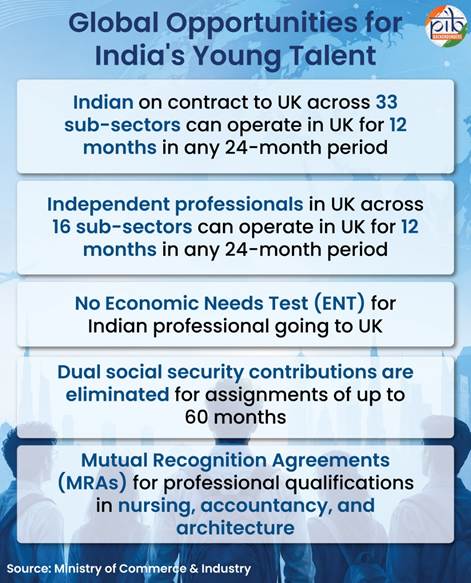
Both countries have agreed to pursue Mutual Recognition Agreements (MRAs) for professional qualifications within 12 months of the agreement entering into force. The proposed MRAs cover nursing, accountancy, and architecture. They are expected to reduce barriers for professionals and facilitate the exchange of best practices.
The UK has agreed not to impose numerical restrictions or an Economic Needs Test (ENT). The removal of the ENT is expected to reduce uncertainty and facilitate smoother mobility for Indian professionals. The agreement also reserves a dedicated annual quota of 1,800 positions for Contractual Service Suppliers, recognising India's cultural expertise.
Further, the agreement provides an assured framework for the temporary entry and stay of Indian professionals.
|
Category
|
Stay Duration
|
|
Business Visitors (BV)
|
90 days in any 6-month period across all sectors.
|
|
Intra-Corporate Transferees (ICT)
|
3 years across all sectors, including partners and dependants. Graduate Trainees are also covered.
|
|
Investors
|
1 year.
|
|
Contractual Service Suppliers (CSS)
|
12 months in any 24-month period across 33 sub-sectors, including IT/ITeS, business, finance, hospitality, and transport.
|
|
Independent Professionals (IP)
|
12 months in any 24-month period across 16 sub-sectors, including IT/ITeS, business, professional services, telecommunications, and finance.
|
Double Contribution Convention
Previously, Indian professionals on short-term assignments in the UK, and their employers, contributed nearly 23% of salaries to the UK's National Insurance system. They were not eligible to receive any benefits in return.
Under the Double Contribution Convention (DCC), these dual social security contributions are eliminated for assignments of up to 60 months. The convention is expected to benefit over 75,000 Indian professionals and around 900 Indian companies. This reduces employment costs and increases take-home earnings. Industry estimates suggest current annual saving of more than USD 600 million USD on this account.
Digitally Delivered Services and Investment Opportunities
The agreement strengthens market access for digitally delivered services such as IT, professional consultancy, education, training, and telecommunications. This is expected to boost India's IT and IT-enabled services sector, which already enjoys a trade surplus with the UK.
It also creates new opportunities for Indian companies to establish operations in the UK. These opportunities span management consultancy, education, and environmental services.
- Businessmen and startup ecosystem: The service commitments giving certainty to Indian businesses planning to invest in the UK. The agreement reduces compliance hurdles, helping Indian start-ups reach new customers, especially in digital services
- IT professionals: Mobility-related commitments will have a significant impact, making it easier for Indian IT professionals to work in the UK. These changes will allow seamless and cost-effective talent movement.
- Global Capability Centres (GCCs): This agreement could shift UK companies’ approach to India-from a low-cost back-office destination to a strategic partner for research and development, analytics, cybersecurity, and emerging technologies. It will also support the growth of GCCs.
- Health & Education: Indian hospitals can work with UK counterparts to deliver better healthcare and adopt advanced medical technologies. UK educational institutions will be able to establish campuses in India, while Indian institutions can set up operations in the UK and expand in areas such as EdTech.
- Indian financial firms: The firms will gain better access to the UK, improving their ability to serve the Indian diaspora and businesses there. Non-discrimination rules guarantee fair treatment for Indian firms. The agreement is also expected to support the growth of electronic payments, fintech, and other digital financial solutions, strengthening overall market integration.
- Government Procurement: Indian suppliers gain access to the UK’s government procurement market worth GBP 90 billion (USD 122 billion), while the UK receives reciprocal access to India’s USD 114 billion procurement market. The agreement ensures fair treatment for Indian suppliers, and opens opportunities in sectors such as IT, construction, financial services, insurance, and select educational institutions.
The agreement is expected to accelerate growth in IT and business services. It creates opportunities for Indian firms to expand their share in UK's USD 200 billion services import market, building on India's current exports of ~USD 14 billion.
Towards a Stronger India–UK Economic Partnership
The India-UK CETA marks a new chapter in the bilateral economic relationship. It combines greater market access with opportunities for trade, investment, innovation, and professional mobility. The agreement is expected to strengthen India's global competitiveness while supporting inclusive and sustainable growth. The agreement lays the foundation for a resilient and future ready India-UK partnership.
References
Ministry of Commerce & Industry
https://www.pib.gov.in/PressReleasePage.aspx?PRID=2127321®=48&lang=2
https://www.pib.gov.in/PressReleasePage.aspx?PRID=2274280®=48&lang=1
https://www.pib.gov.in/PressReleasePage.aspx?PRID=2149474®=48&lang=2
Ministry of External Affairs
https://www.mea.gov.in/Portal/ForeignRelation/Ind_UK_25.pdf
PIB Headquarters
https://www.pib.gov.in/PressNoteDetails.aspx?ModuleId=3&NoteId=154945®=48&lang=2
India–UK CETA Comes into Effect
*****
PIB Research
(Release ID: 2284878)
Visitor Counter : 9843