PIB Backgrounder
Empowering India's Skill Ecosystem
Government's Initiatives from Classroom to Enterprise
Posted On:
15 JUL 2026 5:09PM by PIB Delhi
|
India's talent ecosystem is evolving through a whole-of-life approach that integrates education, skilling, employment and entrepreneurship. Policy reforms and flagship programmes are embedding vocational education in curricula from school onwards while promoting continuous upskilling and lifelong learning. The framework increasingly emphasises industry relevance, digital technologies, artificial intelligence and future-ready competencies to meet changing workforce demands. Strong partnerships with academia, industry, international organisations and technology leaders are expanding access to quality training and employment opportunities. Special initiatives for women, artisans, rural communities and other underserved groups are making skill development more inclusive. Together, these efforts are creating a resilient, innovation-driven workforce that is better prepared to support economic transformation, global competitiveness and sustainable growth.
|
Empowering India's Talent Ecosystem
India's journey towards Viksit Bharat 2047 is anchored in building a robust talent ecosystem. A skilled, productive and innovative workforce is essential for sustaining economic growth, enhancing competitiveness and ensuring equitable development. Recognising talent development as a lifelong journey, the Government has adopted a life-cycle approach. It includes vocational education in schools, workforce upskilling, apprenticeships, entrepreneurship development, women-centric skilling and lifelong learning. Together, these initiatives are aimed at creating an inclusive, industry-responsive talent architecture.
Skill development at every stage of life is critical for sustaining employability and workforce productivity. It also positions India to emerge as the world's primary talent hub, driving long-term economic growth and global competitiveness.
Recently, the need for continuous skilling has become more pronounced as global labour markets undergo rapid transformation. Automation, artificial intelligence, digitalisation, climate action and demographic shifts are reshaping the nature of work. These trends are creating demand for new and evolving skills.
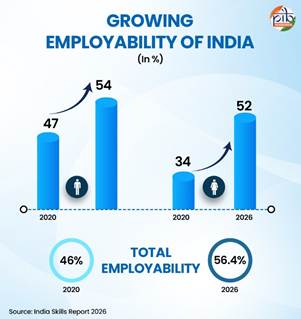
India's improving skill readiness further strengthens the opportunity of achieving 100% skilled labour by 2047 with meaningful employment. The India Skills Report 2026 shows employability rising from 46% in 2020 to 56.4% in 2026. This reflects the impact of targeted skilling and inclusion initiatives. Strong hiring sentiment further indicates growing demand for workforce for tomorrow.
Skill Development: A Priority
Skill development is now a strategic pillar of India's economic and social transformation. It equips individuals with the capabilities needed to adapt to changing labour markets and emerging technologies. It also enables India to leverage its demographic advantage, meet global workforce demand and sustain long-term economic growth.
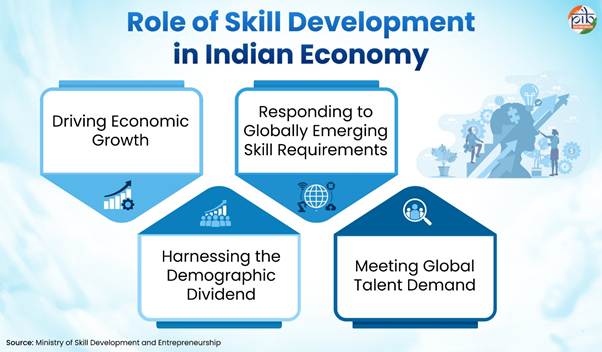
- Driving Economic Growth: Skills and knowledge remain fundamental drivers of economic growth and social development. By enhancing employability and productivity, skill development plays a critical role in poverty reduction, sustainable enterprise creation and broad-based growth. This further creates a virtuous cycle of higher productivity, expanded employment opportunities and rising incomes.
- Responding to Globally Emerging Skill Requirements: Rapid technological and demographic changes are reshaping economies and labour markets worldwide. Imparting relevant skills to our youth to make them future ready and their continuous upskilling is essential to remain competitive in an evolving landscape shaped by automation, climate action, digitalisation and demographic shifts. . The IMF's AI Preparedness Index awarded India a score of 49.3, higher than the 42.1 average for emerging and developing economies. It reflects India's strong readiness to adopt and benefit from artificial intelligence.
- Harnessing the Demographic Dividend: India has over 54% of its population below 25 years of age. More than 62% belongs to the working-age group (15–59 years). This demographic advantage is expected to last until around 2040. Focused skilling is therefore essential to harness this opportunity and build a future-ready workforce.
- Meeting Global Talent Demand: India is expected to generate a surplus of 45 million skilled professionals by 2030. At the same time, global labour shortages are projected to reach 85 million. This presents a significant opportunity for India to meet rising global demand for skilled talent. Building a life-cycle approach to skill development is therefore essential.
Building Skills from an Early Age
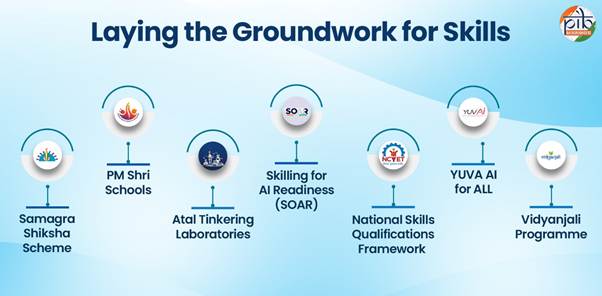
Early skilling lays the foundation for lifelong employability, workforce participation and industry-relevant skills. The Government has introduced several initiatives to promote skill development from an early age.
Samagra Shiksha Scheme
Samagra Shiksha is an overarching programme for school education from pre-school to Class XII. The objective is to improve school effectiveness through equitable access and learning outcomes. The scheme treats school education as a continuum and is in accordance with Sustainable Development Goal for Education (SDG-4). As of December 2025, the scheme has achieved various milestones with regard to skill education:
- A total of 138 job roles have been approved and skilling initiatives have been implemented in 25,140 schools, covering over 35.5 lakh students.
- Under the scheme, the Hub and Spoke Model has been adopted so that the infrastructure available in the Hub schools is utilized by the students of nearby schools (spoke schools) for Skill training. 975 spoke schools optimises infrastructure and expands access to skill training nationwide .
- To strengthen skill training infrastructure in schools, the Ministry of Skill Development and Entrepreneurship (MSDE) has established 1,200 vocational skill labs. These labs are spread across 400 Jawahar Navodaya Vidyalayas (JNVs) and 200 Eklavya Model Residential Schools (EMRSs).
PM Shri Schools
Launched in 2022, PM SHRI Schools strengthen existing schools to implement the National Education Policy 2020. These schools act as exemplar institutions providing mentorship to neighbouring schools. They aim to deliver quality teaching while nurturing holistic, well-rounded students equipped with 21st-century skills.
- Out of the targeted 14,500 PM SHRI Schools, 13,092 have been developed across 776 districts as of June 2026.
Atal Tinkering Laboratories
With a vision to ‘Cultivate one Million children in India as Neoteric Innovators’, Atal Innovation Mission established Atal Tinkering Laboratories (ATLs) in schools. This fosters curiosity, creativity and innovation-oriented skills among students. As of June, 2026:
- Over 10,000 ATLs have been established in 722 districts
- And, more than 1.1 crore students have been engaged
Skilling for AI Readiness (SOAR)
Skilling for AI Readiness (SOAR) aims to equip students from Classes VI–XII and educators with evolving AI skills through courses. These courses are delivered in partnership with Microsoft, HCL Technologies and NASSCOM.
- As of February 2026, 2.30 lakh students have been enrolled in AI to be Aware, AI to Aspire, AI to Acquire, AI for Educators.
National Skills Qualifications Framework (NSQF)
The National Skills Qualification Framework (NSQF) is a competency-based framework that organises qualifications into eight levels based on learning outcomes. It recognises knowledge, skills, aptitude, responsibility and practical experience acquired through formal, non-formal and informal learning. The framework integrates academic education, vocational education and skill training through a common structure. It also enables credit-based progression across school education, higher education and skilling, promoting lifelong learning and career mobility.
YUVA AI for ALL
Under the IndiaAI Mission, MeitY has launched ‘YUVA AI for ALL’, in November, 2025. It is a free 4.5-hour self-paced course to introduce AI basics to all citizens, especially youth. Available on FutureSkills Prime and iGOT Karmayogi, the course offers practical learning and a Government of India certificate on completion.
- As of 8 July 2026, total enrolment stood at 85.27 lakh
Vidyanjali Programme
Vidyanjali is an initiative that advances schools through community and private sector participation. It connects schools with volunteers, including professionals, retired teachers, government officials, NGOs, CSR partners and the Indian diaspora. Volunteers contribute through mentoring, career guidance, skill development and other educational support.
- As of June 2026, 8,44,925 schools have been onboarded.
- The initiative has registered 5,62,296 volunteers and 2,705 CSR organisations and NGOs.
- More than 2.04 crore students have benefited from the programme.
Upskilling and Re-Skilling the Workforce
As labour markets evolve rapidly, continuous upskilling and re-skilling have become essential to support new professionals and enable mid-career transitions. Focused interventions keep the workforce employable and industry-ready.
Skill India Mission
The Skill India Mission (SIM) provides NSQF-aligned skilling, upskilling and reskilling for the working-age population. This is supported by nationwide outreach through Rozgar Melas and the Skill India Digital Hub. The trainings are also provided through an extensive network of Skill Development Centres (SDCs). The flagship schemes under the mission include:
- Pradhan Mantri Kaushal Vikas Yojana (PMKVY),
- Jan Shikshan Sansthan (JSS),
- National Apprenticeship Promotion Scheme (NAPS), and
- Craftsman Training Scheme (CTS) in Industrial Training Institutes (ITIs).
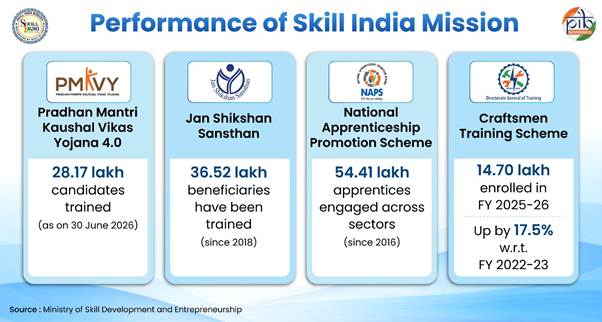
Pradhan Mantri Kaushal Vikas Yojana (PMKVY) is a flagship short-term skilling initiative. Over the course of its four phases, it has progressed from a pilot incentive-based certification initiative to a large-scale, demand-driven and outcome-oriented skilling network. Key achievements are highlighted below:
- PMKVY 4.0 has trained 28.17 lakh candidates across 36 sectors in 36 States and 738 districts as on 30th June 2026.
- Over 21.91 lakh candidates were trained between 1 April 2024 and 31 March 2026. Key sectors include IT-ITeS, aerospace & aviation, agriculture, rubber, leather, apparel, electronics, construction, and tourism & hospitality.
- The scheme has introduced 68 customised courses and 189 future-skill job roles to address emerging industry requirements.
- More than 16,900 institutions, including over 6,800 Skill Hubs, are implementing PMKVY 4.0 nationwide.
Jan Shikshan Sansthan (JSS) provides community-based, non-formal skill training to neo-literates and school dropouts through NGOs with 100% Government funding. As of 31 March 2026, significant milestones of the scheme are:
- 36.52 Lakh beneficiaries have been trained since 2018.
- 4.8 Lakh tribal beneficiaries have completed training.
- Women constitute more than 82% of beneficiaries under JSS.
- 83 NCVET-approved courses at NSQF Levels 3, 3.5 and 4 have been introduced.
- Locally relevant courses include tailoring, embroidery, handicrafts, food processing and health services.
- Since December 2024, JSS products have been marketed through the UdyamKart portal, improving market access for artisans and micro-entrepreneurs.
National Apprenticeship Promotion Scheme (NAPS) promotes industry-led apprenticeship training through the 'Earn While You Learn' model. Under NAPS 2.0, the Government provides 25% of the stipend, up to ₹1,500 per month, directly to apprentices’ bank account and 75% of the stipend is paid by the employer. As of 31 March 2026, significant contributions of the scheme are:
- More than 54.41 lakh apprentices have been engaged since 2016 across sectors including automotive, IT-ITeS, electronics, retail and manufacturing.
- Around 12.35 lakh apprentices were engaged during FY 2025–26, while 6.42 lakh completed on-the-job training.
- 1,32,000 Certificates of Proficiency (CoP) have been issued since their launch in 31 March 2026.
- Over ₹562.75 crore was disbursed through 40.10 lakh Direct Benefit Transfer (DBT) transactions between 1 April 2025 and 31 March 2026.
Craftsmen Training Scheme (CTS) provides long-term vocational training through Industrial Training Institutes (ITIs) to develop a skilled workforce aligned with industry requirements. As of March 2026, key achievements are:
- Training is offered in 169 courses through 13,888 ITIs
- 14 new CTS courses have been introduced and 22 existing courses revised over the past 3 years to align with industry needs.
- ITI enrolment increased from 12.51 lakh in FY 2022–23 to 14.70 lakh in FY 2025–26.
PM -SETU
Launched in 2025, PM-SETU (Pradhan Mantri Skilling and Employability Transformation through Upgraded ITIs) aims to:
- Upgrade 1,000 Government Industrial Training Institutes (ITIs) into modern, industry-aligned skilling institutions. These ITIs will be upgraded in a hub-and-spoke cluster model where 200 Hub ITIs connected with 800 Spoke ITIs.
- Set up 5 National Centres of Excellence for Skilling.
- Train 20 lakh youth over a period of five years.
The courses are introduced related to the service sector, multi-skill courses, and livelihood promotion. This improves employability and makes vocational training relevant to current and future job markets.
- As of May 2026, 32 States and Union Territories have constituted State Steering Committees. 12 among them have floated Requests for Proposals to onboard industry partners under PM-SETU.
- Andhra Pradesh became the first State to operationalise PM-SETU through the Visakhapatnam ITI Cluster.
- The rollout has expanded further with Strategic Investment Plans (SIPs) worth ₹1,237.58 crore approved for ITI clusters in Odisha, Gujarat and Telangana.
FutureSkills Pillar
The FutureSkills Pillar under the IndiaAI Mission aims to build a strong AI talent ecosystem and widen access to AI education across India. It supports learners from undergraduate to PhD levels. The initiative offers national AI fellowships for UG, PG, dual degree and PhD students. It is also setting up 570 AI and Data Labs in Tier 2 and Tier 3 cities, to promote hands-on learning. Market oriented, NCVET-recognised AI courses are being delivered across sectors such as agriculture, healthcare, manufacturing and education.
Future Skill Prime
FutureSkills Prime is an initiative by NASSCOM & Ministry of Electronics and Information Technology. The programme focuses on skilling, reskilling and upskilling individuals in new and emerging technologies through a flexible, online digital learning platform.
- It offers 2,800+ courses and pathways, has 33 lakh+ registered users.
- The reach has widened to 41% women learners, and 740 Tier 2 and Tier 3 cities.
Pradhan Mantri Viksit Bharat Rozgar Yojana
Pradhan Mantri Viksit Bharat Rozgar Yojana (2025) provides a one-time incentive of up to ₹15,000 in two instalments to support first-time employees registered with EPFO during their initial learning phase. The scheme offsets upskilling costs, enhances productivity and employability. It also promotes financial literacy to equip new entrants with essential money management skills. The scheme also incentivizes employers, up to Rs 3000 per month, for two years, for each additional employee with sustained employment for at least six months.
- The scheme has supported the creation of 15 lakh employment opportunities with disbursement of incentives worth ₹2,400 crore (19 June, 2026).
Strengthening International and Private Sector Partnerships
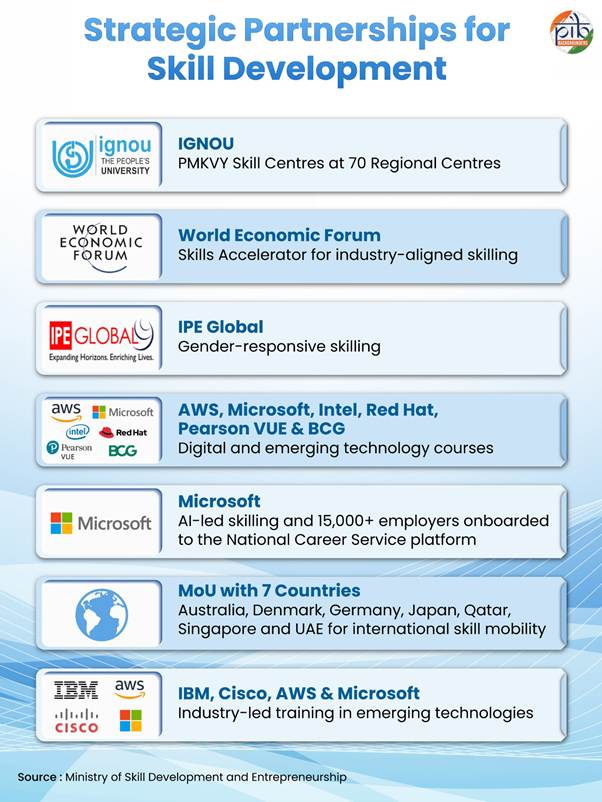
Public-private and international partnerships are playing a key role in transforming India's skilling ecosystem. They are promoting industry-aligned training, digital skills and global mobility opportunities.
Nurturing Entrepreneurial Skills
Entrepreneurship plays a vital role in job creation, innovation and economic growth. Skilling strengthens the capabilities needed to build successful enterprises.
PM Vishwakarma
PM Vishwakarma provides end-to-end support to traditional artisans and craftspeople through skill upgradation, toolkit incentives, credit support and market linkages. The scheme gives special focus to women and disadvantaged groups. This includes SCs, STs, OBCs, persons with disabilities, transgender persons, and artisans from the North Eastern Region, island territories and hilly areas. Beneficiaries receive a stipend of ₹500 per day during skill training.
- As of June 2026, over 24.50 lakh applicants have successfully completed basic training.
- Loans worth ₹5,165.84 crore have been sanctioned.
- More than ₹35 crore of digital incentive has been disbursed.
Start Up India Courses
Hands-on learning and free of cost online courses are available for all registered users on the Startup India platform. The courses range from Programming, Security, Accounting & Finance to Management and Entrepreneurship. These courses help users gain entrepreneurial knowledge while enabling them to upskill their organisations.
Entrepreneurship and Skill Development Programmes
MSDE through its autonomous institutions implements Entrepreneurship Development Programmes (EAPs) and Entrepreneurship Skill Development Programmes (ESDPs). The institutions are National Institute for Entrepreneurship and Small Business Development (NIESBUD), Noida and Indian Institute of Entrepreneurship (IIE), Guwahati. This promotes entrepreneurship and fosters an entrepreneurial culture across the country. These institutes provide end-to-end support to entrepreneurs through entrepreneurship and management training, post-training support through mentorship, handholding and incubation support.
Entrepreneurship Skill Development Programmes (ESDP) of the Ministry of Micro, Small and Medium Enterprises (MSME) encourage youth to pursue self-employment and entrepreneurship. The programmes focus on SCs, STs, women, persons with disabilities, ex-servicemen and BPL beneficiaries by providing technical and business skills.
Empowering Women through Skilling
Skill development for women is essential to enhance workforce participation, economic independence and equitable growth. Targeted skilling initiatives help address gender gaps in employment while enabling women to access emerging opportunities across sectors.
AI Careers for Women
AI Career for Women (2025) is an intensive 320-hour training programme. It intends to empower young women and girls in rural undergraduate colleges with future ready AI skills. The programme is strengthening women's participation in emerging technologies through 25 AI Centres of Excellence operating under a hub-and-spoke model.
- The programme has reached over 10,000 students, including 2,500+ in Hub Colleges and 7,500+ in Spoke Colleges.
Swavalambini
MSDE, in collaboration with NITI Aayog’s Women Entrepreneurship Platform, launched the Swavalambini – Women Entrepreneurship Programme in February 2025. It is being implemented across Assam, Meghalaya, Mizoram, Uttar Pradesh and Telangana. The programme fosters an entrepreneurial mindset among women through Entrepreneurship Awareness and Development Programmes. During FY 2025-26, Indian Institute of Entrepreneurship conducted:
- Faculty Development Programme for 82 faculty members,
- Entrepreneurship Awareness Programme for 1200 participants and;
- Women Entrepreneurship Development Programme for 602 candidates.
NAVYA (Nurturing Aspirations through Vocational Training for Young Adolescent Girls)
NAVYA was launched in June 2025 by MSDE in partnership with the Ministry of Women & Child Development. The scheme aims to empower adolescent girls aged 16-18 years in aspirational districts through skill-based interventions for socio-economic independence.
- Covering 27 districts across 19 States, NAVYA targets training of 3,850 girls under PMKVY 4.0.
The initiative provides demand-driven vocational training in non-traditional and future-oriented job roles. It also builds life skills, financial literacy and digital competencies in areas such as digital marketing, cybersecurity, AI-enabled services and green jobs. This supports employability, self-employment opportunities and gender-inclusive skilling in underserved areas.
|
The Union Budget 2026–27: Key Skilling Initiatives
- The Khelo India Mission proposes an integrated talent pathway, coach development, and greater use of sports science and technology.
- A pilot programme to upskill 10,000 tourist guides through a standardised 12-week hybrid course.
- 3 new All India Institutes of Ayurveda to strengthen education, research and clinical services.
- A National Institute of Design in eastern India to strengthen design education.
- AVGC Content Creator Labs in 15,000 schools and 500 colleges.
- NSQF-aligned programmes to train 1.5 lakh multi-skilled caregivers in geriatric and allied care.
- Five University Townships near industrial and logistics corridors. These townships will integrate higher education, research, skilling and residential infrastructure.
To read more about skilling initiatives announced in Union Budget 2026-27, click here.
|
Conclusion
India's skilling landscape is being strengthened through a comprehensive, life-cycle approach. It spans school education, higher education, workforce upskilling, entrepreneurship and women-centric initiatives. Skilling is being aligned with emerging technologies, industry demand and global labour market shifts. Targeted interventions for youth, women and vulnerable groups are ensuring inclusive participation and equitable growth.
Collectively, these initiatives position India to harness its demographic dividend and build a globally competitive workforce.
Reference
Ministry of Finance
http://www.dea.gov.in/files/monthly_economic_report_documents/FINAL_Monthly%20Economic%20Review%20October%202025.pdf
Ministry of Skill Development and Entrepreneurship
https://www.msde.gov.in/static/uploads/2024/04/National-Skill-Development-Mission.pdf
https://x.com/MSDESkillIndia/status/1998400903376994741
https://www.pib.gov.in/PressReleasePage.aspx?PRID=2204136®=3&lang=1
https://www.pib.gov.in/PressReleasePage.aspx?PRID=2210537®=3&lang=2
https://www.instagram.com/p/DS93yBTEVvO/
https://www.pib.gov.in/PressReleseDetail.aspx?PRID=2200373®=3&lang=1
https://www.pib.gov.in/PressReleasePage.aspx?PRID=2197061®=3&lang=1
https://www.pib.gov.in/PressReleasePage.aspx?PRID=2200389®=3&lang=2
https://www.pib.gov.in/PressReleasePage.aspx?PRID=2197057®=3&lang=1
https://www.pib.gov.in/PressReleasePage.aspx?PRID=2149342®=3&lang=2
https://www.pib.gov.in/PressReleasePage.aspx?PRID=2200384®=3&lang=1
https://www.pib.gov.in/PressReleasePage.aspx?PRID=2204133®=3&lang=2
https://www.pib.gov.in/PressReleasePage.aspx?PRID=2146569&utm®=3&lang=2
https://dgt.gov.in/sites/default/files/2025-10/PM-SETU-Guidelines-Component-I-Upgradation-of-ITIs.pdf
https://www.pib.gov.in/PressReleseDetailm.aspx?PRID=2208158®=3&lang=1
https://www.pib.gov.in/PressReleasePage.aspx?PRID=2236967®=3&lang=1
https://pm-setu.skillindiadigital.gov.in/
https://www.pib.gov.in/PressReleasePage.aspx?PRID=2266939&lang=2®=48
https://www.pib.gov.in/PressReleasePage.aspx?PRID=2250149®=3&lang=2
https://www.pib.gov.in/PressReleasePage.aspx?PRID=2217278®=3&lang=1
https://www.pib.gov.in/PressReleasePage.aspx?PRID=2223364®=3&lang=1
https://www.pib.gov.in/PressReleasePage.aspx?PRID=2238232®=3&lang=1
https://www.pib.gov.in/PressReleasePage.aspx?PRID=2225466®=3&lang=1
https://iie.gov.in/pr/projects/swavalambini--women-entrepreneurship-programme#gsc.tab=0
https://www.pib.gov.in/PressReleasePage.aspx?PRID=2200384®=3&lang=1
https://www.pib.gov.in/PressReleasePage.aspx?PRID=2144958®=48&lang=2
https://www.pib.gov.in/PressReleasePage.aspx?PRID=2281937®=48&lang=1
Sansad.in
https://sansad.in/getFile/loksabhaquestions/annex/186/AS116_8uUyrZ.pdf?source=pqals
https://sansad.in/getFile/loksabhaquestions/annex/186/AU1259_yqXOnZ.pdf?source=pqals
https://sansad.in/getFile/loksabhaquestions/annex/185/AU1175_YigYjs.pdf?source=pqals
Ministry of Education
https://www.pib.gov.in/PressReleaseIframePage.aspx?PRID=1951485®=3&lang=2
https://pmshri.education.gov.in/
https://samagra.education.gov.in/about.html
https://vidyanjali.education.gov.in/
https://sansad.in/getFile/loksabhaquestions/annex/186/AU1164_v0ZRwx.pdf?source=pqals
Cabinet
https://www.pib.gov.in/PressReleaseIframePage.aspx?PRID=1857409®=3&lang=2
Ministry of Electronics and Information Technology
https://indiaai.gov.in/hub/indiaai-futureskills
https://www.pib.gov.in/PressReleasePage.aspx?PRID=2191334®=3&lang=2
https://www.pib.gov.in/PressReleasePage.aspx?PRID=2201472®=3&lang=1
https://www.futureskillsprime.in/
Ministry of Labour & Employment
https://www.pib.gov.in/PressReleasePage.aspx?PRID=2206145®=3&lang=2
https://www.mofpi.gov.in/sites/default/files/pradhan_mantri_viksit_bharat_rozgar_yojana_pmvbry.pdf
https://www.pib.gov.in/PressReleasePage.aspx?PRID=2201346®=3&lang=1
https://www.pib.gov.in/PressReleasePage.aspx?PRID=2148270®=48&lang=2
Ministry of Micro, Small and Medium Enterprises
https://msmedi.dcmsme.gov.in/
https://www.pib.gov.in/PressReleasePage.aspx?PRID=2246894®=3&lang=1
https://pmvishwakarma.gov.in/
Ministry of Commerce and Industry
https://www.startupindia.gov.in/content/sih/en/reources/online-courses.html
Niti Ayog
https://niti.gov.in/sites/default/files/2019-01/Skill_Workforce.pdf
https://aim.gov.in/atl.php
PM India
https://www.pmindia.gov.in/en/news_updates/pm-disburses-incentives-worth-around-%e2%82%b92400-crore-under-the-pradhan-mantri-viksit-bharat-rozgar-yojana/
World Bank
https://www.worldbank.org/en/topic/skillsdevelopment
World Economic Forum
https://reports.weforum.org/docs/WEF_Future_of_Jobs_Report_2025.pdf
UNESCO
https://www.unevoc.unesco.org/en/wysd-2026-skills-shared-future
PIB Headquarters
https://www.pib.gov.in/PressReleasePage.aspx?PRID=2226912®=3&lang=1
https://www.pib.gov.in/PressNoteDetails.aspx?NoteId=155216&ModuleId=3®=48&lang=1
https://www.pib.gov.in/PressReleasePage.aspx?PRID=2256476®=3&lang=1
Others
https://cdnbbsr.s3waas.gov.in/s3kv05b90e8875c131d0760d04c0d4d8f3/uploads/2025/08/2025080227.pdf
https://wheebox.com/assets/pdf/ISR_Report_2026.pdf
https://wheebox.com/assets/pdf/ISR_Report_2025.pdf
https://x.com/Office_ChJayant/status/2041772472798998566
https://aicw.in/skilling
Empowering India's Skill Ecosystem
******
PIB Research
(Release ID: 2284941)
Visitor Counter : 5804