Posted On:
15 JUL 2026 5:29PM by PIB Delhi
The BRICS Labour and Employment Ministers’ Meeting was successfully held in Hyderabad under India’s BRICS Chairship 2026, bringing together Ministers, Heads of Delegation, representatives of BRICS member countries, workers’ and employers’ organizations, and knowledge partners to deliberate on key issues shaping the future of work.
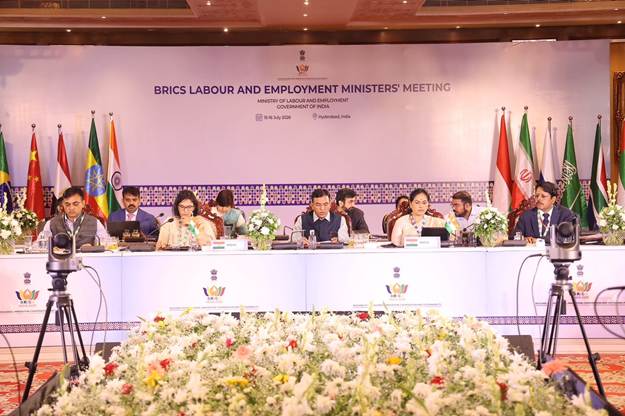
The Meeting was convened under India’s Chairship theme, “Building for Resilience, Innovation, Cooperation and Sustainability,” and focused on advancing collective action in the areas of social protection, labour market formalization, women’s workforce participation, skills development, and the use of digital technologies for inclusive and resilient labour markets.
I. KEYNOTE ADDRESS
A People-Centric Chairship
Welcoming delegations to Hyderabad, Union Minister, Dr. Mansukh Mandaviya said India's Chairship has been guided by the vision of Prime Minister Shri Narendra Modi, approached with a ‘people-centric’ approach and in the spirit of ‘Humanity First’.
Highlighting India's own reform journey, the Minister said India consolidated 29 outdated labour laws into four modern Labour Codes in November 2025, marking a landmark reform that creates a worker-centric ecosystem for India's 1.4 billion citizens.
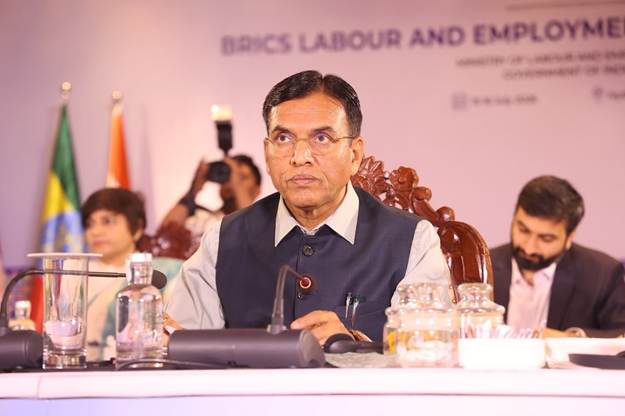
The Minister noted that the e-Shram portal has enabled unique identification, de-duplication and seamless access to welfare benefits for over 317 million registered unorganised workers. The National Career Service portal, he said, combines job-matching, skills mapping and counselling, with the flexible design of India's digital platforms allowing rapid expansion of services to new worker categories such as platform workers. India has also shared this technology with partner countries, including Mauritius, he added.
Dr. Mandaviya underlined India’s consistent initiatives to strengthen international labour mobility by connecting its skilled, future-ready workforce with emerging global opportunities. He noted that India today hosts more than 2,100 Global Capability Centres employing 2.35 million professionals and generating nearly USD 98 billion in annual revenue.
The Minister emphasised that BRICS shares a responsibility to shape a future of work that is productive and equitable. “This forum provides a unique opportunity for the Global South to shape solutions that are practical, inclusive and people-centric,” he emphasised.
II. PROCEEDINGS OF THE DAY
Message from Director General, ILO
In his video message to the gathering, Director General, International Labour Organisation (ILO) commended India's leadership for placing labour and employment at the heart of the BRICS agenda. The Director General extended his appreciation for India’s robust social security ecosystem, which has seen rapid expansion in the past decade. “According to ILO running estimates, India's social protection system now reaches 1 billion people. This milestone offers lessons that can be shared through South-South cooperation,” he said in his message.
Adoption of Declaration; launch of BRICS CONNECT
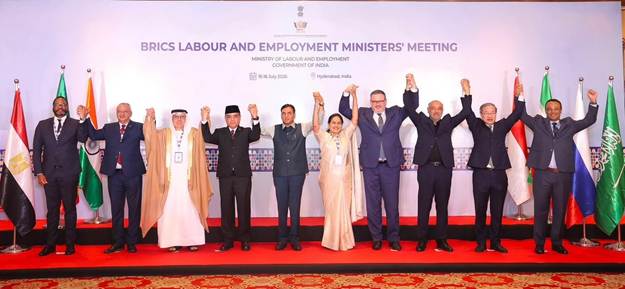
A major outcome of the Meeting was the adoption of the BRICS Labour and Employment Ministers’ Declaration, reflecting the shared commitment of BRICS countries to promote decent work, strengthen social protection systems, enhance employability, support inclusive growth, and deepen cooperation in the labour and employment domain. The Declaration reaffirmed the importance of South-South cooperation, mutual learning, and practical collaboration among BRICS members in addressing common labour market challenges.
Under Priority 1 on Advancing Social Security and Formalisation of Labour Markets, member states have agreed to commend the collective efforts in expanding social protection coverage and that member shall endeavour to progressively expand social protection coverage from existing levels as per nationally determined levels, based on respective circumstances, priorities, and capacities.
Under Priority 2 on Enhancing Women's Participation and Inclusion in the Workforce, Member countries committed to strengthening policy frameworks that empower women through expanded access to skills development, parental leave policies, and protection against workplace harassment and discrimination, while also working towards enhancing women's representation and participation in leadership roles across public and private sectors.
Under Priority 3 on Cooperation on Employability, Skills Mapping and Development, Member countries took note of the ongoing feasibility study on International Reference Classification of Occupations being conducted by the ILO in collaboration with India, joined by Brazil, and encourage member states to consider participation in the pilot in key sectors—Digital, Care, and Green.
Under Priority 4 on Leveraging Digital Technologies for All Workers, including Gig and Platform Workers, Member countries will work together to create opportunities to exchange knowledge and experiences, showcase our digital innovations, and help alleviate transition challenges through peer learning and South-South and Triangular cooperation with extensive consultation, joint contribution, and shared benefits.
The Meeting also witnessed the launch of BRICS CONNECT, an initiative proposed by India, an important institutional initiative aimed at strengthening technical cooperation, knowledge exchange, and capacity building among BRICS countries. It is expected to serve as a collaborative platform for sharing best practices and knowledge exchange in the areas of improving labour market intelligence, supporting skills forecasting, and facilitating cooperation on future skills, digital employment services, social security, and labour market reforms. Member countries welcomed the initiative as a step toward moving BRICS cooperation beyond policy dialogue and toward actionable, country-driven collaboration.
National Statements and Sharing of Best Practices
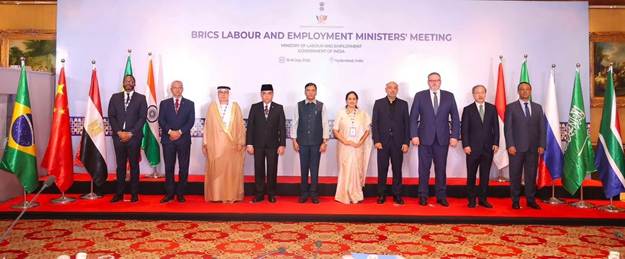
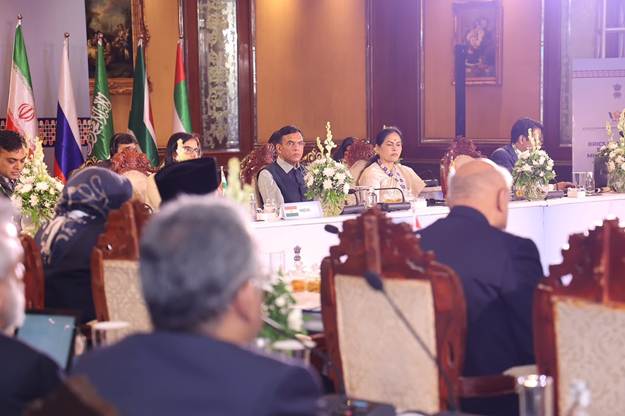
During the Meeting, delegations from BRICS countries delivered national statements highlighting their respective priorities, achievements, and policy approaches. Indonesia emphasized the importance of skills development, social protection for informal workers, job loss security, and inclusive employment opportunities for women, persons with disabilities, and communities in remote regions. Iran underlined the importance of dialogue and cooperation within the BRICS framework. UAE highlighted its labour market reforms based on private sector partnership, agile regulation, openness to global talent, and the use of digital technologies and artificial intelligence for labour administration. South Africa also hailed BRICS CONNECT as an institutional innovation that moves collaboration beyond policy dialogue toward a common labour market that is more productive, inclusive, and equitable.
Ethiopia emphasized demand-driven vocational education, aiming to create one million jobs by 2030, and reaffirmed its commitment to shared objectives in the spirit of South-South cooperation by learning from BRICS partners. Russia shared its progress on declining unemployment rates, digitalization of the sector, and the introduction of electronic applications for payments. Brazil highlighted its micro-internship programme benefiting millions of workers and called for expanded cooperation on AI. China underscored the rise of the platform economy and new forms of work and welcomed the consensus and adoption of the declaration.
The Meeting also included a dedicated Technical Session on Best Practices, where member countries shared practical experiences and national innovations. Representatives of workers and employers also contributed to the discussions, highlighting the importance of social justice, decent work, human dignity, human-centric technology and artificial intelligence, social security for all, portability of benefits, continuous upskilling, recognition of prior learning, and women’s participation in the future of work.
III. CONCLUDING REMARKS
In his concluding remarks, Union Minister, Dr. Mansukh Mandaviya described the Declaration adopted at the meeting as marking the successful culmination of collective efforts and a reflection of the spirit of consensus that guided the proceedings. “We are confident and committed to building resilient labour markets that are formal, inclusive, gender-responsive, digitally empowered and future-ready, ensuring that no worker is left behind,” the Minister said.
The valuable contributions of international knowledge partners, including ILO, the International Social Security Association (ISSA), and the United Nations Resident Coordinator’s Office (UNRCO), in supporting the technical deliberations and enriching the discussions was also acknowledged by the Presidency.
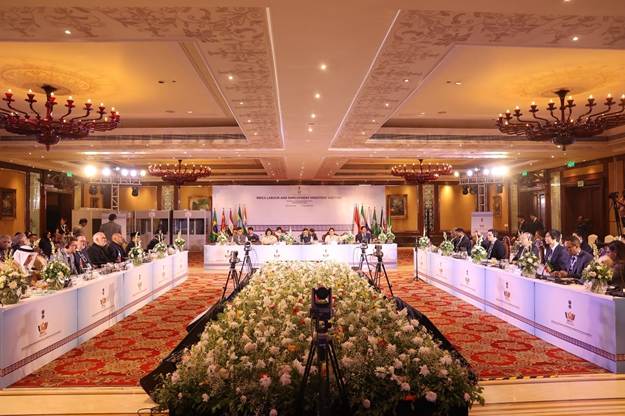
The successful adoption of the Declaration and the launch of BRICS CONNECT mark a significant step forward in strengthening BRICS cooperation in the field of labour and employment. The Meeting concluded with a shared resolve to continue working collectively toward a world of work that promotes social justice, decent employment, innovation, resilience, and inclusive development for all.
*****
Rini Choudhury/Anjelina Alexander