Ministry of Environment, Forest and Climate Change
Posted On:
17 JUL 2026 2:52PM by PIB Kolkata
Kolkata, July 17, 2026
Scientists at the Zoological Survey of India (ZSI) have officially documented two newly discovered spider species from contrasting and highly specialised ecosystems in Meghalaya and Andhra Pradesh.
Published in the prestigious peer-reviewed journals Zootaxa and Records of the Zoological Survey of India, these breakthroughs emphasize the immense, undocumented micro-biodiversity thriving within India’s subterranean caves and forest canopies. Both the species represent the first-ever records of their respective genera within these regions, marking a significant milestone for Indian arachnology.
Overview of the Discoveries
The table below summarises the contrasting habitats and physical traits of the two newly identified arachnids:
|
Attribute
|
Simonia lawbah
|
Hamataliwa papikonda
|
|
Scientific Name
|
Simonia lawbah
|
Hamataliwa papikonda
|
|
Common Family
|
Ray Spiders (Theridiosomatidae)
|
Lynx Spiders (Oxyopidae)
|
|
Location
|
Krem Lawbah Cave, Lawbah, Meghalaya
|
Papikonda National Park, Andhra Pradesh
|
|
Ecosystem
|
Subterranean Cave (Troglophilic)
|
Mixed Deciduous Forest Canopy
|
|
Body Size
|
Microscopic (under  ) )
|
Petite (under  ) )
|
|
Key Feature
|
Slingshot-style cone-shaped webs
|
Hexagonal eye structure and spiny legs
|
Detailed Technical Findings
1. Simonia lawbah (The Cave-Dwelling Ray Spider)
- Taxonomic Significance: This discovery marks the first record of the genus Simonia in India, greatly expanding the known distribution of the family Theridiosomatidae.
- Morphology & Ecology: Measuring under
 in length, this microscopic spider is characterised by its troglophilic (cave-loving) nature. It constructs specialized cone-shaped "ray webs." These structures function as high-speed slingshots, which the spider manually triggers to capture flying insects at remarkable speeds.
The study was conducted by a joint team consisting of Shri Supradipta Dutta, Shri Puthoor Pattammal Sudhin, Dr Souvik Sen, and Dr. Dhriti Banerjee (ZSI Headquarters, Kolkata) along with Shri Rajib Goswami (ZSI Northeastern Regional Centre, Shillong).
2. Hamataliwa papikonda (The Canopy Lynx Spider)
- Taxonomic Significance: This discovery marks the debut of the genus Hamataliwa in Andhra Pradesh, highlighting the Eastern Ghats as a biologically critical evolutionary pocket.
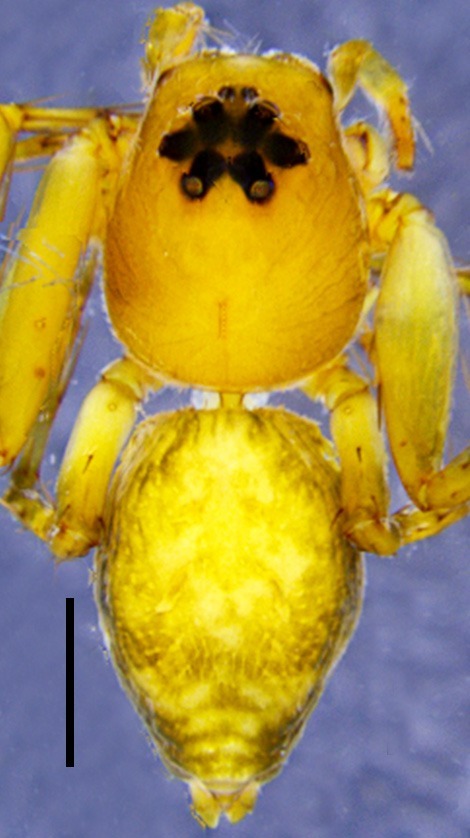
- Morphology & Ecology: Measuring just under
 , this yellow-bodied predator is built for high-speed arboreal hunting. Like other lynx spiders, it does not build webs; instead, it relies on outstanding agility, spiny legs to grab prey, and a unique hexagonal arrangement of its eight eyes for precision tracking.
The investigation was led by ZSI arachnologists Smt Upasana Bhattacharya, Shri Puthoor Pattammal Sudhin, and Dr Souvik Sen.
Commenting on the implications of these findings, Dr. Souvik Sen, Senior Scientist and Officer-in-Charge of the Arachnida Section at ZSI Kolkata and co-author of both publications, stated:
"Such discoveries reinforce the crucial role of systematic biodiversity surveys in revealing species that have remained unknown to science for centuries. Because these species are incredibly small and highly localised, they easily evade detection without rigorous, targeted field sampling."
Dr. Dhriti Banerjee, Director, ZSI, reaffirmed the institution's ongoing mission to map India's lesser-known ecological niches as, "Every new species we discover, no matter how small or cryptic, is another step towards building a more complete picture of India's remarkable biodiversity. These findings underscore the critical importance of preserving fragile habitats—ranging from dark cave systems to dense canopies—from escalating human encroachment."
***************************
SSS/Kol/17.7.26…….